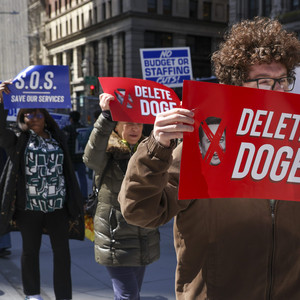
Cuts, chaos, and now the end of Doge.
This is the chainsaw for bureaucracy.
It was the equivalent of Godzilla rampaging through the city and destroying things.
It's World Business Report from the BBC World Service.
I am BC at Dubai.
Coming up, the Trump-Mosque efficiency drive known as Doge is gone.
We ask what the fallout means for the people caught in the middle.
And at the box office.
Wicked cast a spell on cinema owners with one of the biggest openings of the year.
Plus, Real Madrid plans to open the door for the first time to outside investors.
So the Department of Government Efficiency, led by Elon Musk, is no more wrapped up eight months ahead of its allotted time.
But first, let's remind ourselves how the newly reappointed President Trump first announced it.
To further combat inflation.
We will not only be reducing the cost of energy, but we'll be ending the flagrant waste of taxpayer dollars.
And to that end, I have created the brand new Department of Government Efficiency, GOAD.
Elon Musk waved a chainsaw as he launched Doge, echoing the actions of the Argentine president, Xavier Millet, where the Tesla boss put together a team and launched into a heavy series of government department cutbacks.
The Trump administration said in August it had fired about 300000 federal workers, crediting the vast majority to Doge.
Among them USAID workers and national park wardens, some of whom were later rehired or moved to seasonal work.
In another case, the federal government had to rehire some nuclear safety employees it had fired after concerns proved that their dismissal could jeopardize national security.
Tom DiBetto was a climate scientist and science communicator at the National Oceanic and Atmospheric Administration.
Well, that was until he was laid off back in April, along with hundreds of others from the government agency.
One thing that kind of gave away the game for me as it relates to Doge is that if you ask any federal employee about better ways of making the government run more efficiently, ways of saving money, they would talk to you for hours and hours and hours of time.
Everyone has examples of what we could do more efficiently.
But Doge never actually talked to any of those people.
Instead, they came in and what they did was they fired the easiest people to fire people like me who were probationary employees.
And you can tell that they didn't actually think about how they were doing this, because in many cases they fired a group of people and then had to rehire them.
Max Steyer is the president of the Partnership for Public Service, a nonprofit research group.
And I asked him for his reaction when he found out Doge no longer exists.
Thank goodness.
It was a disaster from the start.
It was a waste making machine and it did truly unimaginable harm to our government's ability to to meet the needs of the American people.
Well, why would you say that?
Because the whole essence of it being established in the first place was to save costs.
Yes, and it is certainly the stated intent of Doge, but it resulted in the exact opposite.
Instead of dealing with waste, it was a waste creator.
And it was the equivalent of Godzilla, rampaging through the city and destroying things without any understanding about what was happening.
Can you give practical examples of why you would say so?
From the get-go.
It was an unplanned for, non-strategic effort to reduce a workforce that was already the same size as it was in the 1960s.
So the target itself made no sense.
The way they went about reducing the federal workforce was the most harmful way possible, including destroying the morale of everybody and removing the people who were most qualified and capable of dealing with the problems of the day.
And it was not just what was done, but it was the way it was done in the most inhumane way possible.
There's no doubt that our government, like all organizations, could get better and needs investment and change to make it better to meet the needs of today's world rather than yesterday's.
They had no appreciation of the context that they were working in.
And it was an exercise of fire, fire, fire, rather than ready, aim, fire.
But the government is still standing in spite of those cuts.
It is still standing and that's a testament to the incredible commitment that the remaining civil servants have to our government.
But the reality is that, in any way we can measure, our government is not performing in the same way as it could have and should be, but for the destruction caused by Doge and beyond Doge, by the Trump administration itself.
So if you look at the customer satisfaction rate For folks of the Social Security Administration or the VA, all evidence suggests that the American people are getting less rather than more.
And unfortunately, although Doge itself is gone, many of the animating spirits behind it remain.
And we unfortunately expect that yet more harm will be taking place.
Well, let's talk about the role of Elon Musk, who led this team there.
What did you make about his approach?
Well, again, he tried to treat the United States government as he treated Twitter.
I don't know that it was a real successful approach for Twitter itself, but it certainly wasn't right for the United States government.
Any good leader understands that they need to contextualize their capabilities to the specific environment they're operating in.
And Elon Musk had zero curiosity and zero knowledge about how the federal government itself worked.
You saw this in many instances in which people were fired and then had to be rehired to, because it was so obvious that what the people who were let go were doing was vital to our immediate interests.
And Elon Musk, again, didn't learn the lesson.
It's one thing to make a mistake.
It's another thing to make the same mistake over and over again.
And that's what he did.
Have you been in touch with any one of those who perhaps lost their jobs?
I've been in touch with many former public servants who were either directly fired or constructively fired because the conditions of their employment were made so difficult that they had to leave.
And they feel a sense of betrayal.
They were there to serve the American public and they were treated in the least appropriate way possible.
They were not respected.
And ultimately, our government lost critical resources, and so did the American people.
Max Steyer, president of the Partnership for Public Service there.
Joining the conversation now is Liberty Vitted Capeto, a professor of data science at Washington University in St.
Louis.
Many thanks for joining us.
Listening to those who have lost their jobs and hearing people like Max Steyer challenged the way these cuts were carried out, I wonder how you actually see it.
Was there really no better way to manage the process, both in terms of planning and compassion?
Even okay, I mean, there's no good way to fire someone.
Okay, it's a horrible thing.
Anyone who loses a job, especially when they have a family.
I mean, everybody's lost jobs before and it's it's a.
It's a really sad and crummy thing.
But that doesn't mean that the American taxpayer should be holding up people who are not necessary for a job in the government.
I mean, that's not the responsibility of the American taxpayer.
We live in a democracy.
So I understand what Max is saying, that it's bad when people lose jobs, but it's bad whether they lose jobs from the government or from anywhere else.
It's not the government's responsibility to give people jobs.
So I think that's sort of the first thing.
And I think that the second aspect of this is I mean no offense to Max.
I wouldn't know him if I fell over him.
It's one thing to sit there and say, oh, there's such better ways to do this.
And it's very easy at a nonprofit think tank to say something like that.
But this is a $6.9 trillion business a year.
The United States government pays $6.9 trillion. trillion.
I don't think some think tank is running $6.9 trillion.
So there's enormous amounts going on here.
And Doge did a lot of good.
They cut programs that needed to be cut.
They cut funding to the Chinese Communist Party.
They cut funding to Hamas.
They cut funding to 10000 a year subscriptions to newsletters that government employees were getting.
So we have to take this for what it is.
Was it perfect?
Of course not.
But the American people and, by the way, it was a bipartisan whether you like Trump or don't like Trump, people want government waste gone.
And this was the first attempt to do that.
And it's not going to be perfect, but at least someone's trying.
And are you saying that Doge actually achieved this aim?
Do they do they get rid of all of government waste?
Absolutely not.
You're not going to be able to do that in eight months.
This is a this again, it's six point nine trillion dollar business.
This is a this is not an easy task, for even you know again, whether you like Elon Musk or not.
You have to agree that he's smart and capable.
I mean, you can hate him and he's still a smart and capable guy.
This is.
This is an unbelievably monumental issue to tackle government waste frankly, whether it's the United States or the United Kingdom.
But it's something that we have to try to do.
So it's really easy to sit from a place of judgment like these think tanks and again, no offense to Max, but like Max and just say, oh well, they're doing a terrible job.
Well, what's your proposal, Max?
Like, come on.
Well, Liberty, there's still the debate about how much money this project actually save.
Can the public be confident in those numbers?
You know, I really don't know.
I think it's questionable how much they saved, how much they didn't.
But the point is, I mean, I have numbers that are definitive of how much you know, of how much I know that have been saved, that we've calculated.
Is it what they've said?
I can't confirm or deny that.
But you know they've at least cut.
You know billions of dollars which you know if someone's lived paycheck to paycheck, you take billions of dollars.
Every American taxpayer, that's like cutting a $300 or $400 check a year to the American taxpayer.
And anyone who has ever lived paycheck to paycheck knows what $300 or $400 a year means to them.
All right, Liberty.
I think that's an important point.
Right.
Let's bring in Peter Jankowski, who's Vice President of Research and Analysis at Arbor Financial Services in Chicago.
Peter, you've been listening in on the conversation there.
Do you get a sense of how much Doge has saved?
Well, their website listed savings of approximately 200 billion, but many people feel that those figures were inflated, citing various individual examples where factors were off by 1000 or more.
But I think they probably did result in some savings, but more likely in the neighborhood of 10 to 20 billion would be my guess.
All right, Liberty, let me just come back to you on a final note now.
The question really is, why didn't Doge make it to the end of its planned term?
Absolutely.
And I think that's a question all American people should be asking.
And I think it's a really unfortunate one for the American people, you know, to be able to tackle something that is a 69 trillion a year crisis business for lack of a better word.
You have to have an unbelievably capable person behind it.
There's not that many people in the world who can do that.
Is Elon Musk the perfect person to do it?
I don't know, but I think it was a pretty good get.
If you take sort of who are the smartest, most capable people in the world to be able to do something.
Again, whether you like him or not.
But I think it's unfortunate.
I don't know whether What you want to call Trump and Elon Musk, two of the most powerful people in the world.
And unfortunately, it didn't work out.
But I think it would be a real disservice to the American people to not be able to try to figure it out.
Thank you very much, Liberty Vitet Capeto, Professor of Data Science at Washington University in St.
Louis.
Peter, we're continuing the conversation, but we're talking about another big story of the day, which is in Japan, where government has approved a substantial 135 billion economic stimulus package to counter its sluggish economy and address soaring prices there.
But Peter, does this seem sensible, given the fact that the country has been struggling with inflation and even rising prices of some essentials?
Well, struggling with inflation is relative.
Certainly, based on their targets, they're retiring 2% to 3% or 2% and they have been hitting 3%.
But this is a country that for many years was actually in deflation.
So, having some inflation is probably a good sign that things are moving forward a little bit.
In terms of the potential for the stimulus package.
It's a fairly straightforward provide money to citizens type of package.
It doesn't really seem to address any structural issues.
So from that perspective I don't really see it to have a really long-lasting effect on the Japanese economy.
All right, stay with us, Peter.
We're staying in Japan for the moment because once upon a time, Japan dominated the chip industry, but decades of decline left it trailing behind the likes of Taiwan and South Korea.
And now Tokyo is investing billions of dollars to try and turn that around.
We sent our Asia business correspondent, Suranjana Tiwari, to find out if Japan can actually reclaim its tech title.
You are witnessing the ultimate miniaturization of the cassette player.
It's 1979 and the Sony Walkman has just burst onto the scene.
For the first time ever, people could take the train, go to work, exercise with music in their ears.
It was a real moment for Japanese tech brilliance and paved the way for the iPod and then today's smartphones.
When Japan led the world in electronics, people used to come here to Akihabara in Tokyo from all over the world to buy the most cutting-edge gadgets.
But in recent years, Japan has fallen behind in innovation.
And that means, as China, South Korea, Taiwan battle it out to make the most advanced semiconductors, Japan has a lot of catching up to do.
I traveled to the northern island of Hokkaido, where the government is making its boldest bid yet to reclaim that league through a startup called Rapidus.
I sat down with CEO Atsuyoshi Koike next door to the company's new chip vat, which is currently under construction.
First, can you tell me why you decided to start Rapidus?
They call them the lost decades.
While we remain strong in manufacturing, we've fallen behind in semiconductors.
The national and local governments are backing a revival, with support from other major Japanese companies.
We want to deliver powerful, high-value products from Japan again.
Earlier this year, Rapidus announced it had successfully produced two nanometer transistors, the most advanced chips yet.
Mass production is planned for 2027.
A timeline Mr Koiki told me Rapidus is on track to meet.
Can you explain why it's so important that countries have their own chip-making capabilities?
There are two reasons for that.
One is national security.
Advanced chips are absolutely essential for that.
The other is that we want to collaborate with customers on products that enrich their lives.
In February 2024, Taiwan's TSMC opened a chip plant on the southwestern island of Kyushu.
It's the other part of Tokyo's plan, attracting foreign players to make chips in Japan.
From the phone in your palm to the refrigerator in your kitchen.
Imagine.
We're in a world where AI is increasingly part of our daily lives.
And so having the chips that power those systems is likely to separate the winners from the losers.
Our Asia business correspondent Saranjana Tiwari reporting there.
You're with World Business Report from the BBC World Service.
Now to some football news off the pitch.
The conclusion is clear.
We will continue to be a club of partners, but we must create a subsidiary.
That was Real Madrid president Florentino Perez yesterday, outlining what could be a historic change for the Spanish soccer giant.
For the first time.
President Perez says the club would be open to outside investors taking a small stake.
And this is huge because Real Madrid is entirely member-owned and the biggest in the world by revenue.
And they are now considering selling 5% to 10% if member-owned. give it the green light, of course.
I had a chat with Spain-based football journalist, Peter Jensen, and he explained what's behind this move.
Madrid.
Look around and they see the investment, the private investment, that comes into clubs in the Premier League.
PSG have become a massive rival that they simply can't compete with financially.
And even in Spain, Atletico Madrid were recently sold 55% of their club to private investors.
So they feel that they need to do something along those lines.
So this is basically about Real Madrid not wanting to be left behind in terms of sports investments.
Basically, that's it, because the stadium looks fantastic.
It's not completely finished yet.
The retractable roof, the retractable pitch, the plan is to use the stadium 365 days a year.
They held an NFL game there last weekend, which brought the club 10 million euros back.
But it cost big money that in 2018, the members agreed for the club to take out a loan of 575 million to play for the stadium.
The stadium ended up costing 1.4 billion.
So Madrid are paying back 60 million a year.
And that will be the case for the next 30 years or so.
They need the money.
Well, they really need the money, like you've just mentioned.
But we've seen Real Madrid and Barcelona famously opposing the CBC deal a few years ago.
That was the agreement where private equity firm CBC injected billions into La Liga in exchange for a long-term share of broadcast revenues.
So, given that Real fought that move to protect its independence at the time, Does opening the door now to outside investors now weaken that argument?
They turned down the CVC deal on the basis that they didn't feel the terms were good enough.
The idea also with this sale of 5% of the club is that it will also set a value.
Once you have that overall valuation, he's then talking about every socio, every member, having a share.
At the moment, they have a symbolic share.
They have a vote, but they would have a literal share further down the line.
But Florentino Perez is insisting that that share would not be able to be sold outside the Madrid family.
So you could only sell it to another socio, another member.
So he's talking the talk, at least, of trying to maintain the club within Madrid hands and not allowing foreign investment to come in and then call the shots.
But as we know, if investors come in with money, then they are going to want decision making.
Exactly.
And is that not a complicated move?
You know, converting members into shareholders when you're talking about what it might mean for power balance inside the club.
Yeah, I think they're looking towards the Bayern Munich model.
Three big German companies have a 25% share in Bayern, Allianz, Adidas and Audi.
And yet the club manages to walk that tightrope of having this private money.
And yet still there's dissent.
And the fans still believe this that the club is theirs and they call the shots and they run things.
So that is, if you like, the model.
And this is a sort of modest first step.
The next step is another meeting and a referendum.
And Florentino Perez would need a simple majority to get this over the line.
And what about the fans?
What are they saying about this?
I think the fans will be split.
Many younger fans maybe will see this as the way forward.
The traditionalists will fight against it and will urge everyone to vote against it.
And we have to remember that Madrid, for all that, they can't compete with PSG in terms of the transfer fees and wages.
There are still many cases where a player and Mbappe is the perfect example prefers to play for Real Madrid than he does to play for PSG, precisely because Madrid is a different sort of institution.
And you lose...
The idea that they're seen as a special club and a different club.
You would lose that if you lose this sports club status.
And they do end up becoming a PLC.
Football journalist Pete Jensen from Spain there.
Well, let's turn to the box office now.
Haven't you heard?
I'm a wicked witch of the West.
Well, the film Wicked for Good has had a huge weekend and blown past expectations, opening to about 226 million globally.
And that includes roughly $150 million in North America alone.
And it's one of the strongest openings of the year in the US and ranking as the second highest, just after a Minecraft movie in April.
Jeremy Kay is America's editor for British film trade magazine Screen International.
I think, you know, there was a lot of love for the first film, which came out a year ago.
And as we know, it's done extremely well.
People want to see the concluding part of a story.
And I think there's a lot of love also for the stars Ariana Grande and Cynthia Erivo, not to mention the rest of the cast as well, like Jeff Goldblum, and
Michelle Yeoh.
I think Universal and the stars have done a very good job of coming around and making sure that we were ready for this film and weren't forgetting about it and building it up.
And talking about a good start now, because we're seeing all of this come at a time when the movie industry is actually struggling.
So how much of an impact is this likely to make?
There's been something like a 20% drop off in the film going audience since the pandemic.
And And I don't really see that coming back.
Maybe a portion of it will.
But I think what's happened is the casual filmgoers may have dropped away.
And your diehard filmgoers who want to see certain brands or properties like Wicked or other big tent poles, they'll turn up.
And there can be surprises too.
Absolutely, there can be.
But by and large, I think the industry is, even if it doesn't want to, needs to acknowledge that there's that lost audience from the pandemic that probably won't come back.
I'm very curious to know what this means or what this could mean for streaming as well.
Does the big box office run delay when it might land on digital platforms for those who might not be able to go to the cinemas to see it now?
I...
I'm not aware of what the specific plans are for this.
But broadly speaking, the studio behind this film Universal, was one of the first to announce a revised distribution plan during the pandemic.
And I think that films will typically go into the cinema for about three weekends before they will go on to streaming and digital.
And if they do well in the opening weekend and I think that means grossing something like more than 50 million, which this is clearly done then it will stay longer.
And I think What's happening in Hollywood is.
Over the last year or two, we've seen the heads of the media companies, who all want to grow their streaming businesses, concede that a film that has a good, noisy run, a successful run in cinemas, can act as a very good marketing for the streaming platform data.
Peter Jankowski of Arbor Financial Services in Chicago is still with us.
Peter, have you seen the film Wicked or are you making any plans to do so?
I would like to see it.
I saw the first one and really enjoyed it.
Cool.
So before we wrap up, let's talk about lots of U.S. economic data ahead for tomorrow.
And among them is September retail sales, which were delayed by the recent government shutdown.
And the way initially due in October, we're also looking ahead to the Fed's beige book.
So what should we expect?
Well, I think we are going to see some slowing in consumer confidence and retail sales actually have been holding up pretty well.
But the confidence numbers are the ones that people are really worried about at this point.
All right.
And let's talk about the news about the company behind the weight loss drug Wegovy.
Yes, Novo Nordisk had a trial trying to see if Wegovy could be effective in treating Alzheimer's and that failed.
And as a result of that, you know, the stock took a bit of a hit today.
It was down about a little more than 5%.
All right.
Peter Jinkowski is Vice President of Research and Analysis at Arbor Financial Services in Chicago.
Wrapping up this edition of World Business Report with me, Bissi Adibayo.
Don't forget to subscribe wherever you get your BBC podcasts.