Hi there, Alistair here.
This is a special From the Vault episode.
It was one of our member only ones, but this month it is unlocked and available to everyone.
You can follow along with the interactive transcript and PDF study pack for free.
There is a link in the show notes that will take you right there.
And remember, if you'd like to unlock hundreds more member only episodes and all the learning resources that go with them.
Hello hello, hello and welcome to English Learning for Curious Minds by Leonardo English, the show where you can listen to fascinating stories and learn weird and wonderful things about the world at the same time as improving your English.
I'm Alistair Budge, and today we are going to be talking about something called cryonics, the practice of deep freezing people who have just died with the hope of bringing them back to life at some indefinite date in the future.
It is, to state the obvious, a big deal.
If it works, that is.
So in this episode we'll look at the history of this fascinating but controversial practice, how it works or doesn't work, and what this all means for the future.
Okay then, cryonics and freezing people in time.
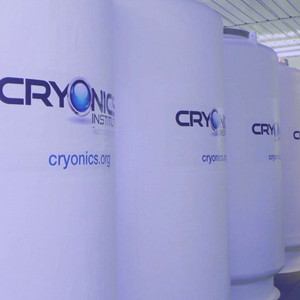
Roughly two hours north of Moscow... in a small warehouse are 94 people and 61 pets.
This isn't the start of some joke, a dog talent show, or an unusual family.
The people and their pets are dead.
Their bodies are hung upside down.
All the blood has been drained from their body and they have been frozen in minus 196 degrees Celsius.
Liquid nitrogen.
Like a group of frozen bats, they hang there awaiting a possible future when they can be brought back to life.
To state the obvious, the technology doesn't exist yet.
These people are as dead as any other dead person.
But they all paid a lot of money anywhere from 12000 to 36000 by some reports to be frozen in the hope that at some time in the future they will be unfrozen, perhaps technologically altered and able to live again.
The process that these people underwent is something called cryonics.
It's the idea of preserving a dead person so they can be brought back to life in the future.
The idea of someone coming back from the dead is, of course, something that exists in many cultures and societies.
After all, we all die.
So the prospect of dying but then coming back to life well, understandably it's a universal and an appealing one.
But for much of human history it has remained a fantasy, a pipe dream, something relegated to myths and science fiction novels.
When someone dies, they die.
You might have certain religious beliefs about what happens to their spirit or their soul after they die, but their body in its original form is no more.
This was also what a 12-year-old American boy called Robert Ettinger thought.
That was until he started reading a story called The Jameson Satellite.
The story was published in a magazine called Air Wonder Stories in 1931, and it was written by an author called Neil R Jones.
In the story, a professor decided to send his corpse into space after he died, where he thought it would be preserved forever at absolute zero, minus 27315 degrees Celsius.
Then, millions of years later and with humanity long extinct, a group of intelligent robots discover the professor's frozen corpse.
The robots, these machine men are fascinated by the discovery of a human being, as us.
Poor humans have been extinct for millennia.
They decide to revive the Professor by transferring his brain into a mechanical body similar to their own.
It works.
This transformation grants Professor Jameson immortality and the ability to survive in space.
The 12 year old boy, Robert Ettinger, didn't just read the story and think, wow, cool story.
He read it and thought wow, one day this will be possible.
He realised that that day might be quite a way off.
I mean, this was 1931, and nobody had ever even been to space.
But technology was rapidly advancing and the young boy assumed that working on the secret to eternal life and preserving the human corpse would be a big focus for scientists around the world.
In this he was wrong, and as the years went by he started to realise that it was extremely unlikely that sufficient progress in the subject would be made in his lifetime.
He was destined to face the same fate as every other human being in history.
He was confronted by the reality of his own mortality.
But Robert Ettinger wasn't the kind of person to just give up on an idea that had captured his imagination.
As he grew up, this thought stayed with him.
He had decided to become a physics professor, and the idea of preserving human life beyond death became his focus and obsession.
And in 1962 Ettinger published a book that would become a cornerstone in the field of what would come to be called cryonics.
This book was called The Prospect of Immortality, and in it he detailed his theories and ideas about how humans could be frozen and potentially brought back to life in the future.
As you might imagine, this was a revolutionary idea and Ettinger was all over the news talking about this hypothesis.
This idea, which he had been cherishing since he was a 12-year-old boy, was finally something that serious people were considering as a viable option.
So let me briefly explain how it works from a scientific point of view.
As you'll know, freezing something is an effective way of extending the lifespan of something.
Whether it's fish fingers, ice cream or some leftover lunch.
If you put something in the freezer, then it won't go bad for a long time.
But clearly the purpose of freezing a human after they die is very different to freezing a fish finger.
The freezing is the easy bit.
Freezing safely is where it gets more complicated.
So cryonics works something like this.
After someone dies, there is a very short window in which their body can be frozen.
Too long, and the body starts to decay.
And of course, you cannot start the process before the person is dead, as that is legally considered murder.
So you have this short window after someone is pronounced dead to lower their body temperature so that all the metabolic processes are slowed down or stopped.
To do this, a corpse is typically placed in an ice bath before being transported to the cryonics company for processing and storage.
During this time it needs to be kept cold, but not too cold, because if it gets too cold, ice crystals can form in the organs and in the blood.
Ice crystals are problematic because they have sharp edges, so as they form they can cut through cells and tissues, which can cause irreparable damage to the cells.
So the key is to keep the body cold enough to stop the metabolic processes, but not so cold that ice crystals form.
Then, when it is safely at the cryonics laboratory, all of the blood is drained from the body and is replaced by a fluid similar to the kind that you put in your car to stop the engine freezing.
The purpose of this is so that the corpse can then be frozen without any damage to the cells.
And this is a process called vitrification.
If you know your Latin, vitrification comes from the Latin word vitrum, meaning glass.
And what vitrification does is it turns bodily fluids into a solid, glass-like state so that it freezes, but ice crystals don't form.
And then the final stage is to reduce the temperature even further, bringing it down to minus 196 degrees Celsius.
Of course, this is not really the final stage of the procedure.
The final stage is bringing the patient back to life again, but we'll come to that bit in a minute.
Now, there are a bunch of different cryonics companies around the world, but fewer than 10.
They all work in slightly different ways and the process they use is similar to the one I described, but with a few variants.
And in terms of the costs, well, these vary wildly.
The leading US company is called Alcor and It charges 200000 for a full body cryopreservation and 80000 if you only want your head done.
You might think hey, I can understand that I might be able to save a bit of money by only getting my head done if I'm having a massage.
But if I'm going to be brought back to life in a thousand years time, I'd quite like my entire body.
Thank you very much.
That's a perfectly sensible argument, but the reason that there is the option to only preserve your head comes back to the idea in the 1931 story The Jameson Satellite.
If you remember, the professor's head was brought back to life and implanted on a robot body.
And the theory goes that if technology has advanced far enough to bring someone back from the dead, then the technology will exist to attach a head onto the body of another human, or a robot or computer or something that you or I can't even fathom.
We can't imagine.
So if you'd like to save a cool 120000 and you'd like to chance it by only getting your head done, then that option exists too.
In fact, if finances are a little tight and even 80000 is too much, you can go to the Russian cryonics company you heard about right at the start of the episode, Cryorus.
There, it's $46,000 for entire-body cryopreservation, or a mere $23,000 for just your head.
But the facilities seem to be somewhat more basic.
The American one, to my untrained eyes at least, looks more like a genuine medical facility, while the Russian one is located in what looks like a normal countryside house, down a road in a forest, and seems like a more artisanal affair.
If money was no object, and this was something I was keen on, I think I'd know which one I'd go for.
Now on the subject of cost.
The main cost of cryopreservation is the start and the end, the preparing the body to be frozen and then the reviving of the corpse.
But keeping the body properly stored is not cheap.
And you might well be thinking okay, I pay a one-off fee for this service, but I might be frozen for hundreds or thousands of years.
Presumably there's an annual subscription or something.
I can't expect my great, great, great, great, great, great grandchildren to keep footing the bill.
And that is also a perfectly valid question.
And the way that these companies tend to go about it is by investing the large lump sum you paid at the start into a stock market fund so that it continues to generate enough of an annual return to cover the costs of the storage.
Well, that's their theory at least.
And in terms of the one big elephant in the room that we haven't talked about yet how and when does one go from a frozen corpse in a Russian warehouse to a singing dancing, smiling and undoubtedly alive human being?
That is the big mystery, and cryonics companies tend to conveniently sidestep that question, instead saying we're not sure, but hopefully in the future.
To quote the Alcor website's FAQ section to the question of when will patients be revived, the answer is
That depends on when they are cryopreserved, the specific details of how well they are cryopreserved and how rapidly future medical technologies, particularly molecular nanotechnology, are developed.
Eventually, a time will come when human suspended animation will be perfected.
In other words, it will be possible to routinely turn people off and on for medical time travel, space travel and other purposes.
Some think it will take centuries before patients can be revived, while others think the accelerating pace of technological change might so rapidly transform our world that decades would suffice.
Alcor is planning for however long it might take.
In other words, these cryonics companies are not responsible for developing the technology that will allow their patients to be revived.
But when this technology is developed, it will be harnessed to revive these patients.
Now, the first person to be cryogenically frozen was an old woman from California in April of 1966, a matter of few years after the publication of Robert Ettinger's influential The Prospect of Immortality.
But a few months later, her relatives decided that they weren't so keen on the idea.
So she was removed from the container thawed defrosted, one might say, and then given a traditional burial.
A year later, in January of 1967, saw the first person to be cryopreserved, in the form of a university psychology professor called James Bedford.
He was actually the first client of Alcor and is still there today in Alcor's storage unit in Scottsdale Arizona, patiently waiting for the day to come when he can safely be brought back to life.
Now the final area to touch on when talking about cryonics is the ethical questions around.
These are all theoretical at the moment, as Professor James Bedford and the other few hundred or so people who have been cryopreserved around the world are as dead as Mother Teresa or Napoleon or Anne Boleyn, or your or my ancestors, who died centuries ago.
But if it works and of course this is a big if it fundamentally changes the concept of life and death.
And it would almost certainly cause people to behave differently.
If you knew that you could be brought back to life in the future, how would that change your behavior today?
How would it change our perception of what it means to grow old?
And what would it mean to be able to bring someone back from the dead?
What's more, clearly it is an expensive process.
And there are many valid questions about other ways in which the medical expertise and costs could be better used.
Helping people live longer and healthier lives today, rather than potentially being brought back to life in a thousand years.
And that's even before we get into any discussion of the ethics or problems of how someone who died in 1967 might adapt to life in the year 3000.
Thinking back to Professor James Bedford, the first person to be cryopreserved.
He was born in 1893 and died in 1967.
He would probably be baffled if he was brought back from the dead today and could see life in 2024.
So imagine what life would be like for him in the year 3024.
I mean, your guess is as good as mine, but in all probability it would be so mind-bogglingly different that there would be ethical questions about whether it is the right thing to bring someone back from the dead in such a foreign world.
But to take the other side of the argument, it's what they wanted.
They paid a large amount of money for it and, no doubt, fully considered all of the questions that we are today.
And if someone can be brought back from the dead and given the chance to live again, surely that is one of the greatest gifts that can be given.
In 2015, there was a sad case of a two-year-old girl from Thailand who developed a rare form of brain cancer.
When it became clear that the disease could not be treated and it was going to be fatal, her parents decided that they wanted her to be cryopreserved.
They contacted Alcor and after the poor young girl died, shortly after her third birthday, she was whisked away and is now a patient at Alcor.
In her case, Her parents wanted to do everything they could to give her the chance to live.
And when it was clear that the cancer treatments would not be enough, they decided that this was the only chance they had left.
The chance might be slim, but it was better than zero, at least in her parents' eyes.
It was the last thing they could do for their daughter.
But to the critics of cryonics and cryopreservation, it is a scam.
It is very successful at selling the dream of returning from the dead, but provides no concrete plan about how to do it.
As you saw on the Alcor website, there is no plan, just a hope that at some point in the future someone might solve this problem.
And even if the technology does progress to a position where these companies feel like they can give it a shot at reviving someone, inevitably the first attempts would fail.
People might be brought back to life in a hugely damaged state and into a world that they do not want to be in.
And Even if the process of bringing someone back to life without any degradation is perfected, this would lead to the most monumental shift in society.
It is still a very long way off, but it's certainly a thought-provoking subject to learn about and leaves us thinking about the very nature of life, death and what it means to be human.
Okay then, that is it for today's episode on cryonics.
I hope it's been an interesting one, and that you've learned something new.
As always, I'd love to know what you thought about this episode.
Did you know about cryonics before?
If money was no object, Would you do it?
And how do you think it would change our world if we knew it was possible?
I would love to know, so let's get this discussion started.
You can head right into our community forum, which is at communityleonardoenglishcom, and get chatting away to other curious minds.
And, by the way, if you enjoyed this episode, keep a lookout for the next one, as we will be talking about the related and similarly unusual subject of transhumanism.
You've been listening to English Learning for Curious Minds by Leonardo English.
I'm Alistair Budge, you stay safe, and I'll catch you in the next episode.
Okay, I hope you enjoyed that From the Vault episode.
You can find more episodes with free transcripts and learning resources on our website.
And if you'd like to unlock the entire catalogue so almost 600 episodes now then the place to go is LeonardoEnglishcom.