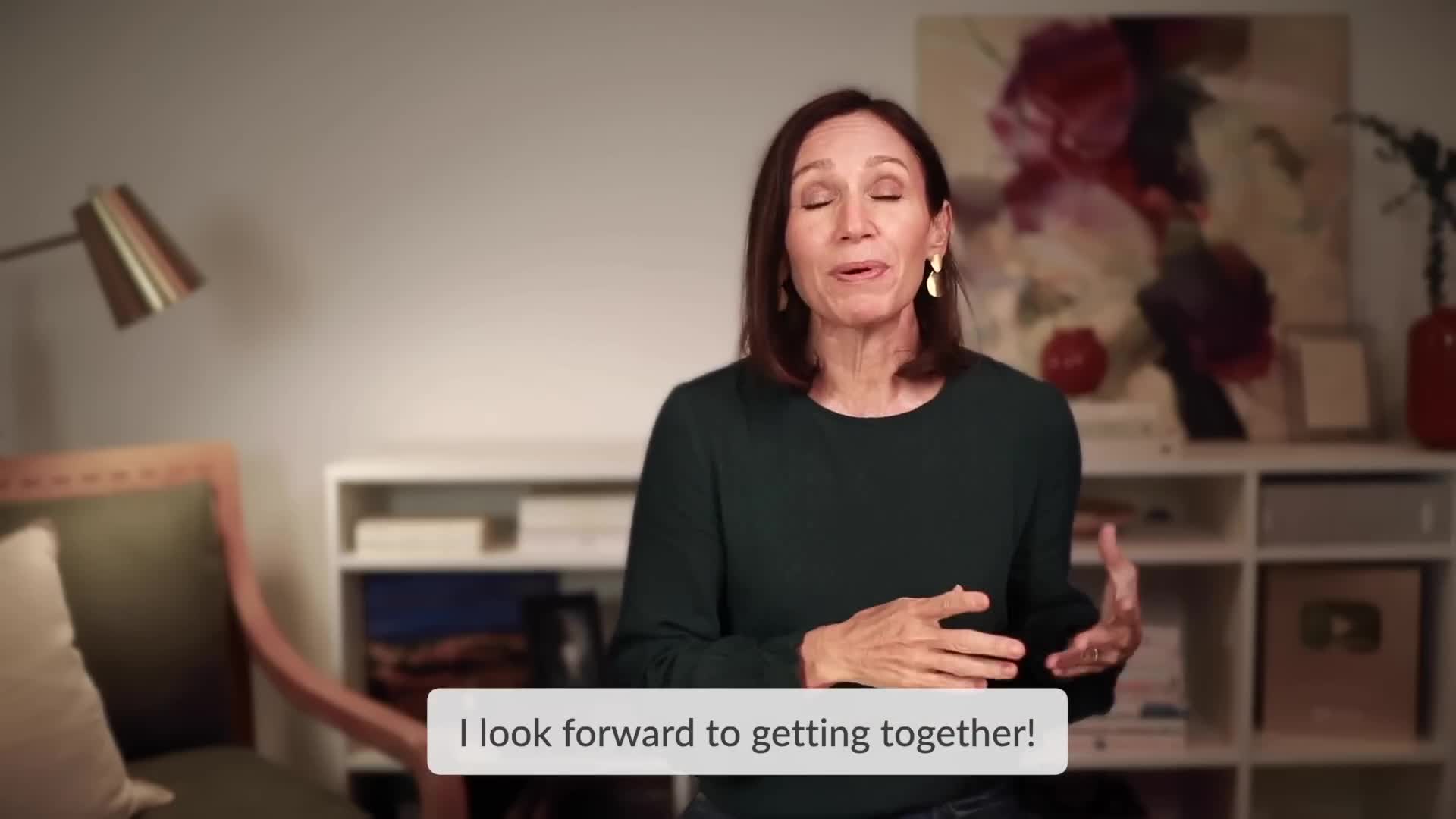
What's the difference between I look forward to getting together versus I can't wait to hang out?
Both of these phrases express excitement about seeing someone, right?
But of course, they send very different signals.
For example, the first one I would use with people I'm just getting to know whether they're potential friends, professional contacts or even members in my book club where I live.
That phrase, I look forward to getting together, is polite and warm, but it isn't overly familiar.
It shows respect and creates a comfortable distance while also expressing positive feelings.
But that second one, I can't wait to hang out.
This is what I use with my close friends and family.
It's much more casual, more intimate.
It assumes a level of closeness and informality that comes with established relationships.
So why does this difference matter?
I want you to think about your native language for a moment.
You already make these kinds of shifts in your everyday conversations.
Similarly, in English speaking culture, using overly casual language with someone you've just met might make them feel a bit uncomfortable, like you're moving too fast.
It can seem like you're skipping steps in the relationship or not picking up on important social cues.
On the other hand, being too formal with close friends or family can send mixed signals.
It might make them wonder if you're upset or trying to keep them at arm's length, even if that's not your intention.
Choosing the right tone or the right level of formality is all about respecting relationships and making people feel at ease.
It's about matching your language to the relationship or context.
And this doesn't just apply to making plans with people.
It's a critical skill across all kinds of conversations.
Just recently, in fact, I was in a workshop with one of my students and she said I feel like I'm always being too careful, even with people I know well.
But when I try to sound more relaxed, I worry that I'm impolite or unprofessional.
So I replay these conversations in my mind over and over, asking myself if I did it right.
That kind of second guessing is exhausting and also discouraging.
So if you've had the same frustrations, today we're going to eliminate that.
We'll explore the power of tone and how to confidently navigate from formal to informal in any situation.
By the end, you'll have practical strategies for choosing the right words in every context.
And I'll even give you a kind of quick tool, a sort of mental checklist that you can use in real conversations.
So let's start with this.
How can you know when to switch from formal to informal?
To answer that question, we first need to understand a key concept, what it means to read the room.
Reading the room means paying attention to the energy, the body language, the tone of conversation and then adjusting how you speak to match it.
In English we often use this phrase to read the room, to describe someone who knows how to respond in a way that fits the moment not too formal, Not too relaxed, but just right for the situation.
And the truth is, you already do this.
As I said, if you think about your first language, you adjust how you speak depending on who you're talking with or what you're talking about and where you are.
For example, you probably sound different when you're talking to your manager rather than when you're chatting with a good friend over coffee.
That shift might happen automatically.
You just feel it.
You read the situation.
Reading the room in English works exactly the same way.
And this isn't about changing who you are or trying to get grammar just right.
Instead, it's about tuning in to a few key signals.
These are things like who's in the room?
What's the purpose of the conversation?
How are others speaking?
What is their tone, their pace, and their word choice?
How are others using body language and facial expressions?
The better you are at noticing those details, the easier it becomes to shift your tone with confidence.
So in the next part of this lesson we're going to look at exactly how to recognize the difference between formal and informal English.
And later I'll give you that simple tool I mentioned that you can use to decide what language is right for each moment.
But for now, I want to start with this key idea.
You don't need a perfect formula or black and white rule for every situation.
You just need to know what to watch for, and how to respond.
So, now that you know what to look for when you're reading the room, let's talk about the key differences between formal and informal English.
As you might guess, formal English is structured, careful, and polite.
This is the language that you hear in job interviews, business meetings, academic settings or official communication.
It often sounds more professional and more intentional.
Informal English, on the other hand, is relaxed and conversational.
It's how we talk with friends, close colleagues or family.
The language is still correct, but it's shorter, warmer and more natural for everyday situations.
And to highlight this, I want to give you a few comparisons.
First, let's look at language for apologizing.
A more formal statement would be, I apologize.
Whereas a more informal statement is simply, I'm sorry.
Or let's say you're describing a report in a business meeting.
If the meeting is formal, you might say the report demonstrates profit growth.
If it's a more relaxed conversation among colleagues, you know well, you might say the report shows profit growth.
And here's one more, how you might express thanks.
If it's a formal situation, you might say to someone I'd like to express my gratitude for this opportunity.
That would be a perfect one in a job interview, for example.
However, if it's an informal conversation or situation, you might say thanks.
So much for the opportunity.
In each case, the meaning of the phrases is the same, but that tone is different.
Again, the formal language sounds more polished.
The informal language is softer and simpler. but it's still correct.
And that's an important point that I want to emphasize.
One of the biggest misconceptions I hear from my students is the idea that informal language is lazy or incorrect.
It's not.
Informal English still follows grammar rules.
It's just more relaxed, more friendly in tone.
So yes, saying something like, I'm gonna head out is grammatically correct.
So is using can't instead of cannot, or don't instead of do not.
You might not see these forms in english grammar books, for example, but native speakers use them all the time.
They're real english.
They're useful and, most importantly, necessary when we want to get the tone right.
That brings me to the next key question when should you use each one and how can you tell to get that right?
Let's explore some general guidelines.
No matter what the situation might be, here's a general rule that can help you decide whether to use formal or informal language.
If you're talking to a boss, a client or anyone you don't know well, formal language is usually the safest choice, and then, if you're in a casual setting or talking with a friendly co-worker, informal language is often more natural.
But here's where it gets interesting.
It's not just about who you're talking to.
It's about why you're talking to them and where the conversation is happening.
You might speak formally with your manager during a performance review, but then speak informally with the same manager at a team lunch.
You might choose to use formal language in an email to a colleague in another department, but then speak to them in a more casual way in a hallway conversation.
The truth is context matters more than titles.
So, before you speak, if you're feeling uncertain, here's a quick checklist that you can use to help you decide which tone makes sense for that moment.
First, Ask yourself, who am I talking to?
What's the purpose of this conversation?
Where is it happening?
Is it a formal business meeting, a coffee chat, a networking event?
And how formal or informal are the people around me?
That last one is key.
I recommend that you listen carefully to the tone others are using.
Are they speaking with contractions and casual phrases?
Or are they using more careful language and complete sentences?
This kind of listening helps you make small, smart adjustments so that your English matches the tone of the moment.
And if you're thinking okay, this all makes sense, but it's still hard to do in real conversations, you're not the only one who feels that way.
In fact, it's exactly why I have the Confident Women Community.
It's a space where you can try things out, where you can experiment with your tone, speak freely and get feedback from people who understand what you're working on.
Because learning how to switch between formal and informal English in the moment doesn't just happen by studying.
It happens through real practice.
In the Confident Women community, we use lessons just like this one, but we bring them to life in real conversation so that you can build up that confidence to speak clearly and in a way that feels like you.
So if that's something that you've been looking for, I'll leave a link with all the details below this video.
But for now, let's keep going.
Okay, so we've just talked about some general rules you can follow when you're trying to decide whether to use formal or informal language.
But how do you know what tone to use when it's not obvious and it doesn't fit one of those general rules?
One of the best ways is to watch and listen for signals.
Signals that show you whether the conversation is formal or informal.
So let's start with some signs that a conversation is formal.
First, the pace is slower.
People take their time when they speak because they're working to choose their words carefully.
You'll also hear clearer enunciation.
This means that words tend to be pronounced more clearly and carefully.
You'll also notice modal verbs like could, would, might, should.
People also often use full names or titles like Dr. Smith or Ms.
Johnson.
The tone of the conversation is more serious and there are fewer interruptions.
People wait for their turn to speak.
And now let's compare all of that to an informal situation where the pace is faster.
People speak more freely.
You're going to hear contractions and relaxed forms like gonna and wanna.
You're going to hear first names or even nicknames.
On top of that, there's more laughter, personal comments, or even jokes.
People are also more likely to interrupt each other in a friendly way, and body language is more open or relaxed.
These tone signals are a great starting point for identifying informal and formal situations and many North American contexts.
They provide a general framework for understanding how people often communicate in different situations.
However, it's important to remember that what counts as professional or formal can vary depending on where you are, even if you're in the same country.
For example, when I lived in Washington DC, I noticed that professional communication tended to be much more formal or buttoned up, you could say, compared to what i experience here in california, and this is why one of the most valuable skills that you can develop is the ability to observe and adapt your tone to the signals around you.
I want you to pay attention to how your colleagues, clients and friends communicate in different situations.
Notice the specific words, phrases and even non-verbal cues they use to convey either formality or informality.
So if you're in a new environment or simply unsure about the appropriate tone, it's always best to take a step back and observe first, then adjust your language to match the overall feeling or vibe in the room.
This isn't about mimicking others or losing your own voice, but rather finding that little sweet spot where you can communicate effectively and build rapport, build great connections with people around you.
The examples I'm going to share with you here show both versions, both formal and informal, so you can hear the difference and start to really notice these differences for yourself.
So first let's talk about introducing yourself.
In a formal context you would likely use hello, my name is maria rodriguez and i'm the new marketing coordinator.
An informal example of that is hi, i'm maria, i just joined the marketing team.
In the formal version you hear the full name and job title.
The tone is more structured and the phrase is very complete.
In the informal version it's first name only and the phrasing is more relaxed.
We're using simpler language.
For example, just joined sounds casual and friendly.
And now let's take a look at how you might ask for help again.
First, in a formal situation, you might say could you assist me when you have a moment?
Versus informal, can you help me out when you get a chance?
Notice the key difference between the verb choices.
The first one uses a more formal verb assist, and in the second one we've selected a phrasal verb to help out.
Next let's look at making a request again formal would it be possible to reschedule?
And then informal can we move our meeting?
In these examples i want you to notice that the formal tone uses more indirect, polite phrasing with the modal would.
Would it be possible?
And the informal tone is more direct using simpler everyday verbs like move.
Here's another, expressing thanks.
A formal example would be, I appreciate your time and consideration.
Informal, thanks so much.
Again, the formal version adds more structure and distance with I appreciate your time while the informal version is quicker and warmer using the simplified thanks so much, which feels still very friendly and personal.
Next is how you might decline something, which is never an easy thing to do.
In a formal circumstance you might say regretfully, i won't be able to attend.
And informal sorry, i can't make it.
Next, making a suggestion formal, i would recommend we do more research.
Informal maybe we should look into that more.
Asking for clarification, a formal phrase would be could you please elaborate?
And informal what do you mean by that?
And here's one more, apologizing.
A formal apology sounds like, I sincerely apologize.
I've fixed the issue.
And informal, sorry about that.
It's fixed now.
In each case, both versions are absolutely correct.
However, one feels more appropriate, depending on where you are, what the conversation is about and who is involved.
Now that we have more clarity on this, I want to introduce a third element.
What about those situations that are not clearly formal or clearly informal?
And the truth is, Most workplace conversations is where communication is somewhere in the middle.
And that's what we call semi-formal tone.
This is where this middle ground comes in.
To understand this more middle ground, we have to know what exactly does semi-formal actually sound like?
And how can you recognize it in real conversations?
The truth is it's a kind of gray area.
It's professional, but not overly stiff or formal.
And it's friendly, but not overly casual or too familiar.
To illustrate this, I want to give you a quick example.
Let's imagine a coworker helps you out while you're caring for a family member and you want to thank her as a result.
A too formal response would be, I would like to express my sincere gratitude.
This version uses a very formal structure with I would like to express and the vocabulary feels distant or overly serious.
It's polite, but in most modern workplaces it's going to sound too stiff for a simple thank you.
An informal example of that could be thanks for your help.
It's friendly and correct, but it's also very vague.
It doesn't give much context for what you're thanking her for and as a result, it doesn't sound meaningful.
It's not appropriate for someone at work covering for you while you were away.
So the semi-formal version is something in between, Something like thank you so much.
More informal.
I really appreciate you taking on my work while I was away.
We're using phrasal verbs like to take on here.
So again, the language is still casual, but we're also using fuller sentences and providing more detail than a simple thanks a lot.
As a result, this version is polite and professional, but also personal.
We're keeping the language simple with words like, thank you so much.
I really appreciate.
And as we highlight it, it clearly names the situation.
As a result, it feels thoughtful, but not too formal.
Earlier, I shared with you some guidelines for what you might expect or hear in a formal conversation and what you can expect to hear in an informal.
So I want to give you something similar. some common features of semi-formal English.
In these conversations you're going to hear please and thank you, but not overly elaborate phrases and not an emphasis on modal verbs.
There may be contractions and phrasal verbs and even connected speech, but not slang.
The vocabulary is professional, but the tone feels more natural or relaxed.
It's warm, but with some clear boundaries.
It's respectful, but not robotic the way formal language can sometimes sound.
And if you're working or living in an environment with English speakers from North America, the tone you're going to use most often in professional conversations, especially when you want to sound approachable, competent and clear is this semi-formal language.
So with that in mind, let's do a quick check-in.
I'm going to share some phrases with you and I want you to identify which one is semi-formal.
First, would it be possible for you to review this document at your earliest convenience?
Two, could you please review this document when you have a chance?
And three, can you check out this document when you're free?
What do you think?
The best choice for semi-formal is B.
It's polite, it uses please and the phrasing is professional but not overly formal.
This kind of tone gives you flexibility.
It works across teams, with clients and even in conversations with leadership, when the situation allows.
And now let's put all of these principles, these guidelines, into action with some real world scenarios.
I want to talk through two real world situations where tone matters and when you may need to shift tone very quickly.
To do that.
There's one more skill that makes a big difference, and that is recognizing when the tone a conversation changes.
Sometimes a conversation might start out formal and then becomes more casual, and of course, other times it shifts the other way.
So here's how to notice.
If a conversation is becoming more informal, you're going to probably hear more laughter or personal stories someone might say so anyway or shift into a lighter topic.
People may also start using not just contractions, like we're and they'll, but they're also going to start using more connected speech and relax their overall posture.
Now, if it moves the other way, if the tone becomes more formal, then the energy in the room kind of tightens up.
The topic may shift to feedback or conflict or decisions, more challenging topics of conversation.
You might notice people sit up straighter.
They slow down, they use more careful wording and fewer contractions or connected speech.
The easiest way to track these changes is to pay attention to the most senior person in the room.
If they stay formal, you stay formal.
If they relax, you can adjust with them.
So, as i said, i want to walk through two real world situations where we can see this in action.
In scenario number one, I want you to imagine a weekly team meeting that is usually super casual.
You know everybody, you see each other every week.
People laugh, they speak freely, they start with small talk and use first names.
But this time this week, Your company's vice president unexpectedly joins the meeting in the middle of the meeting, and you immediately notice a change.
Your team leader adjusts their tone in a heartbeat.
People sit up straighter.
If they're on Zoom, they might fix their camera and there are fewer interruptions.
The energy shifts, and this is a clear signal that the tone is going to immediately become more formal, and it's your cue to match it.
So in that moment, if it's your turn to speak and maybe introduce yourself, your language is going to be formal.
Again, we'll use the example we had earlier.
Hello, my name is Maria Rodriguez.
I'm a marketing coordinator.
I focus on social media and content strategy.
It's a pleasure to meet you.
Or if your company culture is never really that formal.
If formal for your company means semi-formal.
Here's what that would sound like.
Hi, I'm Maria.
I've been with the team for about six months working on social media and content strategy.
It's great to meet you.
Both of these versions are perfectly correct.
The truth is your choice depends on what the moment calls for.
If the VP is speaking formally, stay formal.
If they use a more relaxed tone, you can shift with them to that semi-formal.
This is where reading the room really matters, especially when the tone shifts quickly.
And now let's take a look at our second scenario.
We're going to change things up a bit here.
And I want you to imagine you're at a professional event, like an international conference, and you're having a casual conversation with a peer at the refreshments table.
So this isn't a formal meeting, but you also don't know this individual particularly well.
In the conversation, you discover that this person also works in social media, specifically with LinkedIn, and you would love to get their advice.
In requesting advice.
A too formal request would sound like.
Would it be possible for you to provide guidance at your convenience?
And too informal would be, hey, could you help me figure out some LinkedIn stuff real quick?
A semi-formal version that is just right is, oh, that's perfect.
I've been trying to figure out LinkedIn campaigns.
Would you mind sharing what's worked for you?
This semi-formal version keeps the tone conversational and respectful.
You're showing interest and appreciation without sounding overly serious or too relaxed.
So now I want to do another practice activity.
Let's check to make sure we're getting this just right.
I'm going to share a few different situations with you, and I want you to decide which tone fits.
So you'll need to ask yourself whether your response should be formal, informal or semi-formal.
I'm going to share each situation first.
I'll give you some thinking time and then I'll share the best answers.
So situation number one you're in line at a coffee shop and you accidentally bump into someone's coffee while in line.
In that moment when you need to respond to what just happened, would you use formal, semi-formal or informal?
And before we look at the answer, let's go to situation number two.
You're asking your manager for a deadline extension.
Again formal, semi-formal or informal.
And finally, situation number three.
You're congratulating a close colleague on a great presentation.
Take a moment to think about each one of those situations, And now let's take a look at the best possible answer for each one.
For the first situation, I would recommend a semi formal response.
The truth is you're in a coffee shop, which immediately makes this a more casual environment.
You don't need to be overly formal.
But most likely, if you've bumped into someone in line, it's a stranger, not someone that you know.
So you don't want to be too informal as well.
A great middle ground is something like, oh, I'm so sorry.
I apologize for bumping into you.
That first one, oh, I'm so sorry, keeps a very casual conversational tone.
And then we repeat with, I apologize for bumping into you.
We're giving a specific reason for the apology.
So it kind of meets that semi-formal space.
And then situation number two, when you're asking for a deadline extension.
The truth is how you make that request depends.
It could be formal or semi-formal.
This is where your ability to understand tone and to read signals becomes really important.
This is where you might want to revisit that mental checklist.
And ask yourself, who am I talking to?
What's the purpose of the conversation?
How formal is this situation?
In this case, you're speaking to your manager about a delay, which can be rather sensitive.
And if this is your first time asking or the project is high stakes, a more formal tone is safer.
For example, I wanted to let you know I've run into a delay on the report.
Would it be possible to extend the deadline by one day?
However, if you have a more relaxed relationship with your manager and this kind of adjustment is common a semi-formal tone might be enough.
For example, would it be okay to move the deadline by one day?
I've hit a small delay.
As always, the key is to match the tone to the situation, not only the person.
And then finally, the third situation was congratulating a colleague on a great presentation.
And here, semi-formal is perfect.
Even though this person is a close colleague, someone you know well, The context is still professional.
So a warm, clear response works best here.
For example, that was such a great presentation.
You really made it easy to follow.
Now, if you got one of those situations right, or if you understood why tone matters, you're already making progress in this area.
And that's the real goal.
This isn't about having perfect grammar or knowing every vocabulary word.
It's about choosing the right tone so your message lands, so it's received the way that you want it to be.
And now that you've learned these strategies for navigating formal and informal English and everything in between, I want to challenge you to put them into practice.
Over this next week, pay attention to the tone signals in your daily conversations and try adjusting your language to match the context.
When you do that, I would love for you to come back here and share your experiences, your insights and also your questions with me in the comments below.
I'd also love to hear how it goes for you as you start to use what you've learned.
With that, thank you so much for joining me today.
If you found this lesson helpful, don't forget to subscribe or follow wherever you're watching from or listening from today.
Thanks again and I look forward to next time.