Hi, I'm Dave I say founder of StoryCore.
Support for this podcast and the following message come from Dignity Memorial.
Did you know that a prepaid funeral plan is one of the greatest gifts you can give your family?
Plan your life celebration in advance to protect your loved ones.
For additional information, visit DignityMemorial.com.
People can get so devoted to a favorite team.
It's almost religious.
So back in the 1950s, when Sister Vincent Cicero was teaching third grade at a Catholic school in Brooklyn, it didn't exactly take a leap of faith for her to start worshiping the baseball gods.
The boys would come in with their baseball cards and I say to them, it's not time for baseball.
Now put them on my desk. And of course, while I give them work to do, I will look at the baseball cards.
Then I went to New Orleans.
I was a Dodger fan and Sister Archangel was a Yankee fan.
Teams would come to play exhibition games and she and I were sneaking the Superdome.
We never missed a game and they called us the Nuns of Summer.
When I came to Philadelphia from New Orleans, they took me to the Phillies, but I don't like them.
I was the seventh inning I have to stand up, but I didn't get up.
I sat because they're not my team.
When we give ourselves over so completely to a team, watching them win is exhilarating.
And watching them lose, they die a little.
You're essentially putting your happiness in the hands of strangers.
Of course, they don't feel like strangers.
We call them by their nicknames and talk about them like they're family.
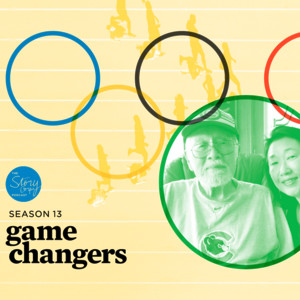
In this episode of our season about game changers, the relationship between fans and those who play the games they love.
I'm Michael Garafalo. And I'm Jasmine Morris.
It's the Storycore podcast from NPR.
Okay, before we go any further, we should note that all the fans we're going to hear from in this episode are baseball fans.
And why is that, Michael?
Okay, yes, it's my fault.
I admit to having a certain bias toward the sport and these stories because I kind of identify with them.
I got hooked on baseball as a kid.
And once it's in your blood, it never leaves.
Case in point. Anthony DeAndre grew up in the Bronx during World War II and spent a lot of time with other kids lingering in the shadows of Yankee Stadium.
They were competing to collect as many autographs from their heroes as possible.
But Anthony used tactics that gave him an edge.
He came to Storycore with his daughter's Monaco McInerney in Mary DeAndre to share his secrets.
As a youngster, I rarely went to a ballgame because we never had any money to do that.
But in the summertime, I would go down pretty much every day to get all the address.
And as a true that the players used to get there by the subway?
Yeah, we'd wait by the subway stop so you could see them coming readily.
And you could spot the players for two reasons.
One of which the only Yankee players had to wear jackets, ties, shirts.
And the second reason is, for 25 cents, you got a book called Who's Who in Baseball?
And they had pictures of most of the team.
One of the Yankee heroes at the time was a fellow named Charlie Keller.
And I had gotten his autograph on a number of occasions.
But you always got another one because you know you could trade and things like that.
And the famous remark he made to me one time was a ran up to him and said, Mr.
Keller, would you sign this?
And he said, Freckles? I just had a lot of freckles at the time.
He said, Freckles, how many times do you want my signature?
I said, I don't know. He's all right.
Now, tell us a little bit.
You have a ball. Well, I started getting people to sign it and the ball was filling up pretty well.
And my father used to get the daily news every morning.
And this one day I noticed that it said next Tuesday is an off day, but the Yankees are going to have a workout.
So I thought, oh, could that be a good day to go because there won't be as many kids around.
And maybe I can get the fellows that I didn't get, you know, because a lot of times the players wouldn't sign if there's like 30 or 40 kids after them.
And so they, you know, they just brush you off.
I got down there early and I realized I was lacking two signatures.
To have the whole team. And one of the people was the Yankee manager, a very renowned man, Joe McCarthy.
And sure enough, he comes out.
And I asked him, Mr. McCarthy, be a sign the ball.
I just need your signature and maybe one other.
And he didn't say much. He signed the ball.
So now I'm down to one who was a reserve catcher.
His name was Raleigh Hemsley.
Sorry, waited and waited.
And I thought, well, could he have gotten by me?
I didn't see him come in.
And it started to get late and I thought, well, I really should go home.
Well sure enough, he comes out.
And I ran up to him and I said, Mr.
Hemsley would sign my ball.
He said, get out of here, kid.
I said, oh, come on, I'm just the only one.
You know, if you, I'll have everybody on a team.
Get out of here, kid. So I just followed him.
And I kept asking him, come on.
No, were you scared of him at all?
The funny part is I was pretty timid kid, but I wasn't afraid of him.
I just kept saying, oh, come on.
I just signed the ball and again, I was just, all right, get me that ball.
And he signed it and that was that.
And sure enough, it was the 43 Yankees, the World Championship team.
That's Anthony DeAndre with his daughter's Monica McInerney and Mary DeAndre.
Anthony died in 2023. People hear from another lifelong baseball fan, even though he hasn't heard the crack of a bat since he was a boy.
My name is Robert Panar.
I just became 89 years old.
But I became deaf from Spinal Men and Riders at the age of pen.
Being deaf never got in the way of Robert Panar's love of baseball.
He told his friend Greg LeVatus about some memorable ballpark encounters.
I found that new house much like the baseball and Babe Ruth was my hero.
This is 1931. So he wrote to the Yankees and he asked if I could possibly meet the bandbeen.
And that he arranged it.
So we went to the ballgame.de.
We sat about ten rows from the field.
And before the game, my father gives that ed from the Yankees toward the Oslo goes down to the dugout, comes back with the bag, big furrow, huge.
He said, Hi kid, how you doing?
So I can end with the bandbeen or when the dream comes true.
And later on, I realized my father, he was trying to get my head in back.
So your father thought that the shock of me, oh yes, the bandbeen, oh wow.
But I still remain that stuff as opposed.
And I remember, later on, taking my son to Memorial Stadium.
After the game, my son says, hey dad, I have a ball.
I would like one to deploy us to sign it.
Brooks Robinson, the third baseman, came out and sat Brooks, excuse me.
But my son wondered if you can give him my autograph.
Brooks, he looks at me and then he signs with his hands.
Oh you daff. I said, hey, you know sign language, where did you learn?
He said, well, I grew up in Little Rock, Arkansas, only boxed from the school for the daff.
So I used to play with the daffton.
He became my art left at that.
Anyway, to this day, I lived with a guy baseball.
I look at it as my religion.
It's my stadium, it's my second home.
That's Bob Panera. He was also at home on the stage.
He co-founded the National Theater of the Daff.
He died in 2014. So far, we've heard about the highs of being a fan.
But when we come back, some of the lows stay with us.
This message comes from NPR sponsors Subaru, who believe that all students deserve an equal and fair opportunity at a quality education.
In their partnership with adoptaclastrum.org, Subaru and their retailers are providing teachers across the country with funding to purchase the resources they know are most needed to help students thrive.
Subaru, more than a car company.
For a lot of fans, the start of a season is about optimism, possibility, hope.
You know, this could be the year and all that.
Of course, only one team wins.
By the end of the season, if you think about it, the majority of fans are more likely to feel disappointment, frustration.
Dare I say despair? In 1951, fans of the Brooklyn Dodgers knew that all too well.
That year, the Dodgers had a comfortable lead over their cross-town rivals, the New York giants.
But as the season drew to a close, the Dodgers lost their hold on first place and had to face the giants in a playoff game.
The winner would get to the World Series.
And in that playoff game, the Dodgers lost in spectacular fashion, with pitcher Ralph Branca giving up a ninth inning home run to the giants Bobby Thompson.
Known as the shot heard round the world, Thompson's hit is one of the most famous home runs in all of baseball history.
Harvey Sherman was a teenager living in Brooklyn at the time.
And like many other Dodgers fans, he remembers every moment of that day.
In 1951, we blew a 13.5 game lead, and we had to play off against the giants.
I think a guy better than ever Thompson had a home run over a guy better than him.
Branca still hurts to talk about it.
Many of our fathers were giant fans, but all of the sons and daughters were Dodger fans because Eftesfield was an abode place.
And those were the days when baseball was during the day.
So in 1951, when Thompson hit the home run, my pals on a high school, the teacher, Mrs.
McPherson, lovely old Irish lady, stopped teaching.
Put your radios on. Let's listen to Dodger again.
And that's what happened in the whole high school.
Everybody had a board of radio, and we all listened to the game, including the teachers.
Well, my friend Bobby had his maroon portable radio on.
Again, we didn't have a lot of money in those days, but when Thompson hit the home run, class was dismissed.
Bobby took his radio, and he threw it down the staircase.
How can you forget it? It's like Pearl Harbor and stuff like that.
We remember it very well.
Six years later, Harvey witnessed another historic moment for the Dodgers, a moment which was again heartbreaking for Harvey.
In 1957, the Dodgers played their final season in Brooklyn before moving to Los Angeles, where they still played today.
Their last game at Eftesfield, which was the stadium in Brooklyn, was on September 24th, and not many fans turned out for it.
But Harvey? Harvey was there.
The first two weeks of September, the Dodgers were on the road, and they were scheduled to come back to Brooklyn for a makeup game with the pirates, and that was going to be their last game at Eftesfield.
It was my birthday. I was 21, and I was going to go to the game.
I've asked a few people to go, and they had absolutely pretty crazy.
You're going to be the only one there who is, you know, the heck with them.
They're leaving us the heck on when I'm interested.
So I went to the game on myself.
The lights were on. The grass was as beautiful as it was in the first day of the season.
The players were on the field, but there was no one in the stadium.
The place was vacant. It was eerie.
I could have set any place in the ballpark I wanted.
During the game, Gladys Gooding, who was the organist.
Everything she played was a blues song about losing a lover.
And after the game, I remember leaving it.
She was my old, old, old, old, old, old.
And then they caught her off in the middle.
And they put the dodge of theme song on.
I'm old, I'm faster. I'm older, I'm faster, I'm faster.
When I walked out of Eftesfield, I stood a block away and just looked back.
The lights were still on.
And I said, you know, goodbye.
It was over. I never thought the dodges would leave.
It was like a divorce. You felt like a child in a divorce that you had no control over what was happening.
And I couldn't make it any clearer than that.
There was a period of time I would even go to a ballgame.
And I had no recollection of what happened at 58.59, 60, 70, 80.
No recollection whatsoever.
And I'm sure wonderful things happen.
But I just completely have blocked it out of my mind.
And to this day, I miss it terribly.
I miss it terribly. That's long suffering Brooklyn Dodgers fan Harvey Sherman in New York City.
And yes, he would want me to say Brooklyn Dodgers fan.
Now we're not going to leave you on a down note, because sometimes hoping does pay off.
I know this personally as a Red Sox fan, we were cursed for 86 years.
But nobody knows it better than Cubs fans, because they didn't win a World Series for more than a century, 108 years.
The longest championship drought in all North American sports.
Many Chicago fans lived their whole lives without ever tasting victory, but still kept the faith like Calvin Tajima.
When he recorded with his daughter in 2016, he'd been a fan for more than eight decades.
There's something special about Cubs fans, because they really love the underdog.
I don't know about underdog.
They're a great team. Yeah, but they've been losing for 108 years.
I mean, we got to face it, dad.
I can't win them all. I'm just fortunate that I'm still alive and they're going to the World Series.
What could keep me from this?
Well dad, remember, just a couple months ago, we didn't think you were ever going to get out of bed.
What do you mean? Well, you had kidney failure.
Oh, that's no problem. You had surgery and...
Oh, I'm alive. I'm kicking.
I know, but it was really scary.
We didn't think you were going to make it.
Well, that's you people, but I knew I was going to make it because once in a lifetime that the Cubs are going to be in the World Series.
We're going to make sure you get to wriggle field.
But how are we going to do this?
Because you're in a walker.
The stairs are steep. Oh, don't worry.
If you just got to get there, that's all.
You know, the elevated train is right overlooking the Cubs Park.
Yeah, dad, you're not going to take a train to wriggle field.
You're 92. Well, I've been waiting all along for this to happen.
So who's going to stop me?
Got to enjoy life while you can.
What more can you ask for?
Hey, dad, who's going to win the series?
Well, it's still going to be a question.
Who's going to serve me?
I'm just kidding you. My time has come.
What do you mean? Heaven.
Oh, don't say that. Oh, if the Cubs win.
Cubs are going to win the World Series.
You hear that song? Go Cubs, go.
Boy, that's the one's the best song around.
Go Cubs, go. Go Cubs, go.
This thing is go Cubs, go.
Go Cubs, go. Go Cubs, go.
Hey, Chicago, what do you think?
How's it going? That was Calvin Tajima with his daughter Renee.
For more than 80 years, watching his favorite team fall short again and again, Calvin was able to attend a World Series game at Riggly in 2016.
And that year, the Cubs finally did it.
Here's the old one. This is going to be a total play.
But because the Cubs win the World Series, it's over.
And the Cubs have finally won it all.
That's all for this episode of the Storycore Podcast.
It was produced by Judd Estee Kendall and Max Young Rice.
Amy Drasdowska is our executive producer, our technical director is Jared Floyd and our fact checker is Katie Scott.
The art for this season was created by Liz McCarty.
Special thanks to Alex Reisner, producer Nadia Raymond and Storycore facilitator Jeremy Hilton, Kim Stevens and Carolina Correa.
We're loving hearing the stories that listeners are leaving on our voicemail.
And this week, we want to know what have you been holding out hope for?
Leave us a voicemail at 702706.
Talk. That's 702706, T-A-L-K.
Michael Graflow. And I'm Jasmine Morris.
Thanks for listening. Support for this podcast comes from the Corporation for Public Broadcasting, a private corporation funded by the American people.