Ted Audio Collective You're listening to Ted Talks Daily, where we bring you fresh ideas to spark your curiosity every day.
I'm your host, Elise Hugh.
Indonesia, with its some 17 ,000 islands, is one of the lushest and most fertile places in the world.
And yet all the healthy and nutritious food that has grown there doesn't get to the people who can consume it, or even benefit the farmers that grow it.
In her 2024 talk, edible entrepreneur Helianti Hilman explains how prioritizing food biodiversity is healthier for people and the planet, and not just for Indonesians, but all around the world.
After the break. A random influencer, a friend who read something somewhere, your doctor.
It can be hard to know where to get trusted health information.
Ted Health is a podcast that will help you focus on the stuff that you actually need to know to live your healthiest life.
I'm Dr. Shoshana Ungerleider, a practicing internist, and I share weekly Ted Talks from certified health experts that break down the questions you're always getting different answers to.
Get the science -backed ideas for a healthier you with Ted Health, wherever you get your podcasts.
And now our Ted Talk of the Day.
Indonesia does not have a food crisis.
What we have is actually a food policy crisis.
We have the answer, actually, in our food biodiversity.
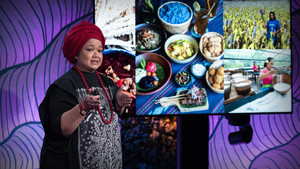
We have over 1 ,200 grains, over 600 edible roots, not to mention more than 550 fruits and 1 ,600 seafood and many more.
And we can find all these food sources in different landscape.
So, Indonesia has a very diverse landscape.
We have over 17 ,000 islands across the archipelago, from sea to the mountain, including rainforest, mangrove area, pitland area, you know, everything is there.
So, actually, there is no need for one fits all diet because each of these landscapes have their own food sources.
For a lot of indigenous communities, these landscapes are supermarket without bills.
So, I started Javaara 15 years ago with the mission of bringing back forgotten food biodiversity to help indigenous and smallholder food bombers to improve their lives, while also providing consumers with healthier diets with products that are also ecological.
So, of course, I got to travel across Indonesia, spending time with indigenous communities.
And to my surprise, places that are so remote and not even touched by the government policy, food policy programs are well fed and healthy.
Yes, they may not have much gas, but there are no lacking of healthy, nutritious food as long as the natural environment is not being destroyed.
So, let's look into the carpe diversity that we have.
We have grains, we have edible roots, we have fruit base, we even have tree trunk.
So, you know, all of these are gluten free.
So, another example is on our sugar diversity.
We have at least four native food trees, including coconut for the lowland and coastal area, orangutri in the forest area.
We have arid land with the lontar or parmilla sugar, and then we have nipa in the wetland.
But by the way, nipa also produce salt.
How bizarre it is. The same plant produce sugar and salt.
And every single of these sugar are low glycemic, providing slow release energy, and they are very sustainable.
They can easily be productive at least for another 50 years.
Yet, the government decided to come up with massive food estate on sugarcane plantations.
So, let's deep dive into an example of ooey or greater yam.
Ooey can be fine in the wild, easily domesticated, can grow under the shade of the tree, and it can easily you get over 40 kilos each harvest.
So, this is the type of staple food which you don't need to destroy the forest, you don't need to poison our soil, and basically you don't even need to introduce new type of crop.
Unfortunately, the government, the policy for over 40 kids choose to ignore our food biodiversity.
And instead, monoculture of rice prevails.
Over 98 % of Indonesians are consuming rice right now.
Let's compare with 1954, where actually it was only 53%, the rest was based on cassava, corn, sagu, and other edible roots.
So, I have to say this is embarrassing, and at the same time very frustrating.
That a country like Indonesia where the food are abundant, we have such high rate on stunting and malnutrition, not to mention the impact of our food policy towards deforestation, land degradation, climate change, natural disaster, impoverishment of our farmers, and also poor diet among the population.
And now back to the episode.
We do have a vision actually on how the policy should be.
We need to shift from monoculture to food biodiversity.
We need to revive back the heritage food that actually can provide good nutrition for all while also keeping intact the nature.
It is time for us to give a center stage for the food biodiversity to be able to find the solutions that we needed.
This is an example of a small village in central Java, which decided to embark on a journey to nutrify its community, making sure that every household have a food garden, cultivating chicken, fish, vegetables, fruits, herbs.
And this is interesting because once they did that, they can reduce their grocery costs by 30%, improving their household income by 20%, increase class attendance, and also improving the student grades.
So, nutrition matters.
Feeding the nation is one thing, but nutrifying the community goes a very long way.
So, children is our future.
It is also time for the food policy to also include food culture education into our curriculum, teaching our children about where their food comes from, what are the food biodiversity available around them, to embrace their food culture identity, to understand the nutrition that they have, and how our food
relates with the sustainability.
So, basically, if we can shift the policy to include the food biodiversity, we can provide nutrition, good nutrition for all without jeopardizing our nature.
It is time for us to invest more on food biodiversity, on the mainstreaming of food biodiversity, as one of the practical, inclusive solutions for the future of our food.
Not only that we have a food policy crisis, we also have a food identity crisis.
For decades, we have been ripped off from our relationship to culture and nature.
We have to help the people to go through this crisis of identity, allowing them to understand the importance of heritage food to become the answer, and also to understand that it is the food of the future, rebranding it, making it sexy and high, so that it is no longer perceived as a poor man's diet.
Thank you. That was Helianti Hillman, recorded for Ted's Countdown Dilemma Series on the Future of Food in 2024.
If you're curious about Ted's curation, find out more at ted .com slash curationguidelines.
And that's it for today.
Ted Talks Daily is part of the Ted Audio Collective.
This episode was produced and edited by our team, Martha Estefanos, Oliver Friedman, Brian Green, Autumn Thompson and Alejandra Salazar.
It was mixed by Christopher Faizi Bogan.
Additional support from Emma Toppner and Daniella Balareso.
I'm Elise Hugh. I'll be back tomorrow with a fresh idea for your feed.
Thanks for listening.