Hello! Welcome to Roundtable, where we serve up piping hot debates on the issues that sizzle in China and beyond.
I'm Yuhong Lin. Imagine this.
You order takeout, and your food arrives hot and ready.
But have you ever wondered what's going on behind the scenes in the kitchen?
Now, imagine the person delivering your food is not just a courier, but also a food safety watchdog.
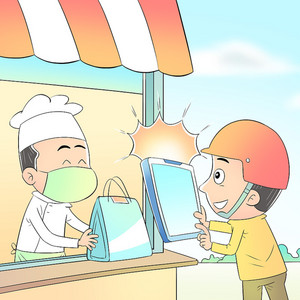
In China, some cities are empowering food delivery riders to act as food safety inspectors.
They see things most of us never will.
And their reports could be the difference between a clean kitchen and a health hazard.
For this episode, I'm joined by Yushan and Steve Hatherly.
Now grab your virtual compass and follow us to the heart of the discussion.
You think your delivery rider just brings food?
Think again. They might be the secret agent of food safety you never knew you needed.
Recently, some cities across China have begun hiring food delivery guys as food safety inspectors, allowing them to report violations via NAP.
These riders can even earn some rewards with this method.
So is this a smart, innovative way to ensure food safety, or are we asking too much of an already overworked group?
So let's first take a look at what exactly is happening, and if you are a food delivery person, what can you do to join this mechanism, and what can you get?
Well, let's get back to the news first.
So like you mentioned, Honglin, in many cities across China, this is happening.
The food delivery riders, they're becoming food safety inspectors as well, in cities including Hangzhou in southeastern China's Zhejiang Province, and Shenyang in northeastern China's Liaoning Province, and Laixi in eastern China's Shandong Province.
So these people, we know that they're the first there in the restaurant to spot potential health risks and food safety problems.
So what they were volunteering to do now as a union is these riders, once they get inside, they see something that's potentially risking the food safety in that dining place, they'll take photos and upload them as evidence or clues onto an app as a way to report this place onto the food delivery app
so that people can get alerted and maybe just not order from this place anymore.
So, from what I've seen in restaurants, it's the same in China as you would see in any other place around the world in terms of food delivery.
The restaurants will prepare the food, they'll package the food and put it by the counter somewhere, the food delivery person will come in, confirm it's that order, pick it up, and they go immediately.
It's a very, very quick - Process.
Transaction and a very quick process, that's right.
But in this case, when the riders get the food from the restaurants, they're going to have the opportunity to see the condition of the restaurants and even the kitchen, which I'm curious, and I want to ask about that in just a second.
But yeah, as you said, if they see any potential health risks or food safety problems, they take pictures, then they upload those pictures as evidence or clues, if you will.
They do that into an app, and then yeah, they get awarded, and I want to know what those awards are as well.
I see, just on the surface of this topic, I see a lot of potential problems, but I also have a lot of questions as well.
Access to the kitchen is my first question because when these riders come in, they don't go into the kitchen to pick up the food, they pick it up generally from a designated area sometimes or from the front counter sometimes, but it's not like these riders are walking into the kitchen.
And the reason for that, I would assume, is because kitchens are very, very busy, space is limited, and there's no place for the riders to come in there and pick up the food.
So how does that process work?
You know, based on my observation, many of such delivery fetching points is actually not open in restaurants.
They carry a title or like a label of a restaurant, but they're also just say dining or little stools of dining spots, and there's not even any chairs or tables or any tables for service inside those places.
Just a little open kitchen, and right next to that kitchen thing is the place, a platform for you to grab the delivery food that's served there.
So these places, they serve food just for one purpose, for delivery.
So they don't really cater to the customer sitting inside their say restaurant or just a dining place.
So that's how the riders, once they arrive, are in phase of the people cooking.
Right there, face to face, seeing everything, see like a Chinese creep, stand, people can just cook in front of the riders, the deliverers, and once they're done cooking, they put together the food and wrap it up.
The deliverer can just take the food from the person who cooked it.
Yeah. That's a good point.
Some restaurants, every restaurant is different, right?
So when the riders come in, sometimes they won't have easy access to viewing the kitchen, I guess.
But in other cases, they would have direct access to viewing the person who's actually cooking the food.
Yes. Actually, as of December 2023, the number of online food delivery users in China reached over 545 million.
That is around 50 % of the total internet users.
So we order food so much.
And with this booming demand for food delivery, a large number of delivery -only kitchens that Yuxuan has just described have emerged.
Now, here are some legitimate, really good cookers.
They find doing delivery only is easy and fast and they make the food and it's all good and happy.
Yet, we have to admit to some restaurants, there are not even restaurants, they're like, they do not offer a dining service at all.
They're the kind of restaurants that Yuxuan has just taken as a division mechanism in the sense that no diners are actually in the restaurants.
So, well, in this cases, maybe the delivery guys are the only ones that are constantly in the area.
Yeah, that's a very good point as well.
Not every restaurant is a dine -in restaurant.
There are a lot, a lot of delivery -only restaurants.
And that is why for some delivery guys, they actually find it a little bit confusing when they have the ability and have the opportunity to actually see some problems, yet they do not know where to report.
They do not want to report to the diner directly.
They do not really have an authority selecting and receiving these problems.
And this specific way of asking some of the delivery guys to become food inspectors are probably just one of the ways, it is one of the ways, allowing them to report the news or the evidence, the clues they collected with this one method.
Yeah, right. So, speaking of the clues that they collected, can I ask what types of things are they looking for?
Because that's, it's kind of a, it's kind of a broad, open -ended topic, isn't it?
To say, if you see something that you think is suspicious, we'll then report it.
But what types of things are they looking for?
What types of things are they reporting?
Let's just use one example.
So, here is one food safety writer, surname, the Cho.
And he's in Fuyang district in Hangzhou.
And he recently uploaded photos showing the kitchen, well, one of the kitchen status of a local dining place with unclean food ingredients scattered on the ground of the kitchen, as well as oily kitchenware, raw meat in plastic bags put close to the broom, etc.
And here this cleanliness is not the, say, the only thing they guard.
There are other things as well.
For example, the expiry of the food ingredients, non -edible substances, as well as false advertising, illegal use of some devices and promotion of food efficacy and price fraud and everything that's related to delivery service and the cooking of the food process as well.
So, here I see they're not just writers anymore, like we discussed earlier.
They're also guarding food safety for the customers who cannot be there to see how their food are being cooked and processed in person.
So, what happens? Okay, so the writers go in, they see something suspicious or something that they think is worth uploading to the app.
And then what's the process after that?
What happens after the report?
Basically, they upload these details and the photos they collected as clues onto this, let's call it an app rather than platform, or maybe it's both.
It's called, well, in Chinese, it's xiaogu mà and translated into English.
It could be called the writer's code.
So, this platform was launched in 2023, first in Hangzhou.
So, it's constantly improving its functions, including reporting different things.
And right after the report, right after the officials receive the report, they're going to try to supervise the process and give some actions on how to deal with the report in about a timeframe of 30 days.
This is actually very interesting.
On one hand, I kind of get why we put more and more responsibilities and emphasize, and also possibilities to these food delivery guys, because if you take a look at the numbers, by May 15, 2024, the number of food delivery guys in China had exceeded 13 million, representing around 1 % of the country's
population. We have a lot of these people running on the road, delivering our food, our drink, our coffee, tea every day.
And this huge group of people can do more, apparently, because of their very unique, yet very popular job description or just job itself.
If you take a look at China's short social media platforms, you see a lot of short videos are based on the experience of these food delivery guys.
You would see short play of the delivery guys.
Well, these are all fake little play, little dramas on the short video platforms.
You see someone would play the role of a food delivery guy getting into this really shabby place with the food all pre -made, yet claimed to be ready, just cooked food.
And you would see them entering this really dirty, too dirty little place.
All of these are drama in place, just to say that again.
Yet, they enter this place and they use these really dirty stuff and, well, dirty ingredient in expired food.
The delivery guy would get the food, deliver it to those who have ordered and tell them what is happening.
Those would be some plot of these plays.
And these are inspired by the experience of some real food delivery guys.
On the other hand, you also see people would go to a delivery guy, say, can you take me to the cleanest little shop you visited recently and take it as a recommendation.
So definitely we put a lot of emphasis on this job because they get to see another side of the story that we usually don't see.
But in the other hand, I feel like this method might also have some problems and risks when it comes to actually practicing this method.
Well, yes. And before we talk about that, the point that you just mentioned, I think, puts to rest one of the concerns that I might have had about this or other netizens or individuals might have about this is that are these riders actually qualified to make decisions like this?
You know, if they have some sort of vendetta against a restaurant owner, or if they just don't get along or something, then this is an opportunity for a rider to get revenge somehow.
Or even if they're not qualified, if they're simply not qualified and they don't know what they are looking for, then false reports might be more common than what we might think about.
So I guess there is some training that is offered for these riders, yes?
Yes. So the local market supervision bureaus are those that's in charge of such trainings, let's call it.
So they offer training on how to use the reporting app, the Xiao Guo Ma, while taking Hangzhou as an example.
And also they tell you how to spot common food safety problems and how to mark them and report them as well as how to use the app in general.
So basically these local food authorities, they're giving tips to riders on how to do such things.
And also you mentioned something about why the riders would voluntarily do it, what's in it for them.
Actually, there are awards for these riders as well.
They get two types of awards.
Instead of receiving money and bonuses directly, first, they can get the award based on their reports according to Hangzhou as an example.
So Hangzhou has this reward measures for reporting harmful food safety behaviors in Hangzhou.
And based on that, they can get some reward.
And secondly, the rider's code platform, so the Xiao Guo Ma app, can also offer them bonus points, which can in turn be used to exchange common necessities or daily goods.
And if they're not choosing the daily goods, then they can get good evaluations.
And by that, I mean like say higher ratings, which means a lot to riders because with higher ratings, they can get more orders assigned to them, referring to higher monthly payment, even monthly bonuses sometimes.
Or opportunities for promotion or it'll just look good for them if they get more points for themselves.
Okay, so one reward was that they can get bonus points that they can turn into, they can't turn it into cash, but it's almost like a coupon that can be used at local marts or something like that for things like daily necessity soap or milk or whatever.
Something like that.
What have you, right?
The other one, it can make their resume look better and it can make them look better overall.
Okay, so those are the two types of rewards.
They cannot get any cash at all as far as we know.
I believe that is not.
Yeah. Okay. I was gonna say, do you see this as a good thing or a bad thing that they get rewarded?
Well, definitely we need certain kind of rewarding mechanism for them to have the motive to do such things besides the fact that some food delivery guys wanted to do it and they just lack a method or lack of platform.
So we're providing them both.
And on the other hand, we still have to think about the fact that if you are a food delivery guy, you're standing in a dirty kitchen and you start taking pictures, there definitely is certain kind of risk and they're definitely.
The owners are not gonna like that.
No, they're not gonna like that.
And if all of a sudden a picture of my own unclean kitchen is uploaded to some platform, allowing everybody to see it, I would wanted to know who uploaded the picture and who reported me.
And luckily, these kind of information is actually protected by the platform.
So we, according to the platform, actually they protect the safety and rights of the supervision.
So they do not have the name out there so that people would not know who reported them.
The name of the writer or the uploader.
In the meantime, we also, this is actually not the only method we have to protect the rights of the eaters to make sure the safety of the food, the cleanest of restaurants.
Actually, back in 2014, the state administration for market regulation has already launched the transparent kitchen initiative.
In Chinese, we call it Yangguangchufang or sunshine, bright kitchen, beautiful kitchen, transparent kitchen, open kitchen.
The idea is for the diners to be able to see what is going on in the kitchen when they're dining.
So sometimes instead of having a wall in between the chef, the kitchen cooking area and the diners, you would have a glass so that you can see exactly what's happening there.
Open kitchen design.
Open kitchen design.
And later on, it got upgraded to the relatively more technological futuristic setting.
That is, you would be given an iPad when you're eating or there will be a screen in the front area in the almost lobby area of the restaurant.
And you can click your table number, allowing you to see the cooking process of your dish that will represent to you a bit later.
It's kind of like when they had, I don't know if they did it here in China, but I know they did it in Korea at certain spots.
They would put cameras in the classrooms of teachers.
Yeah, we have that here in China as well.
Parents or whomever would be able to watch the class.
Yes. And that is actually the third stage of this transparent kitchen method.
That is the kind of function uploaded or installed in the delivery app, allowing you to, if the restaurant is with the service is where these civilian cameras actually on your delivery app, you get to click into the civilian cameras and see what is happening in the kitchen.
So it's kind of like internet plus a transparent kitchen.
So these kind of a lot, there are a lot of different methods out there to protect the rights of the diners.
And I think this one, the allowing delivery guys to do their reports, it's just the newest edition.
So you support it. I support it.
Yeah. I think, as I mentioned, I think there's a lot of potential problems here.
Maybe they could edit the photos before they upload them to make it look worse than it actually is.
I'm not sure. That's just my conspiracy theory.
Like I said, maybe they could have a problem with a restaurant owner, submit false reports, things like that.
I see a couple of potential problems, but that's not representative of my opinion.
I think that this is actually a positive thing because restaurants are, of course, supposed to be 100 % trustworthy.
But we know that there are a ton of restaurants and we would be naive to assume that every restaurant is following all the rules that they are supposed to follow.
So I think that if a measure like this is put in place, just to kind of almost be like a system of checks and balances, if you will, another system of checks and balances to make sure they're doing what they're supposed to be doing.
I think it's a good thing overall.
For me, the biggest source of acquiring information like this is actually from social media on the red or Xiao Hongshu, which is one of the leading Chinese social medias.
I often scroll and find out posts about just delivery guys writing, oh, you should not eat fried chicken because you never know how long the oil that fried your chicken has been out there.
See, they wanted to say something.
They've always tried to reach out to general public.
And also they're not just writers, but also the employees in certain food chain restaurants where it stands, they also say, oh, you can trust this certain brand because when I was working there, I was required under very strict rules and requirements.
We need to wash the cup before we make the next cup of milk tea for our next customer.
And I was like, so frustrated about this rules, but hey, in turn, you guys can trust this brand because I know how it's like from the back of the kitchen.
There's a lot, a lot, a lot of rules that restaurants have to follow.
I looked it up. I was curious to know because America and Canada are kind of well known to have super ultra strict health inspection rules that restaurants need to follow.
So I looked it up for New York City because New York City as of 2023 had 27 ,000 restaurants.
So, and they get inspected once a year, which is stressful for a restaurant owner.
When you say inspected, you mean special and professional people going into the restaurants and do the inspection.
The health inspector comes once a year and gives you a grade.
So upon your initial inspection, if you score zero to 13 points, then that's considered very, very good.
If you score 14 or more points, that's considered very, very bad.
And like I said, every restaurant in New York City, they get an unannounced inspection at least once a year.
And they don't tell them that they're coming, right?
You kind of have an idea of when they're coming, but you don't really know when they're coming.
And if you get a grade over 14 points, over 14, they come back pretty quickly within the next seven days to check again, to see if you've fixed your problem.
And then they'll come back for another inspection within a few months.
If you score very well between zero and 13, then they don't come back for 11 to 13 months.
So you can control your own destiny in a sense in that way in New York City.
And I think New York City is just kind of a cross section of how it works in many cities in North America.
It's really strict.
And when you get your letter grade, you have to post it in the window of your restaurant so that passerby's can see how clean your restaurant is or is not.
Oh yes. It's the same thing here in China, actually in one city in China last year, the city's food safety regulatory departments, including market regulation, public security, urban management, agricultural departments, conducted over 1 million inspections, including routine patrols, supervision checks, special
enforcement inspections.
And they also check different parts, different areas or different aspects of the restaurant, whether or not the eating area and the cooking area is clean enough, whether or not the food is within these expired dates.
Or uncovered stored food or temperature checks to make sure that the food is stored at the proper temperatures.
Yes. And they would also ask the restaurants to put up the notice of whether or not they are perfect when it comes to violation.
That is no violation of any rules, a little violation of any rules and untrustworthy.
So it's like naming and shaming also as well.
So when they put up the untrustworthy, they have already let's say changed or correct the wrong behaviors.
It's just you've made the mistake and people will know.
Yeah. And it's important for people to know and putting that letter grade up in your window, if it's a really good one, is a badge of honor for a restaurant because it's absolute proof, because these health inspectors, they are not just looking for food inspection.
They're looking at employee hygiene as well.
I'm not sure here in China, but in the States, they look at the length of employees fingernails to make sure that they're of a proper length and that they're polished and they take appropriate action when they cough or when they sneeze.
Everything is dissected.
Yes. So back to the delivery guys.
Well, I think the idea of turning them into food safety inspectors may be innovative, but it's not without its challenges as we talked about.
And from the risk of false reports to the safety of the rider themselves, there are important hurdles to overcome.
Still, if implemented well, this could be an effective way to ensure that restaurants maintain higher hygiene standards.
And we all want that.