Discussion keeps the world turning.
This is Roundtable.
You're listening to Roundtable with myself, He Young.
I'm joined by Steve Hatherley and Yushan in the studio.
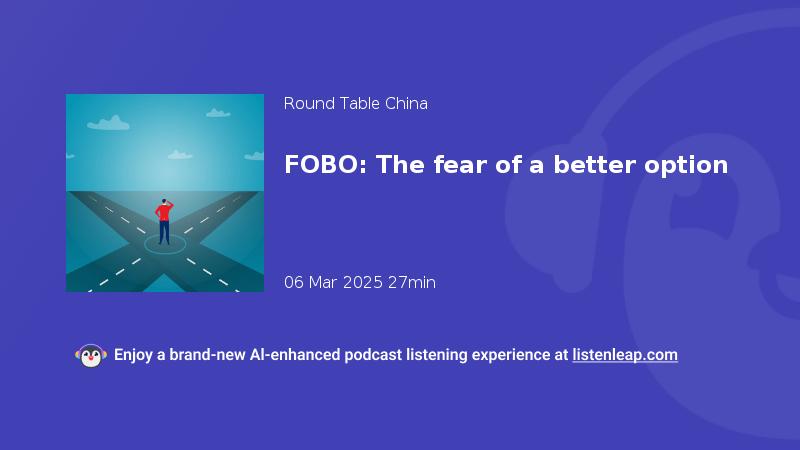
Coming up, FOBO, or the fear of better options.
It's a psychological phenomenon where individuals struggle to make decisions because they're constantly worried that a better alternative might exist.
This paralyzing fear often leads to indecision, procrastination, and dissatisfaction as people become overwhelmed by the endless possibilities and the pressure to make the quote -unquote perfect choice.
We discuss how to overcome FOBO.
And while gluten -free diets have taken over Western kitchens and restaurants, they haven't quite caught on here in China.
After all, we're mostly rice eaters.
Today, we're diving into the truth behind this food trend, its rise abroad, and whether it's something you could jump on.
And here's a heads up, not really.
Certainly not for everyone.
And we'll get into it.
Our podcast listeners can find us at Roundtable China on Apple podcast.
Now, let's switch it up.
We all know FOMO, but have you heard of FOBO, the fear of better option?
It's that paralyzing fear that there's a better option out there so you can't decide on anything big or small.
If you're anything like me, stuck trying to decide between that statement jacket from the spring collection or the sleek new tablet that will deliver an ultra responsive of touchscreen experience.
Both seem amazing, but Phobos got you in a decision loop that's impossible to escape.
So if you ask me, still haven't made that decision yet.
So I guess let's look at this.
It's a play on the infamous FOMO, the fear of missing out.
FOMO's been around for a long time.
It started popping up in dictionaries around 2013.
I think everybody's familiar with the fear of missing out, but the fear of better options FOBO, maybe not so familiar with.
This term is actually not new either.
It was coined back in 2004 by an author by the name of Patrick McGinnis.
At the time, he was a student at Harvard Business School.
So here's the description, and you can tell me, Hyang and Yushan, is this you?
Are you a person who agonizes over every single decision, big decision, small decision, doesn't matter?
And even after you make that decision, then you are stressed by it, too, to the point where sometimes it can paralyze you, leaving you unable to make that decision or regretting it after you've made it?
Heck yes. Well, then you have FOBO.
Yeah, you've described it very well.
It's that difficulty that people have committing to something.
We hear this a lot in relationships, don't we?
A fear of commitment, right?
You don't want to get into a serious romantic relationship because maybe you're uncomfortable with that.
But also it could be maybe there's a better guy coming.
Maybe there's a better girl coming in the future.
That could be FOBO too.
i mean as someone who's just been diagnosed of phobo i feel like this is just me making my each and every decision on a daily basis i do that even when playing games you know for some games your one choice can lead to a totally totally different narration in the following parts of the games yeah and i struggle at that every single time okay so it's there's a difference between being indecisive and suffering from phobo.
And the difference lies in the cause of the hesitation because if you're simply an indecisive person, then you just have a hard time making a decision.
That could come from a lack of confidence.
It could come from a fear of making the wrong choice.
Or maybe you just have too many choices.
That can be a problem as well.
But indecisiveness doesn't necessarily involve the fear that a better option might exist.
It's more about the struggle to commit to a decision one way or the other.
But FOBO is a very specific type of indecisiveness that's driven by the anxiety that, yes, something better might be out there.
And this is a big problem for people because, you know, if you're thinking, well, I'm going to skip this option because something better might come along, that isn't necessarily going to be the best course of action every single time.
Of course not. I'm shocked that those people are that confident something better is going to come along.
According to my limited experience of walking on this earth for more than 30 years, I've experienced, oh, the next thing that comes along is worse.
So cherish what you have in front of you.
The anti -phobo. Cherish what you have now because nothing better is ever coming.
Yeah, the next guy, oh, severely worse than the previous one.
I don't know if they have a term for that.
You don't really know, actually.
So, I mean, yeah, it's you don't know.
And what types of situations are we talking about?
It's not just limited to romance or gaming, as we've mentioned.
Yeah, no. I mean, it could be romance and it could be gaming, of course, but negative past experiences, fear of rejection, those are a couple of the reasons that it might be related to romance.
but it can be a lot simpler than that.
For example, have you ever struggled with choosing where to eat?
Yeah, I understand that.
I'd rather struggle on choosing what to order as a delivery.
But same, same struggle.
Same kind of thing, right?
You can spend, oh my gosh, sometimes deciding what to eat is really stressful for people.
And you can scroll.
If you're ordering online, you scroll and you scroll and you scroll.
And you think, oh, this looks good, but I'm just going to scroll a little more because maybe there's something better.
That's Fobo. How about this?
Shopping online. You put so many items in your cart, but you can't check out because you're not sure if you found the best deal available.
So you think, is this the best price?
Let me just check a couple of more sites to make sure.
That is Fobo. I think somehow social media have a lot to play on that as well because nowadays, whenever people shop, There seems to be this instant comparison tools that you can just find on social media all the time.
Like does this shop has a similar style that I can pay for it?
I can get this same style of product for a cheaper price, stuff like that.
So, online platforms, including social media, nowadays it enables this real -time comparison that's kind of fostering our habit of seeking the so -called the best options.
Yeah, and it could be shopping, it could be streaming a movie or a TV show, all for the same reasons, right?
Oh, you can't settle on which movie to watch.
Let me just keep looking because there might be a better movie available.
This could apply to job opportunities.
Now, which movie to watch isn't that serious, right?
But let's say you get a job offer and you think, I don't know if I should take this one because a better offer might come.
So that's when things can get a little bit more serious when we're talking about football.
And you're right. To what do we attribute this?
Well, that guy that I mentioned before, that author McGinnis, he says that it could come from an affliction of abundance.
And that's a fancy way of saying we are constantly surrounded by choices all day, every day.
And if you think about it, it's kind of true.
We live in an on -demand world.
There are constantly endless lists available to us in terms of choices, online shopping, movies, restaurants, food, you name it.
Job opportunities would be great for you if you had an endless list of job opportunities.
But the author says that could be part of the problem is that we're not limited in our choices in our daily lives.
Yeah. And by saying so, I just want to quickly mention that we're not saying that waiting just a little bit for, say, something serious like a job offer or a school offer is bad.
It's just your high expectation on the next is going to be better.
It's kind of, you know, distracting and harmful in this scenario.
It's not that you can't wait at all.
In some cases, like when a student is waiting for school offers from just all the schools that he or she applied, maybe the next one is coming like it actually happened to me in 2018.
But the very, say, persistent will that you have that the next one is going to be better is the one that we're talking about that's really not very good for your mental health for, you know, overall performance.
Yeah, what you're mentioning, I suppose, for a lot of students who are applying for multiple universities or for your postgraduate degrees, maybe you can particularly feel the predicament.
Sometimes it depends on the application process.
Sometimes I think there is a deadline, so you kind of know you can wait until all the offers come in and then you decide.
In other times, sometimes, let's say you're applying for maybe a university in the British system, they have a peculiar system.
Sometimes people feel, oh, there's a little bit of gambling because you can't afford to wait too long to reject the previous one or whatnot and understand it's agonizing.
But once you flip that page, once you go through that and move on to the next stage of life, you look back, oh, it's not that bad, actually.
And I suppose you guys do make a really good, you paint a really great picture or a fitting picture of this thought that there are an abundance of options out there.
But somehow, if I would invite you to take a true step back and look at the real important options out there and decisions you get to make, I think it's a completely delusional thing that we think there are actually that many options for us.
When you look at your job, when you look at real important life decisions that you kind of turn at the fork of the road of your life, how many decisions of opportunities do you get to make at those moments?
Not that many. And then I advise, well, I encourage you to make a good decision.
Yeah. And again, this isn't just someone who's trying to make a decision between A and B and analyzing it before they make a decision.
No. This is more serious.
This is when you actually can't make a decision because you just don't have that confidence that this is the right decision for you.
And we listed some pretty easy examples, but this can affect your personal life as well.
Let me ask you this.
Have you ever invited a friend for maybe coffee or a dinner and the dinner will be two weeks later?
and the friend says, oh, yeah, maybe, maybe, but they won't commit to that meeting.
Why? Have you ever wondered why that might be?
Well, the friend might be waiting for something better to come along in terms of a social calendar.
Does that make sense?
Have you ever heard that before?
I'm experiencing that with my interviews these days, not with my friends, but same.
That's why this type of behavior can be harmful to your personal relationships, to your friendships as well.
Because if a friend invites you out, oh, well, let's have coffee next Saturday.
And you say, yeah, maybe.
And then you're the type of person that you'll never commit to it.
You'll never say yes.
That will be an annoying thing in your relationship with your friend.
And they will stop asking eventually, right?
And FOBO can affect your friendships and your personal relationships that way.
Just a small question.
Two weeks ahead of time, are you British?
I mean, my ancestors were.
So it still lives inside me, maybe.
What about, you know, coffee on Saturday?
So two days ahead of time and, you know, decide it, drop it or take it up.
But have you ever? OK, so you're the type of person you won't you won't commit to that.
No, no. It's just, you know, when you ask that question, I'm just wondering whether it's because that you give that person the illusion that, oh, you have two weeks to decide, when actually, dude, it's tomorrow or this afternoon.
Some people don't like that, though, right?
That last -minute invitation.
Yeah, so those are the places where PHOBO can kind of have an impact on your life.
So how can you get over it?
Experts say, well, if this is you, if this is seriously affecting your decision -making, be aware of it.
And step number two, and I like this part, Shift your mindset.
The experts say shift your mind.
Embrace the idea that your choices could be the best for you at this moment, even though other choices may come along later.
But at this moment, this could be your best option.
Step three, stop looking at other options as better options and start looking at them as other options.
Just because it's a different choice doesn't mean that it's a better choice for you.
And step four, remember, you're not really locked into a lot of the decisions that you make in your daily life and you have the freedom to change your mind later.
That might be a little bit more liberating for people too.
And here's one more tiny little tip here.
And even if you can't follow step four that you feel that you can change your mind later, even if you can't try to normalize what we call regret, because regret is a natural part of life as well, not a failure as you might fear it to be.
And by viewing it as just a feedback for learning or for future decisions, it's not really a bad thing if you tend to say regret it afterwards.
And last but not least, here's one thing that DeepSea can encourage me to practice as a way to enhance trusting my brain to make choices.
That is to start small by building decision -making muscle with low -risk commitments such as just trying a new hobby for a month, stuff like that.
Yeah, small short -term commitments.
Well, overcoming FOBO is about acceptance and commitment and finding peace with the choices we make.
That's my opinion. And a couple of weeks ago, I shared Ruth Chung's TED Talk in our Motivational Monday segment where she discusses the idea that it's not about making the right decision, but making the decision right.
And I find this to be so relevant to what we're talking about today with FOBO.
Many decisions in life don't have one objectively best option, and the key is to commit to a choice and make it meaningful rather than agonizing over the possibility that a better option might exist out there.
By focusing on the idea that any choice can be made right by how we commit to it, we can ease the anxiety that comes with endlessly searching for the quote -unquote perfect decision.
And Fobo might feel like a modern dilemma, but at its core, it's a fear of imperfection.
The truth is there's no such thing as a perfect decision, only decisions that we make work for us.
Overcoming Fobo, starts with realizing that no choice will ever be flawless, but with the right mindset, any choice can be the best one for you.
Coming up next, gluten -free is a big deal overseas, but is it something we should worry about here in China?
As rice eaters, we've been living gluten -free without even trying.
Today, we'll explore the gluten -free hype around the world and uncover who it's truly beneficial for.
Stay tuned. Looking for passion?
How about fiery debate?
Want to hear about current events in China from different perspectives?
Then tune in to Roundtable, where East meets West and understanding is the goal.
You're listening to Roundtable with myself, He Young.
I'm joined by Steve Hatherley and Yushan.
Gluten, or fuzhi, it is a protein found in wheat, barley, and rye.
And it indeed permeates a surprising range of products.
While the presence in staples such as bread and pasta is well known, it's used in cosmetics and supplements highlights its versatility.
While not a must for most Chinese people, the gluten -free diet has certainly started to gain some attention in recent years.
Overseas, it's a huge health trend with people swearing by it in the West.
But here in China, it's still more of a niche dietary choice for mostly fitness fanatics.
In this discussion, let's get really down into it.
What is gluten and when did doctors learn about it?
Could be very bad for some people.
Yeah, it's that protein that acts as a glue.
It's what gives dough its elasticity, if you will.
And it helps if you go into a bakery and you'll see like some oddly shaped breads.
Well, gluten is kind of the thing that helps it maintain its shape.
Yeah, you can find it in bread, in pasta, in beer.
You can find it in a lot, a lot, a lot of different foods and some products too.
Some people have a disease that is called celiac disease.
And what it is, it's gluten sensitivity.
So avoiding gluten for those people, it's not just a recommendation.
It's absolutely 100, 1000 percent essential because it can lead to some serious side effects like digestive issue, digestive issue, digestive issues, excuse me, fatigue, inflammation.
But it can be fatal as well.
It can be very, very dangerous for those with gluten allergies.
They have to consult a doctor and make sure that they're eating the right things and staying away from him.
it's like this a gluten -free diet to someone who needs it is like insulin for someone with diabetes and doctors you ask when did they discover this well it was found out back in the 1940s this is really interesting so during world war ii that wreaked havoc across most of europe of course and children became malnourished and they had limited access to fruits and vegetables and especially wheat.
And while the lack weakened most of people's health, it seemed to strengthen the people who suffered from celiac disease.
And it was Dr. Willem Carroll Dick, he was a Dutch pediatrician, who noticed that fewer children with celiac disease were suffering symptoms during wartime than before the war, when the disease had a mortality rate of about 30%.
So doctors, They knew about celiac disease a long time before the war.
But during that time, they figured out that it was gluten that was the main culprit there.
And I don't know how to comment on this.
I was just reading some data, and apparently there's about 25 % of the U .S.
population consumes gluten -free products.
And this figure is far higher than the roughly 6 % of people with non -celiac wheat sensitivity.
1 % of people with celiac disease and even lower percentages of people with wheat allergies.
Because, you know, as a Chinese person, when we're, you know, just comparing what's going on here with China to the Western countries, we see gluten -related concerns that's, you know, relatively less that big of a discussion here in China because, well, there are indeed such attention paid to gluten -free diets in recent years, especially with the gluten -free diet coming to the Chinese market as a health -conscious eating trend that's involving gaining attention in fitness or weight loss and healthy eating circles, etc. And also here, interest in the gluten -free diet mainly revolves around health
trends and market growth as conditions like celiac disease are less prevalent here, I'll say.
And also supermarkets and e -commerce platforms now offer a growing range of gluten -free products such as flour, noodles, and oats, typically at higher prices than regular food.
And I can testify for that personally because I have one niece at the age of one year old, and she was diagnosed with this gluten allergic reaction upon birth.
And she has a twin sister Exactly the same built as her But totally healthy without Sensitivity for gluten products And they, the two little girls, one year old Each, they're having very different Products for, you know As an eating habit these days And apparently the one with the Gluten sensitivity is Like having a more expensive diet Than the other ones, so yeah That's so true these days Yeah, and it wasn't prevalent in the United States until about the early 2000 They did a big study there, and that's when they figured out that it existed in North America before, but it was largely unreported.
And that kind of put the spotlight on the gluten -free diet and the various disorders.
And then celebrities started to get involved in 2012.
Miley Cyrus, I don't know if you know who that is.
She's a singer and an actress.
And she tweeted that she had lost weight due to a gluten -free and lactose -free diet.
And then she tweeted out, gluten is crap.
that's going to get a lot of attention right and then when that happened companies they expanded the types of products that they offered to this growing gluten -free consumer base and then it's turned into this multi -billion dollar industry to the point where people even if they don't have those disorders they're still eating a gluten -free diet if they're following it too closely that could be troublesome.
Yeah, because experts warn that gluten -free eating might not offer benefits if you don't have gluten sensitivity, and that the diet could do more harm than good.
Dr. Runa Watkins, she's an assistant professor at the University of Maryland School of Medicine, and she specializes in celiac disease.
She said, we definitely don't recommend a gluten -free diet for weight loss.
My dietician will tell you that.
And the reason is when they remove gluten from a lot of those foods to make them taste more appealing, they add more calories or more carbs.
And the second thing is that being on a gluten -free diet also puts you at risk for other nutritional deficiencies in the long run, like vitamins B12, zinc, and folate.
Oh, so let's get back to the basics.
Where can we find gluten?
So we can alert the people who want to stay away from them or you know who want them uh you can find gluten in a lot of different places pastas noodles breads pastries crackers baked goods cereal granola breakfast foods breading and coating mixes croutons everything there kind of makes sense right but how about this different sauces or gravies flour tortillas beer and malt beverages sauce sausages candy chips, deli meats, ice cream, oats, soups, skincare products, toothpaste, imitation fish, vitamins.
You see where this is going?
It's almost everywhere.
My brother -in -law lives with this and he has to be extra vigilant because if a restaurant makes a mistake, right, and they say that it's gluten -free, but it's not.
I mean, it happened this summer, this past summer, as a matter of fact he had an emergency trip to the hospital his life was on the line uh because he ingested gluten by mistake this is really really serious for for people who suffer from these diseases uh or this disease and uh it can it can definitely um be fatal and it's something that is on your radar every single day for every single piece of food or product that you use maybe this person should move to china safer at least i mean it's not as prevalent so for everybody you know i think it's important to just keep in mind that is usually barley
wheat and rye so these are grains that i think are commonly found in china as well it's just it's not as prevalent a staple food for us yeah we eat a lot of rice i just wondered though because like i said it didn't it wasn't on the radar in in the north american diet it was in europe but it wasn't in north america until the until the early 2000s and like i said it didn't it wasn't that it didn't exist it's that people didn't know and i just want i'm totally speculating here yeah rice is is a safe gluten -free food right but i wonder if baked goods become like the bakery culture grows and grows
and grows and grows in china um if this will be get more attention from the medical community Yeah, sure.
Yes. And so the latest research come in saying that actually gluten isn't always bad and it shouldn't be painted in the picture as if it's a villain, right?
Yeah. Like I said, the topic of gluten -free has become a buzzword just like organic did back in the day.
And now what they're saying is the stuff that I mentioned before, gluten -free products lack dietary fiber and protein and essential nutrients.
So don't take that diet just because you're trying to lose weight.
Be on that diet because you need to be on that diet.
That's what the experts are saying.
Yes, and that's very good to know.
And with that, we're signing off.
Thank you so much, Steve Hatherly and Yushen for joining the discussion.
I'm Ha Young. We'll see you next time.