And I'll just throw this over here and come around the bottom with this.
Oh, add some extra sparkles here.
Wow, Choi, this looks amazing.
Thanks, Lilica.
Rawr!
What is it?
Well, it's Pride Month, and this is the float I'm making for the Pride Parade.
OK, but why is it covered with giant papier-mâché lions?
Well, the zoo is my sponsor, and the theme I came up with is so clever.
Oh, how clever is it?
It's so clever that the retainers are going to fall right out of the mouths of the neighboring float, sponsored by Goldbergstein Orthodontics.
Okay, get this.
But a pack of lions is also called a pride.
So my float is a pride celebrating pride.
It's a pride ride.
Awesome, right?
Oh, that's why the lions look like they're partying.
I love it.
Yeah, but it doesn't stop there.
I'm going all in on my double pride theme.
I'm wearing little rainbow cat ears.
I'm eating only raw antelope.
I'm hugging all my queer friends.
I'm practicing my roar.
And I'm stalking behind the shrubbery in my yard, ready to pounce and licking the male person.
Joy, you can't go around licking people.
But how else will they know that I love them?
You could just tell them and show them.
Hey, what if we work on this pride parade pride ride together?
That's a great way to show support and that you care.
Great idea.
So, Lilica, do you want to join my pride pride?
We wear little rainbow cat ears and eat this uncooked antelope meat.
You get to cough up fur balls.
Oh, oh, and we're part of a lion choir.
Right.
Um, I'll just stick with helping on the float.
And maybe the cat ears.
And the lion choir?
Don't push it.
Okay.
Roar!
Roar!
Welcome to Forever Ago from APM Studios.
I'm Joy Dolo, and my co-host today is Lilika from Santa Barbara.
Hi, Lilika.
Hi, Joy.
Today we're at a Pride celebration.
Our neighborhood is throwing a parade for everyone to enjoy.
There's floats and music and families and dancing.
Pride is a celebration of people who are queer.
Right.
Queer is a word that's often used to describe people who are gay or lesbian, which means they're attracted to people with the same gender as them.
Or it can be someone who is transgender, which means that person's gender is different from the sex they were born with.
Lilika, you wrote to us with a great idea to do an episode about the pride flag.
What made you think of this topic?
Well, I'm really interested in LGBTQIA plus history and especially like how the different flags are made.
And I really love all the different designs of the flag because I'm always curious about them.
Yeah, yeah.
Do you do anything special to celebrate Pride Month?
Um, that's kind of a hard question.
I draw a lot.
And my mom usually like Target has like a big pride section usually.
So my mom usually just like goes through and just buys all of the pride stuff.
Okay, so what is the last pride item you bought weeks ago?
I got a bunch of stickers.
Oh nice, nice.
You know I was.
I had a table.
There was a pride table at an event I was at and they had those um, those buttons that you kind of stick on your shirt or whatever, those like one buttons.
I got two of them and I made them into earrings.
Oh, that is so cool.
Yeah, it was like creative pride.
Is there a pride parade where you live?
Unfortunately, no, not to the extent of my knowledge, at least.
Oh, boo.
You got to start one.
Yeah, I'd really love to go.
Where do you see the pride flag in your life?
Um, there are a couple of like signs and pride flags at various houses, kind of like on our street or the streets around us.
Okay.
Does it make you feel anything when you see it?
Um, it makes me feel seen and it makes me feel like the world is improving.
It also makes me proud too, to know that flags represent so many things and so many cultures, and to know that there's representation out there right now for LGBTQIA people.
It's awesome that we can just wave our flag in front of our houses or schools, or a little bumper sticker on our car.
Yeah, absolutely.
Yeah oh oh, my gosh, look at me.
The parade is starting.
I'm so excited i know i can't wait to see our finished pride, pride float in action.
Yeah, i'd be lying if i didn't say i'm super proud of this float, but dang, all the floats this year are really next level.
Yeah, look at the community playhouse one.
We're here, we're queer.
Get your tickets for king lear.
I love thespians.
Oh, look.
It's the Marty's Discount Tire Gay Men's Choir.
Their motto is, we'll sing the harmonies and save you car monies.
Cha-ching!
And there's Nico's Necktie Emporium.
Look at those rainbow streamers.
More like rain bow ties.
I love it.
Ooh, Bubble Trouble Laundromat is here this year.
What does their sign say?
Wash, rinse, slay, repeat.
And they have a bubble cannon.
Much better than last year.
Lucia's Taqueria tried out a bean cannon.
Tasty, but messy.
I was picking pintos out of my hair for weeks.
Definitely.
Man, pride is the best.
It feels like everyone is here celebrating.
That's what it's all about, celebrating the freedom to be who you are and love who you love.
And show up and be seen as your whole self.
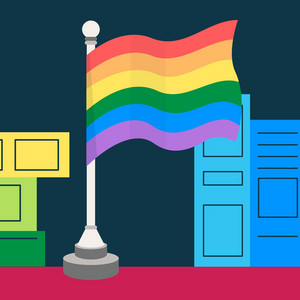
And all over this parade, on the floats, on shirts hanging from buildings, are rainbow flags.
But the rainbow flag wasn't always part of Pride celebrations.
For nearly the first 10 years of Pride, that flag didn't even exist.
Right.
It was designed to give queer people something to rally around, a symbol to let them know they were part of a community.
Of course, queer people have always been a part of all of our communities.
In fact, throughout history, you can find examples of different cultures recognizing and celebrating queerness.
Many indigenous cultures in the Americas recognize and honor two-spirit individuals, which sometimes means people who have both masculine and feminine qualities, or people who are attracted to people with the same gender as them.
And during the Han Dynasty in China, which began over 2000 years ago, 10 emperors in a row partnered with both men and women.
But in many countries, especially in the last several hundred years, it wasn't safe for people to show their queerness openly.
Let's think back to the 1950s.
Your parents would take you to school in one of those big boats of a car.
Oh yeah, you might hear some brand new music on the radio called rock and roll.
And you would not buckle your seatbelt because there weren't any back then.
Frozen dinners served in trays with little dividers were all the rage.
Your mom would take it out of the freezer, pop it in the oven not the microwave, because those weren't common and ding your TV.
Dinner would be ready.
That's not where you were eating a TV for dinner.
It was most likely steak, peas, and potatoes.
It was called a TV dinner because the whole family could eat them easily in front of the TV.
The TV.
The gorgeous, captivating, transfixing television.
Back then, it was probably still black and white.
The 1950s was a great time for TVs and frozen food, but it was a terrible time for queer people.
You could be fired from your job for being queer, or kicked out of your apartment or blocked from entering the United States if you were an immigrant.
If you were caught wearing clothes that didn't match up with your assigned gender, you could be arrested.
Being queer was even considered a mental illness.
And it wasn't just laws that discriminated against queer people.
It was common for people to lose friends or even their families for being queer.
Queer people lived in constant fear of being found out.
But fast forward about 10 years to the 1960s, and things began to change.
All kinds of people were standing up for their rights.
And that big, beautiful TV sitting in the living room was showing it all.
Black people were fighting against segregation and racism.
Women were pushing for the same rights as men.
Young people were protesting against war.
By the time the 1970s rolled around, people understood how important it was for their struggles and their power to be seen.
Queer people were no exception.
Hey, speaking of TVs, there's Ernie.
Oh, my God, like of Bert and Ernie?
No, from Ernie's Electronics.
Ooh, hey, Ernie.
Cool float.
Hey, thanks.
It's an LGB TV.
Get it?
I'm screening a documentary about queer life in the 1970s.
It even comes with a remote.
Check it out.
Okay, let me hit play.
By the time the 1970s rolled around, people understood how important it was for their struggles and their power to be seen.
Queer people were no exception.
Hey, I just said that!
The first Pride marches were organized in cities across the country for June of 1970.
The queer community started new organizations, created newspapers and even changed the laws in some cities so they could express themselves without fear of losing their jobs or housing.
That's right.
And a few years later, they had a major victory when... Joy!
No one can hear my beautiful television!
And a few years later they had a major victory, when the American Psychological Association decided that being gay would no longer be considered a mental illness.
Right.
Not that it ever was a mental illness, but it was good doctors were recognizing that.
And the next year, Kathy Kozachenko was elected.
Lilika, could you turn it up, please?
Someone keeps talking over the TV.
The next year, Kathy Kozachenko was elected to city council in Ann Arbor Michigan, which made her the first openly gay person elected in the United States.
I cannot believe this.
I know.
She was a real trailblazer.
No, I mean, I can't believe this narrator.
They're stealing all my lines.
Still, every time there was a win in one part of the country, it felt like in another part rights were being taken away.
Some cities overturned laws that protected queer people from discrimination.
And in California one lawmaker tried to make it illegal for queer people to be public school teachers.
That's terrible.
I know.
Some people had never felt safe coming out to their friends, families, and employers.
But now, things were even harder.
And it made many queer people feel like they had to hide who they were again.
Wow, Joy.
I had no idea you knew so much about this time.
Um, Ernie, I think the Pride Parade is backing up a little behind you.
Oops.
You're right.
See ya.
Bye, Ernie.
Okay, Ernie's float was definitely the most informative so far, but where is my Pride Pride float?
I'm sure it'll pass by soon.
Oh, I've got an idea.
How about we take a little game break while we wait?
Genius!
Let's play... Fasting!
This is the game where we try to guess the order things came in history.
Today we're talking about the rainbow pride flag.
I looked it up and this symbol was added to the emoji keyboard in 2016 as part of emoji generation 40.
So today you're going to be guessing the order three other emojis came in.
You ready?
Yes.
Are you sure, Lilika?
Are you ready for this?
Okay.
The three emojis are the magic wand, the pile of poo, and the cool guy.
The smiley emoji with the sunglasses on.
You know that one?
Oh, yeah.
You remember that one?
So which one do you think was released first, which was released second and which was released most recently?
Cool poop wand.
Yeah.
Is that where we're going?
Okay, so cool guy, you think that one's the oldest one, the oldest emoji?
Yeah.
Why do you think that?
It just seems, I don't know.
It seems like you kind of have like your basic, like smiley face emoji and then someone's just like hey, let's put sunglasses on it.
Why not?
That's genius.
It feels like a very, I don't know, it just feels like it's kind of like the simplest of.
It's like a natural progression of face ones.
Yeah, it just seems, I don't know, somehow it seems like a wand somehow feels more recent.
I don't really know why, but I feel like it's more of a random idea.
Just like, hey, let's make a wand emoji, or hey, let's make a poop emoji.
But I feel like it's a lot harder to think of than just, hey, look, we have a smiley face.
What if we put sunglasses on it?
I mean, that makes complete sense.
It seems like the natural order of things.
And then also, after you are done with the people, it's like, what comes out of people?
The poop.
Yeah.
Lilica, that's such a weird joke.
Why would you make that?
Just kidding.
Well, I think that's great.
All right.
Cool guy, poop, and wand.
I love those.
We'll hear the answers at the end of the episode right after the credits.
We're back with Forever Ago.
I'm Joy.
And I'm Lilica.
Today we're talking about the history of the rainbow flag.
Pride parades first started in 1970, but the rainbow pride flag came about almost 10 years later.
Before the break we were talking about how, in the late 1970s, many queer people were afraid to let others know they were queer.
But some people felt like being seen and known was the only way to win.
One of those people was Harvey Milk.
He was a trailblazing politician who's had books, movies and even a US postage stamp made in his honor.
But before all that, he was just a guy who loved his neighborhood.
He opened a camera shop right in the middle of an area called the Castro, which was the center of gay life in the city.
Harvey was outgoing and outspoken.
He cared a lot about his new home and wanted to make it better.
He decided to run for city government, and the camera shop became campaign headquarters.
Hey, Harvey.
Hey, Anne.
What are you working on today?
Oh, just making some flyers for my campaign for the Board of Supervisors.
I bet I'll win with my beginner's luck.
Right on.
Well, you got my vote.
He ran in 1973 and lost by a lot.
Darn.
So close.
Hang in there, Harvey.
He tried again a couple of years later.
Eh, you always do better the second time around, I say.
And he lost again.
Aw, man.
Turn.
But it was closer.
He didn't give up.
Two years later, he ran again and...
Won!
Woohoo!
We did it!
Harvey!
Harvey!
Harvey!
I knew it.
Third time's the charm.
Harvey's election was a huge deal.
He was one of the very first queer elected officials in the entire country.
Not only did Harvey help his neighborhood, he fought back against the unfair laws targeting the queer community.
Especially the one we heard about earlier that would have banned gay and lesbian people from teaching in California's public schools.
The people who supported this law were spreading lies about queer people, like they were bad and dangerous.
Harvey felt like the best way for queer people to prove these lies were wrong was for them to stop hiding and tell the truth about who they were.
Then, once people realized that they already knew someone who was queer, they would stop believing those lies.
But Harvey knew that coming out would be hard and scary for people, especially with the way things were going that year.
He wanted to inspire them with a symbol, something that would make them feel proud and part of a community.
But the symbol had to be both simple and powerful, something everyone could rally behind.
The queer community needed the perfect design, and Harvey wasn't a designer.
Luckily, he knew someone who was.
Enter Gilbert Baker.
Gilbert was a good friend of Harvey's.
He was born in Kansas and when he was a kid he would go to work with his grandma, who owned a woman's clothing shop.
While she worked at her sewing machine, Gilbert drew beautiful gowns and costumes and he imagined bringing them to life.
But his parents thought that he should be playing with building blocks or joining sports teams.
Gilbert didn't feel like he fit in in Kansas, so after he turned 18 he signed up for the Army as a medic and was sent to San Francisco.
Once he was there, Gilbert finally bought his very own sewing machine.
He'd spend hours sitting at it, surrounded by colorful fabric, finally piecing together the beautiful outfits he'd dreamed of as a kid back in Kansas.
Gilbert was known throughout the neighborhood as someone who could whip up a creative banner for your protest or march.
Or a fabulous outfit for your next drag performance.
So when Harvey Milk needed a new symbol for the queer movement, he turned to his friend Gilbert.
Gilbert said yes and right away decided he didn't want to make another poster or banner.
He wanted to make a flag.
He was often quoted as saying flags have power.
He saw that, you know, armies will march into battle under a banner representing their country, their tribe, their kingdom flag.
That's Charlie Beal.
He's the president of the Gilbert Baker Foundation, an organization that works to tell the story of Gilbert Baker and the rainbow flag.
Charlie says Gilbert was all in on the flag idea, but there was one teeny tiny problem.
He had no idea what to put on it.
Should it have words on it?
Or pictures?
Maybe it could have a drawing of a bird leaving a cage, like when Gilbert left Kansas.
Or maybe it should be something simpler.
One or two colors arranged in a geometric pattern.
Gilbert was stuck.
He couldn't find the right idea.
But then the right idea found him.
One night, Gilbert was at a dance club called the Wonderland Ballroom.
There, he saw all types of people dancing together under a great big disco ball.
There were hippies and poets and bikers and punks.
People of all ages and all genders.
To Gilbert, the dance floor looked like a rainbow of humanity.
That's it.
The flag will be a rainbow.
So simple.
So perfect.
Gilbert put out a call for volunteers and a couple dozen people showed up to help make two flags to debut at the 1978 Pride Parade.
All right, everybody.
First, we're going to need fabric.
A lot of it.
How's this?
We need more.
Much more.
Next, we're going to need to fill those buckets with fabric dye.
Is this enough?
No way.
We're making two flags, and they're going to be big.
Big enough to park nine cars on each one.
Excuse me?
Big enough to cover ten bowling lanes.
Say what now?
Big enough to obscure half a baseball diamond.
Pardon?
Big enough to, to... No, no, we get it.
It was more of a rhetorical kind of, what?
Oh, perfect.
I'm out of comparisons.
Gilbert and the volunteers cut and dyed the strips of fabric one by one.
Then they lugged the giant wet bundles of fabric to the laundromat to rinse and dry them.
Finally working together through the night.
Gilbert and his friends sewed the flags together by hand, and they were as big as he promised.
Big as nine cars, ten bowling lanes, and half a baseball diamond.
Yeah, big.
These original flags had eight colors hot pink red orange yellow green turquoise, indigo and violet.
The parade was coming up soon and Gilbert didn't have a permit to fly these giant flags, but he had talked his way into getting the keys for the flagpole where the parade would end.
So a few days before the celebration, early in the morning, they hauled the massive flags out and hooked them to the poles.
Okay, the coast is clear.
Coast is clear, check.
Begin operation, flying colors.
Roger that.
Quick, turn the crank.
Up and up and up, the flags unfurled with the wind.
But, uh-oh, this wasn't just a gentle breeze.
San Francisco is famous for its strong winds that come off the bay.
No, our flags!
Ooh, they look like they're about to rip apart.
Quick, bring them down.
Bring them down.
Now what are we going to do?
Luckily, Gilbert remembered that there was a flag company just down the street from his apartment.
They ran across town and got the flags reinforced just in time for the parade a few days later.
Gilbert held his breath when the flags were raised for the second time.
Would people understand this new symbol?
Would they like it?
Would they think it was cheesy or ugly?
Would the flags even survive the wind?
Look!
Up there!
The flags!
They're beautiful!
Radical!
Gilbert watched the faces around him light up when they saw his flags for the first time.
He knew instantly this new symbol was here to stay.
And stay it has.
Today, almost 50 years later, the rainbow flag is everywhere.
Charlie, the president of the Gilbert Baker Foundation, says it's still an incredibly important tool for helping people feel seen and welcomed.
That's really what the rainbow flag is about.
It's to help people come out.
It's to see that symbol on a cafe and know, oh, I'm welcome here.
I'll be safe here.
We asked some friends of the show about what seeing the pride flag means to them.
What the pride flag means to me is representation.
It shows the importance of being seen within the world.
And it shows a unity within our communities.
It's a flag that we can continue to build on to keep showing the wonderful diversity that this wonderful and brilliant community has.
I think when I see a pride flag I really feel just like connected and safe to kind of see someone in my community.
And it's just like seeing that flag can really just it like uplifts my spirit and it's like hey, there's like someone I know that would support me if I told them I was gay or I was trans or whatever.
And I think that's really inspirational because it just makes a community even stronger by even just showing a flag.
Whenever I walk into somewhere that has a pride flag, I let out like a sigh of relief.
And also it's just really easy to talk to someone and like get to know someone, be friends with someone something, go to someplace, often when you know that they accept all types of people.
The pride flag was always something that was important to me, even though I'm a straight person, cisgendered person, but really became personal as my two kids realized and sort of came out as gay and non-binary.
And suddenly this flag that held meaning became something that I really valued, because it stood in many ways for our family.
So I'm grateful every time I see a pride flag or a non-binary flag or something out there that says You know we see you, we appreciate you, we value you and you're part of our community.
To me, it's like immediate comfort and relief because, like, I feel like I will be accepted there.
It just feels like, you know, I'm grounded there.
Today, there are lots of different flags to represent all kinds of queer identities.
And new ones are being created all the time.
The original pride flag has undergone some changes too.
Right.
Pink and turquoise were more expensive dye colors.
So Gilbert changed the design from eight colors to the six we have today.
It turns out Gilbert's hunch was right.
Flags can make people feel brave and part of a community.
He saw some of these new flags in his lifetime and was delighted.
He always said that people should fly the flag that speaks to them.
Whew.
I love doing this episode with you, Lilica.
Thank you so much for sending us this idea.
Of course.
And it looks like we finished just in time.
Just in time for what?
The Pride Ride float.
Here it comes.
Look at our lovely lions.
Roar!
The paper mache looks amazing in the sunlight.
Great work, pal.
Roar!
Roar!
This episode was written by Nico Gonzalez-Whistler, with production help from Molly Bloom, Anna Goldfield, Rosie DuPont, Ruby Guthrie and Anna Wagle.
Our editors are Shayla Farzan and Shannon Totten.
Sound design by Rachel Breeze.
Theme music by Mark Sanchez.
Beth Perlman is our executive producer.
We had engineering help from Josh Savageau, Gianni Trutman, and Anna Haverman.
The executives in charge of APM Studios are Chandra Kavadi, Joanne Griffith, and Alex Schaffert.
Special thanks to Charlie Beal, Zach Osma, Jeff Freeland Nelson, Denzel Balleen, Selena Morrison, Cora Aster Zayden, Olivia Sim and Kate.
Have a topic that you really want to know the history of?
Send it to us at foreverago.org slash contact.
Okay, let's hear the results of First Things First.
So just as a reminder, we did cool guy, poop, and the wand.
Drumroll, please.
And first up in history was the poop emoji.
What?
What? poop.
Poop was first, Lilica.
Wow, that is not what I was expecting.
I did not see that coming.
The pile of poo emoji was released in the very first generation of emojis, before they were even in color in 1997.
Why?
This is what I'm saying.
Why are people so obsessed with poop?
Actually I understand, because I was 10 years old at the time and I think I might have been a little poop obsessed as well.
So I can see it.
I can see it.
I can understand it.
But other emojis in this batch included the broken heart, the thumbs up, and the surfer.
Yeah, so poop was first.
Those are some interesting emoji choices.
I really want to know who came up with the first ones, because I just like what was going through their mind.
Lilica, the 90s were a different time.
I'll tell you about it later.
So first up was poop.
Next up was the cool emoji, the yellow smiley face with the sunglasses.
That was in 2003.
Yeah.
Ooh.
Yeah.
The smiling face with sunglasses emoji was actually released as an emoticon.
Emoticons are symbols you can make with your keyboard keys, like using a colon and a closed parentheses to make a smiley face.
You know what that is?
You know what I'm talking about?
Yeah.
Have you ever done that before?
Yeah, I really love emoticons.
They're so fun.
I know.
This one is a little more complicated, though.
You have to press U plus 1F60E.
And that makes the yellow smiley sunglasses person.
I have to try that when I get home.
When you get home.
Yeah.
Yeah, so that means that you were right about the most recent in history though, and that is the magic wand emoji.
Yay!
Yay, Lilica is the winner of that specific one.
This one was released in 2020 in Emoji 130, alongside the worm roller, skate and potted plant emojis.
Now let's go get some post-float ice cream floats.
What do you say, Lilica?
Yum, that sounds delicious.
We'll be back next week with an episode all about the history of Black Cowboys.