Flow.
English is all about your flow.
All right.
So today we're going to talk about that and we're going to do actual English speaking practice while we do that.
Two birds with one stone.
Let's jump right into it.
Repeat after me.
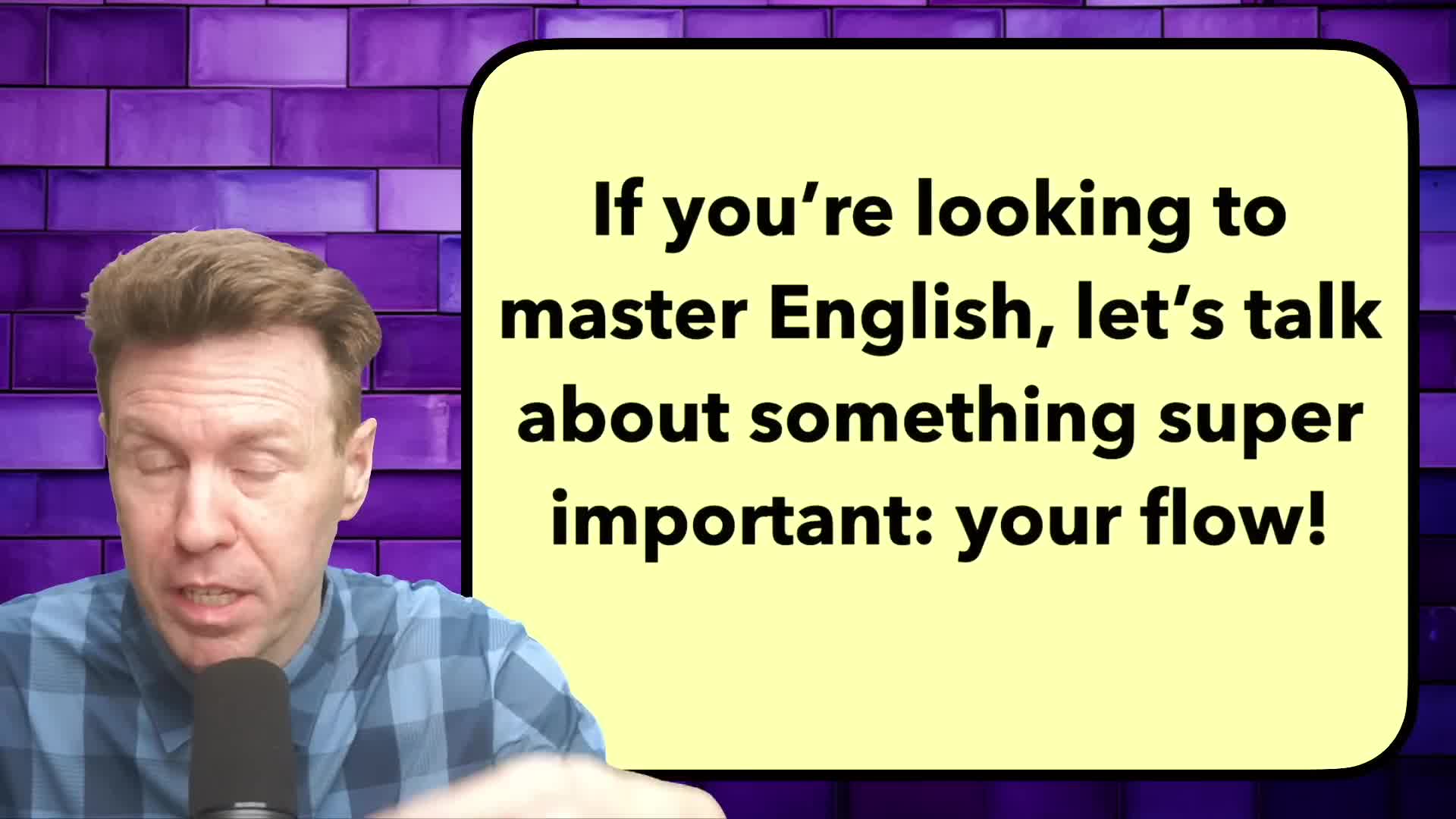
If you're looking to master English, let's talk about something super important.
Your flow.
Flow.
Let's talk about it.
I'm going to say this twice.
Shadow me.
Say it with me.
If you're looking to master English, let's talk about something super important, your flow.
If you're looking to master English, let's talk about something super important, your flow.
So, what does flow mean?
And how can you improve it?
So what does flow mean and how can you improve it?
So what does flow mean and how can you improve it?
First off, let's focus on your pronunciation.
The clearer your pronunciation, the better you'll sound.
Okay, let's say that twice.
Ready?
First off, let's focus on your pronunciation.
The clearer your pronunciation, the better you'll sound.
First off, let's focus on your pronunciation.
The clearer your pronunciation, the better you'll sound.
Flow also includes Getting your sentence intonation right.
And developing a smooth speaking rhythm.
All right, let's say that twice.
Flow also includes getting your sentence intonation right and developing a smooth speaking rhythm.
Flow also includes getting your sentence intonation right and developing a smooth speaking rhythm.
When your intonation is on point, what is on point?
That means very good, precise, just perfect.
When your intonation is on point, Misunderstandings drop significantly.
Misunderstandings drop significantly.
When your intonation is on point, misunderstandings drop significantly.
When your intonation is on point, misunderstandings drop significantly.
Plus, when your rhythm flows nicely, people will actually enjoy listening to you.
Plus, when your rhythm flows nicely, people will actually enjoy listening to you.
Plus, when your rhythm flows nicely, people will actually enjoy listening to you.
To truly master your English-speaking flow, it's essential to develop good listening skills and practice speaking English every day.
To truly master your English speaking flow, it's essential to develop good listening skills and practice speaking English every day.
To truly master your English speaking flow, it's essential to develop good listening skills and practice speaking English every day.
Sure, expanding your vocabulary and strengthening your grammar are important.
But guess what?
Sure, expanding your vocabulary and strengthening your grammar are important, but guess what?
Sure, expanding your vocabulary and strengthening your grammar are important, but guess what?
Grammar isn't the top priority.
When you're talking to someone.
Grammar isn't the top priority when you're talking to someone.
Grammar isn't the top priority when you're talking to someone.
Your main focus should be on your overall speaking flow, including pronunciation, intonation and rhythm.
Your main focus should be on your overall speaking flow, including pronunciation, intonation and rhythm.
Now, you might wonder, How many words do I need to know?
Well, some folks know around 3,000 words.
While others might know 8,000 or more.
Now, you might wonder how many words do I need to know?
Well, some folks know around 3,000 words, while others might know 8,000 or more.
Now, you might wonder, how many words do I need to know?
Well, some folks know around 3,000 words, while others might know 8,000 or more.
But adding 100 new words probably won't drastically improve your communication skills.
But adding 100 new words probably won't drastically improve your communication skills.
But adding 100 new words probably won't drastically improve your communication skills.
If your pronunciation isn't great that can be a real barrier.
If your pronunciation isn't great, that can be a real barrier.
If someone struggles to understand you, They'll have to concentrate really hard just to catch what you're saying.
And that's not ideal.
If someone struggles to understand you, they'll have to concentrate really hard just to catch what you're saying.
And that's not ideal.
If someone struggles to understand you, they'll have to concentrate really hard just to catch what you're saying.
And that's not ideal.
Here's the good news.
If your pronunciation is clear, your accent doesn't matter.
Here's the good news.
If your pronunciation is clear, your accent doesn't matter.
As long as your pronunciation is spot on, Accurate, correct, spot on.
And the listener can understand you.
You're golden.
You're golden.
What does you're golden mean?
That just means you're highly likely to succeed.
You are going to win the gold medal.
Oh, I have to pause this lesson for just a second.
All right, I'm back.
I just now paused the video because my daughter just came home and the doorbell rang.
Okay, where were we?
You're golden.
You're highly likely to succeed.
Let's say this two times.
Ready?
As long as your pronunciation is spot on and the listener can understand you, you're golden.
As long as your pronunciation is spot on and the listener can understand you, you're golden.
Think about it.
If I can easily grasp what you're saying, I won't be nitpicking your grammar mistakes or vocabulary errors.
I won't be nitpicking, noticing all your little mistakes, finding your faults, nitpicking.
Oh, I see a mistake.
I hear a grammar mistake.
Oh, I hear a vocabulary error.
Errors.
We have an S there.
Errors.
I'll focus on you and what you're expressing.
Okay, let's say all of that two times.
Think about it.
If I can easily grasp what you're saying, I won't be nitpicking your grammar mistakes or vocabulary errors.
I'll focus on you and what you're expressing.
Okay, let's try again.
Think about it.
If I can easily grasp what you're saying, I won't be nitpicking your grammar mistakes or vocabulary errors.
I'll focus on you and what you're expressing.
That was better.
When you listen to English, notice the ups and downs in the speech.
That's sentence stress.
When you listen to English, notice the ups and downs in the speech.
That's sentence stress.
When you listen to English, notice the ups and downs in the speech.
That's sentence stress.
We emphasize certain words.
And this is crucial, because stressing the wrong word can completely change the meaning of a sentence.
We emphasize certain words, and this is crucial because stressing the wrong word can completely change the meaning of a sentence.
We emphasize certain words, and this is crucial because stressing the wrong word can completely change the meaning of a sentence.
Adding pauses. and style to your speech is like adding music to your voice.
Adding pauses and style to your speech is like adding music to your voice.
Adding pauses and style to your speech is like adding music to your voice.
Since American English is quite expressive, mastering rhythm is key to building friendships and relationships.
Yeah, you got to master that rhythm.
It makes people feel more friendly and closer to you when you express yourself in American-style English.
All right, let's say that twice.
Here we go.
Since American English is quite expressive, mastering rhythm is key to building friendships and relationships.
Since American English is quite expressive, mastering rhythm is key to building friendships and relationships.
Ultimately, the clearer your pronunciation, the more confident and intelligent you'll sound.
Ultimately, the clearer your pronunciation, the more confident and intelligent you'll sound.
A good intonation minimizes misunderstandings. and a smooth rhythm makes people want to listen.
A good intonation minimizes misunderstandings and a smooth rhythm makes people want to listen.
A good intonation minimizes misunderstandings and a smooth rhythm makes people want to listen.
So, let's aim for that flow together.
When you speak English with great flow, you'll have everyone wanting to hear what you have to say.
So, let's aim for that flow together.
When you speak English with great flow, you'll have everyone wanting to hear what you have to say.
So, now you know.
It's all about flow.
And if you want to grow, you know where to go.
EnglishCoachChad.com is all you need to know.
Practice paradise is the place to develop your flow.
How do you like that poem?
Let's say this poem together.
Emphasize the know, flow, grow, go, know.
All right, let's do it.
Here we go.
Say it with me.
So, now you know.
It's all about flow.
And if you want to grow, you know where to go.
EnglishCoachChad.com is all you need to know.
Practice Paradise is the place to develop your flow.
All right, that's fun.
Let's say it again.
Here we go.
So, now you know.
It's all about flow.
And if you want to grow, you know where to go.
EnglishCoachChad.com is all you need to know.
Practice Paradise is the place to develop your flow.
I'll see you there, bro.
All right.
Woo, that's a long one, huh?
I'm going to try and say it nonstop, see if I can do it without making mistakes.
Probably not.
Anyways, say it with me.
Shout on me.
Here we go.
If you're looking to master English, let's talk about something super important, your flow.
So what does flow mean and how can you improve it?
First off, let's focus on your pronunciation.
The clearer your pronunciation, the better you'll sound.
Flow also includes getting your sentence intonation right and developing a smooth speaking rhythm.
When your intonation is on point, misunderstandings drop significantly.
Plus, when your rhythm flows nicely, people will actually enjoy listening to you.
To truly master your English speaking flow, it's essential to develop good listening skills and practice speaking English every day.
Sure, expanding your vocabulary and strengthening your grammar are important.
But guess what?
Grammar isn't the top priority when you're talking to someone.
Your main focus should be on your overall speaking flow, including pronunciation, intonation and rhythm.
Now, you might wonder, how many words do I need to know?
Well, some folks know around 3000 words, while others might know 8000 or more, but adding 100 new words probably won't drastically improve your communication skills.
If your pronunciation isn't great, that can be a real barrier.
If someone struggles to understand you, they'll have to concentrate really hard just to catch what you're saying, and that's not ideal.
Here's the good news.
If your pronunciation is clear, your accent doesn't matter.
As long as your pronunciation is spot on and the listener can understand you, you're golden.
Think about it.
If I can easily grasp what you're saying, I won't be nitpicking your grammar mistakes or vocabulary errors.
I'll focus on you and what you're expressing.
When you listen to English, notice the ups and downs in the speech.
That's sentence stress.
We emphasize certain words, and this is crucial because stressing the wrong word can completely change the meaning of a sentence.
Adding pauses and style to your speech is like adding music to your voice.
Since American English is quite expressive, mastering rhythm is key to building friendships and relationships.
Ultimately, the clearer your pronunciation, the more confident and intelligent you'll sound.
A good intonation minimizes misunderstandings, and a smooth rhythm makes people want to listen.
So let's aim for that flow together.
When you speak English with great flow, you'll have everyone wanting to hear what you have to say.
So now you know.
It's all about flow.
And if you want to grow, and you know where to go, EnglishCoachChad.com is all you need to know.
Practice Paradise is the place to develop your flow.
What do you know?
I almost made it through there without any mistakes, but that's how it goes, right?
Just working on our flow, practicing speaking English.
Thank you for joining me again today.
Boom, good workout.
English speaking workout, exercising our English speaking muscles.
Let's just keep moving forward together one step at a time, and I will see you in the next step.