keeps the world turning.
This is Roundtable.
You're listening to Roundtable.
I'm Niu Henglin, joined by Steve and Yushan.
In today's day and age, we can just order anything.
We've ordered takeout food, grocery, even manicures at home.
So why not order a sports class?
That's exactly what many families are doing, whether it's a jump rope session in the park or a one-on-one basketball lesson in the neighborhood square.
Sports delivery is making workouts as easy to book as dinner.
But convenience isn't the whole story.
It's also reshaping how kids, parents, and coaches see the role of sports in our daily lives.
Would you order a sports session customized to your needs?
Let us know the answer after listening to today's discussion.
And everyone who has stayed at a hotel knows the drill.
Sign in, get your key card, and leave a deposit just in case.
But this routine has become one of the most contested practices in hospitality.
As more platforms push for deposit-free stays, guests celebrate convenience, while hotels quietly worry about risks.
Here on Roundtable, let's ask the question, is hotel deposit a safety net or an outdated burden?
But now…
For decades, the image of fitness has been tied to gyms, training halls, and stadiums.
Now, that picture is shifting.
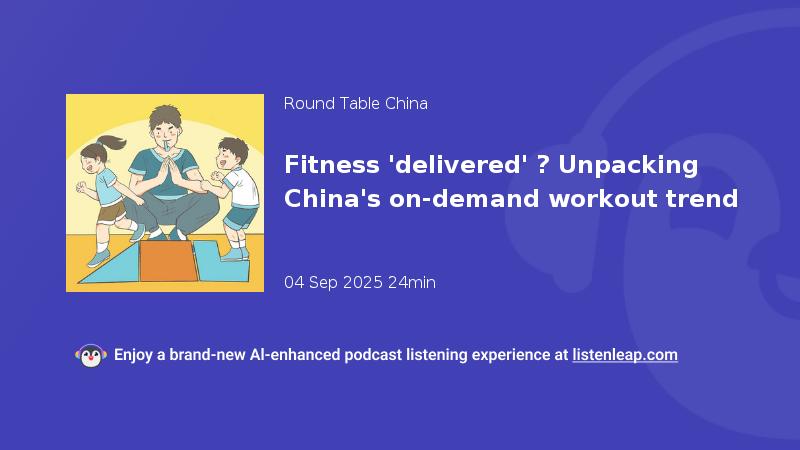
With the rise of door-to-door sports, or what someone calls sports delivery, professional coach-involved experiences has spilled out into parks, courtyards and playgrounds.
What used to demand travel and fixed schedules can now be summoned on demand changing how families approach fitness and even how we think about physical education itself.
But how exactly does it work?
What is a sports delivery?
It's just an idea of borrowing from food delivery, where you can summon any type of PE coach to your doorstep or to any say, venue or yard, backyard or a park that you'd like to meet up.
So that's how the service work, isn't it?
You book a coach through an app or other online channels and, instead of you going to the gym, you expect them to meet where you are at.
So it could be a basketball class in the schoolyard for your kid, or just a fitness session in a park for I don't know, for your elder parents, or personal training in a community courtyard.
So the idea is that any open space becomes a gym and you can do workout wherever you want, whenever you want, with service coming to you.
I had a trainer once I, he had many different clients and he had many different styles of exercise.
He was a great guy.
He and he was very smart and he trained me in a in a gym and But he also had a group class that he would do outside.
And we lived in a very hilly area.
And what he always told his students and even me is that anywhere can be a gym.
You can make use of nature.
And so he would hold these outdoor group sessions.
And I think he would only charge like 10 a session per per student.
That's not bad and they would.
He would have, like you know, 10 people show up to his classes and then they would, they would work out, you know, in the park somehow, and it was kind of a cool in a very successful thing and in a chinese scenario.
Let's just imagine this.
So in the summer morning in nanjing, the city of nanjing in east china's jiangsu province, um Coach Shen Wei, a national level taekwondo athlete and certified physical trainer, he packs up his gear and he take the agility ladder, a yoga mat, maybe a few training cons, and head directly to a nearby sports field and arrive there by 7 am.
He's already running a one-hour session with a 10-year-old child.
A 10-year-old?
That's a very say kind of popular scenario nowadays for parents to book these kind of PE sessions for their kid.
Oh, this is interesting.
Yes, I was about to ask that because you listen to the concept, you find it quite easy to understand.
You order a sports coach like you order food.
It sounds easy, but i have recently talked to someone who is ordering or who is a founder of a platform offering makeup services for people and he used to borrow the idea from uber, for example, that he could organize a platform to link up the makeup artist with the consumer, And the first try was an epic failure because he could not find that many clients.
He could not find that many artists.
And it has a lot to do with the scale of the market.
So I'm curious, what about the scale of the market for the sports delivery service?
Well, on one app, for example, there are thousands of certified coaches that are now offering this door-to-door fitness classes.
And the service has already expanded to over 100 cities all over China nowadays.
And institutions report that 200 to 350 orders per month is how big of a scale the market is nowadays and with peak demand in evenings and weekends.
So some companies, they even handled over 300 classes in one single month.
That's not bad.
Yeah, it's not bad at all.
It can be really good for the clients, too, because a lot of these coaches...
They have sports-related backgrounds.
They could have professional athlete certificates.
They could have physical education teacher credentials.
They could have a basketball coaching license or something along those lines, right?
Also, there are college students who are majoring in some sort of athletics and they're doing this as a part-time thing.
And the experience is really valued.
You said this is really popular with children, right?
So that experience, it really helps kids out because they can manage the kids' emotions better.
They can ensure their safety when they're exercising, too.
You want to make sure that children are doing things in a safe way.
And then some find customers through the platforms and that can help them build their customer base.
And some even find customers and provide classes by other channels, like social media or something like that, taking advantage of those types of platforms.
And I was looking specifically into why parents are remaining to be say, a bigger group of clients within this market.
Is this mainly for children?
It's not targeting children alone, but many children and teens, especially those that's preparing for their say, high school or college entrance examination pe test.
They are the ones that's attending to many of these courses.
You have to take a physical education test to get into high school.
Yeah, that's really fun, because different cities has different say, score levels, i would say.
But to be honest, it's not the kind of test that requires you to get a as high score as you can.
It's more like you can get a full score as long as you practice enough during your school years.
So it's not that most kids would stay in the 80 to 90 range and only the really good ones can get a full score.
It's more like most kids can get a full score as long as you strive for it.
The design of the test.
But this would be a big reason why these types of classes are so popular, because if they've got their tests coming up, their PE tests coming up, maybe a month or two with a trainer to get in better shape might help them out.
And besides that, for you Yushan, for example, if you have the chance to book a PE coach like that, what would be your major consideration, like price, or will it be timely enough, or the professional level of the coach?
What would be the major, let's say, drive for you?
I would consider how professional the person I'm hiring could be.
Because one close example that I can raise from my personal training experiences is that I train our niece, which is a type of say, martial art.
And the teacher that I chose.
I know, before even joining, that he is like one of the best in doing this in the entire city of Beijing.
So I would just have good faith and pay.
However, I need to and train with him with the confidence that I'm learning from the best.
I don't mind hiring one.
Yeah.
But what if I'm asking for something of a higher standard or of a higher professionality that I or other customers do not just have the full faith on students?
I think that is a good point.
But it also explains the market.
Because for me personally, I just need a exercise buddy, someone who would encourage me to continue when I do not want to.
Yeah.
And also someone that is not that pricey.
In that case I can go for the so-called not as professional coaches, but definitely there are a lot of very professional ones that can design specific moves for my special needs.
For example, I want to access more with my arm muscles if I have any.
And also for some others, they want to lose weight a little bit more than want to get stronger.
So these customized goals can be met by this relatively more specialized market.
Yeah, some of the, I mean, the prices will vary, right?
Some of the platforms, you'll find prices somewhere between 300 and 450 yuan per session.
That's between about 40 and 60 dollars.
And I think Those prices would be comparable to what you would pay in a gym for a one-hour session or a 50-minute session with a trainer.
But it really depends.
Some of these private or independent coaches.
They'll charge 200 to 300 yuan per session, which is a little bit cheaper.
It's about $27 to $40.
And then the other, I think, big advantage is that you can pay per class.
Oftentimes at a gym, you'll have to pay for like...
A session, 12, 10 or 12 or whatever.
And the more sessions you sign up for, the cheaper it gets.
But it's still really pricey.
Right.
But with these types of classes, you can pay per class.
So if you just want to try it out and you don't you don't like it that much, or maybe you don't like your coach that much, not the style you are looking for you can simply switch to another one.
Well, it's still relatively a new phenomenon in the Chinese sports market, if I may.
So I'm pretty sure it's not as mature.
So any risks or potential problems we need to address?
Well, you mentioned before about there's different styles of coaches, right?
You could have a national level taekwondo athlete teaching you.
Awesome, teaching you taekwondo preferably, i suppose um, but you know college kids, because it's new, you might, for me it's fine, but for a young kid maybe maybe, so you might want to check qualifications there, a little little background on who that person actually is um, so that would probably be a be a good idea.
There's also safety concerns, because if say, the coaches they are from of say, anonymous platforms with not very clear background, then what if there are uneven agreements made while you're making the order outside of the platform?
Yeah, outside the platform, there are some we call it unqualified trainers or even sometimes like they're not attached to any organization.
Sometimes that can be, it can be an issue.
And also, speaking of safety, there can even be say, external factors, like the place you pick where you're doing the trainings.
What if there are uneven lawns and say hard pavements, Totally unfit?
Well, I mean, it can be okay.
It's just if you get injured.
Yeah, what if you get injured?
Yeah, who's liable?
Yes.
And also with professional stadium.
We know there would be equipment.
There will be professionals, medical professionals helping you.
But in other areas, definitely the consumer or the trainer would have to bear the risk.
But with the industry continue to expand and continue to develop.
Definitely these problems would be solved by supervisors or related departments.
But now for now, those who want to test the water a bit, try the new things.
You have to be aware of the risks and you can dodge the bullet.
What if we combine in the future the two industries? fitness delivery, and food delivery.
So your fitness trainer brings your lunch.
That is so bad.
You train for so hard in fried chicken.
Don't steal my idea then.
I'm going to be the next billion you honor in China.
You will, you will.
Most likely.
Like, why not?
Well, you're listening to Roundtable coming up next.
Should hotel room booking charge deposit?
Don't go away.
Then tune in to Roundtable, where East meets West and understanding is the goal.
It's Roundtable with myself, Niu Honglin, Steve Hatherly, and Yu Shen.
Order takeout, no deposit.
Order a physical trainer, maybe deposit.
Rent a shared bike, your credit score on payment platforms would do.
Stay at a hotel.
Suddenly you are asked to pay hundreds more just to prove you won't steal the hairdryer.
Guests roll their eyes, employees take the heat, and managers quietly count the risk.
Deposits may sound like a small detail, but in today's hotel industry, they have become one of the most emotional topics at the front desk.
So yes or no, let's answer the question before going into the discussion.
Yes or no to hotel room deposit, or you can say I don't care.
Hopefully not, but acceptable if yes.
Very kind customer.
Don't like it, but understand the reasoning for it.
Yeah, sure.
So what conflicts does the hotel deposit typically cause to start with?
Why are some people saying no to hotel deposit when initially it sounds like a reasonable idea?
I mean sometimes, when customers are booking a hotel room, it's not really shown on the online platform, or even told by the hotel staff, that there are any deposits to be charged onto them upon their arrival.
So, upon check-in, if customers just be thorough at one deposit and something that they weren't expecting before the trip, then yeah, of course people complain.
So that's one main reason.
I'll say nowadays here in China, this has become, say, a new norm for many hotels.
Yeah, if people aren't aware, if you're not aware of it right, you're going to feel a little shocked if you're financially not prepared for that moment.
Okay, so let me lay the ground first.
Today, here in China, when we talk about pay the deposit, it's usually in the form of deducting the amount of money you can spend with your credit card first, and then they will return it to you.
So technically speaking, you're not spending the money.
It's just, let's say you have a 50,000 credit or 50,000 yuan credit on your credit card.
You can spend up to 50,000 yuan.
And after paying for a 20000 deposit for your hotel room, By the time that you check out and pay for the exact amount of money that you spend for your rooms, that deposit would go back to your credit card.
So it's not exactly a huge amount of money financially that's been deducted out of your bank account.
Yeah, and it is a deposit.
You get it back, as long as you don't, you know, destroy the room, steal anything or throw a huge party in there and destroy it, right.
But i mean people, and there's evidence of this that people don't don't like it.
Sometimes um again, they don't realize it's happening until they get there.
Sometimes they think it's unfair.
It feels like there's a lack of trust somehow from the customer's point of view, And sometimes the customers can get really upset.
There was even a case in Guangzhou where a guest threw a bottle of water at the staff after being told that he needed to pay a deposit if he wanted to borrow an umbrella from the hotel.
That is a different scenario, though.
Yeah, that's a little... But that would be quite a cheap deposit, I would think.
But it just goes to show you that guests can take this really seriously.
We're not condoning that individual's behavior.
Yeah, and sometimes...
You know, people book a hotel room because they're there to travel where they're going to spend.
So I'm here to relax and spend money.
And this is how you treat me.
You treat me like I'm a threat or like I'm a risk to your property.
Think about if the conversation that took place at the check-in was totally 100% honest, right?
It would be like this.
It would be, hi, I'm Steve.
I'm checking in.
Oh, thank you so much for staying with us.
You have a deposit of $150?
Oh, really?
I didn't realize that.
Why is that?
Well, we don't really trust you.
We don't know your background, so we just want to guarantee in case you do something wrong.
And we feel like there's a chance that you actually will do something wrong.
I get what you're saying.
And also, I think it's partly because nowadays, here in China, less and less scenarios would require you to pay a deposit.
Previously, when we want to use a shared bike, we have to pay deposit first, and then you can pay for one yuan or two to ride the bike for half an hour.
But now, with the credit score on your third payment platforms, you are trusted.
Even without the 100 or 200 yuan deposit, and let alone food delivery services, or if you're purchasing on e-commerce platforms, you do not have to pay deposit, and even when you're paying for the service or the goods, you're paying for a third party.
So it's not that the online shop owner does not trust you.
They would ship you the goods and you can transfer or allow the third party to transfer the money to the shop owner after receiving the goods.
So all these makes people feel like it's a default setting to be trusted.
So in the scenario of a hotel booking situation, people would find it a little bit uncomfortable to be the one who's asked the deposit.
But, that being said, i do have to, on behalf of hotels, share a few of my observations, because previously in china, you will have to wait for the staff to clean the room and make sure everything is there in the room is still there to check out, but that has stopped for quite a long time.
Nowadays, you just give the key card back and you leave, and all the other process is already much, much more smooth.
I think that is um already a gesture from the hotel industry.
With that being said, what are hotels owners perspective on all this?
Are they happy about the discussion Or are they okay with taking the risk?
Well, I think the hotels are doing it for a reason, right?
And one of the reasons might be because of people like me.
When I was a kid, I stole a Bible from a hotel room.
I thought it's for you to take.
No, those are not.
Okay, good.
I didn't take any.
Well, you're an adult, and you still have this question.
I was 10 years old, and we got down into the lobby we were leaving.
I said, look, Dad, I got a new book.
He's like, what?
He's like, where'd you get this?
I said, from the room.
I was under the impression everything in the room belonged to us, and it was available to take.
So that's why I did that.
So, from a hotel's perspective, if other people want to take I don't know The glasses, the robes, that's a really common one, right?
The robe, people will take the robe, the really nice fancy ones.
They'll take pillows sometimes.
Really?
Oh, yeah.
Towel.
No, by the way, that's not me.
My theft experience was only when I was 10 years old.
But yeah, they'll try and take stuff.
Coffee, those little wonderful coffee capsule machines.
So from hotel.
That's why I said in the beginning I get it, because they have to have some sort of protection if you try to take the stuff from the room.
Yeah, and that's just one way of doing risk management for the hotels.
I was kind of chatting about this with my colleagues earlier on that it's not only the fancier and pricier hotels that's doing it, because for them their interior decoration and the environment in general is built for a very appreciable way and maybe one simple lamp or one single drawer is kind of pricey and it's all kind of dangerous and risk-bearing for them if any of their customers they break anything.
So it's gonna cost a lot for them to fix everything and yeah, make him make them everything look like they originally were.
But for say, cheaper hotels or what are those hotels called that are run by individual family owners?
Yeah, B&Bs.
Yeah, for them, it's just, I don't want you to damage my stuff.
Simply out of very simple reasons out of that.
There are some nightmare stories on the internet of people who trashed homes, like B&B homes.
Yeah, really, really terrible stories.
So I guess it takes two parties to improve the situation.
We're already observing the improvement of the checkout experience.
Also in a lot of nice hotels they label it very clearly what you can take with you and what would be charged.
And also they provide really nice, lovely souvenirs for you to take away.
And all these experiences can be more and more common as long as both parties the hotel owners as well as the customers to you know trust each other and respect each other a little more, and that would be a brighter future we can experience in the hotel industry.
And that brings us to the end of today's roundtable.
We'd love to hear your thoughts on today's topics.
Leave us a comment or send us an email to roundtablepodcast at qqcom.
Until next time, keep the conversations going and the ideas flowing.
I'm Niu Honglin with Steve and Yushan.
Thank you for listening.
Bye-bye.