Hey, Joy. Whoa, that's a lot of toys.
These aren't just toys, Em.
They're members of the official Forever Go Fan Club.
See? We've got my Optimus Prime doll, car mechanic Barbie, and of course my President Abraham Lincoln action figure.
Didn't know they made Lincoln action figures.
Oh, you can get anything online.
Anyway, today we're selecting a new president of the fan club, and it's a tight race.
President Lincoln, why should you be the president of the Forever Go Fan Club?
If chosen to be president of the Forever Go Fan Club, I will ensure everyone has a tall, black hat.
Sorry, Lincoln. You can't be president.
I get terrible hat hair.
Ah, chutes and ladders.
Joy, why don't you run for Forever Go Fan Club president?
Joy can't be president.
She doesn't even have a Barbie Dream House.
Plus, her arms and legs are jointed.
What's up with that?
Barbie, I mean, both are technically true but rude.
Anyway, I might be too biased to be president.
I mean, I'm not just a fan.
I also host the show.
If I'm elected president of the fan club, I'll make sure everyone wears pink and has a pink Corvette to drive.
Ooh, I want a free Corvette.
Make mine purple. Free Corvette cars in this economy?
If I win, I promise to ban Mayo from the planet.
Ah, well, I like Chipotle, Mayo, but I also like Corvettes...
Hmm. I'm torn. Yeah, I know who I'm voting for.
All those in favor of Optimus Prime as president of the Forever Girl fan club, squeal!
Eeeee! All these years of learning car maintenance for this.
You're listening to Forever Ago from APM Studios.
I'm your host, Joy Dolo, and I'm here today with Em from Minneapolis, Minnesota.
Hi, Joy. It's election season here in the US, and this year, it's a big one.
We're electing a new president.
In the U .S. we elect a president every four years.
Yeah. Being president seems like a tough job, but it has some cool perks.
The president gets to live in the White House in Washington D .C.
There are so many cool rooms in the White House.
There's a bowling alley and a movie theater.
There's even a flower shop in the basement.
There have also been many presidential pets in the White House.
You've got your classic cats and dogs.
But did you know there's also been an opossum, silkworms, and even a raccoon named Rebecca?
Opossums, silkworms and a raccoon named Rebecca?
Oh my. Wild pets and incredible house features aside, being president is a big job.
It's a huge responsibility.
The president is in charge of the federal government and that's the government for the whole country.
The president does lots of different stuff like enforcing laws passed by Congress.
Putting together a crew of people who are in charge of different departments like agriculture, energy, or education.
And meeting with other leaders from around the world.
The president is also the Commander in Chief of the armed forces, which includes lots of separate branches, like the army, navy, and coast guard. Basically, being president is the biggest government job in the US.
Em, I have a question for you.
Okay. Would you ever want to be president?
Um, I'm not sure I would want to be president.
It just seems like a really big responsibility and, like, really difficult.
It seems like it would take up a lot of your time.
Yeah, it's like you wouldn't even have time for hobbies or pets or anything else.
Like, exactly. Would you ever have, like, a special, like, presidential pet?
I would definitely want a horse or maybe a lot of horses, and definitely my beloved dog Mona.
What kind of dog is Moana?
She's a German Shepherd mix.
Oh nice! How big is she?
She's like really big.
She's also got some mastiff.
Oh wow! She's huge!
Uh huh. Okay, what room would you add to the White House?
Well, I know that if I was the president, I would not be a kid.
But I don't know. I guess like if I lived in the White House, but not necessarily the President, I would add like a big climbing structure.
Oh, like a climbing room.
And yes, like the rope twisting towers and the slides and stuff, I would definitely like to have one of those.
Like a play place. Yeah.
Yeah, that's great.
If I were President, I think the first thing I'd do in office is ban mayonnaise.
But hey, that's just me.
Joy, you're never gonna get the BLT lovers of America to vote for you with that attitude.
Ah, you're right. Maybe I'll just stick to banning mayonnaise from my own fridge.
Let freedom ring! Anyway, back to your regular presidential programming.
In the United States, there are a few rules for who can run for president.
These rules were set way back in 1787, when our Founding Fathers were coming up with a new government.
The United States was a brand -new country back then.
Most people lived on farms and got around on horseback or by walking.
And there were no TVs or phones or computers.
It was a really different time back then.
So back to the rules our Founding Fathers created for who could become president.
First rule, to run for president, you must be at least 35 years old.
35 is such a random age.
It kind of is, but some founding fathers argued that older people might be more mature leaders.
Rule number two, you must be a natural born citizen.
That means you were either born in the US or a US territory, like Puerto Rico.
If you were born outside of the US, but have American parents, that counts too.
And finally, rule number three.
To become president, you must have lived in the US for at least 14 years.
14 is a random number two.
The founding fathers were some random dudes, but the point was, if you're going to be president, you should live in the country you're going to serve and be familiar with its people and government.
That makes sense. So to recap, if you want to be president of the United States, you must be at least 35 years old, be a natural -born citizen, and have lived in the U .S. for 14 years.
Right. Those are the three rules.
You might notice the rules don't say anything about a person's race, ethnicity, sex, gender, or other characteristics.
But even so, for most of U .S. history, every president was a white man.
Until 2008, when Barack Obama was elected president.
President Obama was the first person of color to ever hold that office.
And I remember in 2008 when I went to go vote, I remember being nervous because I was like, oh, it's my first time doing it.
I don't know if I'm going to do it right and where do I take everything?
What district am I in?
And then I remember after I voted being like that really wasn't that big of a deal.
I don't know what I was so nervous about.
Are you excited to vote?
Um, yes, I think so.
I think that's just a really great way of making change in your community.
Yeah, that's great.
Yeah, we should all do that.
So there haven't been any female U .S. presidents yet.
But several women have run for president, including Hillary Clinton and Kamala Harris who's running this year.
Today, we're going to talk about a person who paved the way for these candidates way back in the 1970s.
Someone who did something a Black woman had never done before, run for president.
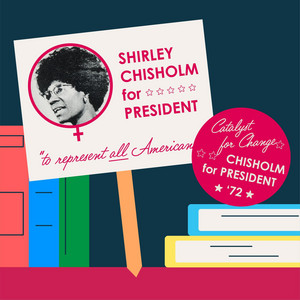
Her name was Shirley Chisholm.
Shirley Chisholm is an icon.
A visionary. I can't wait to talk about her.
But first, let's take a quick break and play...
First Things First!
So this is the game where we take three things from history and try to put them in order of which came first, second, and most recent in time.
Today's three things are famous firsts in women's history.
The first woman to fly in a hot air balloon, the first woman to race in a NASCAR race, and the first woman to win a Nobel Peace Prize.
Okay, um, which do you think came first, which came second, and which came most recently in history?
Oh, this is hard. Mm -hmm.
Wait, was it like a Nobel Prize or a Nobel Peace Prize?
Nobel Peace Prize. Um, that's hard. See, I thought I was kind of an expert on this, but apparently I'm not.
Um, so I think that the first woman to win a Nobel Prize was actually not that long ago, so the first Nobel Peace Prize was probably also pretty recent.
But I would probably say the hot air balloon first. SHHHH then the Nobel Peace Prize and then the race.
Okay, alright, that makes sense so why hot air balloon first. I don't know.
I feel like I've heard of those and they're kind of older.
I mean, like, even like airships and zeppelins and things like that are pretty old.
So like hot air balloons, they're like pretty old.
Yeah! So I kind of thought that would be older, and somehow I wouldn't think that it would take that long for a woman to ride in a hot air balloon.
But I don't know, because there were probably some sexist males who were like, This is too dangerous for the women.
You can't ride in my hot air balloon.
Get out of here with your frilly dress and your hat.
I'm pretty sure that's what they sounded like.
Yeah. And I think it makes sense, Nobel Peace prize, it makes sense that it might have been a little bit more recent.
And then NASCAR, I mean, it's a car.
Yeah. I think that that would be sooner.
You know? Okay. So we have Hot Air Balloon first, Nobel Peace Prize and then NASCAR raise, yeah?
Yes. Great. So we'll hear the answers at the end of the episode right after the credits.
So stick around. We're working on an episode all about jobs that used to exist in the past, but don't exist anymore.
But we want to know what jobs do you think will exist in the future that don't exist today?
And what do you think?
Any ideas about jobs of the future?
I think a space elevator operator because I've actually like read about space elevators they're like a possibility being considered by scientists because they could be like cheaper and safer than like rockets.
Yeah. And I know that there aren't really elevator operators anymore, but I think there would probably have to be an operator for a space elevator.
So maybe a space elevator operator.
Would you want that job?
Yes! I do not, I'm afraid of heights.
But I support your job choices.
You wouldn't have to go up there.
I would just have to push the button on Earth.
Like stay at the bottom, and make sure it's stable and secure.
OK, I can do that. I think I can do it.
I'm still scared but I'm gonna try.
Listeners, record yourself describing what job you think will exist in the future and send it to us at foreverago .org slash contact.
And while you're there, you can send us episode ideas, questions and drawings like me driving a race car.
So keep listening. Brains on Universe is a family of podcasts for kids and their adults.
Since you're a fan of Forever A Go, we know you'll love the other shows in our universe.
come on let's explore Here we are in Brains On Universe Here we are in Brains On Universe Our favorite podcasts Brains On Smash Boom fest 4EVER AGO I found one a -ba -ba -ba -ba -ba -ba Brains On Brains On a science podcast for kids and families Let's start with our pal, the sun. Did somebody call their favorite star?
It's me the sun! The sun is made up of a very, very hot elec Ah, what a great show!
Need more BrainsOn now!
Listen to Brains On wherever you get your podcasts.
You're listening to Forever Ago.
I'm Joy. And I'm Em.
Today, we're talking about the first black woman to run for president in the US, a trailblazer named Shirley Chisholm.
Before the break, we talked about who's able to run for president in the US.
The rules say that anyone 35 or older who was born in the US or US territory and has has lived here for at least 14 years can become president.
That's a huge part of the US population — somewhere around 160 million people.
Even though there aren't any rules about the president's race, ethnicity, sex, or gender, for most of US history, all of the presidents were white men.
And people had a hard time imagining that would ever change.
But in the 1960s and 70s, lots of things were changing.
By this time, most Americans had TVs in their home.
families could gather around and watch rock and roll stars perform like Elvis and the Beatles.
But people didn't have cell phones or the internet in their homes.
The U .S. was trying to be the first country to send a man to the moon before anyone else did.
And across the U .S. there were huge demonstrations, rallies, and protests happening, Many of these protests were part of the civil rights and women's movements.
Americans were demanding equal treatment, regardless of their race or sex, and they had some big victories.
In 1965, the Voting Rights Act was passed.
For many years, there were unfair rules that made it harder for black Americans to vote.
The Voting Rights Act ensured that all Americans could vote, regardless of their race or ethnicity.
A few years later, in 1971, the national voting age was lowered from 21 to 18 years old.
Suddenly, millions of young people were able to vote.
And in all this change, one woman saw an opportunity.
The next year, Shirley Chisholm decided to run for president.
It's a really exciting time for politics because there are all these new people participating.
And she takes the chance.
That's Shala Lynch. She's a filmmaker who made a documentary about Shirley Chisholm.
She loves telling Shirley's story, and we love that she told it to us.
Let's back up to the very beginning.
Way before Shirley decided to run for president.
She was born in 1924 in Brooklyn, New York.
When she was little, she went to live with her grandmother in Barbados.
That's an island in the Caribbean.
Since this wasn't that long ago, we actually have lots of recordings of Shirley herself talking about her life.
Here she is talking about her time in Barbados.
Oh my childhood, I can remember it.
It was exciting. We lived on a great big farm, and we had to take care of all of the animals on the farm, the chickens, the goats, the sheep.
My life, those early years of my life on the island of Barbados gave me the spirit gave to me this funk that was necessary to challenge all of these age -old traditions.
I was never afraid of anything.
I was never afraid of anybody.
And today's the same way, I'm not afraid of anything.
When Shirley came back to live in Brooklyn a few years later, she was held back in school because teachers thought she needed to catch up.
Shirley started acting out in class.
She couldn't sit still and was distracting her classmates.
And one of our teachers said, well, wait, wait, wait, wait, before we, you know, admonish her, let's, let's test her, because I think we, there may be something going wrong.
It turned out that she was very bright and she was bored, and when they put her in her proper class, things ironed out and she was a beautiful student.
She loved school. She loved learning.
Shirley loved learning so much that she decided to become a teacher as an adult.
and she started getting involved in local politics.
Eventually, she decided to run to represent her neighborhood in the New York state government.
Lots of people told Shirley she would never win, that running as a black woman was a waste of time.
Many people thought that America wasn't ready for a black woman leader.
But she did win and started working in state government.
A few years later, she decided to run for an even bigger office, the US House of Representatives.
Voters in every individual state elect people to serve in the House of Representatives, and that group works to pass laws for the whole country.
Again, people didn't think Shirley could win, but she had a strategy.
No one thought she had a chance, but her and her team had done the analysis of who the voters were, and they were women like herself.
So she held coffees all over the district.
In 1968, Shirley Chisholm was the first black woman ever elected to the U .S. House of Representatives, and she said it was about time.
Here's Shirley after she was elected.
How do you feel being the first black woman, you know, in the House of Representatives?
I have mixed feelings.
First of all, I'm very glad to have been able to make history in this country by being the first black woman and boys and girls as far as I'm concerned, and actually, it's overdue.
Here, here. But unfortunately, some of Shirley's colleagues didn't agree.
Some of the other representatives didn't like the change she represented, and they let her know.
One representative in particular couldn't stand that he and Shirley were making the same amount of money.
And he never missed an opportunity to tell her.
Shirley was professional but firm, basically telling him, if you don't have anything nice to say to me, then don't speak to me at all.
And that's what my mama said to me too.
You know, if you don't have anything nice to say don't say anything at all.
And she did great work in Congress.
She helped pass a law so low -income families could afford food, and she worked hard to support students and teachers.
She was also a founding member of a group of Black politicians called the Congressional Black Caucus, which is still around today.
Shirley earned the respect of lots of politicians.
Four years after she was elected to the House of Representatives in 1972, she decided to run for an even bigger office.
The presidency. The first step was to run in the Democratic primary.
The primary is when candidates from different political parties, like Democrats and Republicans, run to be that party's candidate for the presidential election.
Shirley was a Democrat running against other Democrats who hoped to run for president in the 1972 election.
And there were a lot of other Democrats running, over a dozen.
And even though she had done all of this great work in state government and Congress, people did not take her seriously.
Here's Shala again.
I think that that is critical that being able to relay the context of what it was like to be a woman and a Black person in 1972, it meant that everything you wanted to do, somebody was like, no, you are not capable.
Some people even accused Shirley of running just to get famous, But she really wanted to help people, especially working people living in neighborhoods like the one she grew up in.
She supported programs that would end poverty and improve schools.
Here's a clip of her from when she announced she was running for president.
I stand before you today as a candidate for the Democratic nomination for the presidency of the United States of America.
I am not the candidate of black America, although I am black and proud.
I am not the candidate of the women's movement of this country, although I am a woman, and I'm equally proud of that.
I am the candidate of the people of America.
Shirley had to fight all through her campaign.
She got much less news coverage than other candidates, and even had to go to court to be included in a debate with other candidates.
In the end, she came in fourth place in the Democratic primary, which meant that she couldn't go on to run in the general presidential election.
But looking back now, it's clear that Shirley was a true trailblazer.
She inspired all of these people who had not participated in the political process and in the political system to register to vote, to vote, and also to organize her campaign.
The person that stands out the most in terms of that is Barbara Lee.
Barbara Lee was a college student.
She was a young mother and she is at Mills College and Shirley Chisholm comes to speak and says that she's running for president.
And Barbara Lee was like, wow, that's exciting.
How do I connect with your campaign manager?
And Chisholm was like, well, you can be the campaign manager here in this neighborhood, in this area.
Fast forward to today, and Barbara Lee is herself a Congresswoman.
She's been serving in the US House of Representatives, just like Shirley did, for almost 30 years.
That is inspiring. I know.
Hey, Em, what were the rules about who can run for President again?
You need to have been born in the US or a US territory.
Check. Have lived in the US for at least 14 years.
Check. And be 35 or older.
Perfect, I'm 37 1 2, hot diggity dog looks like I'm running for president.
No mayo, all the way -o.
Okay, I need to design some posters and some buttons, we can rework the forever go t -shirts.
I need a really big bus like bigger than you think.
The rules about who can be president in the US don't say anything about a person's race, ethnicity, sex, gender or other characteristics.
Still, for most of US history, only white men were elected president, or even ran.
But in 1972, a black woman named Shirley Chisholm challenged that history and ran in the Democratic primary.
Even though she didn't win, Shirley blazed a trail for other women and people of color to get involved in politics.
This episode was written and produced by...
Nico Gonzales -Whistler.
and Ruby Guthrie. Our editors are Sandin Totin and Shayla Farzhan.
Fact -checking by Jess Miller.
Engineering help from Derek Ramirez with sound design by Rachael Breeze.
Original theme music by Mark Sanchez.
We had additional production help from the rest of the Brains On Universe team.
Molly Bloom, Rosie DuPont, Anna Goldfield, Lauren Humpplant, Joshua Wray, Mark Sanchez, Charlotte Traver, Anna Wegle, and Aran Woldesilasi.
Beth Curlman is our executive producer, and the executives in charge of APM Studios are Chandra Kapati and Joanne Griffith.
Special thanks to Russell Caplan.
And if you want access to ad -free episodes and special bonus content, subscribe to our Smarty Pass.
OK, Em, you ready to hear the answers for first things first?
Yes! OK, so as a reminder, we're putting these three events in order of when they happened.
We have three firsts in women's history today.
First woman to fly a hot air balloon first women to race in a NASCAR race and first woman to win a Nobel Prize And you said hot air balloon first Nobel Peace Prize second and NASCAR race third Yes, yes final answer Okay, M You got it, right.
Wait what? So first up which you were correct was the first woman to fly in a hot air balloon So that was 1784.
A French woman named Elizabeth Thiebaud was the first woman to fly in a hot air balloon back in June of 1784.
And she was just 19 years old.
Back in the late 1700s, hot air ballooning was all the rage and drew big crowds of spectators.
This trend was called balloonomania.
For her flight, Elizabeth dressed as Minerva, the Roman goddess of wisdom and performed opera from the balloon.
and would you ever do that?
Yes, because I like flying and mythology and I love to sing.
I really like to sing.
You better come through with the, I love to sing.
Awesome, we'll have to get more of that later.
So the first woman to win a Nobel Peace Prize was Baroness Bertha von Suttner.
And she was an Austrian writer and activist. And so Bertha won for her anti -war novel, Lay Down Your Arms. The novel went on to be translated into more than 10 different languages and was considered one of the most influential books in Europe at the time.
BERTHA MCCORMACK -LENDOZO Dang.
ALITA Yeah, go on Baroness Bertha.
Bertha is such a great name.
BERTHA MCCORMACK -LENDOZO Yeah, it really is, isn't it?
ALITA Yeah, 1905. It seems like a 1905 name.
So last but certainly not least was the first woman to race in a NASCAR race and that was in 1949.
Huh! Sarah Christian was the first female driver in NASCAR history driving her first race back in 1949.
And to this day, Sarah remains the only female driver to post a top five placement in the Cup Series.
That's interesting.
So you're great at guessing.
You did a great job.
Join us next week for a new episode all about April Fools.
Thanks for listening.
Thanks for watching!