This election season you can expect to hear a lot of news.
Some of it meaningful, much of it not.
Give the up first podcast 15 minutes, sometimes little less, and we'll help you sort it out.
What's going on around the world and at home?
Three stories, 15 minutes, up first every day.
Listen every morning, wherever you get your podcasts.
You're listening to LifeKit from NPR.
Hey everybody, it's Maryl.
So, I am always singing along to music.
And I keep the sound cranked way up, right?
Because it covers me. Even if I'm not hitting the notes, I can still feel like I am.
Like there's this chapel-roan song that I can't get out of my head.
My kink is karma. And my favorite part is when she goes, yeah it's the you, the you, I just, I can hang with chapel on that you.
I'm not at that level. But after listening to the episode you're about to hear, I think I could get a little closer.
And then if I don't get there, that doesn't mean I can't sing.
Or that I'm a bad singer.
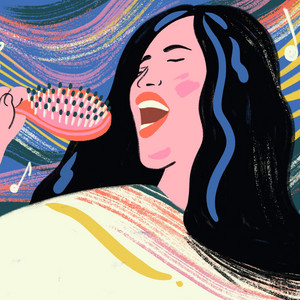
Journalist Asia Drain didn't identify as a singer when she reported this, but she wanted to give it a try.
So, now go, okay, I can do this, okay, I can do this.
She can do this, and I can do this, we can do this, we can sing.
We can get better at singing and figure out what our unique styles are.
Not because we want to sell records or perform at Coachella, but just for the joy of it.
On this episode of LifeKit, how to sing.
Asia is going to step out of her comfort zone and go on this journey with us.
And by the end, we will have more confidence and several voice exercises that we can use to practice.
Support for this podcast and the following message come from Wise.
The app that makes managing your money in different currencies easy.
With Wise, you can send and spend money internationally at the mid-market exchange rate.
No guesswork and no hidden fees.
Learn more about how Wise could work for you at Wise.com.
It's a high stakes election year, so it's not enough to just follow along.
You need to understand what's happening so you are fully informed on November.
Every weekday on the NPR Politics Podcast, our political reporters break down important stories and back stories from the campaign trail.
Do you understand why it matters to you?
Listen to the NPR Politics Podcast wherever you get your podcasts.
This message comes from Chasing Life.
CNN's Chief Medical Correspondent, Dr.
Sanjay Gupta, takes you on a unique exploration of health and happiness.
Listen to Chasing Life wherever you get your podcasts.
Christian Nationalists want to turn America into a Theocracy, a government under biblical rule.
If they gain more power, it could mean fewer rights for you.
I'm Heath Drusen and on the new season of Extremely American, I'll take you inside the movement.
Listen to Extremely American from Boise State Public Radio, part of the NPR Network.
All right, all right. I can hear you all now.
Asia, I don't know. I'm telling you if I try to open these pipes, it's not going to be pretty.
Before we even get into it, I need to burst your bubble right out the gate with take away one.
If you can speak, you can sing.
All we were doing as a singer is we are elongating our natural emotive sounds.
When we're happy, we have a sound.
When we're sad, we have a sound.
And anytime that we're doing things like that, we're actually singing in certain cultures, kind of sing, speak, anyway.
You know, so there's often these entry points that people don't even realize, because they often might think it's a little harder than it is.
That's Trinese Martin Robinson.
She's a PhD in music education, a voice teacher at Princeton and Long Island University, and my vocal coach for this episode.
And if Trinese isn't enough to convince you, oh yeah, we got even more experts to shut down that self-doubt.
That's how we do it at LifeKit.
Joanne Riccowski is an early childhood music specialist.
She's also a former professor at Penn State.
She says, we don't have to leave singing to the pros.
Everybody can do music.
I'm not going to, you know, I play piano, but I'm not going to be a performer with the Cleveland Symphony.
You know, that's not what I do.
And it, but it doesn't mean I can't play piano.
And I'm not going to sing with the met, but it doesn't mean I can't sing and sing with kids and sing with adults and groups.
Because I don't know about you, but I'm not trying to win a Grammy.
I'm just trying to finally work up the courage to go to karaoke with my friends or sing in front of my parents without being roasted.
Plus, if performing is in a motivator, there are a ton of benefits to singing too.
There are emotional psychological benefits.
You release endorphins when you sing.
It can bring you closer to people.
It's an aerobic practice that takes a lot of breath and can increase parts of your immune system.
So there's a lot to gain here.
There are different levels and spaces for you to perform too.
It may be a school talent show, a TikTok cover, or just working up the courage to actually sing at your religious service.
I'm a criminal lip-sinker, which that's a skill for a different episode.
You know, some people might say, what, you know, I kind of feel like I want to try singing, but I'm nervous, you know, I'm shot whatever, singing for you might be just once a week singing along with one of your favorite songs in your room.
That's Nikki Learner, a professional singer and culture coach from Columbia, Maryland.
Nikki was fortunate to have more of a natural aptitude for singing.
And her dream was to perform on a big scale, but singing isn't a zero sum activity.
There's a spectrum of spaces for you to share your voice and in different ways.
Some people say, oh, I think I'm going to try singing and then I'm going to, you know, put this out on YouTube.
Now, I mean, you know, for many people, they need to do that, but that's a lot of pressure.
Right? That's a lot of pressure to go from, I never sing to, now I'm going to share it with the world, you know, or at least the 15 people that will watch it.
Just start doing it and get in practice.
You know, if there's a choir that's local in your community, join a choir, join a community choir, join an ensemble, you know, with people who are just singing for the fun of it.
Just start to get into the practice and the habit without all that pressure.
The right space can make a big difference.
We're already taking a big step doing something new, so as you're learning, you want to make sure you're putting yourself in a comfortable space.
Now that you're comfy, what do you want to achieve with singing?
Visualize it. Okay, got it?
Good, because now we're getting to work.
Take away, too, is practice stretching your speaking voice to your singing voice.
Okay, I can do this. Good.
Now, I want you to do it again and I want you to be over the top exaggerated.
Okay, I can do this. Okay, I can do this.
Yep, that's me with Trinese trying my dandas to sing.
This exercise is meant to stretch my speaking voice into my singing voice.
Try it for yourself. I don't know why, but it's like singing is the only instrument that people don't allow themselves to not be as good at right away.
You know, if you're starting a violin, you're going to expect certain interesting notes to come out.
But for some reason, we're not forgiving of ourselves when it's time to start singing.
So the first step is mental.
It's to say, I can do this.
Give yourself permission to try and honestly, give yourself permission to be bad.
Y'all heard me? I'm not even close to Nermani, but that's not the point.
When you start anything, you're not going to be great at first.
So now go, okay, I can do this.
Okay, I can do this. Trinese is teaching me how to match pitch within my natural range.
She plays the notes, sings it for me, and I just focus on her.
If I was on my own, I could play a piano or an app and try to hum or sing those notes.
Perfect. Do it again. Okay.
Okay. I can do this. Okay.
I can do this. You can probably hear the nervousness in my voice, but I'm still matching the tone of Trinese.
Progress is progress. I just have to start believing the mantra I'm singing.
Then we're just going to take it up.
Okay. I can do this. Okay.
I can do this. Good. Very good.
So you're already singing.
We don't know. We can't translate it in everything.
This exercise serves a dual purpose.
Of course, I'm matching pitch, but the phrase okay I can do this is a positive affirmation.
I'm sing reciting. Sing siding?
Either way, it's helping me relax and get more excited.
Excitement that helps to push my voice into singing.
That as I'm sure you found after exploring more of your natural voice, you may want to push the boundaries of what you can sing and take it to the next level.
That's great. But that process, flipping your register and exploring your range can be tough.
Take the happy birthday song.
You know that part where everybody goes flat.
They're not tone deaf. They're singing the beginning in tune.
But they have to lift their voice out of that speaking register to get the happy birthday.
And you're not going to do that if you're within that register that is lower.
That's Joanne again. Think about this register flip like taking a step up.
We already did it a bit with Trinese with elongating the sound.
Then transitioning to more singing-ness.
However, when I'm trying to see how far my singing range is, it gets tricky.
When I start low and try to sing higher and higher, it feels tight in my throat.
I'm not quite sure if I'm actually going as high as I can.
Start higher and come down.
Don't start with your speaking voice because you'll hit that ceiling and you won't get past it.
So if you start scales from the bottom of your range, your voice might stall out sooner and you won't actually hit the tippy top.
Joanne's top down approach allows you to hit the highest point first so you can see the full expanse of your range.
So practice by starting from a higher note and go down the scale.
It might sound something like this.
If you're still getting in your head, that may be from a disconnect with the voice you have versus the voice you want.
That leads us to take away three.
Find your own singing style or personality.
I have found that the people that have the most difficulty bridging the gap between where they sing and when they speak are the people that have really, really big differences in where they want to sing pitch-wise.
But the challenge and the issue is a lot of times people would a certain natural personality.
They'll say no, I want to do this Broadway wicked.
Defying gravity all of it.
It's critical for your confidence and to stay motivated in the process to find your own sound.
You may be tempted to mimic Mariah Carey, but that'll just be discouraging.
Now you're into identity theft.
Like you don't want to go steal other people's identities.
Like let Beyonce be Beyonce.
Pray let Billie Eilish be Billie Eilish.
Let whoever be whoever.
That's their identity.
It's important for us to be able to say and what do I sound like.
Who would have thought singing would be a practice of self-acceptance too?
This process of self-acceptance is helping you establish more awareness about where your voice is.
And the more awareness you have, the easier it is to channel yourself and your emotions into your singing.
With her expertise, Trinese developed soul ingredients, a unique methodology which can help guide you to the style that best fits your personality and natural voice.
And it stems from how do we teach voice from a scientific level but yet be still true to the person?
How do we express you? How do we identify who you are?
How do we music your personality?
Right? And when you find that voice, it's so special.
I was elated to feel my walls come down and to lean into what I already had.
Because as she constantly affirmed as we practice, I'm wonderfully made.
Oh, I know, oh, I know, oh, I know, oh, I know, oh, I know.
My voice is more animated now and I'm still matching pitch.
You can hear me translating excited speaking into singing.
And how do you feel? I feel pretty like jazz.
I got a little boost. Earlier, the, okay, I can do this exercise really helped me relax.
So as I'm doing this new warm up, it's a lot easier.
Before my voice was a little strain because I was nervous and it made me tight.
Lucy Goosey is the key here.
You're like, I'm doing this.
I'm doing it. Okay. I can do this.
You can do this. You are wonderfully made.
All you need to do is open it up.
And you can do it too. Try speaking more musically or over the top.
And let that slide naturally into elongating your speech and into singing.
So after all that exploring to get comfortable with your voice, we've arrived at takeaway four.
Tune your instrument often and remember to breathe.
Practice, practice, practice will help you improve and build your confidence too.
And there are a lot of small steps you can take to start to hone your craft.
It might sound obvious, but open your mouth.
The mouth is coloring it and shaping the sound.
The tongue position is shaping the bow zone.
A, E, I, O, O, right? It's shaping the sound.
So the more space that you have in your mouth, the easier it's going to be to let the sound come out.
And I often find that that is a major barrier.
Remember as you practice, especially alone without guidance, it's hard to visualize how your voice is changing.
Don't get discouraged.
The difficulty about the voice is you can't see it, right?
If I'm playing the violin, I can see where my fingers are.
I can see what I'm doing.
But the voice we really can't.
And so you have to, it's kind of a head game where you've got to first focus on, are you getting a nice good breath?
That's Joanne again. With the important reminder that when all else fails, go back to breathing.
And actually, if you lay on your back on the floor, you breathe properly.
When I often tell people that they're singing to take a breath, they raise their shoulders.
Well, that doesn't do anything.
I mean, your lungs aren't there, right?
All it does is create tension.
So it's really filling up.
And I tell them to think about filling up their lower body like a balloon.
So you're filling that up like a balloon.
And then the first thing to start is pushing that air out from the bottom, from your belly, up out through your lungs, out through an open mouth, which is just like an open tube.
And in that tube are these little rubber bands, your vocal cords that are vibrating as air goes past when you're trying to make sound.
So when in doubt, take a deep breath, make some sound, and imagine those rubber bands in your throat.
And if it's hard to process too many things at once, record yourself and listen back to hear how you sound and adjust as needed.
There are so many ways to practice.
You could do daily vocal warmups on YouTube.
There are piano apps to help you match pitch.
If you're really serious and want to invest, you can work with a vocal coach.
Or if you need social motivation, local choirs can take the pressure off of singing alone, and also you'd be learning in a group.
Practice will get your voice in shape.
And to keep your voice in shape, taking care of your body is essential.
From the most basic level, just take care of your body, get rest, hydrate.
Things that normally you need to do to keep your body at an optimal level.
And also have fun, I guess.
That's the go-to. Enjoy the process.
Enjoy the process. Singing really does involve mind, body, and spirit.
Your practice can look like whatever you want it to.
And when it all comes together, that's when the real fun begins.
Love pursues, changing everything I thought I knew.
Finding strength again, I've been renewed.
And how comes life, and healing flows, pressing through my pain, it's peace I know.
Reaching for a love I can't refuse, because love pursues.
That's Nikki again. But this time singing her song, Love pursues.
When I was searching for an artist who embodies their full selves and their songs, Nikki was the first person I thought of.
Whenever I sing or want to stage or in front of people, that I'm fully invested, fully connected to who I am as a person.
And that is such an incredible feeling to have.
I actually think it's one of the best reasons why anybody should start singing or to start to discover their voice.
That leads us to take away five.
Singing is a gateway to ourselves and to others.
As I hope this episode has shown you, singing can be so much more than just training your vocal cords.
It's a practice that invites exploration, self-reflection, and also connection.
I mean, creating music or any kind of art form with other people is in and of itself a community builder, right?
Because there's so much that goes into that moment of creation.
There is humility, there's creativity, there's collaboration, there's negotiation, there is a sense of push and pull.
There's all of these things that happen in deep relationship that builds deep community when you make music with other people.
Whether that's in a band, a choir, or a bunch of friends singing karaoke together, music fosters deep community.
I've learned so much about my voice, my goals, and who I am.
I've built confidence and I've gotten to connect with wonderful people along the way.
People who can't wait for you to glean the benefits of singing too.
It's just frustrating to me how so many people lose out on the wonderful opportunity of singing because they think they can't.
And that's not true. That's why we're here.
That's why we're here. I started this episode with a pretty negative mindset.
I'm not a singer, but I am.
I'm not a professional, but I know how to express myself through sound and music, and there's so much beauty and value in that.
Let's recap. Take away one.
If you can speak, you can sing.
Take away two. Practice stretching your speaking voice to your singing voice.
Take away three, find your own singing style or personality.
Take away four, tune your instrument often, and remember to breathe.
And take away five. Singing is a gateway to ourselves and to others.
Singing is powerful, and it's so accessible.
You are, when I say you are wonderful, I mean you are wonderful.
We already have the ability.
It's more just unlocking the potential.
It's all about you. And if you want to sing, you can.
And the great words of Natasha Beddingfield, release your inefficient feel the rain on your skin.
No one else can feel it for you.
Only you can let it in. No one else.
I forgot the rest of the words.
That was a reporter, Asia Dream.
For more life kit, check out our other episodes.
We have one on how to give a toast, another on how to make a great playlist, and lots more at npr.org slash life kit.
And if you love life kit and want even more, subscribe to our newsletter at npr.org slash life kit newsletter.
Also we love hearing from you, so if you have episode ideas or feedback you want to share, email us at life kit at npr.org.
This episode of life kit was reported by Asia Dream and produced by Andy Tagle.
Our visuals editor is back Harlan, and our digital editor is Malika Garib.
Megan Kane is the supervising editor, and Beth Dottamann is our executive producer.
Our production team also includes Clameration Eiter, Margaret Serino, and Sylvie Douglas.
Engineering support comes from Ted Meabane and Valentina Rodriguez Suchis.
I'm Mary Elsigara. Thanks for listening.
New from the Embedded Podcast.
I hear about a clerk at the House of Representatives of the 113rd Journal of Symbolism, say 10 minutes.
What happens when three moms set out to change the way state politics work?
We are smart and we are swift.
We are not going anywhere.
Listen to supermajority from NPR's Embedded and WPLN.
All episodes out now. Here at Shortwave Space Camp, we escape our everyday lives to explore the mysteries and quirks of the universe.
We find weird, fun, interesting stories that explain how the cosmos is parting all around us.
From stars to door planets to black holes and beyond, we've got you.
Let's now to the Shortwave Podcast from NPR.