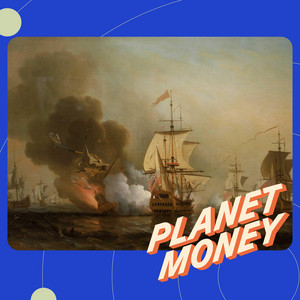
This message comes from Capital One.
Banking with Capital One helps you keep more money in your wallet with no fees or minimums on checking accounts.
What's in your wallet?
Terms apply. See CapitalOne .com slash bank for details.
Capital One N .A. Member FDIC.
This is Planet Money from NPR.
Ten years ago, Mike Purcell was on one of his missions.
On a ship in the Caribbean Sea off the coast of Columbia.
And for about a week, every night, he had been sending out his autonomous underwater vehicle to search the sea floor.
I bet if you go along that coast of Columbia every four miles, there's a ship.
A sunken ship. This autonomous vehicle that Mike helped develop is like a little underwater drone.
It would scan the bottom of the ocean and record whatever it came across.
And one day, it came across a very, very big object.
Yeah, we see something in the sonar that is a possible, yes.
A possible, yes. Mike gets called in for all kinds of jobs like this.
He was once asked to find Amelia Earhart's plane.
No luck. Another time to locate this Air France plane that went down between Rio de Janeiro and Paris.
That one, they did find.
This time, a private group and the Colombian government wanted his help finding a 300 -year -old shipwreck that was the stuff of legend.
The Spanish galleon, the San Jose.
It was one of the most famous shipwrecks and maybe the most valuable one of all time.
To investigate, they sent the drone back down to take pictures.
And when the images came back up, Mike and his team crowded around this one guy's desk to see what they'd found.
Yeah, we're down in this pretty old ship in this room that's big, probably smaller than your closet.
He's at his desk here and we're just looking at it and I'm behind him looking down at the pictures.
And as they look at these grainy, black -and -white underwater images from a few meters off the seafloor, they start to make things out.
There is part of the hull, the wood hull.
There's a hundred teacups sitting on the surface.
A hundred teacups just lying there nestled into the sand next to the fish and crabs.
Well, we saw cannons, we saw the anchor.
We started taking the pictures and put them together like a little bit of a mosaic.
You can see an outline of the ship.
And they see, no joke, a bunch of gold coins.
I feel like my image of what a shipwreck looks like is literally that, like a chest with gold coins spilling out of it.
Yeah. You're telling me that's actually real.
That's actually what the picture showed you.
Yeah, well, they weren't really spilling out.
But they were there.
Maybe not in a chest, but scattered about the seafloor.
Mike and his team were pretty sure this was the San Jose.
We found it. We knew we found it.
The San Jose was a Spanish galleon that sank in 1708 with billions of dollars worth of gold and silver and teacups aboard.
They sent the big news back about a week later when they returned to port.
They were told they had a visitor.
Then the president and everything, they came on board and we chatted with him briefly about finding it.
Wait, you chatted with the president?
Of Columbia, yes. Was he so excited?
Yeah. He was very happy he was found.
There's no doubt about that.
This was 10 years ago, and that shipwreck is still sitting on the bottom of the seafloor.
Because while the Colombian government is clearly invested in this ship, they are not the only ones.
The battle that sank the San Jose was fierce.
And so is the battle over who deserves control of its shipwreck and all its billions of dollars of treasure.
Maybe it turns out to be $20 billion, maybe it's $5 billion.
I don't know. But it seems to me that they're lining up to fight over who gets it.
So, who will make out in the end here, I'm not sure.
Are you in line? Do you have a seat?
All I want is a teacup.
Just a teacup. Hello and welcome to Planet Money.
I'm Erika Beres. And I'm Mary Childs.
So the San Jose shipwreck was found.
But it is not clear who it actually belongs to.
Turns out shipwrecks with billions of dollars worth of stuff on them can get pretty confusing and contentious.
Colombia, Spain, American financiers, South American indigenous groups.
Everyone wants a say in what should happen to the San Jose.
And because the laws that govern this stuff can overlap and the jurisdictions can be so murky, every single group kind of has a valid argument.
Today on the show, the fight for the San Jose.
What one 300 -year -old shipwreck can teach us about just how hard it is to untangle the legacy of colonialism.
this message comes from green light ready to start talking to your kids about financial literacy meet green light the debit card and money app that teaches kids and teens how to earn save spend wisely and invest start your risk -free trial at greenlight .com slash npr this message comes from apple card
if you love iphone you'll love apple card it comes with the privacy and security you expect from apple plus you earn up to three percent daily cash back on every purchase, which can automatically earn interest when you open a high -yield savings account through Apple Card.
Apply for Apple Card in the wallet app.
Subject to credit approval, savings is available to Apple Card owners subject to eligibility.
Apple Card and savings by Goldman Sachs Bank USA, Salt Lake City Branch, member FDIC.
Terms and more at applecard .com.
To Colombians, the ship that Mike Purcell found plays a huge role in the country's cultural imagination.
To them, it was another El Dorado, the lost city of gold.
The great Colombian author, Gabriel Garcia Marquez, even wrote about the ship.
In Love in the Time of Cholera, one of the characters wants to recover the San Jose so the woman he loves can bathe in gold.
I quite frankly thought it was a legend.
This is Juan Manuel Santos.
So I really didn't give that importance to the San Jose until we found it.
He was the president of Columbia from 2010 to 2018, the one who shook Mike Purcell's hand after they found the San Jose in 2015.
President Juan remembers vividly when he found out that Mike's team had located the shipwreck.
The minister called me and woke me up.
And when I said, listen, I think it's two o 'clock in the morning.
Oh my God, Mr. President, I'm so sorry, but I have good news.
And she told me. How did you feel at that moment?
I thought, my God, God is on our side.
And I started to say, how are we going to rescue it?
How are we going to sell it to the world?
Also, the type of legal fights that we were going to have.
He could see the legal fights coming.
But President Juan, he was pretty confident that Colombia would win those fights.
Because for years, people had been beating down his door, trying to work with the government to search Colombia's waters for the San Jose.
Finally, one group got through, the group that Mike Purcell was working with.
And they made a deal to work together and find it.
And then they could figure out what to do with whatever profits.
And then they found it.
So President Juan says it's theirs.
That's how it works.
I remember because I studied, worked and studied in Great Britain.
And I'm not a lawyer, but I remember.
I'm not a lawyer, but I remember something from the British law that the British had always applied that principle that said finders keepers.
So if you find it, you keep it.
So I'm going to apply that law to the galleon.
Finder keepers, the galleon is ours.
Okay. So you're already doing all these machinations in your head.
Yes, yes, yes. I mean, I didn't sleep that night.
And finders keepers is a legitimate legal argument.
It's called the law of fines.
If someone finds a shipwrecker cargo, they have the rights to it, so long as that thing was abandoned.
And Colombia did find it because Mike Purcell and his autonomous underwater vehicle, his group was working with the Colombian government.
And the San Jose has been sitting at the bottom of the sea for over 300 years.
That sounds abandoned.
Now, the law of fines mostly applies to ships found in international waters.
This ship was in Colombia's territorial waters.
And according to the UN's Convention on the Law of the Sea, countries have some jurisdiction over a certain area off their shores and over the removal of archaeological and historical objects found in there.
Not long after he heard the news, President Juan gave a speech standing at the naval base in Caltajena about how Colombia was bearing witness to one of the greatest discoveries in the history of humanity.
President Juan is no longer the president, but he says the nation wants to go from 13 years ago when this program was being expanded.
The training video?
We see an American flag, the Constitution, the Statue of Liberty, more American flags.
As a law enforcement official, you've taken a noble and honorable oath to protect and serve.
This video was made for local law enforcement agencies, you know, like police departments.
And it was made by the Department of Homeland Security, or DHS, because under this new program, those local police departments were suddenly a big part of this national deportation effort, Secure Communities.
First of all, what is Secure Communities?
Very simply, it is an initiative to help DHS identify removable aliens arrested for crimes.
Under Secure Community...
Ricardo says the San Jose was a state -of -the -art ship.
Fue un buque de guerra y de transporte muy adelantado.
With dolphins? Ricardo says the San Jose was a state -of -the -art ship.
Fue un buque de guerra y de transporte muy adelantado a su época.
would automatically be sent to an ICE office, you know, Immigration and Customs Enforcement.
And that ICE office would run the fingerprints through there.
It says it had all...
This person might be eligible for deportation, and then if they might be eligible for deportation, it was a global superpower.
And the route the San Jose took was iconic.
You would have to hold the person they just arrested until ICE could arrive and see if it is the maritime network that can toll for deportation.
So yeah, the message from DHS to local law enforcement was this doesn't really change anything you do.
We'll make it a period when Spain helped to establish this global network of trade.
Because you have taken an oath to uphold the Constitution.
You also act as a guardian of civil rights and liberties.
Thank you for taking the time to watch the video today.
hit the ship's powder reserves.
So, boom, the ship sank, along with nearly 600 men.
Which makes this shipwreck site a Spanish war grave.
This ship was never abandoned, Spain says.
It's theirs. And that is why they also have a claim to the San Jose.
The San Jose was flying the Spanish flag when it sank.
And warships generally have something called sovereign immunity, which means they fall under their country's jurisdiction no plans to use this exact program.
But Trump did use a version of Secure Communities during his last term.
And Chloe says it seems clear he's already approaching immigration and deportation in a similar way, leaning on local law enforcement to be part of it and trying to expand the list of crimes that can get someone deported.
And similar to the 2000s, Trump has justified mass deportation as a safety issue in national history.
It's like a time capsule from the day it sank.
American workers. And this American workers justification, this is what Chloe East has specifically been studying.
What do people generally assume is going to happen to U .S.
citizens when people are deported?
Yeah, so if you just sort of take the simplest economic supply and demand diagram, If you vote, all of a sudden remove people from the labor market through deportations, we think that the supply goes down and that increases the wages for workers who are left behind, which should be primarily galleon bus
and work. It had brought its own school case based on a diagram of.
Did put in the public statement that the score increased jobs and wages for foreign workers.
The other assumption that is embedded in that simple demand diagram were that all workers are interchangeable.
So if we remove one worker without authorization, that U .S.-born workers will just simply slot into the jobs left behind by that unauthorized worker.
In economics terms, that model assumed his people without legal status act substitute for American citizens.
And Chloe says that is a pretty big assumption that can be hard.
Tata Samuel, Pesacruz.
In Bolivia. Which he says is in the jurisdiction of the indigenous Sarakara nation.
But not in another place.
He says once the San Juegos community started, it was pretty beautiful.
of deportation. The movie title didn't just come out.
He says political theories about it.
Own of those odd views on immigration defense.
Lo Jose. Enforcement worked.
That just sort of done automatically.
Have a connection. And people.
He says a lot of the silver sold on the ship came from their land.
De Potosí. Potosí is home to mines.
Or old. And one of the used to study the largest silver 17 Potosí.
Tata Samuel He became kind of obsessed with these things.
He says his nesting had documents dating back to the 1500s.
A whole lot of silver and gold that was mined by his ancestors.
Possibly the same coins that Mike Purcell spotted scattered about the sea floor.
The circumstances under which it led to fewer jobs for U .S.
citizens. We find that for every 13 fewer unauthorized immigrants who are working in a local labor market, that leads to 10 fewer U .S.-born workers who are working in that same labor market.
OK, that seems very dramatic.
Right. That's a big effect.
It is. So why? Why might that be happening?
Well, Chloe says there are two main reasons.
Reason number one, simply when a bunch of people are removed from an economy, when they've been deported, this has an economic impact.
Unauthorized immigrants, as everybody does, go out to their local restaurant.
They get haircuts. They shop at the grocery store.
Unauthorized immigrants also pay sales tax.
Many of them pay various types of income tax.
And all of that helps to stimulate local demand, which also helps to create jobs for everybody in the community, including U .S.-born workers.
And this isn't just about deportations.
Chloe says secure communities likely also had a chilling effect.
You know, people would have stopped working, didn't want to leave their homes or maybe even left the U .S.
completely. All of that would be a hit to the local economy and would cause a drop in jobs for U .S.-born workers.
This is exactly what we saw happening in the Little Village neighborhood in Chicago.
But reason number two, most U .S.-born workers and unauthorized workers do not seem to act as substitutes in the real world.
When you deport someone who doesn't have legal status in the U .S., that does not mean a U .S.
citizen is going to take that job.
Unauthorized workers take the jobs that actually help create more jobs for U .S.-born workers.
So having more unauthorized workers who are willing to take lower paid, more dirty, more dangerous jobs actually helps to create jobs that are complementary to those that U .S.-born workers take.
She means complementary in the economic sense.
Complements are goods or services that are used together, as opposed to substitutes, which essentially compete with each other.
The way Chloe puts it in her paper, their findings from the Secure Communities Program suggest that many immigrant workers are compliments to citizen workers instead of substitutes.
So if you think about like a construction company that's writing a contract to build a new building or to do a remodel, in order to hire a...
One support, meeting you where you are through all of life's changes.
Because what matters most is living a life you love.
Let's find your rich together.
Edward Jones, member SIPC.
Free to the construction site manager.
Or take a restaurant.
If a restaurant can't find anyone to bus tables, they will hire fewer waiters and waitresses.
And those jobs are typically taken more often by U .S.-born people.
Okay. So let's say we're running this restaurant and the unauthorized workers are not there anymore because they've been deported.
Why won't I just offer more money to just pay citizens to work and bust the tables?
I could just make it a better job.
Right. That is what we would expect to see in economic theory.
That kind of gets back to the basic supply and demand diagram.
That is not what we see happening in reality.
We don't see any evidence that employers are offering higher wages.
We don't see any evidence that U .S.
born workers are getting higher wages.
Chloe is not the first person to use a big deportation to try and study this stuff.
There is a paper looking at the late 1920s and early 1930s where hundreds of thousands of people from Mexico were repatriated out of the United States.
And there was another paper that looked at a time in the 1960s when a change in immigration law resulted in half a million seasonal workers disappearing from the U .S.
labor market. Both of those studies came to basically the same conclusion as Chloe's, no positive impacts for U .S.
workers. After the break, how all of this economic theory is playing out in the real world.
Right now, the chilling effect in action.
this message comes from apple card if you love iphone you'll love apple card it comes with the privacy and security you expect from apple plus you earn up to three percent daily cash back on every purchase which can automatically earn interest when you open a high yield savings account through apple
card apply for apple card in the wallet app subject to credit approval savings is available to AppleCard owners subject to eligibility.
AppleCard and Savings by Goldman Sachs Bank USA Salt Lake City Branch, member FDIC.
Terms and more at AppleCard .com Support for NPR and the following message come from Edward Jones.
What counts most to you?
Maybe it's spending more time with the ones you love.
Or maybe it's doing more of what you love to do.
The key to being rich is knowing what counts Edward Jones' dedicated to be anew Yeah, the public transmission has started microphone please.
Last year more than 40 years after they say they found the San Jose they took their case to the permanent court of arbitration.
This is the first. Find your rich together.
Edward Jones member SIPC.
Support for this podcast and the following message come from Sutter Health.
Whether it's prenatal care or postmenopausal guidance Sutter's team of OBGYNs, doctors and nurses are dedicated to building long -term relationships for lifelong care.
With personalized care plans for every patient, it's their commitment to supporting every woman at every stage of her life.
Learn more at SutterHealth .org.
Here in Chicago's little village, there's this restaurant that's been around since the 70s.
It's one of those places that everyone says to check out.
Nuevo Leon. The best Mexican food.
It was opened by an immigrant.
Always a scene. We got there, and it was this big, beautiful mural building.
It had this big marquee sign out front with these light bulbs that sounded like they were about to explode.
So we went in, and it quickly became clear to us that this one restaurant is a microcosm of all the things that economist Chloe East had described.
Laura Gutierrez runs this restaurant.
Her dad opened it back in the day.
Do you have some time for us?
A couple minutes, not much.
Okay. Should we do it here?
Okay. She joined us at a table for her couple minutes, and we asked her, what has it been like the last few days?
What has it been like?
Turmoil. Everything upside down.
People don't know what to expect.
I'm looking around, and it's lunchtime.
It's, like, noon right now.
And this is a very big restaurant.
we're in, but there's maybe 170 people, 170 people.
I do not see 170 people in here.
And what you, when you came in, you were the only table.
We were the only ones.
Is this typical? No.
Even in zero degree weather.
It's not typical. The cold doesn't stop Chicago.
We live in the Windy City.
We've been here for 47 years.
I've been cutting the shift down.
We've been down to one shift a day.
People are losing. Taxes, revenues, everybody's going to take a loss on it.
You said that there's only one shift this week?
That's our producer Willa Rubin.
Why only one shift?
Theirs has a claim.
Colombia and the group that financed Mike Purcell's voyage.
Spain, the Caracara Sea Search Armada.
Because since the San Jose sank in 1708, power has shifted so much.
The way we think about it feeling somehow still kind of cautiously optimistic.
We'll see where this prevails.
Our president, he's a businessman.
I have faith. I don't think he's going to want to hurt the economy vastly.
If you pull out people from the community like that, you will have the USA in shambles.
Our couple minutes with Laura comes to an end.
She leaves our table and heads back to work.
Have a blessed one, guys.
Thank you. After we left Chicago, we checked back in on Little Village.
It's been two days since our visit and still no raids as of this recording.
Today's episode of Planet Money was produced by Willa Rubin with an assist from Emma Peasley.
It was edited by Kenny Malone.
It was engineered by Sina Lafredo and fact -checked by Sierra Juarez.
Alex Goldmark is our executive producer.
I'm Erica Barris. And I'm Amanda Aronchik.
This is NPR. Thanks for listening.
Learning uses advanced algorithms to give the right help to each kid, no matter the age or personality.
Get an exclusive 20 % off IXL membership when you sign up today at IXL .com slash NPR.
This message comes from Tourism Australia.
No matter what you're into, Australia has something for everyone all year round, like the Daintree Rainforest this spring, Melbourne's music scene in the summer, and the wineries of Barossa Valley in the winter.
Come and say g'day.
more at australia .com support for npr and the following message come from ixl learning ixl learning uses advanced algorithms to give the right help to each kid no matter the age or personality get an exclusive 20 off ixl membership when you sign up today at ixl .com slash npr 20 off ixl membership when you
sign up today at ixl .com slash npr