This message comes from Stamps .com.
How much is an hour of your time worth?
Whether you're a realtor, lawyer, accountant, or even a content creator, Stamps .com gives you the ability to focus your time on what you do best, not on tedious mailing and shipping tasks.
Print stamps, shipping labels, or certified mail forms in seconds.
More than 4 million customers have relied on Stamps .com.
Go to Stamps .com slash NPR for a special offer.
No contract. Cancel any time.
You're listening to Shortwave from NPR.
Hi, Shortwavers. Emily Kwong here.
The Trump administration has made many, many cuts to the federal government, and they're not done yet.
The White House's Office of Management and Budget proposed a 24 percent cut to NASA funding in fiscal year 2026.
My co -host Regina Barber has been looking into what's going on at NASA.
Hey, Gina. Hey, Em.
OK, so first we should say that these cuts are somewhat in line with the cuts to science and industry at other agencies like FEMA, HHS, etc. And we've covered all that in past episodes of Shortwave. NASA's not being singled out for cuts.
It's part of the overall Trump administration movement to reduce this federal budget.
That's John Logsdon.
He's a policy analyst and a former member of the NASA Advisory Council.
With that said, when I first heard about this proposed budget, I really wanted to know which programs might get cut, what research might be impacted.
So in my hunt for answers, I reached out to Dara Norman.
She's an astronomer and the president of the American Astronomical Society.
I think this is unprecedented in the amount of cutting that NASA has ever seen.
Oh, wow. Yeah. I also spoke with the assistant director of science policy and government relations at the American Geophysical Union, and her name is Brittany Webster.
We're really kind of going back to the start of NASA with some of these levels.
Some of these cuts, I think, predate the dawn of the space age.
OK, what are these cuts targeting?
Yeah, they're primarily aimed at NASA's fundamental science research. The science divisions that we're talking about are planetary science, astrophysics, heliophysics, that's studying the sun. They're all getting cut by about 50 percent.
Wow. But it's not all cuts.
There's one division that will be getting more money, not less.
What's that? That's human space flight.
And that's going to refocus on, quote, beating China back to the moon and on putting the first human on Mars.
Okay. But the budget hasn't passed yet, right?
Yeah, things appear to be in the works, though.
A couple weeks ago, the White House sent out a bunch of memos basically asking NASA leaders to get ready to shut down specific programs. And I talked to Jack Corelli about it.
He's an expert in space policy and advocacy, and he works at the Planetary Society.
So the thing that leaked is this massive document and supplemental documents, letters to what are called principal investigators, which are the people in charge of of missions saying by middle of next week, you need to have written a termination plan.
And to be clear, these termination plans aren't finalized.
Like none of the programs have been shuttered yet.
But people are like reading the writing on the wall.
And policy experts like Jack are saying, hey, all of these NASA programs are on the chopping block, layoffs and cuts.
They're coming. So NASA's preparing for these cuts before they actually happen.
They may not happen.
What is the long term implication of this genie to NASA and to space science?
Yeah. So experts are concerned that the U .S. is going to lose its dominance in scientific research. that if these scientists start to leave after seeing these proposed cuts, they might not come back.
I think the brain drain is really real.
We've seen other countries literally put out calls, putting up money for American scientists to apply for if they want to move to their country and continue their research there.
Folks really are looking to find positions in Europe and in Canada and other places in order to actually stay in the field.
And so we are really, really shooting ourselves in the foot as far as being leaders in this kind of science.
Today on the show, NASA budget cuts, what they mean for future missions and existing ones.
Some that Americans have already poured millions into.
You're listening to ShoreWave, the science podcast from NPR.
are. Okay. This message comes from U .S. Bank.
As a small business owner, you're used to doing it all, but U .S. Bank Business Essentials is here to help.
It's a powerful combination of checking and card payment processing that gets you fast access to the money you've earned with no monthly maintenance fee checking and unlimited digital transactions.
They even have small business We're business specialists that work together with you to help your business reach its full potential.
That's the power of us.
Deposit products are offered by U .S. Bank National Association.
Member FDIC. This message comes from NPR sponsor Holiday Inn by IHG.
It's a new day for a new stay at Holiday Inn for business travelers.
With modern spaces for meeting and working, plus delicious dining from breakfast to happy hour and dinner, you have everything you need to get work done.
Gina, so before the proposed budget cuts were put out there, what was NASA's budget?
Yeah, so the most recent budget was a little under $25 billion.
That's 0 .3 percent of national spending.
One way to think about it is if somebody were to, like, pay the government $100 in taxes, roughly 37 cents of that would be going to NASA.
Now, the Trump administration wants the amount to decrease to more like 27 cents, and that lower amount, like I said earlier, is mostly going to human missions, which is in line with what President Trump has been promising.
He talked about this during his second inaugural address.
And we will pursue our manifest destiny into the stars, launching American astronauts to plant the stars and stripes on the planet Mars.
mars why do you think human missions are being left kind of financially intact yeah i asked jack that same question like why cut all these programs but like really focus on human spaceflight it's the sexy topic right i mean it harkens back to that like pioneer spirit the president invoked manifest destiny in his inauguration speech these really old american ideals right but the human Human stuff is, you kind of can't have one without the other.
Because, Emily, a lot of basic science and research needs to be investigated so that, like, later humans can get into space.
Here's Dara again. She's the astronomer and the president of the American Astronomical Society.
In order to support human spaceflight, there are other technologies and areas and other science that you need to do to make sure that you understand the worlds that you're going to.
just think about what it takes for you to live on Earth.
You need a food source.
You need water. You're going to need an energy source.
You're going to need a habitat.
Potentially you're going to need medical.
So she's saying it takes a lot of science to get to Mars.
Yeah, that was Brittany from the American Geophysical Union again.
She reminded me that the U .S. has already spent money on sending robots to Mars to get more of this information.
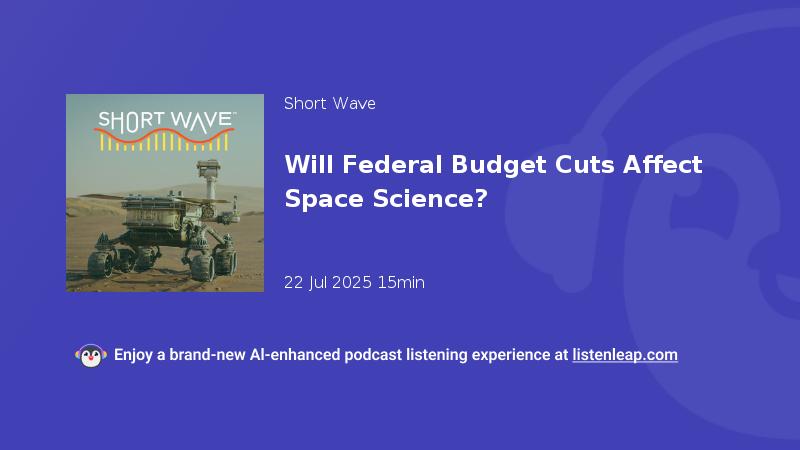
Oh, right. There's been like a whole series of Martian rovers with cool names.
names. You could kind of follow what they were doing on Mars.
One had a very popular Twitter account.
But yeah, on the surface of Mars right now, there's actually little pieces of Martian soil that one of the rovers has drilled.
And those pieces of Martian soil are waiting to be collected.
Those soil samples, on top of being able to tell scientists if there ever was life on Mars, like biosignatures, these samples could inform future human missions about potential hazards from like the Martian environment.
And Brittany says that with these proposed cuts, scientists scientists may never be able to analyze those samples.
Like, this mission might get canceled.
I think the whole Mars infrastructure is really in question with the cuts.
There's a lot of question marks in the budget regarding Mars and kind of the human -to -Mars pipeline, if you will.
I think the future is really unclear.
Brittany says this new focus on human missions really doesn't take into account how much robotic missions have already done.
They gather so much science efficiently with fewer resources and without putting humans in harm's way.
But other policy experts like John say that the Martian sample mission was facing problems long before these cuts were even proposed.
Mars sample return was on life support well before Mr. Trump was elected.
It's a mission or at least an architecture of a mission that has all kinds of problems associated with it.
So if something has to go, maybe that's it.
Hmm. What other programs have already started, but maybe on the chopping block?
Yeah, there's a range.
There's small ones that relate to space weather.
And then there's big ones focused on studying our nearest neighbor, Venus.
Some climate satellites will be scrapped.
Even the administration's lunar ambitions would be scaled back significantly.
Significantly. So Artemis 3, which is the first U .S. lunar mission to put, like, humans back on the moon since Apollo, under this new budget, that would be the final funded mission in that Artemis series.
A plan to build the first space station orbiting the moon?
That would be canceled under these cuts.
Okay, all this is to save money, presumably.
Does it? Yeah, so it does in the short term.
But Britney and Jack say...
I don't think we're being a good steward of taxpayer dollars if there are missions that we've already gone through the trouble of launching their operational state in space.
You know, how much money are we really saving by cutting off these missions when we're actually still getting science out of them?
Right. So the concern here is that all these missions and projects that have already been funded by taxpayer dollars may just stop.
Yeah. And another really big project that's in jeopardy is the Nancy Grace Roman Space Telescope.
That's a really significant project.
I mean, that telescope has been under construction for like a decade, and it was on its way to being capable of finding planets beyond our solar system.
Yeah, and hopefully figure out more about dark matter, dark energy, you know, what's making our universe accelerate and expand.
This telescope would also maybe democratize a lot of space research by making huge amounts of data available to everyone all at once.
I mean, unlike previous space telescopes.
Right, like James Webb or Hubble.
But you're saying that with these cuts, Nancy Roman, that project might just stop?
Yeah, yeah. Some astronomers are worried that's going to happen.
Dara, that's the president of the society we talked about.
She's also an active astronomer and she uses these observatories for research. That mission in particular was really on budget and on track to be launched, I think, in two years.
and funding has already been spent on it.
And right now the cuts are so steep that, you know, it'll be hard to finish that mission in a timely way.
Right. It takes humans to ultimately make missions as cool as Nancy Roman or landing on Mars or the moon happen.
How has the Trump administration justified these cuts?
Yeah. So the White House's OMB, that's the Office of Management and Budget, it.
They put out a statement saying that these cuts are about streamlining NASA's workforce.
And elsewhere, they've implied that some of these projects can be outsourced to private companies and NASA's job should be to focus on human spaceflight.
And Emily, like I was telling you earlier, a lot of scientists feel that these are unprecedented cuts, but John sees things a little differently.
One thing to say is that it was not written in stone anywhere that the United States should have a vigorous space science program.
It's a product of history.
This is an opportunity to ask the question, what priority should space science have compared to all the other demands on the federal budget?
And the answer may not be as much as it has had for the past 40 years.
So I reached out to NASA, and they replied that they're not commenting on any of the proposed budget questions.
But in the past month or so, there has been movement elsewhere.
Every living former head of NASA's science mission directorate signed a letter urging Congress to reject these substantial cuts to NASA's science budget.
The Senate Appropriations Committee met to discuss funding NASA at $24 .9 billion, among other topics.
And this would be just above the current enacted budget.
And last week, the House put forward their own version of this, and that would keep NASA's budget the same.
But again, we need to keep in mind that scientists and policy experts told me that even though these new budgets, you know, sound great, they would probably still reallocate money away from space science and towards human spaceflight.
Oh, OK. So these cuts may not hold.
They may not happen.
No. So the 2026 budget hasn't been finalized.
Congress spends most of the summer putting together the budget plans and then vote on it.
So the earliest we'll see this vote is September, but most likely it won't happen until like the end of the year.
Okay. So things are very much still in flux.
Yeah. It's no small thing to weed through budget documents.
So, Gina, thank you for bringing this to us.
Thank you, Em. Please like, follow, or subscribe to Shortwave now.
You will get a fun and fresh science episode in your feed four times a week.
And Shortwavers, we have an extra special gift for you for our summer series, Seacamp.
Every Monday you get new Seacamp episodes, but you can also get in your inbox every week a limited edition newsletter letter with comics, fun puzzles.
Sign up at NPR .org slash CCAMP.
Thanks so much. Today's episode was produced by Hannah Chin, and it was edited by showrunner Rebecca Ramirez.
Tyler Jones checked the facts.
Kwesi Lee was the audio engineer.
Beth Donovan is our senior director, and Colin Campbell is our senior vice president of podcasting strategy.
I'm Emily Kwong. And I'm Regina Barber.
Thank you for listening to Shortwave from NPR.
This message comes from Ritual.
What makes Ritual Vitamins different?
Ritual Vitamins are made with bioavailable, clinically studied key ingredients as well as the essence of mint.
Get 25 % off your first purchase when you visit ritual .com slash NPR.
As AI permeates every aspect of our lives, who are the people behind this huge inflection point?
What keeps them up at night?
I fear that what it means to be human may suddenly not be our own.
We've got a special series from NPR's TED Radio Hour.
It's called The Profits of Technology.
What they got right, wrong, and where these pioneers think we're headed next.
Listen to the TED Radio Hour wherever you get your podcasts.
Hey everybody, it's Ian from How To Do Everything.
On our show, we attempt to answer your how -to questions.
We don't know how to do anything, so we call experts.
Last season, both Tom Hanks and Martha Stewart stopped by to help.
Our next season is launching in just a few months, so get us your questions now by emailing howto at NPR .org or calling 1 -800 -424 -2935.