In 10 minutes or less, the Opinions podcast brings you a fresh way to understand the news.
With voices from New York Times opinion, I've got a break for you.
I'm actually going to tell you some good news today.
One idea, one analysis, one perspective at a time featuring David Brooks, Trussie McMillan -Potter, Michelle Goldberg, Thomas Friedman and many more.
Find The Opinions in your podcast player.
So, I was in class.
I was about to turn in all my work to the teacher, so I was already starting to pack up my thing slowly, and I got a call from my mom.
She seemed very down and she was like, it's like when you hear somebody, they're trying not to cry, but like they're really like holding it in.
And I could hear in her voice and that's when I started to get a little bit worried.
And she told me that like, your father got detained.
And then that's when it was just like, it felt like somebody put a little like 10 ,000 blocks of like bricks on my chest. I was just hearing mumbles.
I felt like I was building up so many emotions and it was all gonna come out, and I didn't want anybody to see me like that.
So, I just gave my paper to my teacher, and I ran out of the classroom, and I tried to get in my car as fast as possible.
And it's just like, you just start envisioning the worst. Like, he's in this terrible place.
This is a hardworking man, no criminal record. Like, you guys just took him.
From The New York Times, I'm Michael Bobaro.
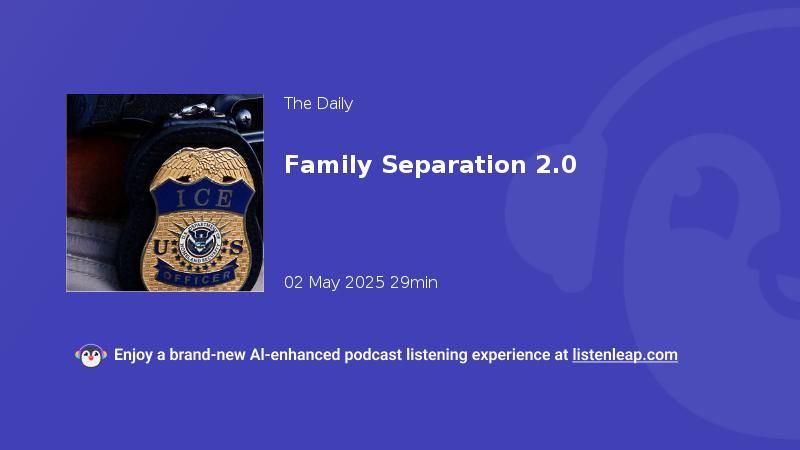
This is The Daily. In his first 100 days, President Trump has struggled to fulfill his promise of deporting one million undocumented immigrants—a reality that has prompted his administration to change its strategy.
Rather than putting its focus on migrants with a criminal record or those who recently crossed the border, the White House is increasingly seeking to deport those who came to the US decades ago and have established a life, career, and family in America.
Today, daily producer Jessica Chung tells the story of one such migrant through the eyes of his daughter.
It's Friday, May 2nd.
I first spoke to Isla back in February.
This was a month into the Trump administration, which had promised quick and mass deportations.
I was calling immigration lawyers around the country trying to get a sense of who exactly was getting targeted for deportation and how ICE was finding them.
And that's when a lawyer called me back, saying, you got to talk to Isla.
Hello. Hi. Hi. So this is Jessica.
This is Ayla. She's Fabrisio's 20 -year -old daughter.
Okay, great. Nice to meet you.
Nice to meet you too.
My name is Isla Gomez.
The first thing that struck me about Isla Gomez was her bubbly personality.
She's excitable, so positive.
Right now, Isla is a sophomore at Wentworth Institute of Technology in Massachusetts, where she's studying architecture and interior design.
She was raised in a town called Saugus, just outside Boston, where days before we had talked her dad was detained by ICE officers.
Tell me a little bit about your dad.
What is his name? lifetime, how old is he and what does he do.
My dad, he's Fabrizio Gomez.
He is 47 years old and he works at a construction company of his own.
ISLA told me in 2001 her dad had settled here in Massachusetts as an undocumented immigrant.
He'd come here from Brazil.
This was three years before Isla was born.
Tell me about why he left Brazil.
Sorry, I'm just asking these questions for my mom because I never really went in depth of… So, my mom said it was due to the violence down there, and he couldn't make a living for himself, let alone have a family down there.
When he first got here, he lived with his aunt, who was already here.
But eventually, he met Ayla's mom, who is also from Brazil.
They actually walked into each other and they were like, Oh my God, like I remember you, blah, blah, blah.
And they moved out on their own with money Fabrizio made by working in construction.
So he had been working like small jobs, almost like a handyman.
And then he met somebody, which is my dad's old boss that still remains in our life, Ken, and he slowly taught my dad how to work.
It went from like changing door panels, windows, to fixing inside the house.
And then it went to roofing until he gathered up all his knowledge that he had.
And then that's when he decided that he was ready to open his company and start creating a life for himself and our family.
And is your sense that he loves his job?
Yes, my dad is actually very passionate for his job.
You would think he wouldn't be because you're constantly going up a ladder.
It's so cold since we live in Massachusetts.
And it's really a hard job.
Even though he wasn't fluent in English, he had this way of connecting with people.
My dad, wherever he walks, he talks out loud to everybody and he talks to people like he knows people.
He's always talked to his clients.
Like he knew them for so long.
I don't know how he talks to them, like everybody understands him.
For as long as she can remember, Aylas wanted to be just like him.
As a little kid, I was like, my dad's like kind of tomboy.
I'd always buy construction, little kid's kit, and I would always go around the house with like plastic toys.
Me and my dad are this type of person where we take something that is not good and we reform it to make it into a better place.
When something's not designed properly, it doesn't feel that good walking into a house that is just simple, there's no design, it just feels down, and when you reform it, it brings another life.
It sounds like you and your dad shared a special bond over your love of building things.
So I wonder if you have an early memory of him sharing that love of construction with you.
Oh yes. So this was a fifth grade science fair.
First, I had to do kind of like the blueprint.
So I went to my cousin and we drew like the measurements and everything and then I went to my dad.
It was for a ramp to like define gravity.
If we were to drop something, it would fall like on the ramp and it would flip up.
My dad took me one of my favorite stores.
is Lowe's in Home Depot.
And you know, that's my dad's automatic favorite store cause he always has to be there.
And we had to buy wood, nails, and we had to use like the saw because the corners had to connect.
So, we had to cut it diagonally to connect.
So, he taught me like measurements too.
I got to do this with my dad.
I was able to present it to my class, I was able to show it to my teacher and I got so congratulated for it at school that it's just like, oh my god, everybody's gonna know me.
Everybody's gonna know my dad.
I'd be like, do you know my dad does construction?
He can build your house.
And I'd offer up, like he could do things for you.
He could build your house.
I would actually walk around with my parent's card in my purse offering everybody.
I always wanted to work with my dad.
I'm not gonna be able to, you know, carry all the shingles, the roofs and everything that he does, but I'm gonna do what my dad does.
which is why I went to college for architecture and interior design so eventually in the future I could work with my dad's company.
Ayla says her dream is that her dad's company becomes a family company with her.
His dream was always for us to go to college and pursue something that we have passion for because they weren't able to choose their own path, like you're not born saying I'm going to clean toilets I'm going to be a contractor you're born thinking like I want to be a businesswoman I want to go after this.
I want to have my own company.
I want to have my own home." I feel like that's what their main goal for us was, that we're able to choose our own path.
My dad, he's always been the person to tell us, work hard, nothing's gifted, nothing's handed, go after it.
So fast -forward to today, the dream that you described your dad having for you guys was progress.
Like you're in college, your dad is working hard at a business that he owns.
When Trump was inaugurated on January 20th, did your family have conversations about what precautions you guys would take given that he was aggressively pursuing people without documentation?
I would always ask my dad, like, should we worry?
And he'd always tell us like, No, like, there's don't worry.
As much as obviously, when I'm alone, when anybody's alone, you always have that thought in the back of your mind.
Like, what am I gonna do?
What if things go down?
Obviously, we worry at all times.
But I try not to, because if my dad himself could be positive through something like this, and always tell us that, don't worry, like, things are always going to get better, I'm not gonna stay here and panic.
Fabrizio had no criminal record and he didn't want to hide from law enforcement.
He wanted to do things the right way.
He's had a pending application for a visa.
In the meantime he's been checking in with ICE, he's been doing that for 12 years.
In February, just one month after Trump's inauguration, he was due for another check -in.
We were all kind of like trying our best to treat it like a regular day, like He literally called his clients, spoke to them that morning, said that after his court, he's going to go to work and he's going to fix so -and -so's roof and do this and that.
So he just shows up for his yearly check -in and you go there, you represent yourself, talk about whatever is being asked.
And that was about it.
And so her dad shows up to his check in like he always does.
And it was soon after that, that her mom called her in class, notifying Isla that her dad had been detained.
I was hyperventilating, I felt like my heart just left my chest. I think about him being there.
I think about him being in this close -up space, so I worry a lot at night.
Like, what if he's panicking and we don't know?
What if he's holding strong but he's actually having the hardest time in his life?
Like, that's what constantly replays in my head.
So it just felt like my whole heart got ripped out of my chest because I never got to really say a proper goodbye, like, I'll see you later, We'll be right back.
This is Somini Sengupta, I'm a reporter for The New York Times.
I've covered nine conflicts written about earthquakes, terror attacks, droughts, floods, many humanitarian crises.
My job is to bear witness.
Right now, I'm writing about climate change, and I'm trying to answer some really big and urgent questions about life on a hotter planet, like who is most vulnerable to climate change?
Should we redesign our cities?
Should we be eating differently?
What happens to the millions of people who live by the coast as the oceans rise?
To make sense of this, I talk to climate scientists, inventors, activists.
Mostly, I document the impact of global warming.
And that impact is highly, highly unequal.
My colleagues and I are doing our best to answer complicated questions like these, but we can't do that without our subscribers.
If you'd like to subscribe, go to nytimes .com slash subscribe, and thank you.
Eila's dad was detained on February 26.
He was taken to the Plymouth County Correctional Facility, about an hour's drive away from their home.
Eventually, Isla was able to reach him on the phone.
I'll give it to my dad.
From the first day that he called us to speak to us, that man has holding strong.
Every time we call, he has the most positive energy, and so positive that he will see us and things will go back to —not normal, because I don't feel like anybody could really treat life as normal after this situation, but definitely better.
Alla's dad told her to hold strong too.
He said the detention center wasn't so bad.
He told her he'd gotten a job cleaning, which allowed more time outside of his cell.
He started a Bible study with a group of other detainees, and he was allowed visitors.
I'm the only one eligible to visit because I'm over 18 and I was actually filling out the papers And I was on the phone with him telling him when he called my mom I'm filling out the papers to come visit you I'm trying like cuz you have to send it through the mail It's a whole process, so I tried to do as fast as possible and he told me Like as much as I would love to see you guys so much Just don't come here because this is not the person that I am and he was just like it would hurt to see and you get up from that chair and turn your back and have to leave. That's when reality would hit.
It's very hard to comprehend that and it's very hard to imagine that.
But as the days in custody turn into weeks, the two of them adapted to a new version of their relationship.
No visits, but they talk on the phone, a lot, as often as 5 times a day.
We open every conversation like he was here with us.
Like, I'm walking into the house saying hi to him.
Ben said, hi, dad, how are you?
I missed you. We continue lives how it is, like on the phone.
What are some of the updates that you give him on how life was going for you?
ILA WATKINS I gave him updates on my grades.
I gave him updates on my finals.
Well, I can't show it to him, my projects, since they're all like online based because they're all like for plan and stuff like that.
But I like give him the visual analysis.
NARRATOR Inside the cell, time had stopped for Ila's dad.
For Ila on the other hand, life went on, and her dad didn't want to miss out on it.
ILA WATKINS So my school requires me to do an internship Within that day that I literally got that interview, like from the night before that I got a call to get the interview, as soon as he called, let him know.
He's telling me, good luck on your interview.
My dad always says to be prepared and be at least, well, my dad at his job, he was like, if he let him, he was an hour early.
So, he would at least tell me to be at least 30 minutes early.
So, I took that advice, I was 30 minutes early.
And on top of that, I already had everything printed.
I literally had it in a folder.
He was like, yep, that's how I like.
So as soon as she was ready to give me the opportunity, I could just give her the folder and I was automatically hired.
Oh wow, amazing. And then how did you share the news with him?
I just like, I couldn't hold it.
I literally was like, hi, Bensah, how are you?
He was like, great, your mom said you had great news for me.
I was like, yep. And I told her, I was just like, I got the job, I'm working at the company, explain the company to him.
And he was like, look at you.
Like, I'm so proud of you.
He would always tell me, like, these are the things that keep me going.
You're going after your future.
You're creating a future for yourself.
And I need you to continue to do that for me.
These calls went on for two months, and then in April, Isla learned of two major developments.
First, Isla was going to enforce an order of removal against her dad, which meant he could be deported immediately.
Second, Isla was moving him over 1 ,600 miles to a notorious detention center in Louisiana, which had been investigated by the Department of Homeland Security for alleged abuses.
After he was transferred there, I gave her a call on a recent Sunday.
How was your Easter Sunday?
Um, you know, it is fine.
We're just missing her dad, so, yeah, um, he got transferred to, um, Louisiana last night.
Aila says her dad's new detention center in Pine Prairie, Louisiana is nothing like the one in Plymouth.
It's quite literally a prison where people that actually committed real crimes would be in.
He's in a jail cell where it's just like ten times worse.
Guards are completely strict, like there's no really sitting there, conversating with them.
Like they're guards.
And he says that it's a mess in there.
It's just like, very chaotic.
Like everybody's everywhere, everybody's mixed.
When Ayla talks to her dad now, things feel different.
She senses that the brave face her dad had put on is starting to crack.
He was very sincere this time on this call.
Hmm. Like, it's not good.
Usually he wouldn't really complain about Plymouth.
But now, like my mom was saying right now to me, that since it started to hit two months and reality is really knocking at our door, especially with the deportation, now I feel like he's really being sincere of how he's truly feeling like and I don't want to say he's in full panic but he's really feeling it even so on the phone like I can hear himself let go.
I can hear his voice drop and I can hear that like excitement that he would try to have low.
And this change in mood is starting to have an impact on Isla too.
It's like this feeling of Like, life keeps going, and life still feels normal, but there's something wrong.
It's just all so real now.
Within these last days, I felt like my anxiety has been over the roof.
It just feels like it's so hard to get through your day.
It's so hard, because I can't believe it.
You cannot tell me they'll be taking my dad, and he will be in Brazil for the next, like 10 years up until we can reapply for him to come.
Like that does not cross my line.
Oh man, would you ever consider moving to Brazil to be with your dad if it came to that?
As much as I would love to stay here and be like yeah my family is going to reunite in Brazil.
It can't be a plan and it's also it can't be a plan due to the fact that my parents have worked way too damn hard too many years of their damn life to come here.
I will be continuing college.
And if anything, I will be continuing their success times that by a hundred.
I refuse to believe that they'll be throwing that away.
And if I can even continue my dad's company to keep going and get other people to manage it, I will be continuing to make their name.
So, Briseau was never in my plans.
It's one thing to take my dad away from me, it's another to take everything that they worked hard for.
I wanted to ask, you know, what do you make of the fact that for a lot of Americans, your father's story, while sympathetic, might, at the end of the day, feel like, yeah, he ultimately was here, not legally.
What would you say to those people who might agree with the administration's policies, to remove people like your dad who don't have documentation here?
I'd get it if you're talking about a murderer that doesn't belong here and he's just out running on the street, or I'd get that.
But if you're okay with separating families because they're just simply immigrants, that's a battle you're dealing within yourself.
If they're hearing my story specifically, I hope they hear that and that they try to picture one of their daughters sitting here and having to talk about their– one of their parents like this because somebody out there is wishing that on somebody else.
And I just really want them to picture that.
I'm really thinking about how your dad coached you through the interview that you did to obtain that internship, and how, if your dad is deported back to Brazil, that that's going to be the permanent state of your relationship, that he's always going to have to coach you from afar, father you from afar.
I wonder if you've thought about that.
Has that sunk in with you?
So... And can you bear that new version of that relationship?
I cannot possibly bear that at all.
I can't even envision that.
My dream is to have both of my parents see me walk the stage.
That's within two years.
I don't believe that my dad will not be there.
Because at the end of the day, I really did it for him.
And that in a couple of years, that I'm supposed to get married and have a family.
That sounds unreal doing that without my dad.
Yeah. And it sounds like you're talking about somebody that passed away, but quite literally I refuse to believe.
Those were my plans.
Those are what I used to pray for God.
Now that's not even my prayers anymore.
That's how much I already feel like I'm changing my life.
It feels like everything that I worked for has no meaning to it.
Everything no longer has a value, since it could all just be taken away from you.
I guess at this point, you know, you're in college right now, you're studying architecture and interior design, and you pick that major because you hope that you could eventually work with your dad and that dream is looking dimmer and dimmer.
What is that dream now?
Um, as of right now, there's like, no dream, no goal.
There's no, that dream that you dream big of, oh, I really want to do this.
It's, it's just kind of like, I want to be like, completely honest. It's just bland.
It's just like, okay, well, my dream is to kind of just be able to push through this.
Have you dreamt about re -uniting with your dad, on the other hand?
And if so, when you picture seeing him, where do you imagine it will be, and what do you think he'll look like?
That, I have, like, a literal, ideal dream.
Me, just getting that call of being told, like, go pick up your dad.
And all I could think of is me just, like, parking my car, getting out my car.
He's standing outside, like, quite literally the same exact person he left. In his work clothes, just the way he is, with his face, like his regular face.
The same exact way he left is the same exact way I'll be seeing him in that vision.
Like, no time had passed.
No. Like, literally no time has passed, but it feels like life spins upside down.
And just hugging my dad, and all I could literally do is cry, like cry my literal heart out.
You ever just cried as a kid where you would literally hiccup so much?
Like, that type of cry, everything I've been holding in within these two months, That's exactly how I see.
It's like a deja vu, like vision is just like, it just feels like it's going to happen and it's all I think about.
That's all I can envision, like over and over again, every single day that I wake up.
And it's just me, like it's not like my mom's around, my sister's around, it's just like me and my dad.
She was told that her dad had been deported from the U .S. to Brazil for the month of April 2, 2019.
Isla never got the call to pick up her dad.
Instead, a few days after we had talked, she received news that her dad had been deported from the U .S. to Brazil.
So Isla packed a small suitcase for herself and a bigger one for her dad.
And she booked a ticket for one to Brazil.
And on Tuesday morning at the Arrivals Terminal in Bella Orazancia airport.
We'll be right back.
Here's what else you need to know today.
President Trump is ousting his national security adviser Michael Waltz, the first major shakeup of Trump's inner circle since the start of his second term.
Waltz had infuriated the president by including a journalist on a group chat that included highly sensitive plans to attack military targets in Yemen.
And he further alienated Trump by espousing a worldview that is far more traditional and interventionist than the president's.
Trump said that his secretary of state, Marco Rubio, would temporarily fill in for waltz as national security advisor.
And, on Thursday, General Motors said that President Trump's tariffs would increase its cost this year by $4 to $5 billion, a vivid demonstration of the tariff's impact on American businesses.
Much of that cost will come from GM cars that are made in Canada, Mexico and South Korea and sold in the United States, many of them now carrying a 25 % tariff.
Today's episode was reported and produced by Jessica Chung.
It was edited by Michael Benoit, with help from Ben Calhoun.
It was fact checked by Susan Lake, contains original music by Diane Wong, Dan Powell, Pat McCusker, Alisha Be 'Etub, and Marion Lozano, and was engineered by Alyssa Moxley.
Our theme music is by Jim Rundberg and Ben Lansford of Wonder Living.
That's it for The Daily.
I'm Michael Bobaro.
See you on Monday.