Hey listeners, Michael Garoflo here.
We're currently working on a new season of the podcast for you.
That's coming later this month.
But today I want to share something cool that we recently found in our archive.
You've heard us talk about the archive.
It's the largest single collection of human voices ever gathered.
There are more than 700,000 people in there.
It's public, too.
You can actually access it online at archive.storycore.org.
Listen to full length, unedited interviews.
If you've done an interview, you can even look yourself up there.
And here at Storycore, we're constantly diving into the archive,
rummaging around to see what we can turn up.
And recently, one of our producers, Kayla Latimore,
discovered what you're going to hear next.
Kayla was looking for stories from veterans
as part of our Military Voices Initiative, which
records service members and their families.
And she found that we had a bunch of recordings
with Montford Point Marines.
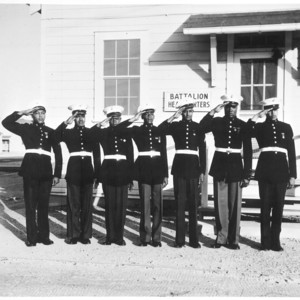
In 1942, the Marine Corps officially opened its ranks to black men.
More than 19,000 black recruits signed up and became known as the Montford Point Marines,
named for the North Carolina base where they trained.
Most of these men have passed away.
But because they made the recordings you're about to hear,
we can still listen to them today.
Do you remember the first time you put on a uniform?
It just felt like, oh, I'm a proud Marine.
I thought I was something.
I wanted to fight for our country and also
to show that we have the courage and intelligence to do so.
We knew we were the best.
Oh, we made it our business.
Be the best of the best.
Not me, the okla, but the best.
Now we'll spend a little more time with one of these men,
Corporal Sydney Allen, Francis.
After serving as one of the first black Marines,
he worked as a New York City police detective.
And way back in 2005, he spoke with his daughter, Candace, at Story Corps.
I wanted to go into the army, but they said no.
And this was World War II?
Yeah, they stamped my papers Navy.
And there was no way in the hell I wasn't going to Navy.
Why didn't you want to go into Navy?
I didn't like the little hats they were.
So then I said, what about the Marine Corps?
The guy says, well, you have to go around and see the Sergeant Major.
First thing he said to me, are you a high school graduate?
I said, yes, sir.
And I went to North Carolina for boot camp.
And what was that like?
I mean, they were rough.
Now, were you drill instructors?
Were they white or black?
No, they were black.
But see, they had trained on the white instructors
because up to 1942, the Marine Corps had no blacks.
And that's why they were extra tough and nice.
They wanted us to make it.
And we did.
Well, I have to tell you, I almost went to jail down there.
I was with my buddy from New York.
He was in a Marine Corps.
And we were going to Raleigh from Montfort Point.
And we're sitting in the back of the bus.
Then the bus stopped to pick up people.
And the bus driver came up and he said, you guys
don't have to get up.
I said, get up for what?
He says, these white people have to sit down.
I said, we're in the back of the bus.
He said, you ought to get up.
And I'd lost my head then.
I said, we're not getting up.
And long the whole night, in 10 minutes,
incomes, police were guns drawing.
And he took me that night to some little prison camp.
And in the morning, I heard, warden, this is Major Papa,
United States Marine Corps.
You got one of my boys.
All the Marines from Montfort Point,
they were on six by six trucks with machine guns at the ready.
You can see they just wanted to sit at jail down.
And when I came up Major Papa, he says,
PFC Francis, you get on that truck.
We're out of here.
And he hollered it back.
Thank you, Warden, that you didn't hurt one of my Marines.
He said, you would have been in trouble.
That was Sydney, Alan Francis, speaking with his daughter, Candace.
Sydney died in 2014.
But his daughter recently came back to remember him.
So I didn't know that story before.
He had never shared that with me.
But it sounded like my father.
I wasn't surprised by that at all.
A lot of black men who served this country
had to also suffer indignities, even while in uniform.
I don't think that they've gotten the credit
that they deserve for putting their lives in danger
and coming out of it with scars that didn't come from the so-called enemy
but came from within.
But what I appreciate about my father
is that he used his military service to give him what he needed
to build the life for himself and his family.
It gave him purpose, and it gave him an anchor.
And I'm grateful for that.
So what do you want your grandchildren to know about you?
I want them to just remember that I loved them this whole.
There's nothing exciting about me.
I'm just a man.
That was Candace Francis with her father, Sydney Allen Francis,
one of the first black Marines.
Is there someone in your life you want to interview?
Someone whose story you want to preserve
for future generations?
Tell us about them.
We've set up a voicemail line, especially for podcast listeners.
The number is 702-706-talk.
That's 702-706-ta-lk.
We'll occasionally be asking for you to call in
about specific things like who you want to interview.
But you can always call in and leave messages
for anyone you hear on this show.
We'll pass them on and maybe even feature your voicemail
in a future episode.
The number again is 702-706-talk.
702-706-ta-lk.
The story in this episode was produced by Caleb Latamor
and edited by Von Diaz.
Jarrett Floyd is our technical director.
Judd Este Kendall is the senior producer for our podcast
and Max Young Rice is our producer.
I'm Michael Garofalo, and we'll be back in just a couple of weeks.
Stay tuned in, as always.
Thanks for listening.
Support for this podcast comes from the Corporation
for Public Broadcasting, a private corporation
funded by the American people.
Hey, Michael Garofalo here.
And I've got a special request for you.
You know, story-core stories are unlike the ones
that you find anywhere else.
They document the moments that define our lives
and the wisdom that can come out of those moments.
So please help us record and share more of these stories
by making a tax deductible gift to story-core today.
You can visit donate.storycore.org slash podcast
to support our work.
Thanks for being part of the story-core family.