This is the Global News Podcast from the BBC World Service.
I'm Julia McFarlane, and at 16 hours GMT on Wednesday, the 3rd of December, these are our main stories.
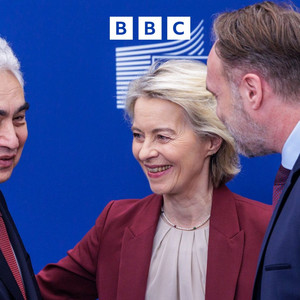
EU chief Ursula von der Leyen says the EU has reached a deal to end Russian gas imports by 2027.
Talks in Moscow between President Putin and US negotiators failed to lead to any breakthroughs.
But the Kremlin says it's wrong to suggest the president has rejected peace.
And President Macron of France has arrived in China, where he's expected to urge President Xi to do more to end the war in Ukraine.
The crisis over conscripting ultra-Orthodox Jews into the Israeli army.
After two years of war, the country is increasingly divided.
I don't think like however religious you are should be an excuse not to go and serve your country.
If you're born here.
I find it quite ridiculous how you want to exempt yourself just because you want to study Torah all day.
Russia has been funding its war in Ukraine largely through its export of oil and gas.
And despite their support for Ukraine, European countries are still a significant market for Russian energy.
Now a provisional agreement has been reached between the European Council and the European Parliament to phase out imports of Russian gas.
The president of the EU Commission, Ursula von der Leyen says it's the dawn of a new era.
Today is indeed a historic day for our union.
Last night we reached a provisional agreement on the Commission's proposal to fully phase out Russian fossil fuels.
We're turning that page, and we're turning it for good.
This is the dawn of a new era. the era of Europe's full energy independence from Russia.
The Kremlin, though, says the EU's ban will only accelerate the bloc's power decline.
Our Europe correspondent Sarah Rainsford is in Rome.
The language from Ursula von der Leyen is talking about a new era of independence from Russian energy, talking about turning off the tap forever and cutting the umbilical cord.
I guess that still, quite controversially, binds Europe to Russia, even after four years almost of Russia's full-scale invasion of Ukraine.
So this is a deal, as you say, provisional deal, but a deal that they're nonetheless hailing as a landmark agreement to have a permanent end to Russian gas supplies to Europe.
Now I think it might surprise some people to know that that doesn't exist already.
Certainly, there were moves to restrict pipeline gas, but that was then replaced with LNG, so liquefied natural gas, which was still coming in.
So the ban will kick in for LNG gas in 2027 and then for all pipeline gas by later in the year, in 2027.
And then supposedly there will be a move to ban all Russian oil too by the end of 2027, because of course Hungary and Slovakia are still importing Russian oil too.
So it is a significant move.
It's provisional.
Nothing is ever done until the final bit of paper is signed when it comes to the EU.
There's an awful lot of countries involved and different political forces in different countries.
But certainly, if it does happen, it would cut off billions of dollars, billions of euros that are still pouring into the Russian economy from Europe even, as I say, after four years of full-scale war.
And Sarah, Russia has responded saying that it will harm Europe.
Is that a threat being taken seriously in Europe?
Well, I mean, Russia has said a lot, and Vladimir Putin specifically, has talked about Europe over the last 24 hours, talking smirking rather, and saying that he, if Europe wants to start a war with Russia, then Russia's ready for that.
Of course, Russia has already started a war with Europe, so it's a very Putin-style comment to make.
But he and Russia have always pushed this line that Europe is the impediment to peace.
That if only Europe would sort of realise it was a spent force and a weak force alliance, then everything would be OK in the world.
So this is this kind of narrative that the Kremlin has been making for many, many, many years.
And I think the Kremlin has also been very happy to keep taking EU money and to point to the hypocrisy that they would say exists in the relationship with You know, the EU, on the one hand, talking very, very tough on Ukraine, on the invasion of Ukraine, and supplying weapons, of course, to Ukraine and a huge amount of support to Ukraine.
And yet at the same time, you know, sending that money to Russia to buy its gas.
So it is.
It has been a line that has not yet been cut and now, as I say, the deadline is supposed to be the end of 2027.
That is a long time after the beginning of that full-scale invasion.
The announcement of the EU's plans came after high-stakes peace talks between the US and Russia in Moscow failed once again to produce any breakthrough.
Russia has dismissed any suggestion that Vladimir Putin rejected all of President Trump's proposals.
But at a NATO meeting in Brussels this morning, the Secretary-General, Mark Rutte, said if the peace talks took too long, there were two ways to put pressure on Russia.
One is making sure that the Russians understand that the weapon flow into Ukraine will keep on going.
That's exactly what's happening today.
Thanks to the US, thanks to the Europeans US sending its crucial gear to Ukraine, paid for by Canada and European allies, but also Europe and Canada doing a lot bilaterally.
And secondly, making sure that the economic sanctions bite, that they are effective.
That's also exactly what is happening.
Well, for more on the NATO meeting, here's our Europe correspondent, Nick Beek.
Despite the customary smiles and handshakes for the cameras.
NATO countries meeting here know they've been sidelined from the Ukraine peace process by their biggest and most influential member, the US.
Secretary of State Marco Rubio is conspicuous by his absence.
President Trump is pushing for an immediate end to the war and has already stopped giving weapons to Ukraine, although he is still willing to sell them via Europe for now.
As for the Putin-Witkoff meeting in Moscow last night, the Kremlin said it would be wrong to suggest President Putin had rejected the US proposals and insisted there could be more meetings with the Americans for as long as necessary.
Crucially though, there's no sign whatsoever.
Moscow is ready to give up its key demand for Ukrainian territory.
It hasn't yet taken in exchange for ending the war.
In Ukraine, it's widely thought that the Kremlin will stick to a maximalist negotiating position whilst it continues to make gains on the battlefield.
For the latest on that, here's our Ukraine correspondent, James Waterhouse.
We haven't had much, by the way, of reaction by Vladimir Zelensky.
He was in Ireland yesterday where in a post, his last post merely said that this war needs to be stopped so Russia doesn't invade for a third time in a year's time.
And I think that is the confidence that Ukraine wants to have in a final peace deal that could In this war.
I mean, I'm just looking at the latest update from Oleksandr Sirski, the head of the Ukrainian Armed Forces, and he's talking about.
You hear these terms when things aren't going well, terms like stabilisation, situation intents, moving to stronger positions.
And I'm not saying that's completely happening this time, but there is a city called Kupyansk that we were last at two years ago, when the Russians were eight kilometers away.
Now the Russians are inside the city and the Ukrainians are trying to stem their attack now that invading troops have crossed the river.
That city is gradually being emptied of life.
The same could be said for Pokrovsk, listeners would have heard about this place over and over now.
It's when a city dominates the headlines that you know that there is an intense pressure.
Pokrovsk was a vibrant military hub The one stays, the Russians are 40 kilometers away.
Now they are, according to some reports, 95 in control of the city.
The food stalls, the restaurants, the hotels, they are all gone now.
And you now have Russian troops once again, raising the flag under the name of so-called liberation.
And this is a trend you fear, given that we are now in winter conditions, that is not going to stop.
It's meant to be difficult for the Russians to make advances when the conditions are the way they are.
And yet they are getting these.
They might not be militarily significant, but they are key trophies at a time of intense negotiations.
James Waterhouse.
President Macron has arrived in Beijing for an official visit that will also take him to the city of Chengdu.
The French president is expected to urge his Chinese counterpart, Xi Jinping, to do more to end the war in Ukraine.
Chinese economic support is vital to Russia's war effort.
Stephen McDonald reports from Beijing.
In meetings at the Great Hall of the People.
The French president is expected to use his standing in China call on Xi Jinping and the entire Chinese leadership to do more to end the war in Ukraine.
Russia relies on economic backing from Beijing, which has been accused of offering hidden support for Vladimir Putin's invasion.
So the Chinese government is thought to be crucial in convincing, And in turn, Beijing wants Europe to lift restrictions on products like Chinese electronics.
For more on one of today's big stories.
You can go on YouTube search for BBC News, click on the logo, then choose Podcasts and Global News Podcast.
There's a new story available every day.
The search for missing Malaysia Airlines flight MH370 will resume this month.
The plane disappeared more than a decade ago on its way to Beijing from Kuala Lumpur with 239 people on board, and sparked the largest ever search operation of its kind.
Stephanie Prentice reports.
Flight MH370 lost contact with air traffic control less than an hour after taking off on the 8th of March 2014, with radar showing it had deviated from its original flight path.
A decade and several investigations on, nobody knows what happened to it.
One team concluded that only the plane's wreckage could provide the answers.
And now a new search for that wreckage will start late December, with a plan to hunt for 55 days.
Families of those lost have never given up trying to find out what happened, holding regular remembrance events and demanding answers from authorities.
There is no closure until the plane is found, until we exactly know what happened to the aircraft and to our loved ones on board.
Yes, it gets tougher every year because we are all expecting some answers.
Previous attempts to find the aircraft include a multinational operation involving 60 ships and 50 planes from 26 countries, which ended in 2017.
And a 2018 effort by the deep-sea robotics company Ocean Infinity ended after three months.
A fresh attempt earlier this year was called off because of bad weather.
One thing that has changed is more detailed analysis of satellite data, radar tracking and ocean currents, which has narrowed down the search area.
And the new team from Ocean Infinity again says it will be looking at targeted areas to try and solve one of the world's greatest aviation mysteries.
Stephanie Prentice.
A new draft law on conscripting ultra-Orthodox Jews, whose support is crucial for Prime Minister Benjamin Netanyahu's government, has sparked uproar in Israel, with the opposition denouncing it as a special privilege for draft dodgers.
Under a ruling made at the time of Israel's creation back in 1948, men who devote themselves full-time to studying sacred Jewish texts are given an official pass from mandatory military service.
Public opinion on the matter has shifted dramatically after two years of war, and this issue now threatens to split the country and undermine the government, as our Middle East correspondent, Lucy Williamson, reports.
In the battle over conscription, Israel's ultra-Orthodox have shown they're prepared to fight.
Security forces who came to arrest a draft dodger from the community last week were quickly surrounded by men in traditional white shirts and black hats and had to be rescued themselves by border police.
A new messaging system called Black Alert has been set up in ultra-Orthodox communities to summon crowds to block these arrests.
The latest move in a looming confrontation that Israel's prime minister has spent decades trying to avoid.
As lawmakers debate a new conscription law, tens of thousands of ultra-Orthodox recently marched through Jerusalem in what many see as a battle for Israel's identity.
We're a Jewish country.
You can't fight against Judaism in a Jewish country.
It doesn't work.
At the Kisra Hamim Yeshiva in Bnei Brak, Hundreds of teenage boys in traditional black skull caps sit packed into classrooms studying religious texts full time.
Taught that this prayer and study also contributes to Israel's military success.
That tradition, in a rapidly growing community, left some 60,000 men exempt from the draft.
In his first interview with the foreign media, the head of the yeshiva, Rabbi Zemach Massouz, told me the traditions would continue, but admitted Israel was changing.
Our soldiers succeed thanks to those who study Torah.
We're partners, just like the Air Force and the tank units.
Together we bring success.
We study Torah and they fight.
But today, many in the government and the parliament have distanced themselves from religion, so they say that yeshiva students are lazy, which is not true.
A small number of ultra-Orthodox men do choose to serve in specially adapted brigades.
But despite promotional videos like this one, the vast majority of those newly drafted by court order last year did not report for duty.
After two years of war, resentment in Israel is growing.
A large majority of the country now wants the ultra-Orthodox to serve, including some of those we met at Tel Aviv's Dizengoff fountain, surrounded by memorial photos of soldiers killed in the war.
I don't think that however religious you are should be an excuse not to go and serve your country.
If you're born here.
I find it quite ridiculous how you want to exempt yourself just because you want to study Torah all day doesn't sound accurate to me.
Everybody should take the effort and support Israel whenever they can donate their time.
It can be one year, two years.
They can do hospital aid.
They can do.
I don't know.
There's a lot of places they can donate their time and fill a part of Israel.
Ultra-Orthodox parties are loyal allies for Benjamin Netanyahu, and this issue has brought down his governments before.
The draft bill...
Much softened, is dividing lawmakers, with one opposition leader calling it a disgrace and a betrayal and vowing it wouldn't pass.
Netanyahu is facing not just a row over security or equality, but two different versions of Israel, increasingly divided but harder and harder to keep apart.
Police in New Zealand are waiting to recover a diamond pendant after a man allegedly stole and swallowed it.
The piece in question was called Octopussy, an egg-shaped locket set with diamonds and sapphires and inside a miniature golden octopus.
Delicious.
The US now, and San Francisco is set to file the nation's first government lawsuit against manufacturers of ultra-processed food.
The city is accusing them of profiting, whilst burdening governments with the cost of treating diseases linked to these products.
For the latest, here's our North America business correspondent, Michelle Flurry.
These days, ultra-processed foods are everywhere, from chicken nuggets to fizzy drinks, even granola bars marked as healthy.
But now, in a first of its kind, ten major food and drink companies are being sued over ultra-processed food.
Among them Kellogg, General Mills Nestle Mars Coca-Cola PepsiCo, Kraft Heinz, Conagra and Mondelez.
San Francisco City Attorney David Chu accused them of using big tobacco tactics, making products addictive and harmful while raking in profits.
Our case is about companies who design food to be harmful and addictive and marketed their products to maximize profits.
Like the tobacco industry, they knew their products make people very sick, but hid the truth from the public, profited from untold billions and left Americans to deal with the consequences.
The lawsuit filed on behalf of the state of California argues that Americans and states are paying billions in dollars in health care costs linked to ultra-processed foods, which now make up 70 of the US food supply.
However, in a statement, the Consumer Brands Association, a trade group which represents many of the companies, said there is currently no agreed-upon scientific definition of ultra-processed foods and that demonising this kind of food misleads consumers.
Still, in a rare twist, this issue is uniting San Francisco liberals with the Trump administration in trying to curb these foods as part of its Make America Healthy Again mantra.
A mobile brain scanning system, thought to be the first of its kind, is being developed to measure the effects of blast exposure in military personnel.
As it happens,
The technology will be used at training sites to give an almost instant assessment of how soldiers' brains are affected by shockwaves from their own weapons.
British scientists say it could also aid research into dementia, epilepsy and concussion.
Professor Karen Mullinger helped develop the mobile scanner.
At the moment, if you want to have your brain scanned with this technology, you have to go to a university or a research centre somewhere.
But what we're going to do is make this mobile like an MRI scanner.
We're going to develop the technology such that we can put it on the back of a truck, and so we can take it anywhere we like.
At the moment, we don't really know what's happening to these military personnel when they operate their weaponry.
There's blast waves that pass through their bodies and they pass through their brains.
It's possible that some of these blast waves are causing damage to their brain.
And the reason that we think that this is happening is that if we look at personnel who've had lots of exposure, then we find that although they've never had concussion or anything more severe, then we can see once they've passed away and their brain is actually cut up, and we can look at the what's called the histology.
Then we can see damage, but we don't know what's happening at the time that they're exposed, and so we can't work out what's dangerous, what's not dangerous.
We think that a lot of what's the damage is happening is happening relatively short time scales after they've been exposed to the blast, and then the brain recovers so that they can carry on functioning.
We'll be able to scan them as they come off of those training exercises and then we'll be able to track how their brain recovers over the hours and the days and the weeks after they've been exposed.
Professor Karen Mullinger.
A BBC investigation has found that more than 2000 extremely abusive social media posts, including death threats and rape threats, were sent about managers and players in the English Premier League and Women's Super League in a single weekend end.
The Manchester United manager Ruben Amorim, Liverpool's Arna Slot and Newcastle's Eddie Howe were the most common targets of abuse in the men's game, while Chelsea manager Sonia Bompasta faced about half of all the abuse in the women's game.
She told us the social media companies simply aren't doing enough.
I think the social media companies are not doing their job, not taking again the responsibility and the accountability for that, and I think, as a club, we need to support our players in the best way possible.
I think if we have to wait for the social media companies to act.
I think we can be in this situation for too long.
James Menendez got more from BBC Sports correspondent Natalie Perks.
So just to explain a little bit about how we found the 2000s.
Nafai is the company, the data science company, we use.
They looked at More than half a million messages that came in on the 8th and 9th of November about 10 Premier League matches and six Women's Super League matches that weekend.
Their threat matrix system is what they call the AI that they use.
It flagged about 22,000 of those messages that it thought could be abusive.
And then their human team put it through two steps to essentially verify the abuse.
We are not talking here about fans saying you had a terrible game with a swear word in it.
We're talking about rape threats, threats of violence, death threats.
And you mentioned the managers there.
Ruben Amari-Medihau and Arna Slott accounted for 20 of all the abuse we saw that weekend in the men's game.
And there were death threats to Amarim and a really horrible rape threat that mentioned on the slot.
And then with Sonia, homophobic slurs of some really nasty things.
One of Amarim's one was kill him, the dirty Portuguese.
And another aimed at the Arsenal manager, Mikel Arteta, urged him to die, die, die.
So just 16 matches in one weekend, meaning there were around 125 messages received.
Yeah, well, that brings me on to my next question.
I mean, if it's possible for this company to identify, you know, the most egregious posts, what are the social media platforms doing about them?
Well, interestingly, a lot of the abuse, so 82% was found on X, which is formerly known as Twitter.
That's not a surprise.
It is the platform people go to to discuss live sport.
But 37 messages were flagged to them and they have taken action in some form about all of them.
That doesn't mean they've necessarily taken them down, because X does prefer freedom of speech overreach, but it does say that it does shadow ban.
So for example, that means you'd really have to look for these horrible messages to find them.
They've restricted people being able to see them.
Meta is the parent company of Instagram and Facebook.
From our investigation, six messages were flagged to them.
They've taken one down almost immediately.
That truly had some of the worst racist abuse I've ever seen online.
They did take that down straight away.
James Menendez speaking to Natalie Perks.
Now police in New Zealand are waiting for evidence to emerge after a man allegedly swallowed a 19000 Fabergé pendant about the size of an egg in an attempt to smuggle it out of a jewellery store.
He remains in custody and is undergoing medical assessments, as our New Zealand correspondent, Katie Watson, now reports.
It's an unusual heist, and the recovery effort demanded of the police will no doubt be more delicate than their item of jewellery itself.
It all began last Friday.
Police were called to a jeweler's in Auckland after reports of a man swallowing a locket made by the world-famous jeweler Fabergé.
The piece in question was called Octopussy, an egg-shaped locket set with diamonds and sapphires and inside a miniature golden octopus.
The egg was named after the James Bond film of the same name, ironically centering on a Fabergé egg heist.
According to police in New Zealand, the man has undergone a medical assessment.
But awkwardly, not just for police, but no doubt for the alleged culprit himself.
It's been several days since he ingested the opulent loot and it's still not been recovered.
Katie Watson reporting.
And our thoughts and prayers are with the police officers in New Zealand.
And that's all from us for now, but there will be a new edition of the Global News Podcast later.
Use the hashtag globalnewspod.
This edition was mixed by Craig Kingham and the producer was Charles Sanctuary.
The editor is Karen Martin.
I'm Julia McFarlane.
Until next time, goodbye.