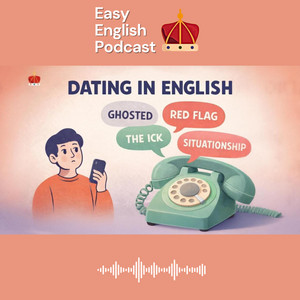
Hello and welcome back to the Easy English Podcast, the best place to practice your English listening skills.
I'm your host, Oliver, and today we have a quite an exciting but also terrifying topic.
And that is dating in English in the modern age.
Yes, that's right.
So if you think dating is difficult in your own native language, try doing it now in English.
We're going to be taking a look at dating apps, the slang and some of the cultural rules around dating in English today.
So if you find that interesting and you want to find a little bit out about that, then keep on listening.
As always, we are going to learn some of the vocabulary for today's episode as well.
So I'm going to go through some key vocabulary that you should listen out for today.
I'm going to read the words and their definitions with a little example potentially as well.
So let's have a look at our key vocabulary for this episode.
And we're going to have five key words for today.
The first is, well, they're actually rather key phrases in this case.
The first is the talking stage.
And this is a noun.
The talking stage.
And this is that period when you're texting and getting to know someone yet, but you're not formally dating.
The next is bio, bio.
A bio is a biography.
Essentially the little bit of text on people's profiles that explains a bit about themselves, a summary about who they are, maybe where they're from and some of their interests.
Our next is a phrase, which is a verb, and that is to ghost, to ghost.
And to ghost means to suddenly drop all communication with someone without any explanation.
And the noun version of this, by the way, is called ghosting, ghosting.
And our next phrase, our fourth one today, is situationship.
Situationship.
And this is a noun and people use it in slang to be more than a friendship but not quite a committed relationship.
So more of a it's complicated kind of stage.
And our final phrase today is red flag.
Red flag.
A red flag is a warning sign that someone is probably not going to be a good relationship partner.
And a green flag on the opposite is a good sign.
Okay, so those are today's key phrases that I want you to listen for.
We will explain them a little bit more as we go.
And, as always, if you are listening or you have been for a while and you're not following or subscribed, make sure that you do.
It's the number one way to support and make sure that you don't miss out on new episodes every Monday.
As always, we have a new episode of the podcast every Monday, but also a bonus episode of the Patreon podcast every week too.
As well as full transcripts, PDFs and vocabulary flip cards with each episode.
And that's available if you support and become a Patreon member.
And you can do that by following the link in the description below.
Let's get back to our main episode today.
And this is our topic of dating in English.
Now, it's been a long time since I have been doing this because I am married.
I'm not dating in the modern day in 2026, but I know that a lot of you are.
So that's why we're going to learn some of these strange vocabulary words.
And it's also useful vocabulary simply if you're watching TV shows and movies.
Maybe American ones, British ones, anything modern.
Some of the slang will even be used in your own language as well.
In 2026, a lot of young people, they're starting their dating journey on an app of some kind.
Whether that's Tinder, Bumble or some kind of new app service, the language is pretty much the same on all of these.
And the slang is pretty common across any type of these platforms.
It does seem to be very popular nowadays for people to meet online on apps.
And in fact, for a lot of people, it seems to be the only way that they meet potential partners nowadays.
In the past I do remember.
When you talk to grandparents or parents you know they usually met through a friend or randomly in a cafe, a library, etc.
At a club or a bar.
But now it does seem like people actively look for maybe a partner or a relationship online.
So that's why a lot of this vocabulary, because of course online we communicate a lot with text.
So a lot of these slang words and phrases have become very popular.
So first you have on these apps what people call the swipe.
So there may be swiping on their screen to find people.
And when someone else sees them that they like, they call it a match.
You can also say that if you meet someone that is good for you, that you might be a good match.
You could be a very good match, the two of you.
And once you match, you will enter that sort of talking phase when you meet someone.
And this is that most dangerous part.
Because especially when texting, people don't want to seem too intense.
But they do want to seem interesting or like they're interested.
And many people struggle here because they use very formal English words.
So, for example, you want to be still fairly casual, but not too casual.
Maybe some complimentary or some compliments and really just keeping it light.
But of course, when I think about this, I don't think I'd be very good at doing a lot of online dating if I was back into that phase.
Because to be honest, not everyone is good at communicating online, at communicating by text.
And some people hate text messaging.
Some people love it.
I'm definitely one in the camp of people that prefer to talk online, in person or even by voice over the phone.
I really don't like texting.
I don't like emails.
I don't like written communication so much back and forth.
I do prefer by voice having that real contact.
I know some people do prefer that, but I think it's very hard to actually show people who you are and to really come across the correct way with your full, real personality.
It can be very hard to do that online.
And of course, when people are dating using technology and online, it isn't always easy.
And in fact, technology has created some bad behaviors.
And we're going to look at what they are in English and learn what these names, which have become almost like a slang I guess very common slang and what they mean.
The first I mentioned already is ghosting.
Ghosting.
And this is the most common, and it's actually common even outside of dating or people trying to talk to people online.
Essentially one day you're texting back and forth or messaging and the next day silence.
This can happen with friends, with potential partners or even just with people that you know online.
They disappear like a ghost.
It's rude, but it does happen in general to everyone at some stage.
And I think it's because it's so easy to do this online.
All you have to do is close the chat, maybe block the person and never see them again.
And because people don't see a lot of these people in person.
Most of their communication and their contact is happening online, which I think can create this behavior, especially if you are dating, for example, or not dating, but talking.
And it's before you've even met the person.
They can just stop talking to you.
And that's what they call ghosting.
Then there's something else which I only heard about for the first time when I was doing a bit of research for this topic for phrases, and that is called breadcrumbing.
Breadcrumbing.
And this is when someone sends you a small crumb of attention.
So a little piece like, for example, a compliment or a light or a short text once every week or every so often, just to keep you interested.
But they have no intention of getting to know you much further or meeting you in person.
So apparently that is a big problem nowadays with people dating online.
And a lot of people that use these online apps, they consider this to be a major red flag.
So a very bad sign if someone does that and engages in that behavior.
In fact, any of those phrases or features like ghosting would be considered red flags.
And in English, we have a phrase and it is don't settle for crumbs when you deserve the whole loaf.
Okay, let's go for a little bit to our listener spotlight, and today's question, of course, is going to be have you ever used online dating?
Have you used you know dating apps?
Tell me your experience and if not how did you meet your significant other?
Was it a traditional way?
Did you meet in a party?
I at a library, in a cafe, through friends, let me know.
So one or the other.
If you've used dating apps before, tell me your experience.
If not, you can tell me how you've met a significant other or a partner before.
Okay, so last week I asked some questions about what you do for your English learning routine.
And I had some great answers.
I'm going to share a few of those with you today.
So the first one that I'm going to share was from Lou.
And she said, I think it's very important to always keep the pleasure of learning.
And I think for me, the best way to learn English is to learn as a melody, as music.
The shadowing method is suitable for me and podcasts like yours, because the music of words is very clear.
I think that's a very beautiful way to think about learning English, like a melody.
And I'm very glad that my podcast is also helping with that, Lou.
So thank you for your lovely comment.
OK, the next comment that I want to read today is one from Summer.
So Summer said, Hello, Oliver.
So her routines are listening to English podcasts on a daily basis, while shadowing those, and listening to songs by English singers and singing along with them.
Once more, I try to write, read and talk as much as possible.
I'm also into watching films constantly without subtitles, of course.
Excellent, Summer.
So it seems that shadowing is quite popular.
That's interesting.
And I love the fact that you sing along with those English songs.
That's a great way to practice your English.
Excellent.
I had a lovely comment from Anna and she said Hi Oliver, I'm 50 years old and I wonder if I can still master English.
Or is it already too late?
But as Confucius said, the best time to plant a tree was 20 years ago.
The second best time is now.
So I'm going to try.
I use an app for learning English, listen to podcasts and watch movies to practice.
Excellent, Anna.
I think it's never too late.
I think that you're right.
The best time is now and that the work that you put in now and the focus is what is important.
All the time in the past doesn't matter anymore.
It's the time that you have currently and into the future which does.
So keep it up and I'm sure that you will do great.
So thank you all for your wonderful comments.
That was really great comments today.
I can't read them all out every episode, but I do read personally each and every one.
So make sure to try and answer, as it helps for your English language practice as well, as I get to read them and they're absolutely lovely comments.
And I really, really enjoy seeing what each of you write each episode.
So just a reminder.
Today's question is about if you use dating apps or have used in the past.
Tell me your experience.
If not, tell me how you have met people you know, maybe your husband or wife or long-term partner in the past.
And I will, as always, choose a few of these and read them out on next week's episode.
Okay, let's go back to our main topic today.
And we're going to look at a cultural nuance.
And that is, let's grab a coffee.
In the English-speaking world, we love to be indirect.
You might remember our episode about indirectness and directness.
I had an episode, I think two weeks ago on Patreon for Patreon subscribers, about politeness in the UK.
But when someone says we should grab a coffee sometime, what do they mean?
Usually they're testing the water.
So a coffee date is very low stakes.
So it's something which is, you know short, it's cheap and it's easy to leave if you don't like the other person.
And if they suggest dinner or drinks, for example, it's more serious.
It's much more serious because they're going to be spending a lot more time and frankly, a lot more money with you as well.
So a lot of people like to invite people for coffee.
It's a subtle way of saying, I want to try and get to know you a bit more, but it's not so serious.
So if you want to ask someone out, but you're maybe a bit nervous in English, you can use a soft question.
So instead of saying, will you go on a date with me?
You could try, I'm going to that new exhibit on Friday.
Would you like to join me?
Or I'm going to... grab a cup of coffee, do you want to come?
So it feels more natural and it feels less like a formal invitation.
So that's just a tip, I guess, with language, because I know sometimes people can come across as a bit more formal than they want to and make it seem more like an intense invitation.
But I think sometimes it's a lot better if people, particularly with these things, are a bit more direct so that you can know.
You know, does someone want to go on a date?
Does someone want to see you more?
Does someone like you?
And I think sometimes these things despite cultural or language differences you can always be a little bit more direct about.
Maybe it's a next generation thing where people are a little bit more unclear or ambiguous about things.
But certainly, if we were to look at even in the UK, like previous generations, they were much more clear, much more direct about and more maybe specific about what they were looking for.
Whereas today it seems maybe with the world of online dating how things are different, that it's a bit more ambiguous, a bit more unclear.
What do you think?
Do you like those phrases or those kind of soft questions and meetings?
Or do you prefer people being more direct?
But really, when using English for dating, just be yourself.
This episode.
That's why I haven't focused so much on things that you should say really because it doesn't matter.
You should really be yourself.
It is always about connection rather than grammar.
Don't worry if your grammar or your vocabulary or your English is not perfect.
The right person will care a lot more about your personality than your prepositions and your use of grammar.
So use that talking stage to practice your English.
And, of course, like any situation in life, if you're using English, you're practicing it.
It's a great way to do so.
And remember to watch out for those red flags, particularly when you're on those apps and you're getting ghosted or someone is breadcrumbing you.
So you see, I managed to use almost all of our key vocabulary in this one paragraph today.
So thank you very much for listening.
This was a slightly different episode today.
I just thought I would change up the theme with a slightly different topic.
I'm aware it's very hard to actually...
Get a new topic every week.
So do leave me a comment below as well if you have any specific requests, maybe some themes or topics that you would like.
It can be anything.
You know, it could be something about transport about, about I don't know wildlife, about any specific area of life or theme that you would like me to speak about in English.
It helps me to come up with ideas, because sometimes I'm usually pretty good, but sometimes at certain points of the year I can get a little bit stuck with what to make an episode about.
So it does help to know what you guys want.
And I'm always eager to hear and to see what you're looking for.
Thank you very much for listening and for supporting the show.
And I will see you in next week's episode or on the Patreon for this week's bonus episode very soon.
Goodbye.