Thank you. Welcome to NVIDIA's AI podcast, and we're recording from the floor of the 2017 GPU Technology Conference A gathering of the AI faithful here in Silicon Valley.
We have talked on this podcast a fair bit about self-driving cars.
I am very excited to talk about self-flying vehicles.
To do that with us, we have Dr. Arne Stoschek, who is head of autonomous systems at A-Cubed Airbus.
You know of Airbus as that little company that makes those massive planes.
Arnie, welcome. Pleasure to be here. Thank you.
Thanks for having me. I like to think of what you're working on as flying cars.
But they're not flying cars I know. They're flying vehicles.
Or describe for us what you're working on.
I like to think of it as air taxi. So it implies it's a utility that people use.
They get from A to B, and in this case, instead of moving on the road, we move on the ground.
Air taxis sound to me, especially in compact and dense cities, like a great idea.
We all don't like to sit in traffic. I mean, is the idea of an air taxi because of just that?
Density and congestion. Why an air taxi?
The problem that we want to address is the problem of just congestion and commute.
So... with the ever increased urbanization globally.
So we have 31 megacities, globally with more than 10 million people, three of those in the US.
Particularly looking at the US, people spend more than an hour per day commuting.
And that's a lot of time people spend. It's also very painful.
That's lost time, lost money. Believe me, I commute across the Bay Bridge almost every day and it's painful.
Why the flying taxi? I can imagine, you know, cities are congested.
There's not a lot of space. We don't like to sit in traffic.
But why a flying taxi? We already mentioned commuting in cities is more and more painful.
There's the tendency globally that more and more people live in cities, in large cities, in huge cities of several millions.
Historically, we looked at alternatives to ground-based transportation, such as going underground for about 100 years.
We believe it's now time to take it up there.
And we believe we cannot simply afford any longer to not utilize the third dimension, the space that we have. have on top of the ground infrastructure.
And obviously, main problem is ground infrastructure.
It's at capacity or beyond capacity. Well, I know there's various companies.
There's Google, there's Uber, there's every automotive company is working on a driverless car.
What are the problems, and you know, they have their own problems of navigating a city and navigating a street on the ground.
How is the problem of flying, you know, pilotless a different problem or is it the same problem?
My background is actually from autonomous cars and ground with robots.
So naturally, the first point for me was to look at how is it different or similar to an car and you can roughly break down in terms of self-piloting the VTOL flight into two phases.
One, if you're at the ground or close to ground, then it's at very slow speed, very close proximity to a lot of obstacles. humans, pets, bicyclists, cars.
So it's a problem that's very similar to that of autonomous cars.
How do we get picked up? Like, how do we start this journey into the air?
We develop a vehicle for urban transport and for pilotless urban transport.
It's an electric vehicle. So the range of vehicle is a bit less than 100 kilometers, up to 100 kilometers.
So we want to be able to maneuver in an urban environment, not in an airport or in a constrained environment.
Example for that would be a vertiport or top of a building where we can land with the vertical takeoff and landing mechanism, VTOL. an aerospace peak, and the combination of VTOL and then cruise flight allows us to get from A to B.
It's very fast, so roughly 240 kilometers an hour speed.
Wow, that is fast. Yeah. So they would be getting from San Francisco to San Jose, say, in 15 minutes. that I think is a good value proposition for a lot of customers.
Yeah, for people who don't live here, as opposed to the hour plus slog, and it's an hour if you're lucky.
It's usually way more than that. So vertical takeoff, are we talking, I think we all know the Osprey, which is these rotors rotate, or is this more drone-like where there's rotors that are always...
I don't know, spinning like a helicopter.
So we're employing what's called a tilting mechanism.
We want to combine the efficiency of a traditional aircraft, fixed wings, with a drone or helicopter type of aircraft that has the ability to land and take off vertically.
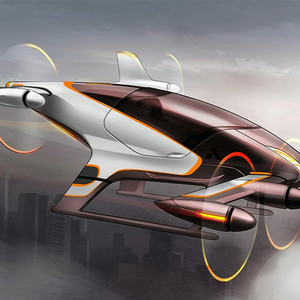
So we simply or not simply tilt our wings and we have an assembly of eight electric motors and propellers that tilt with the wing.
And how many passengers? So we target one or two passengers or cargo if needed.
Right. And just to give you an idea of size, it's roughly the footprint of two parking spots.
So we have to be able to fit in a typical dense urban environment that size of roughly two parking spots.
You could land or pick up or land on a roof.
You could pick up or land in a designated ground space that was, you know... made for this or is it mostly picking up and landing on roofs?
Theoretically, we can land on any hard surface.
We also have to understand at the beginning of the rollout how people interact with the vehicle, what's a safe way to interact.
A very good starting point is the concept of vertiports, centralized hops that you have in the middle of the city. that are connected to existing infrastructure and where you can efficiently have people utilizing that vehicle to get in and out.
And we also assume that people interact with our vehicle with like a cell phone or an inhaling service that they call the vehicle.
Right. And I hail it or I go to the vertiport and I show up and get in my vertical liftoff air taxi and then I'm on my way.
Yeah, but it's a radically new product. There will be a lot of learning on our side, also people in the activist side, what's the best way to deploy that.
How is it then different from developing a driverless or a pilotless or a autonomous system in the air versus the ground?
So we touched on the case once the vehicle is close to the ground or at the ground.
There's a surprising amount of similarities to an autonomous car.
Once we open the air, it's a very different situation.
So we move very fast and it's a 3D problem.
So coming from automotive, the surprising fact was there's little braking you can do.
So you basically have to escape the situation.
And then you can have vehicles coming at you at a very fast speed.
And so it's the worst case you have closing speeds of about 100 meters per second.
And it means you want to see obstacles ahead of you very fast. and very far.
Just to give you an example, if you have a closing speed of 100 meters per second and you can see an obstacle at 500 meters, it's five seconds to impact.
So, that means you need to see and identify an obstacle that is very high precision and has to be fast.
And you also need to, do you imagine, let's say the sky is dark with these flying taxis, How do they communicate then with each other?
Does it become sort of a root like we have in you know, for airplanes, there's these kind of air routes that they follow.
Do you imagine some sort of network that these vehicles follow as well?
Or is it... Hey, we're just going to go where we can, when we can and how we can.
We envision a system of air roads, similar to probably what you have in urban environments where you can bundle traffic. in a way that you can condense it in a given ground or volume in our case.
And it has several aspects such as safety, throughput, noise topics.
The reality is none of that is in fact existing in a way where we would need it currently.
There are a lot of regulations for the airspace. but they're mostly geared towards other type of air vehicles, not the urban air taxis.
Because there are some helicopters, but there's not a lot.
Otherwise, it's aircraft taking off and landing at airports.
So what regulations or what changes need to occur for this to actually happen.
So we started the interaction with the FAA to discuss what type of regulations do we need to have in place to permit that type of flight and to make it safe.
Right. So I'm sure it's an ongoing conversation and we'll get there.
I mean... Why electric, too? I mean, I can imagine, but they certainly they're not polluting and they could be quieter.
But are they? And what are the considerations there?
So at the beginning of the project, we spent a lot of time in understanding what are the enabling factors, cost drivers, And they're basically two key enablers.
One is electrification and the other is piloting.
So electrification, if you do a cost breakdown of the hourly cost for a helicopter to be operated, If you simply go from a traditional engine to an electric engine, you have a cost savings of almost 70%. which is dramatic.
The cost saving is mostly maintenance and energy costs.
Right, because helicopters, I imagine, are pretty complex engines and electric engines are like one moving part.
And then also moving to an electric propulsion system, you can have an inherent redundancy.
So if you have... eight motors, you have a whole different redundancy concept than if you have one motor.
So since we're talking low cost urban air mobility, the cost factor was essential.
And this is the key for electric propulsion.
If it has a range of 100 kilometers, how does it then, if there's landing or...
Vertiports, you go charge at the vertiport, you know, in between pickups or how does that work?
That's still something we are looking to what's an efficient way how to do it.
Obviously, there's the aspect of charge time.
We also currently look at battery switching. as a different alternative.
Right. Swap out a fresh one for one that's under you.
Pardon the interruption, but we have a favor to ask.
Leave us a review on iTunes, Google Play Music or whatever your favorite podcast platform of choice is.
It helps more people find us. As always, thanks for listening.
Now, back to the good stuff. What does it look like?
I know we're doing this, you know, it's audio, so it's hard, but you talk about eight and they tilt.
I mean, it must look pretty cool. It basically has a rear and a front wing. that you can tilt.
It has a passenger cabin that we designed to be very inviting and open. and has skits and it's a very compact design and basically look at what's the design that's inviting for people that the people can accept.
Right. And when you say it's got an inviting interior, I'm not cramped in like I'm in some tiny little plane.
I'm doing my work, read my email? Well, it has to fit one person or two and a minimum amount of luggage.
Right. And the market, as you imagine it initially, is whom and kind of where?
Urban commuters. Yeah. Any large city. that has sufficient amount of congestion, which would be all of them.
A lot of them. All of them. Yeah, good point.
And so we envision a system where we have basically a billion flight hours per year that we can provide.
So obviously this is really... a scalability topic.
Coming back to the vehicle design, we look at low-cost solution designed for mass manufacturability. and also develop and manufacture an air vehicle at substantially higher volume than what's common currently in the aerospace.
And the materials, I mean, I know things change quickly, but is it materials that we're using in aerospace today or is it all sort of advanced composites and things like that?
Let's put it lightweight materials are key for that.
Yeah. Because, I mean, you're energy limited. and there's a cost weight equation among other things that we have to put into place.
Now, the folks who are working on autonomous driving, they have the advantage of, you know, there's plenty of people and cars on the road that can drive that they can get the data from to help teach their systems to drive safely and efficiently.
How do you guys do the same thing? How are you going to be able to teach your deep neural net, if that's what it is, to fly in this manner?
That's actually a very good question. Indeed, it's significantly different.
We don't have the situation necessarily that we have a human driver and then we learn from a human driver.
It's a different rollout strategy that we have.
When we roll out a system like this, We don't need to go into previously unknown areas.
You could foresee a rollout in an area. We simply fly from A to B.
And we have full 3D modeling. We can model all the safety cases.
And when we are absolutely safe flying from A to B and back to A, then we fly A, B, C to understand what's safe.
Right. And all these outlier incidents, et cetera, things coming at you, wind shear or whatever you might encounter.
That's correct. Part of the development is then also to set up the right balance between physical verification and kind of virtual verification. both for outliers, for algorithm development.
A couple of interesting topics. How do you even generate enough, speaking about machine learning training samples, For an object detection, say we want to detect a drone, then certainly we could buy all the drones in the market and do modeling.
Yeah, just because you could recognize one drone doesn't mean you recognize the other one as a drone.
An interesting part is now Burt's. My favorite bird is the Canadian goose, 20 pounds.
You don't want to hit that thing. You do not.
Now, how do you generate 100,000 training image from a Canadian goose?
It's a very... Interesting topic. So what do we do with real data and what do we do with modeling and how can we basically also abstract a class of objects, then Tying into that, I always like to explain the case.
You have three obstacles coming at you. A large bird, a drone, and an aircraft.
First, you have to understand something is coming to you.
Then you have to detect what exactly is coming at you.
And then you assign... a risk to each. And now you do an escape maneuver and all of the three also do an escape maneuver.
So it becomes very quickly a very complex decision-making problem.
And obviously, different things that fly have different kinematics. and different risks towards us.
And yeah, it's a very interesting decision-making problem.
So the escape pattern would work differently for a plane than a goose.
Yeah. For sure. And then a drone too. That's interesting.
I want this. We all want this clearly. And I can imagine that you could build a vehicle that flies today.
Maybe you already have. What's the hardest thing that you're up against?
And, you know, is it regulatory? Is it...
Just the fact that like people are like, I'm not getting in that, which I don't think actually that's the problem, because I think you could have as many people on these things as you want.
What are you up against and what's a kind of realistic timeline?
Well, it's all the excitement and fun of building a completely new category.
And there's always the question when you do that, What's the right approach?
What's the right rollout to bring it in the market?
How do you bring the market where the customer acceptance?
That's something, what are regulatory topics?
So there are a lot of topics that we need to look at that.
And in terms of timeline, so by the end of the year, we want to fly a full-size prototype.
So currently we fly subscale prototypes, so air vehicles that are just scaled down.
Right. And the full-scale flight by this year.
And we want to have productizable demonstrator available by 2020 which is very, very soon.
And in general, I think this type of air taxes will have market traction in roughly a 10-year timeframe.
Right. Depends on who you talk to about driverless cars, but in some ways it might be an easier kind of sell or... problem to solve from a regulatory environment from a congestion you know anyway then then on the ground i mean you have experience in both what is your feeling on that Coming from the autonomous car world, if you basically assume you're in the US, the first autonomous car, then you have to live with the other 260 million road vehicles.
Meaning your safety is not necessarily only defined by your own ability to get from A to B.
It's by a major part defined by your ability to basically interact with the mistakes from the 260 other million vehicles, which serves this legacy problem. as a new type of vehicle.
And in our case, it's less of a legacy problem.
I like it because it's a clean sheet approach.
So we can have a system of rules and regulatory framework, but also a way how those vehicles interact, how we utilize them. starting with a white sheet of paper and doing it the right way.
And this is a huge opportunity. Well, I can't wait to see both the smaller version and the full bore version end of the year. sometime by the end of the year, let's put it that way.
And then I can't wait to fly in one. So this is exciting stuff and I can see how it's going to happen sooner rather than later.
Arnie Stoszczyk, A3 Airbus, thank you so much.
Pleasure to be here. Thank you.