Welcome to NVIDIA's AI Podcast, and we're recording from the floor of the 2017 GPU Technology Conference.
A gathering of the AI faithful here in Silicon Valley.
Depending on who you are, preparing a meal is either a joy or a chore.
And sometimes it's both. What is true of either scenario is that when you are in the kitchen, you can always use help.
From that moment when you stare into the refrigerator and wonder, what can I possibly make for dinner? to keeping an eye on that chicken in the oven so it is roasted to perfection.
Our guest... Christo Bojanoff, CTO of Init, thinks AI can help us to eat better, cook better. and spend less time slaving over meals and more time with family and friends.
Bristo, welcome. Thank you. All right, what did you eat for breakfast?
What did I have for breakfast? My breakfast are usually very light.
I have some fruits, maybe some oatmeal. And they weren't prepared by robots?
No. Okay, you prepared them with stuff. Well, that gets me to my point.
We don't have robots in our kitchen yet, but the connected kitchen is coming and coming fast.
In it and in your work, how do you bridge the world that we're in today where I go and get a box of cereal out and have... cereal for breakfast or whatever, and this connected world that we all know we're headed toward.
Sure. goal is to actually take part in all phases of your interaction with food.
That includes things like planning your meals for the week, for example, which doesn't have anything to do with robots.
You're shopping and inventory management.
But then it goes into... For the times when you cook, perhaps we can watch that process for you and execute it to perfection so you don't have to be... involved in it directly.
You don't have to spend your time away from family and friends and monitoring your oven.
This sounds like a data problem at the first level of it, right?
You need to collect the data about how I eat and what I do and what I like for that matter.
So how are you envisioning that part of it?
How does the data kind of get into your AI system?
And then what does it learn about us as it learns about us?
There are several aspects to this, in fact, so connected ovens are already a reality.
Many people already have a connected oven.
They don't necessarily know it, but Wi-Fi is getting very inexpensive.
Costs have been dropping down significantly. over time.
So connectivity itself is not an issue. So data will be available and the ability to control those appliances remotely or programmatically is there already on the market. so we're looking at leveraging that on the other hand looking at things like your inventory for example what's in your fridge identifying items can tell us a lot about who you are, what your preferences are, what brands do you buy, do you like organic, do you like fresh foods, things like that.
We approach this on many different levels.
And ultimately, if you get this full picture of me, and my family too, for that matter, if you have a family, but then you get this whole idea, I'm running out of... peanut butter or this thing that you like, or you're buying a chicken.
Have you thought about, you know, you need these herbs or you need these potatoes to go with it?
Is it the full kind of picture? And how are you getting that picture?
Absolutely the goal. I mean, clearly we cannot build a full picture of everything you have anywhere in your house.
That will be coming over time. But realistically, by knowing what are the major items that you've purchase, we can actually make those recommendations that you mentioned. you know, what would be a nice, fresh side that is nutritionally appealing as well as tasty and that your family will like. this is definitely something that we're highly interested in.
And this is why we approach this not as a, a recipe duration experience.
We approach this as a meal orchestration or your weekly meal planning experience.
And that's where we get a lot more power to be able to say, well, you're buying some kale, why not use that, you know, the rest of it in a separate meal later on in the week, for example.
So walk us through what that week could ultimately look like for people.
I go out shopping on Sunday afternoons because I'm like, oh, God, here comes the next week.
What are we going to eat? So how would that week sort of scenario play out?
So we're looking at a few different options.
We want the experience, your experience within it to be quite easy, right?
We don't want it to be constraining in any way.
So some people like to plan ahead and we've done quite a bit of user research in that.
So some people will buy for the week, so they like to make a plan.
And this is Or we can help by understanding different recipes and the amounts of different ingredients involved. to make some recommendations about how you can reuse what you have or buy something that will last across multiple meals.
Some people will prefer to buy for that day or for that evening.
And we certainly want to be able to address both kind of scenarios.
Right, I'm in the latter camp where I can't think that far ahead, so I just plan for one meal, which drives my wife a little bit crazy.
Is there going to be something on board where I walk into, you know, the produce section and I take a picture of a beautiful, I don't know, dandelion greens or something, and you're like, okay, What do I do with those?
What could they go with? I mean, is it that kind of thing where it prompts all sorts of options?
Yes, I mean, that's certainly a scenario that we've actively worked on.
And this is where we use a lot of computer vision technology to identify items that you yourself might not exactly know what they are or what the real name is and what you can do with them help you with that step but then go a step further, make some recommendations.
If this is the first time you're encountering a particular problem, vegetable or fruit you know maybe there's a more conservative recipes we can suggest versus If you're an experienced user, you likely know what it is.
And maybe we can then push you a little bit further and recommend something more exciting.
Oh, that's a great approach where you're not, you know, because people's level of either interest or experience in cooking is all over the map.
Yeah. It'd be nice to sort of like build up your experience and build up your expertise as you go.
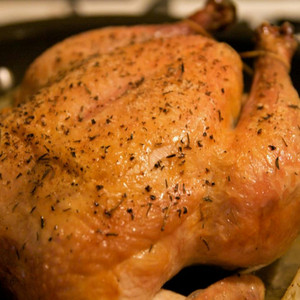
So you mentioned... Computer vision, and let's talk about the lowly roasted chicken, which is both the lowly roasted chicken and one of the greatest things ever if done correctly.
People who know how to roast a chicken know how to roast a chicken, but it's not always that easy.
So can computer vision, you know, at the end of the day, help me roast a chicken to perfection?
Absolutely. And the way we see this is it's a combination of computer vision as well as a number of other sensors.
We have a culinary team that researches particular products and the best way to cook different products depending on their initial condition, on their temperature, on the weight, all of those factors get taken into account.
Certainly, we've been looking at using computer vision to identify the state of that chicken.
Does it look like it's perfectly roasted?
We also use it to complement and monitor user activities.
For example, if in the middle of the recipe you need to flip your chicken or do some operation, we can actually make sure that you actually did it and you didn't forget and then just push a button in the application or on your oven.
And our appliances, I mean, programmatically could, and they don't do this yet, but You know, they're either sort of on or off, and you can turn down the temperature or turn it up, but that whole programmatic approach to whatever it is you're cooking, do you foresee that our appliances will do that for us?
That like, hey, Here's the start. Here's the finish.
It will handle all the kind of adjustments in the middle.
Absolutely. We feel that's coming. And we're working on making that happen.
So from an AI perspective, what are you bringing to bear in this?
Is it, it's a deep learning problem and how does the data come to you guys and And then what are you teaching, you know, your systems to really do?
I mean, I guess be good cooks or are they good oven watchers or good pantry cooks? spies or something.
Yes. We've explored different AI flavors, if you will.
Computer vision has definitely be in a core area for us simply because it helps us identify both inventory and product state.
So that has been very useful. We've used deep learning heavily relying on GPUs for that, for both speed and cost efficiency.
We've looked at different approaches to more textual tasks like analyzing recipe, analyzing user reviews, So that's kind of another flavor of AI where we need to be able to match your preferences and your needs to what you have and what you don't. typically buy in your history and then be able to make some meaningful recommendations.
Over time, absolutely, we would want to integrate the sensors and help you be a better cook or help you.
You know, it's like your car's ABS. You hit the brakes, it detects if there is some slippage on one wheel or the other, it can act much faster than you.
And the idea is the same, right? So give you control over the high-level picture of what is it that you're making, how would you like to make it, but then Take a lot of the grudgery of how do I monitor that product and how do I test that it's right and automate that for you.
But you won't peel garlic for me, at least not yet.
That's one of the things I hate the most, where all the little garlic papers get stuck to your fingers.
You know, that's right. There's a lot of robots technology coming up. there are different estimates about how far out that is.
And there are a lot of questions there about how maintainable such technology is.
I mean, you have to wash the whole robot every time.
And that's what kind of take away some of the magic.
Yeah. I love the idea, though, after dinner, like, oh, God, it's my turn to watch the robot again.
But that may be coming, right? So, again, it's a matter of timeframes.
We certainly feel, though, that the connected kitchen that can help you make intelligent. decisions and help you act them out for you is just around the corner.
And let's talk about you personally. How did you come to this and kind of focus your brainpower on this problem?
I mean, do you hate to cook? Do you love to cook? is it just a problem that you saw out there in the world that wasn't being addressed so I joined in it through my network you know one of the co-founders that in it we've worked closely together in the past, so that's how I got introduced to the idea and the team.
For me... It's an opportunity to really do something revolutionary in a different market, right?
So we see a lot, even here at GTC, we see a lot about self-determination. driving cars and about drones and all those applications.
But we felt that we can use technology to really uplift an industry that has been fairly conservative and for a good reason, but it's a good time to do this.
Yeah, I mean, most, you know, the concept of refrigeration, yes, we've had some Freon versus other coolant changes, but, you know.
The idea is the same. Ovens, you know, something heats up either electrically or with gas or, you know, maybe microwaves.
There's nothing dramatically different there.
The latest rage is, you know, circulators, which is just precision temperature control and maybe, you know, induction tops.
Yeah, but they're not programmed. Like, they don't have real intelligence as far as I can tell.
But it sounds like it's coming. Yes, we certainly feel it is.
And that's our mission to make this possible and make it really useful.
When you look out over the landscape, like, for example, at CES in January, there was a lot of large appliance manufacturers there, and they were all integrating with Alexa.
Amazon's spoken machine learning device.
Is that how it's going to go down, you think?
Is it going to... The connected home and the connected kitchen...
Is it going to funnel through individual appliances as you see it, or is it going to be their central hub through which things happen?
Likely a lot of the activity will happen through a hub, which more likely likely than not will be your mobile device, your iPad.
So while you're sitting on the couch, you can plan your meals, you can send instructions to your kitchen, things of that nature.
Certainly, voice control has a lot of appeal and very often while you're preparing some kind of food, your hands are dirty, you would want have a voice interface, that's very natural.
But it's also restrictive, right? So if you use Alexa, you see how often maybe you get misunderstood or it's a different kind of interface. which will keep improving and it will be an essential part of the process.
I don't feel that that will be the only entry point necessarily.
And for Init, you guys are software makers, developers.
You're not hardware developers as well. Not in our core, although we actually, the way we started out is we prototyped ovens.
We have active prototypes in our kitchen today that we use for a lot of the culinary research because our prototypes are highly programmable. right so this is this is where we see the field is going eventually and for us to be pioneers, we need to have access to that early on before it really is available on the market.
So we've built hardware, but we're not... hardware makers as a company.
You know, cooking and food is one of those things that's very personal for people, or for a lot of people at least. you need to be sensitive of too as you're developing your AI and your system and approaches.
And then culturally, kind of what change do you think do we need to get to to make this just part of all of our lives?
When we do our user research, we do some segmentation.
We look at different groups, different socially, age groups, things of that nature.
So some parts are more receptive to change of this kind.
Now, having said that, our goal is to make this a very seamless experience where you don't have to commit a lot upfront we don't have to make you change the way you work I mean this is why for example we invest so much in things like computer vision so that we can see what it is that you have we can see what you're interested in and take actions or make meaningful recommendations for you rather than ask you to log everything you purchase or or something of that nature which nobody wants to do So your background is as a computer vision expert.
Is that fair to say? So my background, I've done a lot of different things in the past, all around software development, but varied.
I've been in storage. My research in grad school was in computer security actually, which is very applicable here.
We take users' privacy very seriously. You take my famous recipe for upside-down crab cakes seriously, too, I bet.
You better protect that. Well, you know, that's IP.
I mean, that's precious, right? But yeah, I've also done a lot of work in the mobile development field, which for some of our early work on hardware, for ovens, we've actually had embedded, essentially an embedded tablet as part of an oven where It's kind of the whole package and we can run our software in that environment and control the device.
Is it embedded in the controls of the oven or is it like inside the oven?
It's your window into the oven is a big tablets screen and you can see inside, you can see your recipes.
It's a rather innovative and our experience design really shows through.
That brings to mind, I mean, you have chefs, obviously, and food people as opposed to technology people.
Where do you guys butt heads or where are their requests kind of? make you scratch your head or vice versa?
Or are you guys always in sync? Oh, you know, it's a very interesting question because it took us some time right to find our groove and make sure that people with with these very different backgrounds tech versus food really worked well together, but there's nothing to that.
The reason I ask is because engineers, you know, that kind of end road for food sometimes seems like it's soylent Like, well, I just put nutrients in a jar and let's drink it.
Well, we actually, in our engineering team, we have many foodies, right?
I mean, we have people who enjoy... enjoy going out and exploring.
They enjoy making a meal at home. So I think it goes both ways.
Certainly have those who think that, you know, it's Soylent and, you know, something in a cup every morning and that's that.
But, you know, I think claiming that's the future, I mean, that probably underestimates people's need for creativity and for diverse experiences.
So we're trying to help uncover those things, right?
How can we make it so you can make something new yourself but remove the anxiety and remove the stress of well it's something new you know will it work out you know I have friends coming over, how will all this fit together?
So that's the idea. The goal then, too, it sounds like, is not to take people out of the equation at all.
I mean, we're all going to be better cooks.
We just might not have to do as much of the tedious stuff that we don't like to do.
No, yeah, because if you take people out of the equation, we're even doing things which... some of the partners we speak with love is we take frozen meals and we show how If you follow the standard recipe, which is on the box, you put it in the microwave, you run it for this long, it comes out mushy and not particularly appealing. you put it in an oven, you let our programs run on it, and you get something that's actually tasty.
I mean, it's almost like you went out and you got the fresh pizza, right?
That's the objective here is make things that may not be exciting, make them exciting or make things that are exciting accessible to you.
One final question for you. Most people, at least here in the US, and most places I've been, They'll buy appliances, and it's a big investment, and you expect them to last a long time.
Once you combine that kind of lifespan with technology that moves and changes so quickly, are we talking about having to replace things every two years like our handsets or, you know, can we get upgrades over the air like a Tesla?
I mean, how do you see this playing out?
So this is a really, really good question.
And this is where, at Tinet, we've tried to leverage cloud computing as much as possible, where As you get new technology, you get upgrades kind of for free, right? your oven, your fridge, they're sending the data up to the cloud that gets processed and you get actionable results as a user to your mobile device and this way all of the technology can progress at independent paces.
So you ride the curve of whatever is behind the cloud provider or however you guys are doing in ISA.
Exactly. Exactly. And over time, you will have these modules that get embedded in particular devices.
It's unavoidable, but... This is why our goal is to work with major vendors who design the whole kitchen appliance suite and help them make this a modular system where we can replace just the right piece.
So if you need to embed anything, then you can do it in a way that's maintainable over the lifespan of the device.
We talk a lot about on this podcast, autonomous, you know, fill in the blank.
I mean, this isn't the driverless oven or the driverless kitchen, really.
It's I mean, how would you describe it in those terms?
Our oven prototype is what we call the self-cooking oven.
Not self-cleaning, but self-cooking. I say, well, all right, so maybe we're headed to driverless ovens.
Risto Bojanoff, thank you so much. Thank you, Michael.
PostScript here. If you are listening to this podcast on iTunes, Google Play Music, or whatever your favorite podcast player is, do us a favor and leave us a review.
Thanks for listening.