Oh, here we go.
We got some repeat after me and shadowing practice.
Let's work on our pronunciation, our fluency, our speaking skills.
Steve Jobs' favorite book.
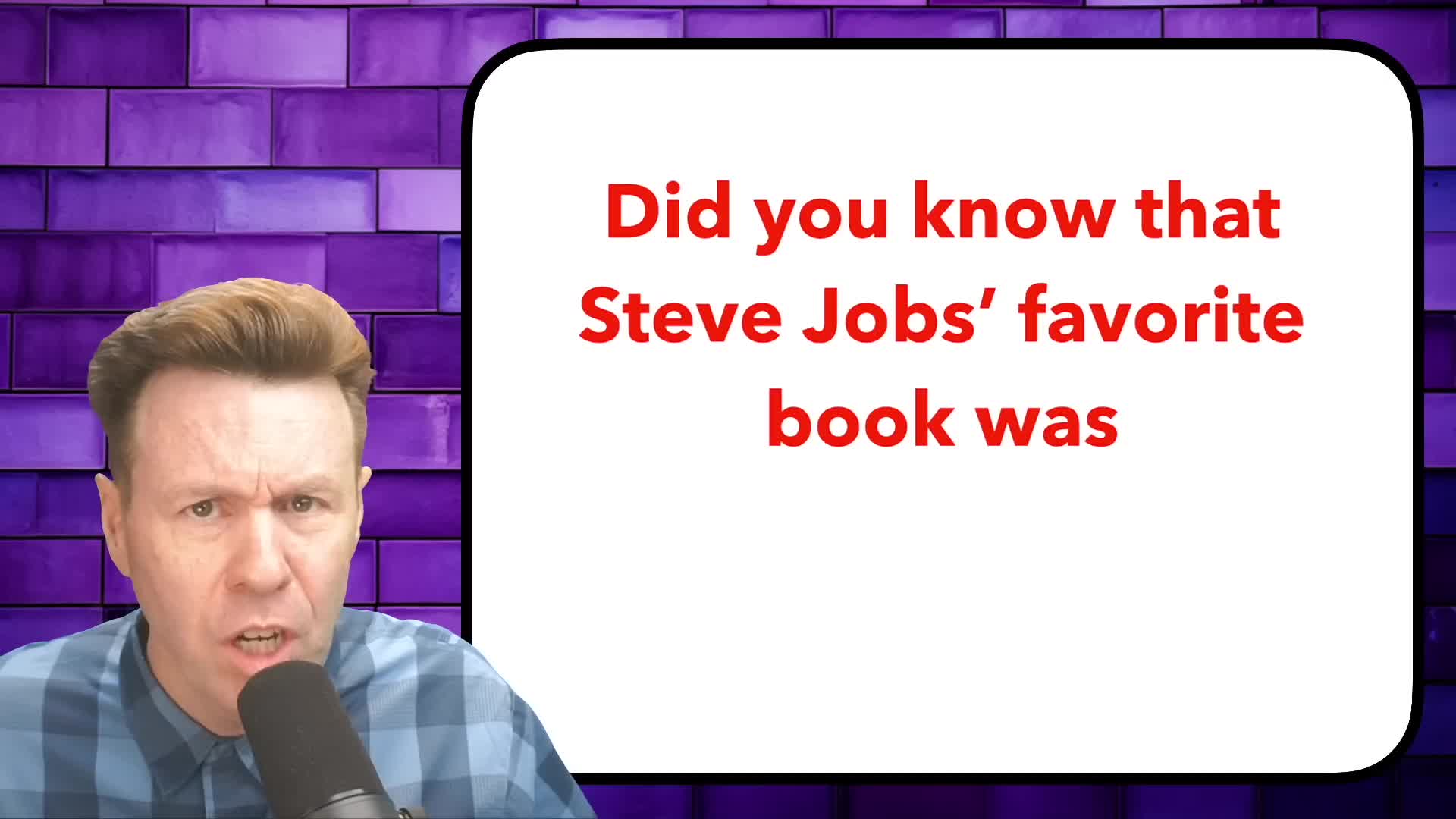
Did you know that Steve Jobs' favorite book was?
I want you to repeat after me.
Did you know that?
I want you to say, did you know?
Did you know?
I want you to say, did you know?
Did you know?
Did you know that?
Did you know that?
Did you know that Steve Jobs' favorite book was The Inventor's Dilemma?
Dilemma.
What's a dilemma?
Dilemma is a situation in which a difficult choice has to be made.
You have to make a choice between two things.
This one or this one, it's a dilemma.
It's a difficult choice.
So let's say all this together two times.
Here I go.
Did you know that Steve Jobs' favorite book was The Inventor's Dilemma?
Did you know that Steve Jobs' favorite book was The Inventor's Dilemma?
It explores a common issue in business.
It explores a common issue in business.
Where large successful companies, where you can say, in which in which large successful companies, where large successful companies often overlook obvious opportunities.
So if you overlook something, you fail to see it.
You overlook it, you fail to see.
Obvious is just clear, plain, easy to see.
If it's an easy to see opportunity, it's an obvious opportunity.
And if you fail to see it, you overlooked it.
All right, let's say all of that two times.
Here we go.
It explores a common issue in business, where large, successful companies often overlook obvious opportunities.
Again, it explores a common issue in business where large, successful companies often overlook obvious opportunities because they're too attached to outdated technologies.
Outdated, old, old technologies because they're too attached to outdated technologies, you say it.
And can't see the value in moving on.
So they're unable to recognize the benefit of keep moving forward.
They just got to keep moving forward, moving on.
Out with the old, in with the new.
And they can't see the value in moving on.
Okay, we're going to say all of it two times.
Here we go.
Because they're too attached to outdated technologies and can't see the value in moving on.
Again.
Because they're too attached to outdated technologies and can't see the value in moving on.
A classic example of this is Kodaks.
Kodaks, you know the film company Kodaks.
They made lots of film and cameras.
Well, they didn't make so many cameras, but they made mostly film.
They sold a lot of film and some cameras.
They actually experimented with digital cameras back in 1975.
That's right.
But let's go back.
They actually experimented with digital cameras back in 1975.
You say it.
They actually experimented with digital cameras back in 1975.
Try again.
Good.
But they never fully embraced...
The technology.
But they never fully embraced the technology.
So if you embrace it, you accept it, you adopt it.
So they never fully accepted, they never fully adopted the technology.
Why?
Because they had invested billions in analog films.
Analog, that's the opposite of digital, right?
Digital film, analog film.
Because they had invested billions in analog film.
Okay, we're going to go ahead and say this two times.
Here we go.
But they never fully embraced the technology because they had invested billions in analog film.
But they never fully embraced the technology because they had invested billions in analog film.
Fast forward 30 years.
Fast forward 30 years.
30, 30 years.
So that just means now, 30 years later.
Now, 30 years later, fast forward 30 years.
And Kodak ended up going out of business.
That's right.
Kodak went out of business.
They ended up, they eventually went out of business.
They ended up going out of business.
I'm saying it two different ways there, aren't I?
Kodak eventually went out of business.
Kodak ended up going out of business thanks to digital cameras, so that's a little sarcastic.
Thanks to, it's due to as a result of digital cameras.
Thanks to digital cameras.
All right, we're going to say this two times.
Fast forward 30 years and kodak ended up going out of business thanks to digital cameras.
Fast forward 30 years and Kodak ended up going out of business thanks to digital cameras.
The concept from The Inventor's Dilemma.
So that's the book, right?
The book, The Inventor's Dilemma.
The concept from that book isn't just limited to business.
It isn't just limited to business.
It extends beyond business and is relevant to life as well.
It also applies to life. is relevant to life as well.
I had two ways to say it.
I couldn't decide which way should I say is relevant to life as well.
It also applies to life.
Two ways to say that, right?
It is relevant to life as well.
It also applies to life.
All right, let's say that twice.
The concept from the inventor's dilemma isn't just limited to business, it also applies to life.
Again, the concept from the inventor's dilemma isn't just limited to business.
It also applies to life.
Often when we miss out on significant opportunities.
Miss out on, miss out on means to fail to get something, or you overlook something, you don't see it and you miss out on it.
You fail to get it, you miss out on it.
Often, when we miss out on significant opportunities, it's not because we're unaware or not looking.
It's not because we're not paying attention.
It's not because of that.
It's not because we're unaware or not looking.
All right, let's say this two times.
Here we go.
Often, when we miss out on significant opportunities, it's not because we're unaware or not looking.
Again.
Again.
Often when we miss out on significant opportunities it's not because we're unaware or not looking.
Rather instead more precisely it's because we're so comfortable with our old habits.
Rather, it's because we're so comfortable with our old habits that we let potentially life-changing chances potentially means it might happen.
We let life-changing chances that potentially they might change our life, we let them slip through our fingers.
If something slips through your fingers, it gets away from you.
It escapes you.
It slips through your fingers.
All right.
Two times.
Here we go.
Rather, it's because we're so comfortable with our old habits that we let potentially life-changing chances slip through our fingers.
Try again.
Rather, it's because we're so comfortable with our old habits that we let potentially life-changing chances slip through our fingers.
And that's it.
That's our little story about Bill Gates' book.
We're going to start from the beginning, non-stop.
Go ahead and shadow me.
Read along if you're not able to shadow.
If you're able to shadow, say it with me.
Here we go.
Did you know that Steve Jobs' favorite book was The Inventor's Dilemma?
Okay, I messed up there.
Let me start over.
All right, we're going to start over.
Steve Jobs' favorite book.
I said it wrong, so I'm like, oh, I said it wrong.
Here I go.
Did you know that Steve Jobs' favorite book was The Inventor's Dilemma?
It explores a common issue in business where large, successful companies often overlook obvious opportunities because they're too attached to outdated technologies and can't see the value in moving on.
A classic example of this is Kodak.
They actually experimented with digital cameras back in 1975, but they never fully embraced the technology because they had invested billions in analog film.
Fast forward 30 years and Kodak ended up going out of business thanks to digital cameras.
The concept from The Inventor's Dilemma isn't just limited to business, it also applies to life.
Often, when we miss out on significant opportunities, it's not because we're unaware or not looking.
Rather, it's because we're so comfortable with our old habits that we let potentially life-changing chances slip through our fingers.
Boom.
Good workout.
Where's my camera?
There it is.
Boom.
Good workout.
Keep moving forward one step at a time and we'll get to the end.
All right.
There is no end, by the way.
So we're never going to get there.
It's like chasing the gold at the end of a rainbow.
All right.
We'll just keep making more and more of these English speaking practice videos.
It's fun.
I'll see you in the next one.