Hey, everyone.
I'm Alex.
Thanks for clicking and welcome to this lesson on five ways to use infinitives.
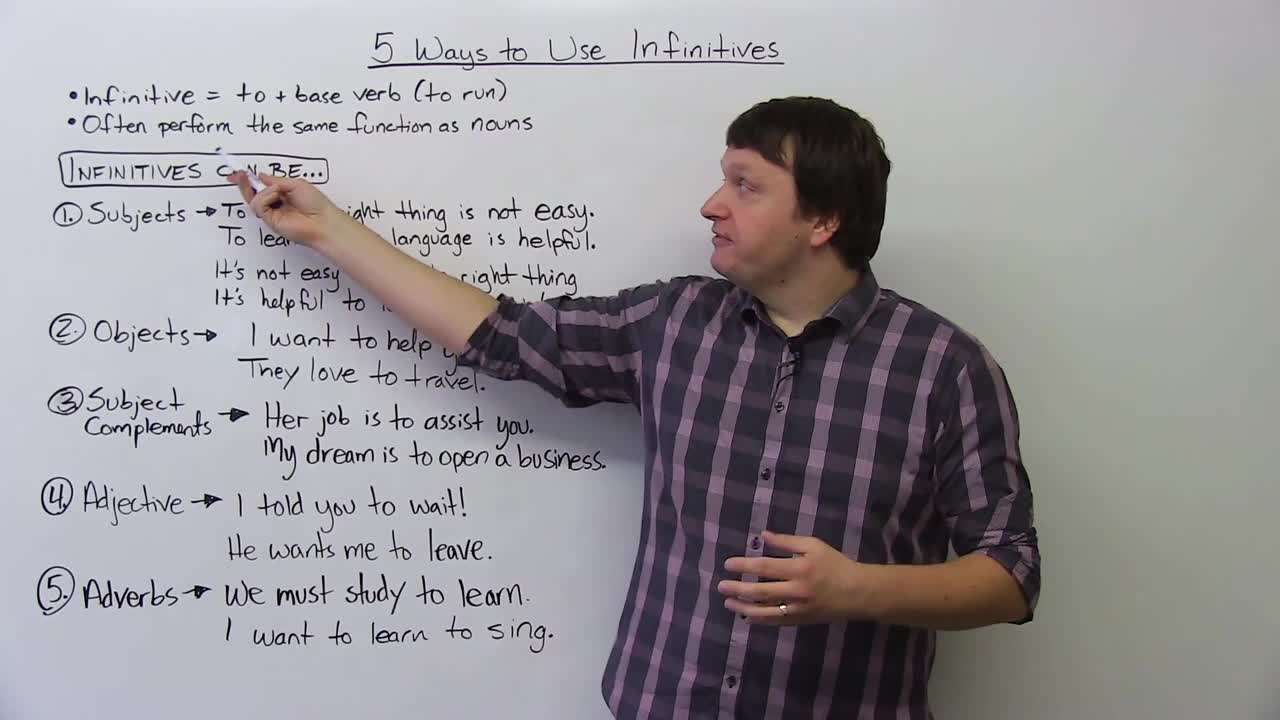
To refresh our memory, an infinitive in English is two plus the base verb.
So for example, to run, to play, to hide, to eat, to go, these are all examples of infinitives.
Now, despite the fact that infinitives refer to actions, they often perform the same function as nouns.
So let's look at the five ways that we can use infinitives in English.
So here we have, infinitives can be subjects.
They can be the subject of a sentence.
This is a very formal structure, but it is possible.
For example, To do the right thing is not easy.
To learn a new language is helpful.
So here we have to do, to learn.
Okay?
And again, these are infinitives, and this is a very formal structure.
So in speaking we don't often use infinitives as subjects, but I want you to know that it is possible.
However, in speech, when we use infinitives in this kind of context, we usually put them in the middle of an it phrase.
So, for example, instead of saying to do the right thing is not easy, we say it's not easy to do the right thing.
Or instead of to learn a new language is helpful in common speech, we say it's helpful to learn a new language.
Okay?
So again, this is formal.
This is much more common.
Okay?
Second of all, infinitives can be objects.
So for example, I want to help you.
Here we have I, the subject, want, the verb, to help.
And to help here would be an object.
Okay?
So I want to help.
They love to travel.
And in both of these sentences, the infinitive is actually the object of the sentence. here, number three infinitives can be subject complements.
Now, a complement is basically something that gives you more information about the thing you're talking about.
In this situation, we want more information about the subjects of these sentences.
So for example, her job.
Okay?
Tell me more about her job.
Her job is to assist you.
So if this is a receptionist, for example, her job is to assist you.
You're giving more information about her job.
My dream.
My dream is... What is your dream?
Give me more information about your dream.
My dream is to open a business.
Okay?
So here we have infinitives used as subject complements.
Now, these last two infinitives can be adjectives and adverbs.
You might be surprised, because when you think of adjectives, you probably think of colors or words like happy or sad, or cold or hot.
However, if you're not comfortable with thinking them as adjectives, maybe think of them as object complements.
That's another way to look at it.
If it's mentally, it doesn't make sense for an infinitive to be an adjective.
However, let's look at an example.
I told you... So here we have subject, verb, object.
I told you to wait.
So what did I tell you?
I told you to wait.
So you're describing what you told this person.
He wants me to leave.
What does he want me to do?
He wants me to leave.
So I'm describing what he wants.
Again, adjectives are description words, right?
Describing what he wants.
I'm describing what I told you.
Okay?
And finally, adverbs.
So again, adverbs give more information about a verb.
In this situation, we must study.
We have the verb, study.
Why must we study?
To learn.
So here, you have verb plus infinitive.
And here, I want to learn to sing.
So here, I want to learn.
To learn is an object, and we want to give more information about the object and why we do it.
So here, we have to sing.
Now again grammatically, if you don't understand adjective adverb, subject complement, I don't want to say it's not important.
But in everyday speech it's not that important to be able to say This is an adjective.
This is an adverb.
This is a compliment.
The most important thing is do you understand these sentences when you see them?
Do you understand the meaning of, we must study to learn?
I want to learn to sing.
As long as you understand what the sentences mean, the grammatical you know.
The grammatical language is not as important as long as you know how to use it in different parts of the sentence.
Okay?
So if you want to test your understanding of this information, as always, you can check out the quiz on wwwengvidcom.
And don't forget to subscribe to my YouTube channel.
Also, don't forget to click on the other videos related to this infinitive series.
I'll see you next time, guys.
Take care.