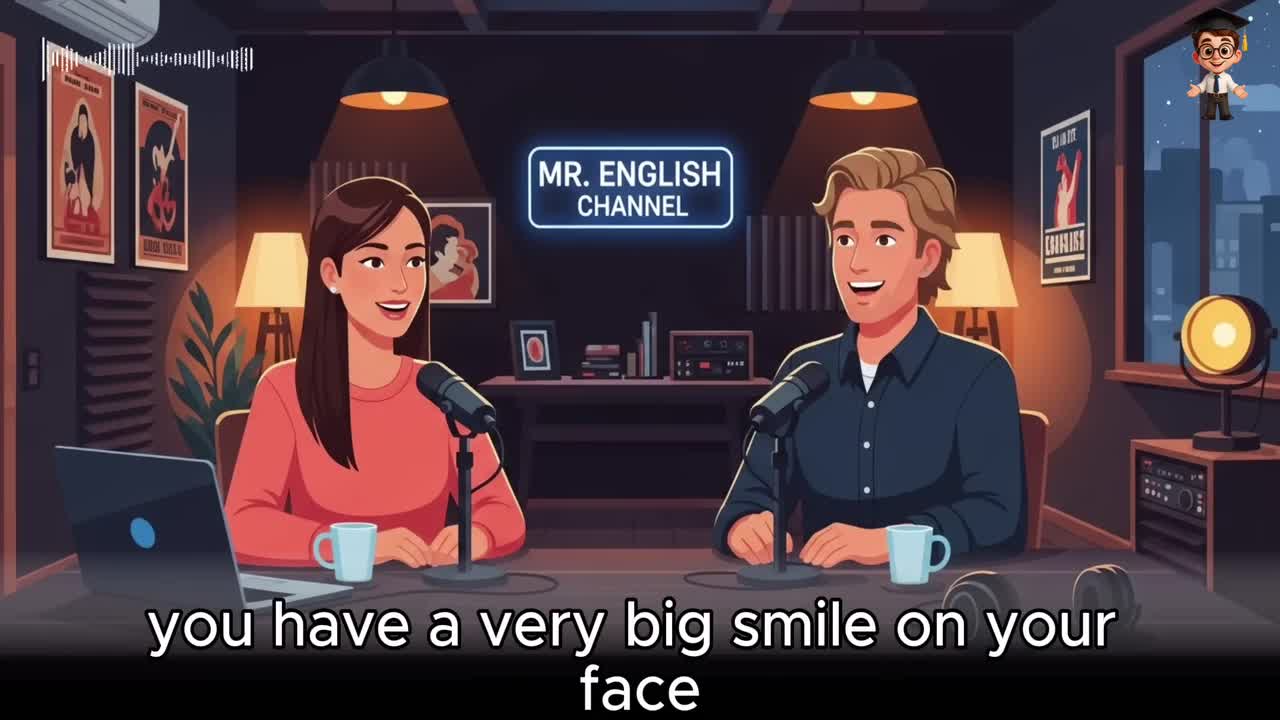
Hello, everyone, and welcome back to Mr. English Channel, where learning English is easy and fun.
I'm Emily.
Hello, Emily.
Hi, everyone.
Wow, it is so good to be here again.
I am very, very excited for today.
I can see that, Paul.
You have a very big smile on your face.
How are you doing today?
I am doing great.
Thank you.
I have my favorite green tea, the sun is shining, and I am ready to talk.
How about you, Emily?
How are you?
Oh, I am wonderful.
I am very happy because our topic today is so nice.
It is about friends, food, and talking.
Mmm, food.
I love food.
And I love talking.
Yes, we know, Paul.
You love to talk.
But before we start our big conversation, we have a small favor to ask our wonderful listeners.
Yes.
Everyone, if you like our podcast, please click the like button right now.
It is a big help for us.
Yes, it really helps Mr. English channel.
And please subscribe.
If you subscribe, you never miss a new episode.
And share this with your friends.
If you have a friend who is learning English, send this to them.
Learning with friends is much more fun.
Exactly.
Okay, Paul, are you ready for today's dialogue?
I am ready.
Who are we listening to today?
Today we have Mike and Sarah.
They are friends and they are having a very nice, easy conversation.
I like Mike and Sarah.
They always have good things to say.
Let's listen.
Hi, Mike.
How was your day?
Hi, Sarah.
It was good.
Thank you.
How about yours?
It was a bit busy, but I feel happy now.
Why do you feel happy?
I cooked dinner for my family today.
That's nice.
What did you cook?
I made pasta with vegetables and chicken.
That sounds delicious.
Do you like cooking?
Yes, I enjoy cooking a lot.
It helps me relax.
I usually order food because I don't cook very well.
You can learn.
Cooking is easier than it looks.
Maybe you're right.
Do you cook every day?
Not every day, but I try to cook on weekends.
That's a good idea.
Can you teach me one day?
Of course.
We can cook together sometime.
Great.
When are you free?
How about Saturday afternoon?
Saturday afternoon is perfect for me.
Nice.
Let's meet at my place at 4 p.m.
Okay.
I'll be there at 4 p.m. on Saturday.
Awesome.
I'm sure you'll enjoy it.
Thank you, Sarah.
I'm looking forward to it.
Wow.
What a lovely conversation.
I feel hungry now, Emily.
Me too, Paul.
Pasta with chicken and vegetables?
Mmm, that sounds very, very good.
It really does.
And Sarah is such a good friend.
She wants to help Mike learn to cook.
She is.
But let's look at this conversation.
There are many great expressions here for beginners.
Yes.
Let's start at the very beginning.
Sarah says, how was your day?
This is such a classic.
It is.
It is the perfect way to start a conversation with a friend.
How was your day?
We use was because the day is almost finished or we are talking about the past.
Right.
And Mike says, it was good, thank you.
Then he asks, how about yours?
Oh, I love that phrase.
How about yours?
It is so fast and natural.
Instead of saying how was your day again, he just says how about yours.
It's like a shortcut.
I use that all the time.
If someone asks me how are you, I can say I'm great.
How about you?
Or how about yours for the day exactly, it makes the conversation flow.
Then Sarah says something interesting.
She says it was a bit busy.
Hmm, a bit.
That is a very common expression.
It just means a little right.
Yes, a bit busy.
It's not very, very busy, but just a little busy.
You can say, I'm a bit tired, or the coffee is a bit hot.
I am a bit tired today.
No, I'm just joking.
I am full of energy.
Good, because Sarah says she feels happy because she cooked dinner.
Ah, yes, I cooked dinner.
She used the past tense cooked.
Yes, she did it today, but it is finished and mike asks what did you cook?
I like mike's response.
He says that's nice.
It is so positive when a friend tells you something.
It is always good to give a positive response like that's nice or that's great, very true, it shows you're listening.
Then sarah explains what she made pasta with vegetables and chicken.
Now i really want pasta.
Wait, Paul.
We have more to talk about.
Mike says, that sounds delicious.
That sounds delicious.
This is a great way to talk about food when you don't see it or taste it yet.
You just hear about it, so it sounds good.
Yes.
You can use sounds with many adjectives.
That sounds fun or that sounds difficult.
Or that sounds like a plan.
Exactly.
And then Mike asks a question.
Do you like cooking?
And Sarah says, I enjoy cooking a lot.
It helps me relax.
Relax.
That is a beautiful word.
Cooking is a hobby for her.
It helps her feel calm.
I understand that.
For me, walking in the park helps me relax.
For you, Emily, what helps you relax?
Oh, reading a good book helps me relax. and drinking coffee.
Of course, the coffee.
But Mike says something very relatable.
He says, I usually order food because I don't cook very well.
Poor Mike.
Order food.
This means he calls a restaurant or uses an app to get food.
He doesn't make it at home.
I think many people are like Mike.
They think cooking is hard.
But Sarah says, cooking is easier than it looks.
I love that phrase, easier than it looks.
It means it seems difficult, but when you try it, it is actually easy.
That is true for many things, like English.
Sometimes English looks difficult, but when you talk with us, it is easier than it looks.
Oh, Paul, you are so right.
Easier than it looks.
You can use this for a game, a job, or even a recipe.
Then Mike asks, can you teach me one day?
He wants to learn.
And Sarah is so kind.
She says, of course, we can cook together sometime.
Sometime.
That's a good word.
It means a time in the future, but we don't know exactly when yet.
But Mike wants to know when.
He asks, when are you free?
When are you free?
This is a perfect question for making plans.
It means, when do you have time?
Right, and Sarah suggests a time.
How about Saturday afternoon?
There's that how about again, but this time it is for suggestion.
How about Saturday?
Or, how about pizza for dinner?
Yes, it's a very friendly way to give an idea.
And Mike agrees.
He says, Saturday afternoon is perfect for me.
Perfect for me.
That means the time is very good.
No problems.
Then they decide on the place and the time.
Sarah says, let's meet at my place at 4 p.m.
My place.
Beginners, this just means my house or my apartment.
It's very common to say my place or your place when talking to friends.
And notice the word at.
We use at for specific times.
At 4 p.m., at 10 o'clock, at noon.
And at for the place too.
At my place.
Mike says, okay, I'll be there at 4 p.m. on Saturday.
He is confirming the plan.
This is very important in a conversation.
It is.
You want to make sure everyone knows the plan.
Then Sarah says, awesome.
Awesome.
Sarah is very excited.
It's a great word for very good or fantastic.
And Mike ends with, I'm looking forward to it.
I'm looking forward to it.
This is a slightly more advanced expression, but even beginners can use it.
It means I am happy about this future event.
I am waiting for it with joy.
I use that phrase all the time.
I'm looking forward to our next podcast or I'm looking forward to my dinner.
It's a very polite and friendly way to end a conversation about a plan.
Wow, Emily, we analyzed every part.
Mike and Sarah are going to have a lot of fun on Saturday.
I think so too.
Learning to cook is a great way to spend time with a friend, and pasta is a good first step.
It is easy to make.
Yes, you just boil the water, put in the pasta, and maybe don't burn the kitchen.
Yes, that is the important part, Paul.
Don't burn the kitchen.
You know, I once tried to make a big dinner for my friends and I forgot the salt.
Only salt.
But the food was not very good.
Oh, no.
Salt is very important.
But that is how we learn, right?
We make mistakes and then we get better.
Exactly.
Just like English.
If you say in Saturday instead of on Saturday, it's okay.
We understand you.
And next time, you'll remember on Saturday.
That's the spirit, Paul.
Mistakes are just steps on the way to success.
I feel so much better now.
Not just about cooking, but about everything.
I'm glad.
Conversation is like cooking.
You need the right ingredients.
Some hello, some how are you, a bit of how about you, and a lot of smiles.
That is a very poetic way to say it, Emily.
The ingredients of conversation.
I like that.
Thank you.
Now, I think it is time for our listeners to hear Mike and Sarah one more time.
Now that we know all the expressions, it will be even easier to understand.
Great idea.
Let's listen again.
Hi, Mike.
How was your day?
Hi, Sarah.
It was good.
Thank you.
How about yours?
It was a bit busy, but I feel happy now.
Why do you feel happy?
I cooked dinner for my family today.
That's nice.
What did you cook?
I made pasta with vegetables and chicken.
That sounds delicious.
Do you like cooking?
Yes, I enjoy cooking a lot.
It helps me relax.
I usually order food because I don't cook very well.
You can learn.
Cooking is easier than it looks.
Maybe you're right.
Do you cook every day?
Not every day, but I try to cook on weekends.
That's a good idea.
Can you teach me one day?
Of course.
We can cook together sometime.
Great.
When are you free?
How about Saturday afternoon?
Saturday afternoon is perfect for me.
Nice.
Let's meet at my place at 4 p.m.
Okay.
I'll be there at 4 p.m. on Saturday.
Awesome.
I'm sure you'll enjoy it.
Thank you, Sarah.
I'm looking forward to it.
Ah, it was even better the second time.
I understood everything perfectly.
Me too.
They are so clear.
And I love the way they make a plan together.
It's so simple.
It really is.
When are you free?
How about Saturday?
Done.
Yes.
No stress, just a friendly chat.
You know, Emily, we talked about many things today.
It's good to remember the main points.
Oh, you're right.
Like using how about yours to ask the same question back.
That was a big one.
Yes, and a bit when we want to say a little, like, I am a bit hungry now.
And don't forget, that sounds delicious or that sounds fun.
It's such a natural way to react to news.
Right.
And the words for time, at 4 p.m. and on Saturday, those are small but very important.
And my favorite, looking forward to it.
It's such a nice way to say you are excited.
Yes, I am looking forward to my pizza tonight.
Pizza?
I thought you were making pasta like Sarah.
Oh, well, maybe I will just order food like Mike today.
Cooking is still a bit difficult for me.
That's okay, Paul.
One step at a time.
Well, everyone, we are almost at the end of our episode.
We had so much fun today.
We really did.
Thank you all for listening to us and learning with Mike and Sarah.
Yes, thank you.
And please, before you go, don't forget to subscribe to Mr. English Channel.
And give us a like if you enjoyed this conversation.
It really helps us make more for you.
Also, share this episode with your friends.
Maybe you can practice this dialogue together.
One person can be Mike and the other can be Sarah.
That is a fantastic idea, Paul.
Practice is the key.
And we have a question for you in the comments.
Tell us, what did you cook yesterday?
Or what is your favorite food?
Oh, I love that.
I want to know what everyone is eating.
Me too.
We love reading your comments.
It is our favorite part of the day.
Yes, it is.
Well, Paul, I think it's time to say goodbye.
Okay, Emily.
It was a pleasure as always.
The pleasure was mine, Paul.
Goodbye, everyone.
See you in the next episode.
Bye-bye.
See you soon.