Hey, I'm Tracey Mumford. There is a lot happening right now.
The Headlines Podcast from the New York Times will catch you up on the latest in 10 minutes or less.
We'll take you inside breaking news and big investigations from the Times newsroom.
Plus bring you the stories that make you go, huh?
Well, I didn't know that.
Listen to our show The Headlines every weekday morning wherever you get your podcasts.
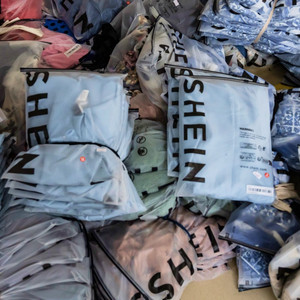
Hey everyone! So I have a haul!
From the New York Times, I'm Katjaan Benholt.
This is The Daily. Now, this box is so heavy.
Yeah, $1 shirt, $2 shirt, $3 shirt, $5 dress, it was ridiculous.
For years American consumers have been able to spend next to nothing on the latest fashion trends.
So for a sweatshirt, a T -shirt, and a tank top, the total was $14 .82 cents off of Shein.
If you want to be a baddie on a budget, Shein is the way to go.
Thanks in large part to Chinese clothing companies like Shein.
I might be the overconsumption, final boss, because I keep buying the same things, just different colors and different fonts.
That have long used a loophole to send millions of packages a day into the US from China, tax free.
But now… She and these new prices got me looking like, what the f***?
President Trump is killing that loophole.
Even as he de -escalates his larger trade war with China… A dress I had on my car was like, $9.
It's $18 now. They were in plain.
And prices are going up.
What if, like, prices just, like, never go down?
Like, what if I could never get a mini skirt for $7 ever again?
It's like, I'm scared!
Today, I talk with my colleague, Megan Tobin, about whether this might be the end of fast fashion.
It's Thursday, May 15th.
Are you guys gonna miss the prices before the tariffs?
Let me know in the comments.
Megan, welcome to the show.
Thanks for having me.
So I know you've been reporting on Shein and other fast fashion companies for many years, but I can reveal to you that I am also an expert on the subject because I have a teenage daughter who spends a lot of her time and pocket money on SHEIN.
And I did my research before coming on today and asked her about her latest haul.
Tell me what she bought.
So she got a lot of things.
Wait for it. She got a bikini for $5, a jewelry box for $2 .60, a phone case for $2, a tube top for $2, a couple of tank tops for $4 each, a claw clip for just under $1, And I think the single most expensive thing on her receipt was actually a pair of jean shorts for like $6.
It's kind of insane.
That sounds like a classic Shein haul.
And I'm really wondering, how can they keep it this cheap?
So clothing from Shein is so cheap in part because until a couple of weeks ago, it could come into the United States without anyone having to pay any taxes on it, thanks to a tax loophole called the de minimus exemption.
but that loophole has now been closed, which means customers in the United states are going to have to pay more to get their fast fashion.
And it's still closed, even though China and the U .S. passed their super high tariffs earlier this week?
Yes, on Monday, President Trump issued an executive order saying that goods that previously would have come into the United States under this loophole will now be subject to tariffs of 54 percent.
Okay. OK, so let's talk about this loophole.
What is it? So, this loophole's called the de minimus exemption, and it's basically Latin for it's too small to matter.
And it started back in the 1930s when the US government was trying to come up with a threshold for which it basically decided it was not worth the effort to collect taxes on imports under a certain value.
So, in the 1930s, the de minimis exemption was a dollar.
And the de minimis threshold was raised in the 90s as part of a wave of new trade policies worldwide that were based on the idea that more open trade would benefit everybody.
And it was raised again to $800 in 2016.
Wow, $800. I mean, that feels like a pretty high amount to not pay any tariffs on.
What was the justification for letting this threshold be this high in the United States?
The thinking at the time was that this would help American businesses who relied on imported goods.
And it really coincided with a period of time when online shopping took off around the world And also, when the Chinese government was pushing businesses in China to find markets overseas, the Chinese government wanted China to be the world's factory.
And so, all of that really opened the floodgates into the United States for low -cost goods from China.
And let me guess, Xian was one of the companies that took that opportunity and ran with it.
Yeah, Xian was one of those companies.
And also, Timu and Amazon and Wal -Mart all took advantage of this loophole to send a lot of small, cheap packages to the United States from China.
But it's Xian that really created an entire business model around it.
So let's talk about that.
What does this entirely new business model look like?
So when Xian first started drawing a lot of attention, people compared it to H &M and Zara, early models of fast fashion.
But H &M & Zara, the way their business model worked is they would look at runway trends and order a bunch of clothes in advance and then ship it to warehouses in the United States in bulk.
And Xian is totally different than that.
It's not actually one single brand.
It's an online marketplace that sources from a network of thousands of Chinese factories.
And instead of having specific collections for the time of year, they are just constantly creating thousands of different garments every day.
And SHEIN responds essentially in real -time to trends.
They have this proprietary system that allows them to place really small orders with really short turnaround times with their suppliers.
That enables Chien to avoid the cost of maintaining a lot of inventory, and unlike Zara or H &M, who shipped their clothes in bulk to warehouses in the United States who then distribute it to shops, Chien mails their items directly to customers.
And what's interesting is that because of their proprietary system, they can see how things are selling on the app and quickly notify suppliers that they need to make more.
So sometimes when you buy something on Tshien, it might not actually even have been made yet.
And so if all of a sudden everyone in your TikTok feed is wearing baggy cargo pants or lime green crop tops, immediately you can also see those being offered on Tshien.
And if more people start buying them, the platform can quickly ask more suppliers to keep making them.
That enables them to offer a huge variety of products on their app for very little money.
So instead of fast fashion, it's more like ultra -fast fashion.
Yeah, it is kind of crazy.
You see something on TikTok, and before you know it, it's delivered directly to your doorstep, and for, like, no money.
It's a little bit like consumerism on steroids or something.
Totally, and Shein is not without its critics.
There are all kinds of concerns about Shein and ultra -fast fashion.
And there are concerns about labor practices at some of the factories that supply for Shein.
And of course, there are environmental concerns because millions of packages are being flown across the world every day.
And because the prices are so low, it makes the clothes feel almost disposable.
And in the United States, a lot of businesses were angry that Shein and other companies were using this loophole and not paying any taxes.
They felt that was really undercutting their prices.
Like, for example, Forever 21 partly blamed Xi 'an and Timu and their use of the de minimis exemption when it filed for bankruptcy earlier this year, and all of that concern eventually reached the White House.
It plays right into President Trump's narrative about China ripping off the United States.
It absolutely plays into President Trump's narrative that, particularly when it comes to trade, the playing field with China has not been even.
And Trump also says the de minimus exemption was leading to fentanyl and the chemicals that are involved in making it coming into the US from China, because he said drug traffickers were taking advantage of the limited checks on these packages to sneak illegal substances into the country.
And all of this is why earlier this month, he got rid of the loophole.
Which is bad news for all the Americans who have become used to paying next to nothing for these clothes, right?
But it sounds like it could be existential for companies like Xi 'an and all the people who make the clothes.
Yes, which is why I went to Guangzhou, a city in the Southeast that is, in many ways, the heart of the global garment industry.
It's where many of Xi 'an's halls are made, and I wanted to go there to see what the end of this loophole means for the millions of people who work in this industry.
and ultimately what it means for the fate of fast fashion.
We'll be right back.
I'm Helene Cooper. I cover the US military for the new york times.
So I'm sitting in my car in a parking lot outside the pentagon.
I had a cubicle with a desk inside the building for years, but the Trump administration has taken that away.
So, now I sometimes come out here to make phone calls and even to follow my stories using my car as sort of a makeshift desk.
People in power have always made it difficult for journalists.
It hasn't stopped us in the past. It's not gonna stop us now.
I will keep working to get you the facts.
I want people to understand exactly what we're asking these young men and women of the U .S. military to do All my colleagues at the New York Times are dedicated to helping you understand the areas that they cover None of this work happens without subscribers If you'd like to subscribe, go to nytimes .com slash subscribe So Meghan, you're actually talking to us from China, you're in China Tell us about your recent trip to Guangzhou.
What did you see? So, the thing you need to know is that China makes nearly one in every three garments sold around the world.
And much of that comes from Guangzhou, in the factories that are part of the Xi 'an network.
And in a lot of ways, the city is really the global hub of garment manufacturing.
and I wanted to see what the impact of the end of the de minimis loophole was gonna be on the ground here so my colleagues Zee Jao and I went to Guangzhou to check it out.
Many of the Garmin factories in Guangzhou are essentially open -air workshops they're like big warehouses with garage doors that open onto the street, and they're full of sewing machines that are clacking away at all hours of the day and different workshops have different functions.
So, some places might assemble whole garments and other places will just sew on zippers and ruffles.
And one of the places that we went was a labor market for day laborers.
There's kind of informal market where a lot of the workshops go to recruit their labor for the day.
And hundreds of managers from different factories were lined up on the sidewalk looking for people to do different sewing tasks all day long.
So some places are putting together the main seams of a garment and then down the street is a place that will sew in the zippers and another one that will do the elastic waistband.
And then there's a different company that will come and pick up the packages and bring them to a collection point.
So all over the city you can see trucks that are piled high with rolls of fabric just rocketing down the street, and at the same time they're being passed by guys with carts and in driving vans who are collecting the finished products and taking them to the airport.
So there's this whole ecosystem of businesses that are all interconnected in the task of making clothes as quickly as possible.
So it sounds like it's actually a very sophisticated operation, Almost like a sort of supercharged Ford assembly line.
If you can imagine that assembly line like spread over an entire city that is essentially what it is like so you've got just whole neighborhoods that are geared toward the production of clothes and this industry is a really important part of the economy there it employs millions of people and a lot of them are migrant workers who come to the city from all over China.
So we talked to managers and workers and And what they told us is that business was already down.
In the month of April, Xi 'an was putting in fewer orders in anticipation of the loophole being closed.
And because of that, factories were hiring fewer workers.
And some people said they were considering moving their factories to other provinces where they thought they could pay workers less or even out of the country to places like Vietnam.
And many of the people we spoke to had actually seen nearby businesses close down.
Now, we were in Guangzhou on the day the loophole closed.
And one of the people that we talked to was Han Junshou.
Junshou was 30, and she is the second generation factory owner.
She makes house slippers and bags and other accessories, and she sells them on Xian and And one of her most popular products is a pair of fluffy socks.
She markets as being for pajama parties and girls' nights.
And she was telling us how she gets inspiration for her colorways by looking at the colors of outfits that Kendall Jenner posts on Instagram.
She clearly understands the American teen market.
But that's so cute.
But Juncho says that her orders in April were down nearly 20 % compared to previous months.
and she's already starting to look for other markets to make up for the loss of American consumers.
How's she going to do that?
Well, if Americans aren't going to buy things because they're more expensive, Jinsho is going to have to sell her fluffy socks and bags in other places.
So she's looking to Europe and South America.
And that's something we heard from other business owners too.
There are all these chat forums online that are almost offering like, crowdsource tech support, teaching people how to set up an account in Bahasa Indonesia to target Indonesian customers, or what buttons to click to get set up to sell Mercado Libre in South America.
But I imagine it can't be that easy to replace the American market because American consumers just seem to buy so much more stuff than anyone else.
That's right. The U .S. is China's biggest single market.
it's a big economy with a lot of consumers who have enough disposable income that they can buy reusable water bottles and strollers and toasters and flash drives and basically anything they need or want from China.
So on top of looking abroad for other markets, factory owners like Junsho are also trying to target shoppers in China.
And the Chinese government really needs this to happen, Because the economy has been pretty slow in the last couple of years, and exports have really been the main driver of growth.
But the problem is, people in China have been really careful about spending money.
And Junqiu ultimately sees this as a lose -lose situation.
She thinks that not only are Chinese manufacturers going to suffer but American shoppers are going to also.
They say that China makes so much stuff.
If you cut out China, where are you going to be able to buy all your products?
And she definitely thinks people in the U .S. won't be able to replicate manufacturing the way that Guangzhou has.
There was no way that Guangzhou wasn't going to be the engine of the global garment industry.
And if she's right that America can replicate the system and bring that kind of manufacturing to the US, that basically means the end of this ultra -cheap clothing for Americans?
Well, President Trump could change his mind.
He could pause or reverse his position on closing the loophole altogether.
Yeah that has happened before.
Exactly. He's rolled back the tariffs from an additional 145 % down to 30 % but that's for most goods coming from China.
For the packages that we're talking about which previously entered the United States without paying any taxes, now they'll be subject to either a tariff of 54 % or a flat fee of $100.
And more than likely it's the shopper who will end up paying that extra cost. So that means anything you buy from she in that's coming from China will costs more and could mean that people will buy fewer things.
And a Xi 'an haul might become a little bit more of a mini haul.
And some people might not be so unhappy about that, right?
I mean, it sort of raises these bigger questions about our consumer culture.
We've gotten so addicted to all this cheap stuff.
And there is this question, kind of elephant in the room, would we be better off if there was less stuff?
And I guess I'm wondering who's this going to hurt more long -term, China or the US?
I mean, that's a big question at the heart of the trade war right now.
It's really difficult to say.
Like I said, China is an export -driven economy, and this trade war is really bad news for the one area that had been driving growth, but it's also not just a place of manufacturing, it's also a place of innovation.
When China is quickly becoming a leader in other technologies, in many ways push back from the US just pushes China to become more self -sufficient in many areas.
And we can see that happening in semi -conductors and artificial intelligence.
And so it might just be that the garment industry is one of the next places where that happens.
And in the end, this could accelerate the shift that the Chinese government hopes it would to helping China become a more consumption -driven economy.
And how about the U .S.?
There are several things to consider.
This is definitely going to hurt the United States in pure economic terms. Very few economists believe that it will actually create a significant amount of the kind of middle -class manufacturing jobs that President Trump has been promising.
And like I said, things will definitely get more expensive, and that means Americans will likely buy fewer things.
And the president himself does not actually dispute this.
In fact, he seems to be actively embracing it.
Remember when Trump recently said that thing about American kids don't need to have $30?
Maybe they can just have two or three.
What do you make of that?
Yeah, that's the story he's telling.
And it's a position that extends to some of his administration, too.
Scott Bethn, the Treasury Secretary said something really similar.
That the American Dream is not about having access to cheap stuff.
It's about prosperity and upward mobility and economic security.
And that for too long, the people making the trade deals have lost sight of this.
So he's kind of reframing this all as a good thing.
that we'll be breaking a bad addiction to cheap stuff we don't need.
And what's interesting here is that even people who are skeptical of Trump's tariffs might be in favor of reining in fast fashion for environmental reasons or because they're against overconsumption.
And you can actually see that playing out online.
We need to stop filling up our closets and fill up our banks.
There's this whole Buy Less movement.
We're not rich enough to afford these tariffs, so let's embrace the idea of underconsumption.
Maybe we need to start taking responsibility for how much textile waste is in landfills in other countries.
Our relationship with consumption is fundamentally unhealthy and people cannot stop buying stuff.
On TikTok, alongside the massive Shein Halls, you can also see people having conversations about consuming less.
If you are the type to buy a new outfit for every date night, every girl's night out, every vacation, stop.
Your last outfits, slay.
Wear those again. And being more intentional about where they're buying things from.
If there was ever a time to develop an interest in second -year fashion, I swear now is the time.
So the end of the De Minimus loophole might result in something that a lot of people agree with.
making fast fashion a little harder to buy.
I hope that all of this will just reset our relationship with consumption and material goods.
It could be wishful thinking, but that is one potential benefit of all this.
I think I need to introduce my daughter to some of those other TikTok channels.
Good luck. Thank you, Megan.
Thank you, Katrin. We'll be right back.
that? Sleeping well.
Voted Best Luxury Mattress by sleepfoundation .org, every SAPA is handcrafted for a great night's sleep.
And they cost far less than retail.
Save $600 on $1 ,000 or more at sapa .com slash nyt.
Here's what else you need to know today.
On Wednesday, President Trump met the new leader of Syria, Ahmad al -Sharra, a man who once ran a branch of Al Qaeda.
Last year he led the rebel alliance that ousted Syria's long -standing dictator Bashar al -Assad.
It was the first time in 25 years that leaders from the two countries had met, and came one day after Trump announced a plan to lift all sanctions on Syria.
When asked what he made of his Syrian counterpart, Trump called him attractive and tough.
Trump also said al -Shaara had a good shot at turning his country around.
The encounter marked a stunning reversal for the Syrian leader.
Until just 5 months ago, the US had offered up to $10 million for information leading to his arrest. Today's episode was produced by Ricky Nowitzki, Shannon Lin and Anna Foley, with help from Claire Tenniscatter.
It was edited by Maria Byrne and Paige Cowett.
Research help by Susan Lee.
Contains original music by Marian Lozano, Diane Wong, Rohan Nimisto, and Pat McCusker.
And was engineered by Chris Wood.
Our theme music is by Jim Brenberg and Ben Landswork of Wonderly.
Special thanks to C .E.
Zhao. That's it for The Daily.
I'm Katrin Benholt.
See you tomorrow. You