You're listening to TED Talks Daily, where we bring you new ideas to spark your curiosity
every day.
I'm your host, Elise Hugh.
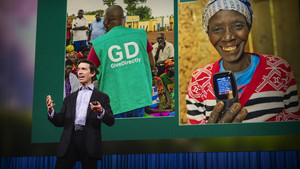
Rory Stewart is a former member of the UK Parliament and gave an audience-favorite
TED Talk on international aid money at TED 2024.
So we're going to let one of the TEDsters set it up.
Rory Stewart is going to give you a completely 360 view on how to do aid.
If you ever thought that government money was ineffective or inefficient or even charitable
aid giving was ineffective and inefficient, he's going to just blow your mind and give
you a completely different way of looking at it.
Get ready to have your mind blown.
That's all coming up after the break.
Like TED Talks?
You should check out the TED Radio Hour with NPR.
Stay tuned after this talk to hear a sneak peek of this week's episode.
And now our TED Talk of the day.
I'm here today to talk to you about the most extreme horror and scandal in our age, which
is the horror of extreme poverty, the fact that there are hundreds of millions of people
around the world today who cannot clothe themselves, who cannot shelter themselves, who are struggling
to eat once every two days.
But I'm also here with a message of hope, to say that this is a moment where we have
the ideas, where we have the technology, that we could end extreme poverty in our lifetime.
Let me begin by going back to the question of why we have failed to address extreme poverty.
And all of us, I think, have been through this.
We feel often that all we can do is hope that some new magical technological solution will
emerge, or that extreme poverty around the world is somehow disappearing by itself, or
that somehow, if we just give money to the experts, to the agencies, to the governments,
they're going to be able to solve extreme poverty.
I was, in a sense, one of those experts.
I've been working in international development for 30 years.
I started working in a poor developing country in Asia.
I went on to work in countries emerging from conflicts.
I set up a nonprofit in Afghanistan.
I lived in Kabul for a number of years.
I went on to join the British Agency for International Development.
I ended up as the boss, in charge of $20 billion a year budget,
directed to addressing extreme poverty.
What I saw was deeply depressing, that when you go out on the ground,
these projects are far worse than you could possibly imagine.
The statistics and the evidence are shocking over decades of attempts to address this.
It's true that, in percentage terms,
the number of people living in extreme poverty around the world has reduced.
A lot of that, of course, is to do with countries like China,
which have had incredible economic growth rates.
And even in South Saharan Africa, there has been some reduction in the percentage of people
living in extreme poverty since 1980.
The absolute numbers of people living in extreme poverty in Africa
have gone from 170 million people in 1980 to 430 million people today.
That's almost half a billion people not able to meet their most basic needs.
And that is often because of just how bad our projects are.
Let me try to give you an example.
When I was a British government minister,
I went out to see one of these projects in East Africa,
which was directed towards trying to address poverty
through addressing the needs of young women.
The idea was that young women, during their menstrual cycle,
if there are not sanitation facilities available in schools,
will often leave school in order to return home,
and that will contribute to them not being in the workplace and to poverty.
I set off to visit the project,
and as you can imagine, I received an amazing 100-page document
full of descriptions of all the smart stuff that we thought we were doing.
Needs assessments, community consultations, engineering diagrams,
logical frameworks, theories of change, and I arrive at the project,
and what I find is a line of white land cruiser jeeps and smiling engineers.
And I get out, and all of them are explaining to me
all the wonderful stuff they're doing
in terms of sanitation, engineering, design and consultation.
I asked to see what the results of it is,
and the result was literally two holes in the ground
with brick walls around them and five red plastic buckets.
$2,000 maximum impact in terms of what we'd done for a $40,000 project.
And I said to people,
why did you not just give $2,000 to the head teacher
and let the head teacher buy those buckets?
And the answer was, we were worried that if we didn't do all our paperworks
and studies and needs assessments and consultations,
the project would go wrong and he would steal the money.
And my response was, we stole the money.
We literally stole 38,000 out of $40,000.
We could have done 20 times the number of schools.
We stole the money.
Now, why is it that we get ourselves stuck in these problems?
Well, often it is because of mindsets.
It's because of institutions, it's because of careers,
but it's also because of mental models.
And in particular, is this lovely phrase.
Give someone a fish, they eat for a day.
Teach them to fish, they eat for a lifetime.
It's a miraculous phrase.
You can see why it's incredibly appealing, right?
Instead of imagining yourself flopping trout into someone's boat,
you imagine that you've taught them something
where magically they're going to be able to feed themselves
for the rest of their lives and you just step aside.
The problem is, unfortunately, that this phrase,
although incredibly appealing,
is actually leading to very patronizing programming
and programming that often achieves exactly the opposite
of what it claims to do.
And I realized that because I went out
to see a completely different project.
I went to Rwanda, to the Rwanda-Burundi border,
three years later,
and I saw a project where an NGO had turned up on the ground,
and instead of doing capacity building,
instead of teaching people how to fish,
they were quite literally just giving unconditional cash to people.
They were handing out cash.
They were turning up in village houses and saying,
here is $900 in cash, right?
Not a monthly payment, a lump sum payment.
It's not a microcredit or loan.
This is your money.
You can do with it what you like, right?
And I was completely astonished.
This seemed to be the most anti-development
fish-giving projects I'd ever seen in my life, right?
But the results were absolutely staggering.
This community had completely transformed
the amount of electricity in the community.
Almost everybody was ending up with roofs.
Almost everybody had health insurance.
It was a fantastic increase in the number of children in the school.
The whole place just felt better, happier, honestly.
In my entire life in international development,
I'd never seen anything like this village.
And it turned out that it wasn't a fluke.
Because academics over the last 10 or 15 years
have begun to use randomized control trials.
These are studies like a medical trial
in which you compare a treatment group to a control group
and study them over time.
And what they discovered in hundreds of studies
in many countries in the world is that consistently,
cash was leading to a real reduction
in things like child mortality and depression
and fantastic increases consistently
in education, in health, in businesses, in savings,
in incomes, in investment.
More than that, it was actually leading to a multiplier effect.
For every dollar delivered into a community,
there was $2.50 of benefit for the surrounding villages.
It was a fiscal stimulus.
And no, it was not, as you might imagine,
leading to people just lying around in bed drinking alcohol.
In fact, people were investing the money productively.
Now, why was this?
And now, back to the episode.
Well, I realize that there are probably four reasons
why cash is so effective.
The first is that people in extreme poverty
frequently don't require knowledge.
What they require is capital.
Take Jean.
A traditional program that I used to run
when I worked for the government would have gone in
and taught her how to run her business.
But Jean already knows how to run her grocery business.
She just doesn't have the money for the biscuits, right?
In other words, she already knows how to fish.
What she doesn't have is the money for the fishing hook.
The second reason why cash works is that everybody's different.
If you work your way around that village,
Jean needs to open a grocery shop.
Serafin wants to get her children into school.
Esperance wants to access health care.
Telephore wants to get a cow
so that he can have milk and yogurt to sell.
Marie may want to set up a tailoring business.
Demacin may want to get a motorbike taxi.
In other words, people don't want to learn how to fish.
They might want to open a bakery.
The third reason that cash works
is that it's, of course, much more efficient.
Instead of going in with an international construction company
or an NGO building someone's house for them,
if you give them the cash,
they will work with their neighbors and with local materials
to repair and fix their house at a fraction of the cost
and then have money left over for other things.
And the final reason why cash works is it trusts people.
People are making their own choices
on what they want to do with the money.
And when people make their own choices,
they are then able to sustain and take pride in the investments
in a way that isn't possible if somebody else does it for them.
So we are now at a moment where I believe unconditional cash transfers
could unlock the secret of addressing extreme poverty worldwide.
And the reason to be excited by it
is that technology is suddenly making this much easier
over the last 10 years.
So the extreme poor in Africa can now, for seven or nine dollars,
get hold of a feature of her phone
and money can be directed directly to their phone,
cutting out all the middle people,
all the governments and NGOs that used to take the money along the way.
Artificial intelligence is now allowing us to target
and understand communities in a way we couldn't before.
In Togo, for example, the Togo government was able to deliver cash
through people's phones to 100,000 people in a matter of hours.
Technology is also helping us with climate change.
In the past, cash assistance arrived after the flood had hit.
Now AI is allowing us to predict far better than before
when the extreme weather event would occur
and allow us to get the cash to people to move their livestock,
move their families before the flood arrives.
Now, of course, cash is not the answer to everything, right?
There are many other things that governments need to do.
They need to make sure, for example, that there is good government.
We need to build roads, we need to build bridges,
we need to build dams,
need to improve the quality of education in schools.
These are all things that need to happen.
But what cash does is it allows the extreme poor
to participate in that development story.
It allows Jean to use that road to get her products to market.
It allows Esperance to use the clinic.
It allows Teleford to find the markets for his milk or his yogurt.
And this is where everybody here can contribute, right?
As an individual, on a lower income,
you can send $30 a month directly to someone in extreme poverty.
It will make 100 times more difference to them than it does to you.
If you're a wealthier person listening to this,
put in tens of millions of dollars, put in hundreds of millions of dollars,
demonstrate that what we've seen at a small scale
can lift an entire country like Rwanda or Malawi out of poverty,
and do so to get to people like me to convince the government ministers
and the big agencies that they should be putting the money behind cash.
Because the money's there.
We spend almost twice as much annually on international development
as it would take to lift everybody in the world out of extreme poverty.
And we can do it.
And the most important thing to understand here
is that the cash is not just proven in evidence to be more effective,
more efficient, more tailored.
There is a moral dimension here,
because it respects people's choice.
At an age that's worried about patronizing and colonial aid,
it doesn't just consult them or listen to them.
It puts them in charge.
It literally lets them make the choice.
It respects their equality,
and it respects their dignity.
Thank you very much indeed.
Jennifer Vail studies friction and how to deliver just the right amount of it.
Like when you get a flu shot.
If friction was working against you so much
that that needle is having to be pushed multiple times and harder and harder
because the stopper is getting stuck, you would definitely know.
The hidden role of friction in our lives.
That's next time on the TED Radio Hour from NPR.
Subscribe or listen to the TED Radio Hour wherever you get your podcasts.
PRX.