I spent years exploring the science of health.
And if there's one thing that supports it all, recovery, focus, emotional wellbeing, it's sleep.
Hands down, it all hinges on those vital hours we spend in bed.
And what's so cool about the eight sleep pod for ultra is that it turns your bed into this amazing sleep performance tool, but it's not just a mattress cover that allows you to control temperature.
It's a comprehensive sleep system that tracks your biometrics and also uses that information to better regulate that temperature to better promote restfulness in real time.
I honestly love this thing.
It's been absolutely huge, it's up leveling how I feel, think, and recover.
The results are very real, and I'm not alone.
Clinical studies show that the POD Ultra IV can increase quality sleep duration by up to one hour per night.
Think about that. One extra hour of restorative sleep can absolutely transform your performance, your focus, and your health.
What sets the Pod4 Ultra apart is its intelligence, machine learning that fine -tunes temperature in real time with a range of 55 to 110 degrees Fahrenheit.
Well, sensors monitor sleep stages, HRV, and breathing.
I felt the difference firsthand, deeper rest, better recovery, better life.
Ready to revolutionize your sleep?
Head to 8sleep .com slash ritual and use the code ritual to get $350 off your Pod 4 Ultra.
With a 30 -day trial, you've got nothing to lose and potentially hours of better sleep to gain.
I love coffee, but the jittery anxiety that comes with it, not so much. And while I've tried my share of coffee alternatives, most fall pretty far short when it comes to that satisfying boost that I'm looking for.
So when Peek sent me Nandaka, their adaptogenic coffee alternative, let's just say I was a bit dubious that this would be any different from the others.
But I got to tell you, I was pleasantly surprised.
It definitely leaves me feeling elevated, energized for sure.
But also calm, focused, but steady.
And this is because it's made with fermented Pu 'erh tea, which provides a slow release of caffeine.
The formula is legit.
It's made not only from gut health promoting probiotic teas, but also triple -toxin -screened fruiting body mushrooms, not mycelium, including chaga, reishi, cordyceps and lion's mane.
It also has ceremonial grade cacao, warming spices like ginger and cinnamon, and cacao butter for enhanced absorption.
All organic, all vegan, no junk, and listen, it tastes great.
So if you're looking to adjust your morning ritual, now's a great time to try Nandaka.
You can get 20 % off for life and a free starter kit that's a rechargeable frother and glass speaker when you visit peaklife .com slash ritual that's P I Q U E life dot com slash ritual.
All of you who have been alongside me for this podcast to coaster ride know that I am and have been for quite some time an avid user of and a partner with AG one but this is not just another version of the shout out you've come to expect this is actually sort breaking news because AG1 has just launched their new next generation nutritional formula.
It's the same single scoop you know, but now it's been significantly upgraded with more vitamins, minerals, and upgraded probiotics.
It's an upgrade that's of significant proportions based upon four human clinical trials that go above and beyond the industry standard and testing to make a great product even better.
More specifically, the new formula has been optimized to improve absorption, new vitamins and new minerals have been added.
And AG1 has enhanced their probiotic blend, all part of their ongoing commitment to producing the best foundational nutritional supplement designed to support overall wellness.
Now clinically backed with an advanced formula, this is the perfect time to try AG1 if you haven't yet.
I've been drinking AG1 for many years now, as I mentioned, and I'm so happy to be partnering with them.
So subscribe today to try the Nextgen of AG1.
If you use my link, you'll also get a free bottle of AGD3K2, an AG1 welcome kit and five of the upgraded AG1 travel packs with your first order.
So make sure to check out drinkag1 .com slash richroll to get started with AG1's next gen and notice the benefits for yourself.
That's drinkag1 .com slash richroll.
The chances of carbon being created in the solar system in the universe is so incalculably small as it'd be impossible.
Life is something that is far more extraordinary than even we could possibly know or possibly understand.
And so, what do you make of that?
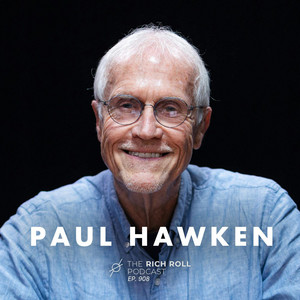
How? Paul Hawken is a legend.
He's one of the great elder statesmen of environmentalism, as well as an author, a lecturer, an entrepreneur who, for decades, has distinguished himself as one of the truest leaning voices, calling for the regeneration of nature and humanity.
But Paul isn't just an activist. When it comes to planetary stewardship, he is a precious resource for the many solutions to the existential threat of climate change we currently face.
Paul's latest book and the subject for today's conversation is entitled Carbon.
It's been called a spiritual encyclopedia of the earth, and it's his most expansive, humble, and hopeful text to date, one which posits that our greatest solutions for planetary healing reside in a deeper appreciation for the complexities of the natural world.
I was a teenager and I lived in Nevada city and dealt with fire where I lived up in the Sierras and where it burned.
You look at this wasteland, it's tall black, the trees and everything is just gone.
But I do also remember in the spring, the grass is greener than you've ever seen and you see wildflowers that you've never seen before.
I use that today as an analogy.
It's easy to see the fire.
It's harder to see the birds.
You mentioned before we started the podcast, an interesting definition of the word apocalypse that I hadn't heard before.
Can you share that?
Yeah, it's a Greek word and it's migrated into English, of course, and other languages.
But the core root is still from the Greek, which is apocalypse.
And it means a revealing of what is hidden.
That's what an apocalypse is.
We're in an apocalypse right now.
and a revealing of what is hidden is a necessary step on the path towards rebirth or rebuilding.
So there's like a kernel of like hopefulness in that definition, like the idea apocalypse, it's a disaster, end of days, all of that, like this is a reframe on that to say like, if you wanna be reborn, first all must be revealed as a necessary step in that process.
Yeah, you have to see it.
What you do with it is different for every person.
The one thing I try to emphasize to people is that you're most effective where you are and that we look to top -down solutions like the Conference of the Parties on Climate.
There's a Conference of the Parties 16 on Nature.
There's a Conference of the Parties on Land Use.
okay, there's three of them every year, and they've been ardently attended to by people, but you have to say the comments of the parties on climate has been a total failure.
You know it's actually getting worse, much worse, and the problem with those is that those are top -down solutions, and nature and life is not top down.
Mm -hmm. And I'm not saying it's bottom up either, but it's certainly not top down.
And so, you have these governments institutions, trying to solve something that can't be solved from the top.
I'm not gainsaying what people are doing or their sincerity or their care.
I certainly not. I'm just saying, yeah, but it doesn't work.
And it's obvious that it doesn't work.
On some level, in order to solve this problem, we need regulatory shifts.
We need our laws to change.
We need our entire system of capitalism to be kind of reformed in order to, you know, find a more sustainable regenerative way of living on this planet and, you know, sharing this one home that we have. But essentially what you're saying is that's also a recipe for us as individuals to kind of abdicate our own personal responsibility because we're looking to the top to solve it for us as opposed to shouldering, the maybe burden is the wrong word, but the responsibility of like, what can we all do now from a bottom up perspective?
And when I look at your work, kind of the arc of the last couple of books, draw down regeneration, draw downs like, okay, how are we gonna get into the nuts and bolts of like drawing down carbon regeneration, more of a rebirth?
of how can we restore this planet?
And this latest work, carbon is your most expansive perspective.
It's almost like it's a more enlightened call to action to say in a very kind of poetic and encouraging and hopeful tone to say like the solutions cannot all be extracted from new technology or from these processes about like how to, kind of sequester carbon.
The real answer lies in reframing our relationship to all living things such that it can be symbiotic.
And you approach this from a perspective that feels somewhat analogous or familiar to the way you've all know Harare looks at culture or societies or civilization or history.
But you're just doing it with respect to like all life, all life forms, going all the way back to like, what is carbon and where does it come from and how did it originally arrive on planet Earth and what does it mean?
To say it's a 10 ,000 foot view is to understate.
You're outside the solar system looking in on this shiny blue dot and trying to make sense of it altogether, is that accurate?
It's very accurate and it arose from two different directions or sources.
The first one really is the climate movement narrative.
In other words, there's a narrative.
It's been around for decades.
And it's based on fear, threat, reduction, less, blaming, you know.
And when it hasn't worked then it's just been amped up.
You know? You know, Extinction Rebellion, for example, as a name of an NGO that's gone to schools in the UK and told children it's game over.
I mean, that's some narrative.
And I would say that narrative has completely failed.
If we hired an ad agency decades ago and said, you know, we need everybody in the world to understand this is a threat to civilization and to our future into your children's children's future and we need to get together and come together and figure out what to do about it because we know the cost".
Well they said, got it and what we're going to do is scare the shit out of people and you'd fire that agency.
So that's not selling the product that is not bringing people in that.
Again, saying like people have become involved, they are involved, they're doing great work, but less than one percent of the world's a fraction of 1 % does anything every day about climate.
So how could that be?
And so that was, so that's one source about we're using carbon as the object you know, as a thing, like a bad boy, a culprit, you know, we gotta do this question, stop emitting it and carbon neutrality, you know, those kinds of terms. net zero, and net zero what?
And well, the implication is net zero carbon emissions, right.
And so, by doing that, we've objectified it.
This is a thing over there.
It's a very male, you know, left brain oriented, we're going to solve this problem, we're going to fix it, you know, here's the problem, this is what we're going to do, which can be done.
But that thinking of objectification of any aspect of the world, whether it's people, or plants, or creatures, or places, is the mentality that's caused the problem.
We've objectified the living world and we've been selling off the living world to the highest bidder for 500 years and we wonder why biodiversity is plummeting.
That's why. So, to me, what is the narrative that makes sense?
The narrative that makes sense to me isn't one where everybody gets it in the same way.
Oh, I got the story, you got the story, I got it.
No, it's not a single story.
But it arises from human need, from human delight, from human wonder, from human curiosity.
And what I'm trying to suggest in the book and so forth is ways to look at plants, at creatures or butterflies, and mycelia at other people, other cultures, in a way that promotes a sense of wonder, a sense of awe, a sense of respect, a sense of, oh my gosh, who knew?
Yeah, the more you know the less you know though, right?
Exactly. That's sort of what the book's theme - But I think that when you have that experience, it changes you.
When you see the world differently you are a different person.
There's no separation from that awareness and that consciousness and then what you become aware of in a way you never did, you never understood.
And so I do give a few anecdotes in the book about that happen for me, but it's available to everyone regardless of age or tenure or job or culture, nothing, and that is the source of regeneration on Earth, not from people meeting in Paris or Washington DC or Nairobi and having these big meetings and go on for days and days and coming out with something that is a new declaration, it won't work.
So rather than lambasting people for making bad decisions and conferences congregated to create policy, the solution is inspiring awe and wonder in the average everyday person by demonstrating just how magnificent and complex and just astronomically mind -blowing this biosphere actually is, right?
It's sort of like a David Attenborough kind of like way in to make us feel Like, we're not this thing that is existing on the outside of this place that we live, but actually we are integral to it and can be part of the solution by reframing our relationship with it.
Yes, I would say, but let's not do it like David Attenborough because when you see and he's a beautiful human being and his films, the BBC stuff is a crazy good, except it's a nature you will never see.
Never in your life, no matter what you do.
You don't have enough drones and cameras and you know, and so that actually separates us from the natural world.
We can appreciate it.
I do. I love to watch it, love to listen to him, but it doesn't, I don't feel closer to nature when I see that I'm in awe for sure.
That's a thing. But so we have to think about things that are more, you know, like down to earth, I guess, you know, and a way of seeing the world.
Was the butterfly or I give an example of the book about a scientist who for whatever curiosity, whatever reason, wanted to know how many roots were on a seed of rye.
One seed was a grass seed of course, you know.
And so I don't know how he did it probably with electron microscopes and so forth but I mean he counted 14 million roots, he and his students, 14 million roots on one seed that big.
Okay, so what? Well each of those seeds has a hyphae at the end connected to mycelia, and those mycelia and the hyphae and the plant are actually in a conversation.
They're doing transactions and sugar's coming from the rye seed which is making it from, you know, CO2 and sunlight and make it in the and the mycelium needs that.
That's food for it.
It's down below. It's got phosphorus, nitrogen, potassium, zinc, selenium.
And the plant is saying, I need this.
And the mycelium somehow is saying, phosphorus, it's over there.
Those people over there beneath, whatever, have phosphorus and it comes from and they exchange it.
Okay. That's from one seed of grass.
So it's so what that teaches me is that we don't know where we live.
And I say that respectfully.
Who could know? Just that one fact, that one scenario?
Like, what else don't we know?
But But when you start to go into nature and see things where you ...
or hear things, or ...
you can watch them, you can read them, you can hear them from somebody you trust, you know.
But you start to see nature in a completely different way.
And the other example I gave, I live in a redwood country, have about 20 redwoods between myself in the carport.
And I've been walking that back and forth for years and I love the redwoods and then I read the work of many botanists, particularly the Italians, do this amazing analysis of plant perception, plant intelligence, and they pointed out the plants have 20 senses.
We have five, and one of the senses plants have is kind of a charskuro thing all over on the branches and in the bark and leaves where they can see movement.
They can see it, like if you were moving past, you know, it's just sort of fuzzy black and white, you know, you know, they see that.
The tree sees that.
So I realized, I was, you know, writing reading all this sort of stuff and then I I've walked out from my home, the house, you know, and then I'm walking by this trees and I realized they're noticing me and I haven't been noticing them, and I've never gone back.
And if anyone was gonna notice them, it would have been you.
Exactly. You're the guy.
Yeah, yeah, you would think.
And now I feel their presence, I really do, because I know they have presence it's not this is science this isn't belief and you know so again is that possibility of us seeing the living world and we are living world too so I don't want to say okay it's nature then there's people see it allows to see people in a different way with a kind of a sense of compassion you know that maybe we don't have we haven't touched upon that ourself we've been so busy and so you know in a sense troubled by the world.
And so that is the source of the ...
that's where it starts.
It starts with one person and who knows what that one person does and so forth but you look at the biographies of like, Gandhi, and you look and say, when he was in South Africa as a solicitor and he basically presided over this meeting of people of color to object to the Black Act, which was gonna make them register and carry, dang, they had to register, right?
And this meeting got together and in the theater that was owned by a Jewish couple, they were the only theater that would let them meet in Durban, and said everybody decided they're going to get arrested.
They're going to be objectors, they will not do it okay.
And then Gandhi's going home thinking, oh shoot, I'm a little skinny brown solicitor in South Africa and I'll be disbarred if I'm arrested.
He knew that. Well, why did he get arrested.
He did. And when he got arrested, he carried in this thing, paper, written by Thoreau called, we all know that one...
Leaves of grass? No, not leaves of grass.
On Walden? No. Which one?
On Civil Disobedience.
Oh, Civil Disobedience.
I should have known that.
Yeah. But the famous, what we know about that, is Thoreau never named it.
No one knows where name came from?
They think maybe his sister, you know, but they're not sure.
But that he wrote the essay because he objected to the poll tax, which is 25 cents at that time, was a lot of money.
And so it disenfranchised people who couldn't pay it, certainly black people as well.
I mean anybody who didn't have them.
He objected to it he was arrested and he went to jail.
And his sister Sophie took him hot chocolate and he got out the next day okay, and he wrote that essay, so that's one person not wanting to pay the poll tax or writing an essay and there's Gandhi in South Africa and then that's the man who led the salt march that got rid of the Raj in India.
So I'm telling that story because it's possible to understand what one person can do and even they don't understand it you know, in real time.
So, we tend to, you know, minimize the effect of a single individual.
Not true, not true.
It's the other way around.
You know, we look at power lies of the president, you know, and think, okay, that's powerful.
That's not powerful.
That's weak. Couldn't be weaker.
We're all part of this complex super organism.
I love this stuff about the trees and the mycelium, I've read about old growth trees and the root systems and how they communicate with each other and how they make basically decisions about how resources are gonna be allocated amongst the forest and how the mycelium is the connective tissue.
It's almost like the nervous system amongst that to keep everything in some version of homeostasis.
it's like it's so complicated and rich and robust and beautiful.
And to your point of like Attenborough versus like what's underneath our feet, right?
Like the magic is here.
And the real thesis of the book is like the answers that we're seeking, like in the way that regeneration was very much saying like we don't need to pioneer all these new technological systems. We actually have all of this stuff right now that could be solving these problems, we just lack the political capital or whatever it is to like scale them up.
You're taking it a further step in saying, actually, yeah, this stuff's great, but maybe we don't need any of that because it's right underneath your feet.
And it's about reframing your relationship with this place.
Each book related yeah, I mean, they're a stair step.
Drawdown was very much about carbon and sequestration.
and bring it back home and stop admitting it, okay.
And this is the way you do it.
And we can talk about that if you want.
Regeneration, I knew I was gonna write before Carbon.
I knew it. And so it wasn't like, okay, now what am I gonna do?
I knew that because I feel like and you're a writer and you author books and one thing is you have to stay in your lane in your book.
If you get out of your lane, the book is, you know, toss it, like I didn't give you permission to go off on the tangent.
I'm reading the book because you said, this is what you're going to write about.
And so, I knew that in a sense I was creating the book, which is now called Solutionism.
The idea that, okay, we're going to fix it, if you do this, this happens and everything's better.
And I got, it's not really true.
And so with regeneration, it was like every aspect of the economy today is, as we know, extractive.
Okay. And we're killing where we live.
You know, it's a mortality crisis, really.
Death of the oceans, death of big fish, death of forest, death of land, death of insects, death of pollinators.
You can just, check, check, check, check, check, check.
Okay, and so what I was saying then, is like commerce, business and governments can see the end of the road that they're on.
they're on this road.
And now you can see it.
That's called degeneration.
It was degeneration before they saw it, but I mean, now they can see it.
You can't go much further, we cannot go much further.
So what do we do? Well, you pivot.
Can't go that way. What's the pivot?
It's to regeneration.
Now, what do we do?
How do we create more life by providing the goods and services that people need in order to live a good life?
You that, but I do have the question.
And I think everybody's asking that question more, not everybody, more and more people are asking that question for on behalf of everybody, which is, well, how can we stay here on the earth in a way that actually creates more life for succeeding generations, as opposed to we've done the opposite, which is to take more life away?
And so draw, so that's Drawed On Dawn as Regeneration.
So, carbon, the book of life, is really about in a sense how do we connect ourselves to the living world in such a way that actually inspires us and the people around us.
And not because we're trying to inspire people but because you walk out.
It's intrinsic. Past the 20 redwood trees and going, Holy, Oh my God, I didn't know I lived here.
Now no I do. And it's a joy.
It's not guilt. It's not something that rests heavily upon your shoulders.
We have enough of that already.
It's something that actually uplifts you.
And it's everywhere.
I talk about the owl butterfly in Mexico and it's a butterfly, seven inches big, and it comes out at dusk so it won't be predated.
But you look at that but our butterfly or go look it up on Google image and so forth and it's like what has two eye spots and they look exactly exactly like the eyes of an owl I mean okay so that is to keep predation away from it so a bird looking or a bat looking oh I'm out of here that's an owl right then how did it get there?
You and I with the best artistic equipment couldn't draw a picture of an ally as good as the butterfly did.
Now how, where did it come from and if you read the science it says well it's genetics passed on genetics okay great, where did the image come from?
It didn't tell you anything about how a butterfly in Mexico created two wings that look exactly like the eye of an owl to protect itself.
So this is also the world we live in, which is like utter mystery of the beauty and the capacity of species.
And we're one of them to adapt, to change, to innovate, and to create beauty by the very especially of its life.
We're brought to you today by Element.
Whether you're training for a spring race or maybe just navigating a busy day, proper hydration makes all the difference.
And that's where Element comes in, a zero sugar electrolyte drink mix without the junk food in typical sports drinks.
We all need electrolytes to perform at our best, but most of the options out there are loaded with sugar and artificial ingredients and artificial coloring, all kinds of stuff that you don't really want.
And what I appreciate about Element is their carefully formulated mix provides exactly what your body needs and nothing it doesn't.
Become an essential part of my daily routine whether I'm training, recording podcasts, writing or just, you know, trying to stay sharp through a busy schedule.
And I'm not alone, and Olympians and professional sports teams rely on it too.
The best part, you can get a free element sample pack with any purchase at drinkelement .com slash rich roll, whether you're training or just staying active, Element has you covered.
That's drinklmnt .com slash rich roll.
Hey everybody over here.
I need your full attention because today's episode is brought to you by On.
Now, listen, confession here.
I'm somebody who has spent many decades obsessed with hard metrics, actually measuring the value of my life against the number of seconds I could shave off my splits, for the distances I could run, and even the number of people my words and my voice could reach. But age and wisdom hard earned have actually taught me a lesson, and that lesson is that the hardness required to do hard things is only going to get you so far.
the best of what movement and even life has on offer is so much more about soft wins because the victories that stick with you, I can tell you, never have anything to do with a stopwatch. So what is this idea of soft wins?
Well, it might be that perfect trail moment where maybe you're moving slow, but you're in the zone where time dissolves and you're purely present and so connected with nature that you're overwhelmed with gratitude.
or it could be that soul -filling feeling that you get when you share a deep conversation with a running buddy or perhaps it's just the way you feel restored after that group jog following a stressful day at work.
This, soft wins, is what ON is all about and why partnering with them feels like partnering with myself.
Because not only is ON best in class when it comes to premium sportswear with gear that's battle tested by world -class athletes, they're also innovating what it means to be active, and more importantly, why we move in the first place, which is what I care about and talk about all the time here on the podcast. Find out what all the fuss is about by maybe starting with their new Cloud Surfer 2, which is this beautiful, effortless shoe, that embodies the soft winds philosophy by reconnecting you with this very wide.
So whether you're finding joy in your pace or rediscovering your love for running fills That is your cup, that is a soft wind we're celebrating.
To explore your own soft winds and check out the new Cloud Surfer 2, head to on .com slash ritual.
There's a humility that you have to have to appreciate those things.
And I think humans, we wanna feel ourselves to be masters of the universe and we can solve all these problems. And there's that kind of egoistic piece to that.
like a hubris that these problems can be solved by applying kind of the scientific methodology that we use to make sense of the universe.
But that's by definition reductive.
It's sort of like, here's a problem and we can identify the variables, isolate them and solve it.
That applies to decarbonization.
It's the same approach with medicine, looking at the human body and saying, well, here's a symptom, and we're gonna throw this pharmaceutical at it, it's gonna resolve that symptom, and the problem goes away without the humble appreciation for the complexity of the holistic organism.
Like the same principles apply planetarily, and you're saying like, look, we have to appreciate this complexity, the beauty with a level of humility, and we can't continue to have this reductive approach of thinking like, if we solve this problem, we're good, while we're still pursuing this extractive relationship with the planet at large.
Absolutely, and the pharmaceutical example is really good, actually, because if you see an advertisement on TV for a pharmaceutical, by law, they have to tell you all the side effects and dangers.
And sometimes it goes on and on and on.
I mean, it's comedic at this point.
It is, I'd say you have to start laughing going, you're gonna swallow that, you know, okay we don't have to do that with our climate solutions or even our solutions we have a world that's doing this and doing this what about the side effects of doing that we don't talk about it it's not known to us at least when you take a drug it's known and you know that it may absolutely it may do something for you believe this, do that, whatever but man you better watch out because a whole bunch of other things could happen to your body." Well, the same thing about the current system, whether it wants to just
create more damage without talking about it or reconciling its actions with the effect, or it's companies that are doing things that they think are good, you know, in a sense that this is going to help us like direct our capture.
or, you know, there's a whole world out there of financiers and engineers and big companies that are going to suck air from the atmosphere and, you know, take out the carbon, liquefy it and put it in geological formations, you know, and say that's a solution.
And you're even seeing now the IPCC, the Intergovernmental Panel on Climate Change saying, we can't get there from here unless we do that.
And you don't have to be educated past ninth grade science, maybe seventh grade science to know that actually that will never work ever.
It's about physics, it's not about belief.
And that is that the gas, the CO2, what's up in the atmosphere is called entropy.
In other words, you burn something and that's kind of its ash as well, which is a gas CO2, you know?
The carbon was in the wood, or in the coal, or in the oil, or in the natural gas, right?
And you burned it as combined with oxygen and CO2, and goes up there.
We know how CO2 reflects infrared radiation back down when it's in the air and we get a warmer climate.
Well direct air capture is these huge machines, gigantic and use amazing amounts of energy.
They say, well we're going to use renewable energy to this, okay, renewable is...
we'll talk about that.
But I mean the fact is it takes energy to take this energy out, so you're using entropy to cure entropy.
It will never ever work.
And so, and yet, we're pouring billions of dollars into this and we talk about hope.
That's hopium. That's just ridiculous.
And I'm not trying to be a smart ass, I'm just trying to say But do the math, and stop buffaloing or convincing us that we can just live the way we're going to live far into the future, and we're gonna have these high tech bros out there figuring out how to take the carbon back out of the air that we're emitting as fast as possible.
Yeah, maybe a more relatable example of that is just electric vehicles like, these are good thing.
you know, we're not, you know, putting emissions into the atmosphere in the form of exhaust as we always have. But fundamentally, it's still an extractive technology, we have to power these batteries up.
The source of that power, you know, depends upon where you live, but it's not great.
And we still have to create these batteries, which are extractive in terms of how we have to strip mine for these minerals, etc. So it's a step, it's a stop gap, but it's not a solution that is inherently regenerative in any way, right?
So that's the real problem that you're getting at.
And maybe to kind of like take a step back here, you talk a lot about like language, nounism, verbiage, the way we talk about the problem, but the book really begins with like how we talk about carbon itself.
Like we think we know what it is, carbon's bad in the atmosphere, we need to remove it.
But like, it's also the building block of life.
And do we really understand what this is, where it comes from, why it's important and what it represents?
Like, you start off with just kind of blowing our minds with the origins of carbon itself and reframe how we should actually properly think about this.
Yeah, I had to do that myself.
Like where did it come from?
and what does it do?
And we know there's no other element like it and change it has memory and stores energy.
So carbon does that, salt doesn't do that, foster doesn't do that, helium doesn't do that.
Okay. But what we know is that its ubiquity is astonishing.
And the best way to think of carbon is a flow like water, like a river as a flow.
Or the wind, actually, as a flow.
It's the only way to understand it in terms of its presence and what it does and where it is.
Every cell, and you have 32, 34, 36 trillion cells you know, in your body, every single cell has 1 .2 trillion atoms of carbon.
Okay, well, what's it?
It's too many, our brains can't.
No, you can't handle it.
It's 44 octillion, that's the number by the way.
But it's - I don't know what that means.
No one else does either, including me.
But the point being is what is the carbon doing in that cell?
And well, it's chemistry the same that you see outside of the cell.
And so it's basically a chemistry experiment called the cell, you know, and the eukaryotic cell.
And so without carbon there's no such thing.
But everywhere we look in the world both, you know living and actually just, you know geologic carbons there and and in terms of the earth itself the flow of carbon is astonishing and beautiful and But it's abstract.
That's an abstraction But what I'm trying to do is take it away from its objectification as it's a thing and we just figure out this thing, we're gonna fix it, but actually, that way of thinking has caused it, as I said, caused the problem.
We're gonna fix things, no, we're not.
We're gonna live with things in a way that is supportive.
You have this beautiful line in the book, speaking of the poetry of all of this.
Carbon is presented as the narrator of life, the courier of existence, and the lattice that permeates cultures and organisms. I've never thought about carbon in that way.
Right, yeah. And the origins of carbon itself.
Can you talk a little bit about that?
Well, sure, yeah, because it was commonly thought, I think until the 40s or 50s, that all the elements on Earth came from the Big Bang, which is 13 .8 billion years ago.
And Fred Hoyle, who is an astronomer in the UK, coined the term Big Bang, because he thought it was just BS.
he said the idea that everything, that we have all the elements and so forth, you know, were created in a millisecond from an explosion 13 .8 billion years ago, he said that was ridiculous.
And he was proven right.
And so most of the elements, we didn't know where they came from.
They did not come from the Big Bang, only hydrogen and helium did.
But nobody knew where carbon came from.
And just to get into chemistry, I mean there's in hydrogen, you know, there's...
Hydrogen makes helium.
That's fusion. That's the sun, okay.
And there's an extra neutron that neutron creates an extraordinary amount of energy you know when they come together.
And that's why we have sunlight and heat and warmth.
But what Hoyle wanted to know is, okay, but yeah, great, but then where did carbon come from?
Because you would think if you count the protons and neutrons and electrons, you think, wow, three times helium is carbon, three times four, this is 12.
And so carbon is six, six, six, and helium is two, two, two.
and in terms of particles and that was accepted except what physicists discovered is that two helium can't make a carbon because of what's called resonance or vibration or their gradients.
They just can't mix into the other.
They can't form. They can't fuse into carbon.
So that was accepted but no one knew where carbon came from.
How and they looked into space because you have these beautiful spectrometers you know they can look out into space and then deduce what they're seeing by color by the vibration of what's out there and nobody could find you know carbon that way either that is in our bodies is in your cells you know.
And so Hoyle came up with the stars are dying, they become giant red stars.
And in that moment, beryllium, which is two helium molecules, can capture another helium molecule and that becomes C12, that becomes carbon, right?
But the thing is it's a trillionth of a trillionth of a second that happens every 2 ,500 times beryllium is made.
So you do the math on that one, it's like, you give it a kitty.
And yet carbon is ubiquitous, it's in 99 % of everything on Earth, it's in every living – well, the math didn't make sense, you know, like, how can – and yet Hoyle insisted that was true.
And he went to Caltech and he gave a talk about it, and he was almost derided on stage.
People – physicists – are going, who invited him, what's he saying, you know.
And one scientist said this is the most outrageous prediction ever made by a scientist means it's the worst. But they, he convinced people to test it and so they got a spectrometer to bomb nitrogen with protons and strip away and see if they could form the C12 that's everywhere in the world and they did.
Basically recreating what would happen out in the outer stellar galaxy.
to see if you could create the formation of carbon.
It's astonishing that the universe conspired to create carbon in the first place.
It's this unlikely event that can only occur under very specific circumstances.
Yes and to this day, really world -renowned physicists in Cambridge and Oxford and other universities say, look at the chances of carbon being created in the solar system, in any system, in the universe, is so incalculably small as it be impossible.
And yet it's robust here on planet Earth.
And so what do you make of that?
Like what do you infer from that?
Like, in other words, the scientists can go all the way to that point, you know, of creation and described it and they know the resonances and the gradients and all the things that would have to be just right in order for that one single atom to be created.
Okay, got that, but they can't explain the ubiquity and how much of it is in the universe or that it exists at all, and they accept it, actually they denote it but they can't really explain how all the things came together.
It's just the number you know 44 Artillion is beyond that number.
So how, who, where, what, you know.
The very fact that we don't know should give us some actually pleasure that life is something that is far more extraordinary than even we could possibly know or possibly understand.
And yet, there are, you know, trillions upon trillions of, you know, stars out there, you know, numbers we can't fathom.
I would have to imagine there are other planets that have the capacity to host carbon -based life.
Absolutely, and it's hard for us to scope the universe how big it is, but talk about the giant red stars that's what our sun's gonna do.
As it dies, it gets bigger and bigger and then it explodes into a supernova.
86 ,000 suns explode into supernovae every single day in the universe.
Wow. So now we can see the universe as actually kind of a garden or maybe that's not the right word, but you know, it's a generative force.
It's generative, yeah.
Yeah. And it's not just there, like frozen in the Hubble telescope.
It's active when you look at it from that point of view and it's generating these supernova and then these clouds are huge and they float around for 100 million years and inside they're protected from cosmic rays and they're creating elements inside these clouds.
I mean it's hard to look from that point of view would not say, is this alive?
You know what I mean?
You could say, describe it physically.
It's all physical, but part of you has to say, really.
It's like, is that all it is, it's just physics?
So that's what Hoyle said, you can't explain it with physics enough, sufficiently.
Well what is true for the macro is true for the micro and the same example that we were discussing about, how medicine treats the physical body and how we diagnose the planet, the similarities with that, the idea that the galaxy would operate as this massive superorganism that is generative is true.
And yet at the very microorganism level at the cellular level, these same things are happening all the way from the subatomic all the way to the galactic universal or whatever.
And this book is sort of like, okay, here's carbon, head explodes, now let's talk about plants, let's talk about animals, insects, fungi, food, farms, you kind of canvas all of these things.
But the fungi to me feels like the most interesting, you kind of call it the dark, it's sort of the dark energy of planetary life because we know so little about it.
And you have these crazy numbers about like, I mean, I think we only have identified, like 10 % of the fungal species that actually exist. Like, we're just at the beginning of understanding what it even is, let alone the crucial role that it's playing with respect to our biosphere.
It's interesting, when I wrote that chapter, I call it the queendom.
There's five kingdoms and one of them is fungi.
And the reason I called it the queendom is because without that queendom or whatever you wanna call it, there wouldn't be the other four kingdoms, okay?
That's the mother, okay?
And so when Merlin Sheldrake, who wrote The Tank of Life, beautiful, beautiful book about fungi.
Is it fungi? I always say fungi.
Fungi, doesn't matter.
Fungi, fungal. Keep going, sorry.
Anyway, he read the chapter for me and then he said, but I wouldn't call it Queendom.
And I said, well, why not?
I kind of love it. And he said, well, there's too much royalty in there already.
You can't help but stratify it.
Yeah. Even when you're trying to give it the feminine genre.
Well he's English. And so we agreed on kindom, which is it's the kin, dumb.
So talk a little bit more about the role that it plays that we might not.
We don't fully know.
We just know what I explained earlier about basically connecting to the root systems of every plant almost everywhere.
Not quite every plant, but there's some exceptions, but virtually every plant on earth.
And Toby Keers who's doing really amazing science in Amsterdam, she's actually from the Bay Area, but they're now able to video the process of mycelium.
Notice what's going on in there.
And what you see is two things.
You can hear it, there's a clicking sound.
It's like making clicking sounds.
And then it's transporting nutrients.
But when you look at it though, you would think, okay, it's like a highway, it's going along, it's not, it's going opposite directions in the same vessel, the same mycelium.
Things are going opposite directions.
Why? Like arteries and veins at the same time in one vessel.
Yeah, in one vessel because they must be encoded in some way for this nitrogen to go here and this phosphorus go there and to that route into this plant.
I mean it's like a stock exchange or a marketplace or, I mean, except the dimension of it in terms of numbers is so fantastic and so unbelievable.
So yeah, and those clicking sounds, Adam Adamaski at the Royal Society in London has been recording them for years.
And what he says is that actually they're making words.
in other words, there's patterns, pattern recognition, and they're repeating these things.
He went on to say, and some ecologists just agree, so I'm gonna be really clear about that, but he went on to say, yeah, but they're stringing these words together in sentences, what we call sentences, and those sentences as complex as Indo -European languages.
So let's step back and say he's not right, but he's not wrong.
better say there's something going on there.
You have to just really think, well wow this is one crazy organism in terms of its capabilities and what's going on down there and the honest answer is we don't know, we do know molecularly what's being transported in terms of nutrients that are being fed to the plants and the plants are demanding them by the way they're saying I want this, I want this, I want that.
You I got nitrogen, that's all you're gonna get.
I mean, the mycelia actually are mapping out the territory and knowing whether it's rich in phosphorus or rich in this, where I can get selenium, which is not as common as the mineral in soils, and then going right to the source or that requestor, which is another plant somewhere, and doing the transaction and getting carbohydrates.
So we do know that, and we know that these fungal, would you call them organisms can be gigantic, one can be acres and acres and acres and acres, 50 acres can be one species, one organism.
You talk about the Oregon national forest where I think it's like a four square miles of like fungal beds, I don't know what you call them that have been there for thousands of years.
It's one species. One species.
This idea that there's such a, you know, on first inspection, like a rudimentary life form.
And yet the complexity of the communication and the functionality of this is mind boggling, like how is that even happening?
Well, and the importance of it, because we have basically engaged in an agricultural system that effectively destroys the fungi in the soil.
I mean, it's just been an afterthought, right?
Like we just don't really think about it or consider it as important.
We never - It's these weird things that sprout up when it rains.
Well, yeah, that's the seed, that's the fruit of the fungi, but the mycelia, are destroyed by plowing, they're destroyed by chemical fertilizer, they're destroyed by herbicides.
But the roots of a plant depend on this relationship in order to be nutrient -dense.
Now, it's for the food itself to be the most nutritious as possible.
And so what we're doing is by putting in NPK, nitrogen, potassium, and phosphorus in a chemical form and top dressing the soil with it, we get tremendous production.
and the plants are weak, tend to get infested.
You keep doing that, the soil dies, we have to put herbicides because weeds then colonize sick soil, and we have glyphosate, and so now we have pesticide glyphosate, we have sick plants, and so forth, that are not nutrient dense, all right?
And all because we really destroyed the source of life, which is soil, and so in the book I talk about, you know, dark earth for sure.
But soil is not to be seen as a medium just because we can take a bag or something and pour it into a pot and grow something, we think it's just a medium.
But in the ground, it's actually an organism.
It's one of the most complex, it's the biggest organism on earth is the soil.
And it's alive. And it makes sounds and you can hear it if you stick microphones on there and listen to it.
and that life is what creates life, right?
All life comes from the soil, no place else.
And so that's why every single culture on earth that we know of has called the earth Madre always.
No one said Father Earth because everyone knew that life came from the earth, from the female.
And we're the one who ...
the male, you know, basically, you know, Fritz Haber, the German chemist, invented a way to bypass all that.
And that's the agriculture that we have today, which is, you know, polluting rivers in the And amounts of food in terms of corn, soy, but so much so that we take 35 % of the corn we grow and put into gas tanks as ethanol.
And then another, I forget, 70 % of what's left goes to animals for CAFOs, confined area feeding operations.
So we're growing all this corn and soy in a very, very damaging way.
The second highest rate of cancer in United States is Iowa not surprised you know because of the chemical use.
Spearing. Yeah spraying and so so but these are all things that we can change and are changing and that will produce more food, healthier food, a healthier environment, healthier farmers more resilient systems, you know that aren't so subject to disruption from heat and and water, the problem with global warming is that water is too much water, too little, too much heat or too much cold.
I mean, it starts to whipsaw the jet stream, up and down.
So, you get these strange, anomalous things that were, that are difficult for farmers to deal with.
I mean, either flood the fields or kill the crops, whether it's too much water or too little.
And so, one of the things that has to be done is to look at agriculture because if we don't have food that's game over.
And so how can we create systems that are resilient because we all have to be resilient going into these next decades given the vagaries of a heating planet and the effects impacts is going to have on water, river, streams, deserts, fields, crops, oceans, et cetera.
You've mentioned that things are changing and I wanna press you on that a little bit.
It feels to me like, yes there is progress in certain pockets, but short of overhauling our system such that it's premised upon an appreciation for the long -term incentives of restoring our soil and creating regenerative systems and doing all the things that you're talking about.
we're stuck in a paradigm that prioritizes the short term benefits and incentives.
We're set up to be extractive.
All of the incentives of our system basically emphasize that and unless we blow up the system and create a new one, how are we gonna get out of this ouroboros where we're eating our tail, right?
Like we're never going to transcend this unless we reach some kind of tipping point threshold where we can't step back from where we're actually grokking the fact that we're not gonna be able to grow food anymore and kind of like a interstellar situation.
I don't know, like it's hard for me to hold on to that level of hopefulness that you seem to inhabit.
Two things there. One I was talking to and indigenous person once and saying we da da da da da, we da da da da da, and he looked at me in the eye and said, who's we?
Good question. Because the rhetoric around what's going on is as if everybody thought, assumed, knew what we're talking about and or was causative that is was the cause or was the and so I think we have to talk about the state of the world in the actors who seem to be completely abut is to where we live and what's going on from their actions you know corporate CEOs companies the stock market capitalism and politicians who enfranchise that and say okay we can be aware of that and so forth.
But we really want to talk about it in a different way and you talked earlier about language.
And the language we have inherited as English, you know, as students, as in a culture, and English in really all the European languages are very much about nouns, German very much so, English the most so, because it's a kind of a language that just took words from five or six different languages.
But words, that came from the enlightenment that's about naming things.
And we are very good about naming.
To name something separates it.
It's a this and not a that.
That's what science does.
And then let's study this because it's different than the that.
And okay, great science.
But the indigenous languages, and I point to them because, you know, cultures go back now that I see in Australia over 100 ,000 years, but certainly 60 ,000 for sure, and so how do they manage to stay there for all that time?
And if you look at those languages, there are languages that are about verbs, the verbs, because verbs are relational.
They're about relation, they're about connection, they're about never losing that inner parlance in we speak to each other or about the world in a way that separates us or separates you or separates us from each other or from the world that supports us our mother.
And so I think what you're seeing right now is a coming together of that intelligence and that wisdom with western science and the There's amazing discoveries and understandings that are emerging from that.
And you talk about hope.
I mean, one of the things that I love right now is that science is just exploding with observations and tests and understanding of the world is completely different than what we're taught.
What would be an example of that?
I gave you some about roots, about plants, about butterflies, about...
I'll give you more, you know, just like what's going on there.
What we're discovering is what we don't know.
That's what's so wonderful about it is that we don't know as opposed to, oh, we know this is true, this is true, this is true.
That creates the openness.
That's empirical science.
Like all those discoveries, like, holy shit, like we only are touching the surface of this.
There's so much more to discover and therein lies that humility that can put you on a different trajectory in your exploration.
Traditional ecological knowledge really always looks at life as a complex system and it is, and Western thought tends to look at systems as parts and pieces.
We're brought to you today by the wonderful folks at GO Brewing.
Let me tell you a story.
A few years ago this guy Joe Chura rings me up out of the blue and he asked if I'll fly out to Illinois and speak at this event that he was hosting called Go, which ended up being this really incredible weekend oriented around taking Inspired Action.
Joe and I hit it off, but you know, that was kinda that, and it wasn't until I ran into him a couple years ago at Jesse Itzler's Running Man event that I realized that he had taken Inspired Action himself by creating this new enterprise that was also called Go.
Go Brewing in fact, which from Go has grown into what it is today.
one of the most exciting revolutions in craft brewing.
One of the many things that makes Go Brewing extraordinary is that they don't outsource like most companies.
They handcraft everything from scratch in small batches.
In fact, this commitment to quality has fueled their growth into one of America's fastest growing breweries now in over 5 ,000 locations across 20 states and available online.
The salty AF chilada earned the untapped number one non -alcoholic lager in the United States and they're constantly creating bold, new flavors almost every month that pushed the boundaries of what non -alcoholic beer can be.
Double IPAs, mouth -watering sours, all with zero added sugars and none of the junk.
You hear that? Incredible stuff.
The non -alcoholic revolution is here, people.
I am proud to help champion it alongside Joe.
So get on board by Getting With Go by going to gobrewing .com where you're going to use the code RICHROLE for 15 % off your first purchase.
Go. If you're a long time viewer of this show, then you already know that I've spent plenty of episodes diving super deep into the evidence -based science behind the many health benefits of fasting from disease prevention, all the way to healthspan extension.
At the same time, there is this elephant in the room, which is acknowledging that foregoing all food for extended periods of time, well, it's kind of a big ask and intimidating enough to dissuade many who would otherwise benefit from this practice.
But what if you could tap into those benefits without committing to a full on fast?
That is the question my three -time guest, Dr. Valter Longo, one of the world's top longevity researchers set out to answer.
And after decades spent looking into this at USC's Longevity Institute, he developed the Fasting Mimicking Diet which is a protocol now accessible to everyone through ProLon.
ProLon's got this five -day program that gives you the benefits of fasting, supporting healthy blood sugar and boosting energy and even enhancing skin without going full on fast mode.
Everything you need comes in one box, you open it up it's all laid out in easy to read instructions.
All five meals are packaged right in here for ease and convenience and you've got soups you got snacks you got beverages all dialed in for each day and the science backs it up three consecutive cycles can drop your biological age by 2 .5 years and trim one and a half inches off your waist amazing to help you kick -start a health plan that truly works Pro -On is offering all of you my audience 15 % off site -wide plus $40 bonus gift when you subscribe to their five -day nutrition program.
Just visit prolonlife .com slash rich roll.
That's P -R -O -L -O -N -L -I -F -E .com slash rich roll to claim your 15 % discount and your bonus gift. Prolonlife .com slash rich roll.
I forget which culture it is in the book that you talk about, but a culture that would name all of the trees based upon the sound that the branches would make at sunset in October, right?
So you're somebody who's keyed in to nature, probably more than anybody I know and you walk past the redwoods without really paying too much attention.
These people are taking it to a whole other level, right?
They did. But like, are we gonna do that?
Like if Paul Hawken walks past his redwoods on the way to the carport and has to remind himself to pay attention.
Where's the hope for the rest of us?
The native Canadians who were referred to as a Mic Mac.
And what they did was extraordinary, which they can name the sound the tree was making, not the sound the wind was making, we have words for that.
Right the, but the tree rustling, when the wind blows what the branches making.
The tree had a specific sound, like we have a sound, our voices have a specific sound.
You know, you can close your eyes, oh that's rich, or you know, like you can, you have a very distinctive sound and these trees do too.
But the thing about it was they could hear it but they can name it.
They could give it a specific name, right?
And remember the name, that was the name of the tree that sound it made in October, you know, and every year, and so they could go back five years later, ten years later, and listen to the sound and know that the tree had suffered or changed or was good doing good.
In other words, they could tell the condition of the tree from the sound, and they didn't write it down.
They remembered the name of the sound.
We thought million words in English, we have no such word for the sound a tree makes.
The tree makes. You can say sauffing, that's the sound the wind makes.
So what do we get? What do we get from that?
Just like this extraordinary understanding of the living world, if the living world is all you have, you don't have anything else, nothing's being imported, there is no nobody's going to rescue you save you, you become very very aware.
And that awareness I think is, again I use the word exploding it's probably the wrong word but just is burgeoning all over the world from the interaction between Western scientists and traditional knowledge holders in indigenous cultures around the world.
And it's just marvelous and beautiful to see that exploration, the understandings that are arising.
And again, what is arising is like how much we don't know and that's a really wonderful thing because, you know, it's discovery, it's delight, it's possibility.
I just think if people can imagine such a thing, because it's true, that there is a delusion, corporations, and profit -making, and extractive economies, I think it is important for us to know that, to be aware of what's happening and how ridiculous it is in terms of our stewardship of the earth.
But at the same time, something's happening.
Right, beauty persists with a resilience that is remarkable.
And to your point around awareness, it proves the adage that on some level, like all the answers reside in our capacity to develop our awareness to like be present, whether it's the nature of our own minds or what's happening right beneath our feet by slowing down and actually like being present and attuning our focus and our attention to things we often overlooked.
That's where there's all this mystery to be explored.
Like in meditation when a thought pops up, where did that thought come from?
I didn't think that thought, it simply arose.
And then what happens when it vanishes?
Where does it go? And where is all of this happening?
Like these serve more existential questions of what it means to be alive and be a conscious being apply in the same way to all of the unseen things that are happening all around us all the time.
I have this experience, I've only been invited once to talk to writers, as a writer at conference.
They have writers conferences.
And I described something there which I hadn't ever said out loud before.
But sometimes when I'm writing I'll write a couple of paragraphs and fiction writers often write thousand words or something then go look the next day and see if it is any good.
I write a couple of paragraphs and go right back to the top and edit it.
I'm going in like this, all the way down through.
I come into that too.
It's not a recommended approach. No it's not, but I do it.
But there's times I go back to the top and I started to read it and going, I don't know, I didn't write that.
I have no recollection of writing that or having those thoughts.
So it doesn't make me special.
In fact, it's the other way around, it just makes me observant or aware that when you're writing it's not just disgorging what you think, okay, and what you believe or what you've read or what you have learned.
that there's something else going on, or it's possible.
Certainly that's true for poets, we know that.
But great literature, I don't know, I don't talk to that many writers about the process, but it's definitely not a deductive and deliberate and process, it's something different.
Yeah, it's a download from the unified field of consciousness, Paul.
Thank you. So now I know.
And yet, you could take credit for having - Sat there.
Yeah, sat there and given expression to it.
But it is interesting, like this is a very different book.
Like the last two books were these big books that were almost as much manuals as they were books.
But this is like a book book.
This is a literary poetic kind of adventure that you take the reader on.
Yeah, because that's where I wanted to go.
I mean I want to go into the mystery, and I went to, you know, Ed Young and Carl Zimmer and Merlin and Elizabeth Kolbert, I mean other writers really beautiful writers, you know, and just absorbed I almost want to put on the back of the book, these are all the books I read, you know, just to open that up I may do it on a website just say look at at this one, look at this one, look at this one, you know.
and I'm not the origin, but I am storytelling and what's emerging, again, I'll say this.
I mean from observational science is just heartwarming and beautiful and breathtaking.
Anthony James was a person in South Africa and he had of a reserve and a wildlife reserve and in an area, Northern South Africa, where elephants had been extirpated a long time ago.
There was no elephants around.
And somebody called him and said, I have enough from another reserve in the south, I have eight elephants that are just acting so badly that we're gonna shoot them all.
He said, you can have them if you want.
He said, I'll take them.
Well, he got them there somehow in trucks and he made a special place for them to kind of season them into the property.
They couldn't get out, it was electrified and this and that, and he just tore the shit out of it, and they were everywhere on the property.
And then he tore down the electric fences, you know, and they had to go capture them again and it was just hell.
But he got him back, and he spent years.
And he had a Land Rover, of course, and he'd go park nearby and just with the Land Rover.
And they could see it and then watch and then, okay.
At first they started to come near it like it was a threat but then eventually he realized it wasn't a threat, and then he would get out and stand there just next to the Land and then as time went on, he would actually move out further from the land rover and then closer.
And they began to trust him as a person as a human being.
Obviously they had been treated really, really badly by human beings.
You don't become that destructive as an elephant for no reason.
And eventually they started to come up to his house and all eight of them and his wife was a French chef and they would take everything in the garden because they didn't know it was a garden.
They just ate it. But they got used to that.
And then one time he was in Durban and the elephants were coming to the house and he called his wife and said, the plane's been canceled and she noticed right away that the elephants stopped and turned around and went away.
Okay, he died someplace else he didn't die there on the land, and the next day he had 18 elephants by then.
They surrounded the house and stood there all day.
A year later on the exact day they back, stood around the house, right, for the whole day.
And so it went. So, what we were talking about was what do we know?
How do they know? How do we know what they know?
We don't. And so, that's the world I'm talking about which is not the world that I know, hey, read my book, I can explain everything." I don't explain it at all.
I'm ignorant, but I care about discovering where we live or where I live in discovering what I don't know.
And we know there's 3 .4 trillion creatures, you know, on land and ocean, and every single day they're communicating.
Not just once a day, by the way.
They're communicating.
They're making sounds.
are they saying? They're talking.
Those elephants were obviously talking to each other.
But we have no idea.
And so we live on a planet where just suffused with intelligence and sentience from creatures we never thought had any sentience at all.
We know now that insects are sentient.
They have feelings.
It's like, oh, come on, you know people you know, and some entomologists will go, ah!
You know that's crazy.
No, we do know that from Lars Zick at work and other people's work.
So, I'm just trying to like open the curtain a little bit for the reader and going, and verify it.
There's notes, there's footnotes, there's sources, you can look it up yourself.
It's not me, I'm not the source.
And just like what happens to you when you know that's the world that we're losing.
And that's a world we've never really understood.
And that's the world we thought was dumb as a rock.
I mean, it may have four legs and a tail, but we never gave it any thought that it had language.
Mother bats speak a dialect in their ultrasonic thing, and they named their children, and they teach their children to avoid certain male bats because they're not cool, right?
That's... they call that mother -ese, that language.
They don't know what to call it.
And if you take that ultrasonic sound which we can't hear, and you slow it down, so in the audible range it is so beautiful, it's one of the most beautiful sound you've ever heard, and we are the only culture that demonizes bats.
They're sacred everyone else in the world.
And so maybe they're not demons, you know.
It's just that trying to open up, you know, just that way of seeing where we live.
I mean the scorpion came into my house this week, you know.
I mean I am so gentle with that scorpion.
I do not want them in my house.
I don't want to be bit by one, okay?
I know that one, but I don't kill it.
I take it out to its ecosystem, you know, which is not my house.
And that came from just seeing the insect world in a new way.
And like I just can't kill mosquitoes very easily, but I will kill a mosquito.
I mean, I'll confess, if it's keeping me awake, I'll slap you, but I can't kill anything else.
I'm not surprised to hear that.
Are you ready for this?
Yeah. The story that you just told of the elephants actually came up on the podcast yesterday.
And to you James? That same story.
And it came up in the context of a discussion around a lack of appreciation or a hubris that we have around the sentience and emotional intelligence and interior lives of our fellow creatures.
But it was in the context of a larger conversation about something else altogether different.
I was hosting a podcast with the host of this podcast series called telepathy tapes where she spends, I don't know, if you've heard of this, she spends time with non -speaking neurodivergent autistic people and it's this exploration of, you know, the possibility of extra perceptual abilities.
But in the context of this, you know, Take what you will from that.
But just to ask the question is also to expand your horizon of appreciation for the complexity of other living creatures.
And she talks about Rupert Sheldrake and like his experiments with animal consciousness, since et cetera.
And that story of the elephants like comes up as an illustration of that point.
Like we think we know, but what do we really know?
And when we look up and we see the swarms of birds who all pivot at the exact same time and never collide with each other, or the migratory patterns of whales and the way they communicate across vast distances.
Like all of these things would go, yeah, wow, that's crazy.
And then we never think about it again, let alone like try to get to the root of like how this is even happening to begin with.
That these organisms could be collaborating and communicating with each other in a way that we have a hard time believing is possible because of the simplicity of their brains.
Not so simple, though.
Yeah, somebody, I forget, did a calculation.
Why can bees do the waggle dance, and do all this stuff, and convey all this information to each other?
And the bee brain is very, very small compared to our brain, except that any given moment, it can have a million different connections within that brain.
Okay, so it's not size.
Size does something too, for sure.
But we have been reductionists in the sense of the smaller brain, the small intelligence, and that doesn't play out.
Also reductionist in what we consider to be intelligence.
Yes. We're intelligent because we can do these certain things but perhaps it's more intelligent to not live in an extractive relationship with the world, but more in a symbiotic one of harmony where, I mean, if you're a dolphin cruising around with your family members, having a good old time, like that's probably a better life, most of us are living.
Well, we're the only species that disregulates the climate.
There's a point they say four or five, six species, species.
Okay, we're the only one.
The rest of them don't do that.
And so, intelligent?
I question that. I mean, if we were so intelligent, why would we destroy the atmosphere?
We know it. I mean, we know it since the 19th century, and we know it very well.
The science is locked.
There's no argument about the science, and because it's really simple, the science.
You or triatomic molecules, we radiate heat back to earth, it comes up from infrared.
I mean, this is so simple, it's like Climate 101.
So we've known that since 1856, Eunice Foot demonstrated that a woman scientist in the United States, 1856, demonstrably.
And she wasn't listened to because she couldn't go to scientific conferences, because she was a woman.
scientists didn't allow women in the conferences but so i mean and yet we still do it so it's really interesting to see what is intelligence in this context you know i mean are we brilliant yes no question about it and i would say also not to be a gainsayer but i mean we live in one of the craziest stupidest times in history in terms of our relationship to each other and to the living world but i also think we live in the most brilliant time in history.
So both are happening at the same time.
And there is a brilliance in the world that's arising and emerging and present today that is so heartwarming and so inspiring and so extraordinary.
So I'm not here to, you know, I'm here to be curious and observe.
I see both at the same time.
And what will emerge, what will finally happen, what will we survive even, I don't know.
But I know that I want to be here and do whatever I can, you know.
And in so doing, it just changes my life, you know.
And who I meet and what I read, and you know everything where I live all that sort of stuff, and it can change everybody's life.
Yeah. It feels like part of the problem has something to do with our proclivity for pursuing self -interest, like the idea that what's important is like what I wanna do and what I need to get and like how I'm gonna get it as opposed to what's good for the commons.
And I don't think it's a genetic wiring that we have when you look back on Indigenous cultures and you talk about this in the book, like it seems like people were really all about the commons back then, it's systems that have been laid on top of us that have, you know, tweaked and thwarted our better interest and, you know, diluted us into believing that like getting what, you know, what's ours is really what life is about.
Yeah, Nate Hagens, who is a broadcaster, talks about the carbon pulse that really when we discovered, you know, coal gas and oil, It was a huge change in human civilization because of what it gave us in terms of fossil fuel slaves, you know?
I mean it used to be we'd have to have a person do work for us and each person could only do the amount of work that they could consume in terms of calories, you know, and that was it.
And then wood helped and that was kind of a breakthrough but it didn't really change what a person could do.
fossil fuels, oil, coal change what a person could do, what they could make and what we could make and so forth.
And so the carbon pulse is this increase and use of carbon -based fuels, you know, to this day, to this minute, you know, we have increased, it doesn't level off, it doesn't, oh, we have enough.
No one's ever said that.
And so if we don't recognize that, then we're gonna just repulse ourselves right out of our civilization.
And we have these fossil fuel slaves and we're taken for granted, we grew up in it, we have our cars, we have our gas stations.
Everywhere I drive, you know, I'm in LA, just look at the patterns of retail, the patterns of the consumption, the patterns of who's at the airport and so forth.
I mean and the increase in convenience and speed and quickness and facility and convenience that impels the culture.
All those increasing footprint that we're having and the impact we're having until the end, so.
Along with our entitlement to that footprint.
Of course, we grew up that way.
And I'm gonna take care of my family and this and that.
So that's all left brain thinking and what's happened historically.
If you look back over like last 2000 years, is you get these kind of shifts in humanity to the left brain, which is a problem solving brain, but the right brain, its synthesis is really different, quite different, and looks at connections and systems and looks at the whole.
We look at systems, the right brain looks at complex, you know, interactive systems. Relationships between.
Always about relationships.
and so we're all, look at, we have a presence, all left brain, and it's all about getting, taking, wanting, and so we're there.
How do we get there?
I don't know. I don't know how it matriculated that way, but I do know that there are some just extraordinary people who are walk amongst us who are doing fantastic things, and if I was a betting man, I'd put my money on that side, than the one that's in power now.
That's good to hear, because it is, I agree with you, it is a situation in which we're kind of escalating, we're hurtling towards catastrophe on one level and then kind of on a parallel track, we're the acceleration of technological innovation and kind of first principles thinking in terms of problem solving and a more expansive appreciation for the natural world.
Like all of these things are kind of all happening at once and they're all speeding up together but it is a ticking clock.
Like there is a deadline here.
We're sort of quickly approaching this precipice and it's like which version of ourself is gonna get there first before it's too late.
It's weird how it's like everything feels really sped up though.
Well the existing system is self -terminating, there's no question about that, and accelerating that we're in the self -terminating system, and period.
So I'll give the example about growing up and fighting fires, you know, I'm not sure I like the verb, but you dealt with fire where I lived up in the Sierras, and I was a teenager I lived in Nevada City with the family who took me in.
I didn't have a home.
And you'd marshal everybody who was able -bodied to fight the fire.
We didn't have a big briggah in the farm in there, couldn't afford it.
And they taught you what to do and everything like that and afterwards you tamp it down with your boots and make sure there's no hot spots, there's nothing, there's no embers in there.
You find them, they're embers, you know, a manzanita will stay hot for a long time you know and the ash is over so you don't see it and then you get a wind at night and then blow embers restart a fire so you have to walk the fire where it burned and then you eventually go home or whatever you know and you look at this wasteland it's all black the trees you know everything is just gone you know but i do also remember like in the spring the grass is greener than you've ever seen because of the ash feeds it.
Those are nutrients.
And you see wildflowers that you've never seen before you've or I was told that hadn't been seen before.
Because there are certain wildflowers that only break open the carapace under extreme heat.
They're not annuals.
And so I use that today as an analogy for what's happening, the world's on fire.
It's on fire is no question about it.
But at the same time the fire and the wild flowers and their emergence is happening at the same time, not sequentially.
And it's easy to see the fire.
It's harder to see the birth, the emergence, because it's not centralized.
It doesn't have a voice, it wasn't elected, it doesn't make the news cycle, it doesn't light up the amygdala for click -throughs.
It's the best of humanity and there's a lot of it out there.
I feel there's extraordinary human beings in communities and in jails and villages all over the world who actually see the fire, they're singed by the fire.
And they're coming together.
And I use the word regeneration but restoration, renewal, whatever word works for it doesn't matter but they're creating more life for themselves, their children, their future, their land.
And not only more life on a biological level but also in terms of schooling, education, the welfare of the children, the welfare of of all the creatures and animals and that live around them that they have that they now, I guess, value in a way that they never had before because they never knew they were never threatened before and now they are.
Well, that example that you just provided illustrates this notion that everything is an opportunity for rebirth and regrowth and hidden within whatever or name your crisis, there's some possibility for something to blossom that couldn't have otherwise.
And you're nothing if not hopeful, like hope is a recurring sort of theme or strain in all of your work and I can't help but think like in this particular moment that we're all experiencing right now where there's so much political division and uncertainty for somebody who's listening to this, who does find themselves doom scrolling and feeling a lack of agency or struggles to find anything to hold onto to feel that hope and identify that wildflower, like how does one go about doing that?
Like what are you really trying to say in this book to the reader?
It doesn't have to be a wildflower, it can be a child.
the suffering around us of children is extraordinary.
The suffering of migrants is extraordinary.
You know talk about if you're going to use the word regeneration which I have of course you want to do it as with the biggest arms as possible, because if we're not restoring renewing the lives of the six billion people who wake up every single morning on earth facing existential threat.
It could be food, it could be security, it could be school, it could be jobs, it could be money, it could be income, I mean, just, and this is in the United States, too, this is not some other country.
And that's the bulk of humanity, is waking up every morning with that and you wonder, they're going to do something about climate or biodiversity?
No they're not. They You have to take care of themselves and their family and children first. So if there is to be a genuine climate biodiversity slash movement, and I think people do understand this, who mentioned earlier, you know, you have to do it in such a way that improves the lives of those six billion people, you know, who are not, you know, basically they are extractive, but that's because they've been forced to, they have no other choice, you know, because they're right there at the margins, you know.
But, so it's not about butterflies, it's about whatever you see, whatever you know, whatever you care about, whatever causes grief is your pathway.
And grief is like the gift of the angels, because grief can only come from one place, and that comes from love.
You can't feel grief if you have no love, and love comes from the heart, and the heart is the organ that infallibly tells the truth.
Never lie to you or anyone else.
And so I don't mean to say, oh, it's out there in nature somewhere, I'm just saying that everything that we have taken for granted in terms of the living world is sent in alive, communicating just as we are, but not destroying its habitat, not destroying its children, not destroying others.
And so it's just so much to take in and learn and so forth, but you can do it right in your neighborhood, and right where you are.
And churches kind of got a bad rap, especially in the last election cycle, but let's put that aside, you know, mosque and synagogues and churches.
Forget what happens on Friday night or Saturday or Sunday okay.
All the other time, what do churches do?
They take care of people.
They care. And that's what all religions have done and so forth so you can gainsay religion for all the things it's done.
They're really stupid.
Catholic Church probably leads the pack on that.
But you can't, again, say the fact that the parishioners and the people, the attendants, people who worship, the people pray five times a day, they actually do things besides that, which is to take care of other people in other places.
That's us, that's also us.
And that's kind of overridden or not looked at.
I think that's a really beautiful place to end it.
Like I feel like I have a lot of other questions for you, but that was such a poetic way to punctuate what is a very poetic book.
A deeply soulful book, like you're a soulful guy, right?
You've written all of these amazing books that really get into the brass tacks of the problem and the solution with respect to the environment.
But this is your soul song.
And I think what you just said is a really eloquent way of encapsulating the message that you're trying to carry.
It's really a beautiful thing that you've created.
Thank you. Thank you.
Thank you, Rich. It's lovely being here with you always.
That's it for today.
Thank you for listening.
I truly hope you enjoyed the conversation.
To learn more about today's guests, including links and resources related to everything discussed today, visit the episode page at richroll .com, where you can find the entire podcast archive, my books, Finding Ultra, Voicing Change and The Plantpower Way, as well as the plant power meal planner at mealplanner .richroll .com.
If you'd like to support the podcast, the easiest and most impactful thing you can do is to subscribe to the show on Apple Podcasts, on Spotify and on YouTube, and leave a review and or comment.
And sharing the show or your favorite episode with friends or on social media is of course awesome and very helpful.
This show just wouldn't be possible without the help of our amazing sponsors who keep this podcast running wild and free.
To check out all their amazing offers, head to richroll .com slash sponsors.
And finally, for podcast updates, special offers on books, the meal planner, and other subjects, please subscribe to our newsletter, which you can find on the footer of any page at RichRoll .com.
Today's show is produced and engineered by Jason Camiolo.
The video edition of the podcast was created by Blake Curtis and Morgan McRae, with assistance from our Creative Director, Dan Drake.
Content Management by Shaina Savoy, Copywriting by Ben Pryor.
And of course, our theme music was created all the way back in 2012 by Tyler Piot, Trapper Piot, and Harry Mathis.
Appreciate the love.
Love the support. See you back here soon.
Peace. Plants. Namaste.
and I'll see you next time.