This episode is sponsored by ScienceNearMe.org.
Visit ScienceNearMe.org and search for local science experiences.
What's wrong, Squeaks?
Oh, I see.
I'm sorry, buddy.
They do look pretty dry.
Oh, hi, everybody.
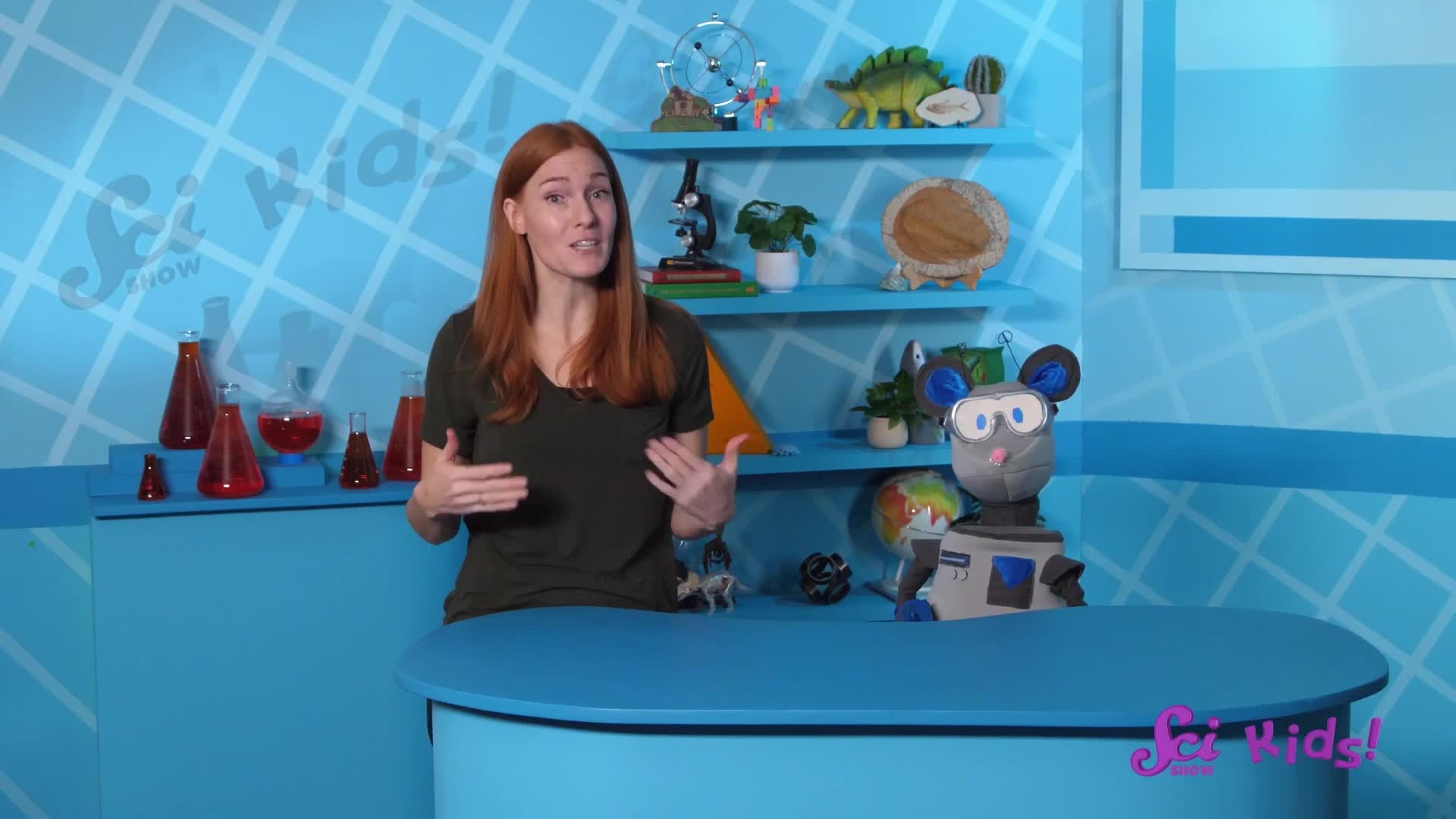
Squeaks is upset because he forgot to water his plants, and they've dried out.
It hasn't rained in a little while here at the fort, so they didn't get any water on their own.
Squeak says our friend Juniper told him his plants would need more water because it's so dry out.
On the bright side, it won't be this dry forever.
The weather will change sooner or later.
Of course it will!
The weather doesn't stay the same every single day.
Remember a few weeks ago when we had all that rain?
The area around the fort always gets a bit of rain and snow.
We don't have a super dry climate.
No, not climate, Squeaks.
It doesn't have anything to do with climbing.
Climate describes the weather in a particular place over a long period of time, like whether it's windy or rainy, sunny or snowy.
Exactly!
We've had dry weather for a while now, but over time, the weather here will change.
Unlike climate, weather is temporary.
It isn't always dry and sunny here like it is now, right?
Oh, maybe it feels like it now, but it will change eventually.
The climate here at the fort includes some sun, but not all the time.
It also includes rain and snow.
Those are weather patterns.
And those weather patterns make up the climate.
In fact, weather patterns.
Let us guess what a place might look and feel like during certain times of the year.
Right!
We can guess that it will probably snow in the winter, but not the summer.
I have an idea!
Let's look at some places where the climate includes very little snow or rain.
Let's take a trip way down to Arica, a city in Chile.
The climate in Arica is very dry, meaning it hardly ever rains there.
One time, it didn't rain at all for 14 years!
It is a long time, even longer than you've been around.
Based on what I've told you, can you guess how much it's going to rain in Eureka this month?
Right!
Probably not very much.
But Arica is still near the ocean.
We can find an even drier place if we travel away from the ocean and visit the nearby Atacama Desert.
A desert is a place where the climate includes very little rain.
And the Atacama might be the driest desert of them all.
It gets only around 5 millimeters of rain every year.
That's about the size of a pencil eraser.
The Atacama is also one of the oldest deserts in the world.
Parts of it might be 150 million years old.
That's so old, dinosaurs were still around, and would be for a long time.
Squeaks wants to know why the Atacama is so dry.
Well, there are a few reasons.
One is that it's near some very tall mountains.
Sometimes mountains can be so tall that rain clouds can't cross them, so those clouds can't bring any rain into the desert.
Another reason is that the ocean near the Atacama Desert is very cold.
The cold ocean means the air stays pretty cold, too.
And cold air doesn't have very much water in it, unlike warm air, so there isn't enough water to form clouds and rain.
That means both the ocean and the mountains stop any rain from coming to the Atacama.
Oh yeah, Squeaks thinks that the plants probably want rain pretty badly, just like he does right now.
But sometimes in places with very dry climates.
When they do get rain, there isn't anywhere for it to go.
Once, when the Atacama experienced a lot of rain, they actually had very bad floods.
Right!
The people, animals, and even the land in dry climates get used to the dryness.
Hey Squeaks, I've got a question for you.
Deserts are often hot and sandy.
But do you remember one very unusual desert that we learned about?
You got it!
Good job!
Antarctica is a place at the very bottom of the Earth.
And even though it's very cold and covered in snow, Antarctica is a desert.
Being a desert is all about how much water falls to the ground.
And water can either fall as rain, which is liquid water, or snow, which is solid ice.
Some scientists think that Antarctica is just as dry as the Atacama.
In parts of Antarctica only 3 millimeters of water might reach the ground, even less than the Atacama.
Squeaks thinks maybe it's not so bad here at the fort.
At least it isn't as cold as Antarctica.
Climates, whether they're dry or wet, can tell us a lot about a place.
We know that Antarctica and the Atacama Desert will usually be pretty dry.
A bit like the fort is right now.
Right, Squeaks?
Let's go get some water for your plants.
Maybe we can still perk them up.
Squeaks, and I love looking for ways to learn about and experience science right here in our own backyard.
This can be through citizen science, planetarium visits, nature talks, science festivals or fun activities and games.
You can find all of these events and programs by using the Science Near Me website and Opportunity Finder to filter search results by location topic, age level and more.
Dweeks and I can use ScienceNearMe.org to find everything from astronomy programs to zoo events.
You can create a free account and see what's happening near you.
If you're interested, we'll provide more information in the video description.
And thanks for joining us today here at the Fort!