This BBC podcast is supported by ads outside the UK.
If journalism is the first draft of history, what happens if that draft is flawed?
In 1999, four Russian apartment buildings were bombed.
Hundreds killed, but even now we still don't know for sure who did it.
It's a mystery that sparked chilling theories.
I'm Helena Merriman and in a new BBC series I'm talking to the reporters who first covered this story.
What did they miss the first time?
The History Bureau, Putin and the apartment bombs.
Listen on BBC.com or wherever you get your podcasts.
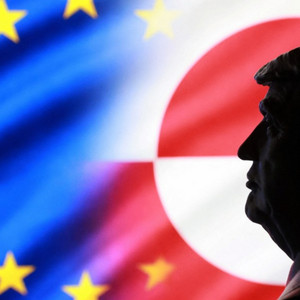
Trump steps up pressure over Greenland and Europe comes out fighting.
I may do that for Greenland too.
I may put a tariff on countries if they don't go along with Greenland, because we need Greenland for national security.
An ally, a friend of 250 years, is considering using tariffs.
We don't like tariffs, but certainly we don't like using tariffs as a geopolitical weapon.
Welcome to World Business Report from the BBC World Service.
I'm Sam Fenwick.
President Trump is increasing threats to take control of Greenland, saying he'll impose tariffs of 10 if a deal isn't done.
It's prompted a strong pushback from European leaders.
We'll look at what it will mean for business on both sides of the Atlantic.
And we hear directly from US farmers about how a year of tariffs has affected them.
So tariffs are once again being used as a geopolitical weapon, this time in a growing dispute involving Greenland.
Markets have been reacting, with investors selling US assets, the euro strengthening, gold hitting another record high and European stock markets falling.
In an interview with the US news channel NBC, President Donald Trump says that he will 100 follow through on threats to impose additional tariffs on European countries that oppose his ambitions over the territory.
Throughout Monday, political leaders from across Europe, the UK and Greenland have responded.
The use of tariffs against allies is completely wrong.
It is not the right way to resolve differences within an alliance.
We are very devastated on behalf of our partners and allies that are now threatened with tariffs that will affect their economies quite a bit.
And what it will do to Greenland, I think it creates uncertainty about investments.
Should the threatened tariffs be imposed, the European Union has tools at its disposal and is prepared to respond, because we will do everything necessary to protect EU economic interests.
The US Treasury Secretary, Scott Besant, has been talking to journalists at the World Economic Forum in the Swiss town of Davos.
The president is looking at Greenland as a strategic asset for the United States.
We are not going to outsource our hemispheric security to anyone else.
Great.
I think that'll probably be the last one for today, guys.
I think it would be very unwise.
What you heard at the end.
There was a reporter asking Mr Besant's reaction to the idea of Europe imposing tariffs on the United States.
And he said it would be unwise.
Let's get the views now.
Duncan Edwards.
He's the CEO of British American Business.
It's a trade body which represents almost 500 companies on both sides of the Atlantic.
He's joining us from Connecticut where he's visiting to do business.
Duncan, first of all, tell us what are your members most worried about right now?
Actually, I live in the United States, so I'm talking to you from my home in Connecticut.
But what people are worried about, I mean, it's clearly an uncertain environment for doing business.
It's never helpful.
So, having lived through the tariffs that were introduced last year and just about reached a position of stability, albeit one that is – frankly, worse than what went before to have the threat of new tariffs suddenly coming as a sort of New Year's present is extremely unhelpful.
Actually, I personally think we still have a very good chance that this doesn't happen.
It feels like Trump is exerting maximum pressure to bring negotiations about.
And it's a long time until February the 1st when these are set to be introduced.
So let's hope that this is a negotiating position rather than a fait accompli.
But I suppose, as you said, businesses have to sort of prepare for it in case it's not a negotiation.
What businesses are most concerned about it?
What sectors do you think?
Presumably car makers across Europe and the UK.
Yes.
I mean everybody who sells products and goods into the United States.
Whether you're selling chemicals or cars or Scotch whiskey, everyone will be affected.
And to be to be completely honest, there's not much you can do about it given the time frame.
I mean ordinarily, what you would do is try to time some of your shipments in order to get maximum product across the water before these came came into play.
But with 12 days, you don't really have that luxury.
So, yeah, what will be will be.
Companies will either have to take the decision not to sell, which some companies did last year when there was the super high level of tariffs immediately after Liberation Day.
Just don't ship for a period of time and hope that stocks inside the US will last the negotiating period and you can.
You can sort of wait it out.
Or you just have to rebalance and find another way of managing costs on this higher level of tariff, which is extremely unhelpful for everyone.
Let's bring Matthew Bartlett in.
He's a Republican strategist and a former State Department appointee during Mr Trump's first administration.
We've seen President Trump threaten tariffs before and then pull back Brazil and China, for example.
Does this time look different to you?
It's a great question where the answer is very unclear.
We have seen tariffs being discussed around a new economic world order, you know post-World War II, and certainly things have changed.
And I think there's an argument to be made that so should our economic policy, certainly internationally.
Yet with this aspect happening, It is around Greenland.
It is around potentially, quote unquote, taking over territory.
This seems highly inappropriate, wildly inappropriate, even preposterous.
So it further complicates the economic order and then truly aggravates our allies, our NATO allies, our strong NATO allies, precisely at the worst time possible.
You're using some very strong words there.
You do sit within the Republican Party.
Are there other high profile Republicans saying similar things to you, or are they agreeing with Donald Trump?
Let's be clear the president continues to be a true outsider domestically internationally, with respect to politics.
There is tremendous upside to that.
Already, we've seen how President Trump has crafted a very fragile peace in the Middle East, taken decisive action in Iran, even Venezuela.
Yet when it comes to Greenland, it seems as if this is the president's own singular goal.
His fascination has now escalated from a geopolitical concern around Greenland, which many people can agree to, to now going towards again the sovereign nation of Greenland.
So, no, Republicans, Democrats, the United States Senate sent a delegation.
It seems as if this is stemming, again, from the Oval Office itself.
Have you been surprised at how European leaders have reacted to the president?
They too have come out quite strongly, haven't they?
I was reminded of Mr. Trudeau in Canada when he came out fighting.
There's a similar sort of feel from them this time.
Um, it's been um again a range of of emotions um, in reaction and response to very legitimate um uh, highly alarming rhetoric coming from the president.
Um, you saw, you saw Macron taking a hard stance.
Um, you saw Germany taking something of a more de-escalatory tone.
Um Keir Starmer's um PM Starmer's um Press conference today seemed to again acknowledge legitimate issues, yet refute some of the president's posture and urge for a de-escalation and some sort of a resolution to this, potentially at Davos, where the president will be meeting with many leaders.
Duncan Edwards, do you think business will be cheering the politicians on from the sidelines?
Do you think they've come out with the right tone this time?
So far, yes.
I mean, I think what business is wary of is threats of retaliation.
I don't think any businesses are encouraging full-throated retaliation.
So I think we do need to be a little bit careful.
So let's hope that the sunshine and snow in Davos is conducive to a more reasonable conversation between the US administration.
That was Duncan Edwards there.
The line was fading away as he was speaking, but I think you got the gist of what he was saying.
He is from British American Business.
It's a lobby group for 500 plus businesses in the UK and in America.
And Matthew Bartlett, a Republican strategist, was also talking to us.
The tensions have led to a sharp fall in stocks as investors have moved into safe havens.
So we're going to bring in our markets guest now, one watching for reaction in the United States and one tracking developments across the UK and Europe.
Peter Jankowskis is Vice President of Research and Analysis at Arbor Financial Services.
He is in Chicago and in London for us we have Emma Wall from Hargreaves Landau.
Let's start with Emma first.
European stocks were heading for their worst day in two months.
How did they finish, Emma?
Not very well.
I mean, it's difficult to comprehend that we're still in January.
We've had a super cycle in markets every week so far this year.
And today's news is that, as you say, European stocks have fallen, ranging from down around 04 in the FTSE, down to nearly 2 for both the German and the French indices.
And the gold price has shot up 1.8%.
So really, it's a very much a risk off feeling in Europe.
The worst hit are those ones that are potentially most damaged by tariffs.
So autos, luxury goods, pharmaceutical stocks, BMW, Mercedes, LVMH, Kering, Novo Norsk and Roche.
It's been a sea of red today.
Does that reaction suggest that actually investors businesses, are worried that this isn't just sort of rhetoric from Mr Trump?
It's a really interesting question because the sort of acronym of the year last year was TACO.
Trump Always Chickens Out.
But we've started the year with a very decisive Donald Trump.
You know, he said he was going to invade Venezuela.
And indeed, the military operation in Venezuela was exactly as he stated.
So now, I think, what markets and investors alike are trying to work out is is this Trump saying very clearly and plainly to those eight nations that he tends to put 10 tariffs on from February the 1st and 25 from the 1st of June?
Or is this a negotiation tactic as it has been in the past?
Let's bring Peter in.
Peter Jankowski.
So how are U.S. markets faring?
I know U.S. markets have been closed today, but futures are sharply lower, aren't they?
So how seriously are investors taking it on the other side of the Atlantic?
Well, futures are pointing toward an open tomorrow that would be down about 1%.
So a fairly substantial reaction, though muted relative to the reaction that I've seen in Europe.
We heard a clip there of Scott Besant saying that any retaliatory tariffs would not be a good idea.
Why not?
Well, I think he certainly wants to avoid escalation of this matter.
That's the primary reason that he's saying that.
You know, frankly, President Trump's announcement wasn't a very good idea either.
So, you know, it's a very challenging market.
I
My take on what he's doing here is he's trying to take advantage of the Venezuela situation, where he did act decisively, to put additional pressure on the European governments.
But it remains to be seen where it goes.
European governments have already stepped back from further negotiation on the trade deal that was agreed last year.
And I think, as the costs of this action begin to multiply, hopefully we'll see the Trump administration pull back.
Emma, what might the reaction be across European markets if there were retaliatory tariffs?
I think it would be global volatility.
I mean, what's quite interesting is the EU obviously already has a list of potential targets from the negotiations last year.
So they are threatening to sort of dust off that list.
The number that's being sort of bandied around is around over 100 billion worth of US goods could be targeted.
I mean, I agree that this sort of tit for tat is likely to not have any winners, but we would expect to see considerable unrest, not just in the equity market but in the bond markets too, because geopolitical concerns often do spill into sort of government bonds as well.
I mean, that figure, these figures are eye watering, aren't they?
And I suppose that is why you're seeing these kind of continued rally, if you like, of gold.
Yeah, you are indeed.
I mean, if you have a look at the sectors that could be targeted, those US sectors that most export to Europe.
It's energy chemicals agriculture food, pharmaceuticals.
But you're right with all this uncertainty.
Actually clearly the sort of winning asset class is gold and that flight to safety.
I mean, traditionally, the US dollar has been seen as a kind of real safe haven asset.
But because of the uncertainty with the US policy, gold is definitely favoured at the moment.
Emma Wall from Hargreaves Landown, thank you very much for joining us.
And Peter Jankowskis from Arbor Financial Services, too.
If journalism is the first draft of history, what happens if that draft is flawed?
In 1999, four Russian apartment buildings were bombed, hundreds killed.
But even now, we still don't know for sure who did it.
It's a mystery that sparked chilling theories.
I'm Helena Merriman and in a new BBC series I'm talking to the reporters who first covered this story.
What did they miss the first time?
The History Bureau, Putin and the apartment bombs.
Listen on BBC.com or wherever you get your podcasts.
You're listening to World Business Report from the BBC World Service.
Well, tariffs have been a defining part of President Donald Trump's economic agenda since he returned to office a year ago this week.
And while today's headlines are focused on the global fallout, for many Americans the impact has been far more local.
For US farmers, 12 months of tariffs have meant disrupted export markets, rising costs and a greater reliance on government support.
In December, the White House announced a 12 billion aid package, with most of the money going to one-off payments for crops like corn and soybeans.
Well, earlier I spoke to three farmers from across the United States about how the past 12 months has been for them.
First, you'll hear from Anne Schwagel.
She's a soybean farmer from Minnesota, and she's vice president of the Minnesota Farmers Union.
As producers, we're used to a certain level of uncertainty.
Unfortunately, we haven't figured out how to control Mother Nature, and we haven't been able to control our markets, certainly.
The last year with the number of tariffs, retaliatory tariffs we have seen our markets really be increasingly volatile and our inputs are incredibly high right now in many areas.
Grain producers in the upper plains, including myself, were growing grains below the cost of production.
We saw this in the last Trump administration when they started the initial trade war with China, where the Chinese buyers ended up turning to other trade partners, primarily in South America.
And those buyers went back down to South America this year to buy their soybeans as well.
Have you noticed that, since you know, relations between China and the US sort of thawed a little bit, that sales have gone up to Chinese customers?
There's been the promise of sales, which has helped to encourage our markets in the fall here.
We haven't actually seen that promise come through.
We've seen some buying, but not nearly the same amount that there used to be prior to the trade war.
Let's bring Sid Miller into our conversation.
He's a rancher and Texas agriculture commissioner.
Now you've said Sid, haven't you, that tariffs show that President Trump is serious about American farmers.
What evidence have you got of that?
The evidence is in the first administration.
He was going to use tariffs to help our farmers out.
He personally told me he loves a family farmer.
And he told us, he said, look, guys, it's going to get rough, but I'll take care of you.
I'll take some of this money from these tariffs and I'll prop you up.
And in the end, you're going to have profitable times.
Matter of fact, you're going to make so much money you're going to have to buy more land and more tractors.
Of course, that sounds just like something he would say.
And in the end, in the second half, he was right.
Man, we were getting the best prices for our commodities we've ever gotten.
And so he's using the same tactics this time.
China, just like the lady just said, is coming around.
We're seeing a little boost in soybean prices not as much as we'd like, but we're headed in the right direction.
You know, we've just closed a deal with Taiwan to buy $10 billion of extra agricultural products.
We've never done that before.
So personally my agency, the Texas Department of Agriculture.
We have 45 foreign trade missions in the next 12 months.
So we're hustling it.
What about those short term cost increases, though, that Anne was just talking about?
They're pretty hard to take, aren't they, as a farmer?
Well yeah, the cost of production is just so much higher right now that the markets just aren't keeping up.
Well, the good thing is some of those production costs are coming down.
They're not all going up.
Diesel is an all-time low, at least it is here in Texas.
I filled up my truck for $2.75 a gallon yesterday.
We're seeing the price of potash nearly double year over year.
A key input for grain farmers.
And that's as a result of tariffs on that import, which is primarily coming from Canada.
I want to bring Geoff Winton into the conversation.
Now, he's a dairy farmer on Lake Erie in New York, but also the founder of Rural Mines.
And Rural Mines supports farmers' mental health.
Geoff, how is the economic pressure of the past year affecting the farmers that you're talking to?
I can tell you it's a very difficult time.
As you mentioned, we're on Lake Erie, very close to Canada.
So our fertilizer comes from Canada, our equipment comes from Canada and our input costs have gone through the roof in the last year.
A year or so ago, we were getting $25. a hundredweight, which is how dairy farmers get paid.
You get paid by the hundred pounds.
It's now down to $15 a hundredweight.
So we are really struggling.
As a matter of fact, a number of farmers I know who are also dairy farmers, are now getting second jobs off the farm in order to pay their bills, something that they never had to do.
But as I work across the United States, the story is pretty much the same.
But one thing that's not getting nearly enough attention is what immigration reform is doing to the agricultural labor force.
Within four months last year, we lost 155,000 farmworkers.
That is a big chunk of the farmworkers, and they weren't just the undocumented farmworkers.
They were also the documented farmworkers that are equally concerned.
So this is having a major impact on the mental health of people in agriculture.
Sid, you said that Donald Trump said to you personally that things would be tougher before they get better.
Is that the kind of challenge that you think that he meant?
This sort of situation that Jeff has described and Anne has described?
Yeah, but you forgot the second half of the statement that he said he'd take care of them.
He just released $13 billion worth of bridge payments.
One comment on the dairy industry, $15 is not profitable.
You just can't make it.
I mean, really can't.
It needs to be $20 or more.
What about actually increasing the price of the milk that is being produced by farmers in the U.S.?
You'd feel a lot better if you were actually getting paid for your labor.
It would help my mental health, certainly.
Jeff, presumably it would help yours as well, being a dairy farmer.
I would say it's a very antiquated program as well that even under the best of times, needed to be revisited.
And I maintain that.
I would imagine that both of you feel the same way.
Here in the rural areas of the upper Midwest and Northeast where I am, it was virtually impossible, even before immigration reform started, to get anyone to work on a dairy farm, because the cows have to be milked two to three times a day.
It's very hard labor.
The impact of the immigration changes is that you don't have enough workers to be able to do the jobs or you're having to pay more than those people would have been paid.
Well, it's both if you can find people to pay more.
That's the problem.
Let me make one comment.
So total American agriculture, we need 800,000 agriculture workers.
You know, we started with the H2A program, which was 75,000.
Last year, we'd gotten that up to 375.
And this year, we've added another 100.
So we're up to about 500 of the 800 we need.
Now, the problem is, you know, the soybean farmers, they can participate.
But our dairyman friend, he's not considered seasonal.
So it's no help for him.
So we've got to change that.
So the dairy industry can participate in the H2A program.
Another thing, we're going to need less and less of migrant workers is because of technology.
You know, we have robotic milkers now.
We have autonomous tractors.
We have unmanned drones that spray our field.
We have just about every kind of automated harvesting equipment now.
How do you afford that when you're underwater on your cost of production?
I can't afford a unmanned tractor for my fields when I can't afford to pay my operating note.
And I don't want a bailout.
I want a market.
OK Jeff, do you have any indication of the number of farmers who might be just packing up altogether and not farming anymore because of the things that Anne has described?
There are dozens, if not hundreds.
This farm has been in my family for generations.
But, quite honestly, we are at a crossroads right now where we are trying to determine if it makes sense to continue.
And if it does, we're going to have to change our business model dramatically, because that low price of milk I told you about before doesn't look like it's going to turn around anytime soon.
It's a huge pressure on the shoulders of a farmer to think about being the one that loses the farm.
After it's been in the family for generations.
You do not want to be the one who finally ends that legacy.
That was dairy farmer Jeff Winton, soybean farmer Anne Schwagel and Texas rancher Sid Miller speaking to me earlier.
Peter Jankowskis is still with us.
He's from Arbor Financial Services.
He's talking to us from Chicago.
The policies of Donald Trump, these economic policies around tariffs and immigration.
Ultimately, the impact of those policies is the US consumer, as you know.
In this instance, food prices go up.
Is that right?
Well, ultimately, yes.
All of these programs do have feed-on effects, etc., that come back to prices.
I think the key is to maybe have a little more cohesive policy where those trade-offs are recognized, rather than what appear to be kind of one-off initiatives and no one really trying to take into account how all these things interact.
Sid Miller was very keen to point out that this was short-term pain for long-term gain.
Do investors feel the same?
I don't know if they do.
I think the prevailing feeling among investors is more of this too shall pass.
They don't envision any of these policies standing up for very long.
I think they're trying to just basically wait the administration out.
Peter Jankowskis, Vice President of Research and Analysis at Arbor Financial Services, joining us today from Chicago.
Thank you very much for your insights.
That is all for this edition of World Business Report.
From me, Sam Fenwick, and the team, thanks for listening.
If journalism is the first draft of history, what happens if that draft is flawed?
In 1999, four Russian apartment buildings were bombed, hundreds killed.
But even now, we still don't know for sure who did it.
It's a mystery that sparked chilling theories.
I'm Helena Merriman and in a new BBC series I'm talking to the reporters who first covered this story.
What did they miss the first time?
The History Bureau, Putin and the apartment bombs.
Listen on BBC.com or wherever you get your podcasts.