You're tuned in to Roundtable. I'm Steve Hatherly, joined today by Niu Honglin and Yuxin.
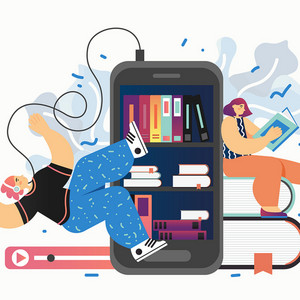
Coming up, from your traditional paperbacks to audiobooks to VR headsets, people have different ways that they like to read.
But with all of those different options, what does it even mean to read anymore?
Does the medium change the magic? Does it make any difference at all how we consume our reading material?
After that, we've all been there, that moment on public transportation when a voice, a little voice, goes from Mommy, I like trains to full volume.
I don't want to be here anymore. That can happen in about half a second.
What happened? You were in such a good mood.
Well, cue the parental panic and cue the fellow passengers suddenly very interested in their headphones.
You know what though, one train attendant in China may have solved that problem for us all.
You can find us at Roundtable China on Apple Podcast.
And please do keep in mind that we love hearing from you and we love hearing your voice. please do send us a voice note to roundtablepodcast at qq.com, roundtablepodcast at qq.com.
You can share your thoughts on any of the things.
And now, for generations, reading meant eyes on a page, deciphering written words. but in our increasingly digital world that definition is totally expanding.
We're consuming information through screens, through our ears, and even through emerging technologies that promise to immerse us into stories like never before.
This leads us to some pretty interesting questions.
What happens inside our brains when we read a book versus when we listen to one.
Is the experience the same? Does our brain react the same?
And as technology continues to evolve how we interact with narratives, What does it truly mean to read in the 21st century?
Let's dig into the landscape of literacy.
Do you still... You should... do you still do you still read a lot i listen to books oh really okay interesting Yes.
When I was a little girl, I used to listen or listen better.
I learned about different knowledge, by saying different knowledge, I mean different subjects. better when I'm listening to the teacher rather compared to reading the textbooks.
So I always thought it's a thing. For me, I thought I was wired differently until I know that many of you are like this.
And it turns out that the brain activity are different when you're reading and when you're listening.
Do tell. How is it different? So reading uses specific brain networks for different types of content.
For example, when you're reading a fictional story, your brain engages areas involved in social understanding and storytelling.
And when it's a nonfiction, it Wood taps into the network for strategic thinking and focused attention.
And that is because when you're reading, you can pace yourself.
Your eyes scan the words. Your brain processes them visually, recognizing the shapes and connecting them to sounds and meanings.
And that means no matter if you're reading an e-book or a paper physical book, you can pause, you can reread the sentence, you can flip back a few sentences or pages to revisit a point, it's a very active I'm laughing because it's happened to me.
I hope it's happened to all of us. It's happened to me a million times where I've read like seven pages, but then my brain says, you didn't read.
I don't remember anything from those previous seven pages have to go back and start.
That is why I read so slowly. And that is why I don't like reading.
Then I turn to listen to books. But for some people, it's a very active action.
It means that you can self-direct yourself when you're processing all the details.
You can paint a mental picture in your brain if you're reading something that is let's say picture oriented, telling you what the story is about.
But when you're listening, your brain is more like a river flowing, processing information in a continuous stream.
Your ears capture the sounds and your brain works quickly to identify word boundaries and connect those words. connect those sounds to meaning and all at the speaker's pace.
You can't really turn back that easily when you're listening.
You can't turn... Well, if you have pause button, you can.
And I'm laughing again because I'm learning Mandarin these days.
And as a student of a second and now a third and fourth language for me, this is what happens in your brain.
I'm listening to a person speaking Chinese and then I'll recognize a word.
My brain stops and congratulates me. Oh, hey, you know what that means.
In the meantime, 25 more words have been spoken and I didn't hear any. any of those at all.
So yeah, that's the difference though, isn't it?
Is that as you very well described it, you know, Honglin, It's a continuous stream, meaning your brain grabs it, comprehends it or not, and then has to immediately move on to the next piece of information.
And the part of brain that is working on processing that information is the working memory part.
It's the brain's temporary notepad. would write down the words that you've just heard and then process that word like Steve.
So if it's your third or fourth language, the process would be slower, which is why when you're listening to information, sometimes you can only grasp the gist of it you would miss some of the details.
And if you want to revisit it, it's better to revisit the written version.
So reading and listening, they activate similar areas of your brain, right?
It's the language processing area. That for sure.
Of your brain, but they do so in different ways.
I guess we could think about it like this.
You can understand in both different ways, but the route to your brain or the path to understanding totally different because readings a visual thing first and listening relies on your auditory system which is a really interesting thing the destination is the same but how you get there there is different.
And that is why I think some people is more inclined to read and some like myself would love to listen to learn because maybe that part of Or different parts of our brains are developed better in different persons.
Well, then, so if the destination is the same, but different.
Different roads are used to get there. Then doesn't that mean that listening to an audio book versus reading a book? is is it would it be not as effective especially when we're talking about things like learning and studying because you said that When we're reading with our eyes, we can go back, we can stop.
We're in charge, right? But when we're listening, we're not really in charge.
So when it comes to learning, are they comparable?
I think so because we know that humans are like visual animals we decide a lot of things we see the world through our eyes and when we're reading books and we see it through our eyes.
And that is the moment that we, the only thing that we're doing that is holding a book and reading it, right?
But when we're listening to things, we can do that in a lot of scenarios when we're doing chores, Yeah, you can multitask.
And oftentimes people are multitasking, aren't they?
Yeah. And that is why when you are listening to things to learn, you can have so many different environments and and that added up to the environment that you can learn.
And also the effectiveness often depends on what you are trying to learn how you're listening.
For example, for simple narratives or entertainment, many studies show Little difference in overall comprehension between reading and listening, especially if you're fully focused.
However, for example, unfamiliar or technical materials like it's really hard to learn math. purely by listening, but it's doable to recite a piece of Chinese ancient article by listening.
So different parts or different subjects and different way of learning.
This is also why some like audio book. apps now even highlight your current like reading process to help you to understand not only for you to listen but also for you to read at the same time so you can better understand and track The process that or the content.
Yeah, I mean some people learned many people learn differently too, right?
So it would depend on the topic, but it might depend on the learner.
For people with dyslexia, for example, that's a learning disorder that involves difficulty reading.
And if you are... suffering from dyslexia, then listening can be an easier and maybe more effective way to access information.
I don't think so. It can make the visual decoding of written words very, very challenging for the reader.
So for those individuals, then listening allows their brain to extract the meaning without the difficult process of decoding the letters into words.
So back to your point about, yeah, it depends on, pardon me, the topic.
It also depends on the person who's doing the learning too, right?
But obviously they're both very important, reading and listening, but maybe we just learned that they are not entirely interchangeable.
So let's talk about some statistics then.
How are people reading these days? We've got so many different options.
How are people consuming their materials from around the world?
Globally, you know, reading habits are diverse and also evolving with a mixed formats influencing how much and what people read while print books are still hold a strong preference for many digital formats like ebooks and audiobooks are increasingly popular.
One example is that recent data from 2023 to 2024 shows. that in the US, around 42% of adults read at least one physical book, while 21% read a digital book. and 19% listen to an audiobook.
I mean, that's still pretty balanced, though, isn't it?
Right. That means, I guess, obviously all three are pretty big markets.
And here in China, we have all these different types of apps providing, like Yusheng has just mentioned, providing different types of materials.
Many of these apps would allow users to read a book while listening to it, having the highlighting part of what's been read by the either the AI announcer or a real announcer.
And for you to have an interest in a real book, they also have this five to 10 minute version describing the content of the book.
So you can decide on whether to read or to listen to it.
I saw a piece of news from The Guardian.
It's a little bit alarming, I think. This is kind of on a different topic, perhaps, but it talked about...
Parents who are struggling to read to their children these days.
I'm talking about Gen Z. Parents, so young people with children already.
And the report was that one in three children saw reading as more of a subject to learn rather than something to be enjoyed.
And that's a really big difference from their Gen X counterparts.
And the kids themselves, this is from Newsweek, I was reading a different story.
On average, children aged 12, they spend four to six hours a day watching and using screens each day. and teenagers can spend up to nine hours on screen, and that means that you're going to have less time for the parents and the children to be reading together as kind of a family activity.
They say that parents are less likely to read to their kids before they turn five.
41% of parents of all ages were reported doing so. which was a steep drop from 64% in 2012. younger parents are not reading to their younger children as much anymore.
A reliance on technology. But speaking of technology... reading is becoming a thing where tech is becoming involved in our reading material.
How does that work? Yeah, that's actually what I was thinking about it when you were talking about young parents are not reading to their kids anymore.
Maybe that's because these group of people are more like adapt to a world with all of these technologies and they are not like reading it in person. but using another tool to read to their kids.
Yeah, doing it, but just in a different way.
Yeah, and... immersion reading or immersive reading is a thing that we are having right now. that kind of highlighting thing is one manifestation of immersion reading of course and also you can use some VR goggles to read your virtual books and that can give you so, so realistic and authentic experience of reading.
It sounds like my worst nightmare when I was in my early 20s.
I have to learn all the time and now the words are in my world when I'm wearing the goggle. are everywhere they're not just in the book oh no no I mean it's it's so cool now it may or may Really it may or may not be for you.
I watched a video I think you should watch maybe the same or a different video about It was a VR headset.
I don't know which VR headset it was. But the user, when you look into the screen of the headset, the bookstore is there.
And then you swipe with your fingers to choose your book. and then the pages open up right in front of you and when you want to turn the page you just kind of swipe your hand in the air.
And the attractive thing of this is that you can like lay down, right?
You can lay down on your bed and you don't have to hold a book physically.
And no need to worry about your eyesight anymore.
Yeah, but the complaint was that the headset is really heavy.
Oh, yes. And it's like wearing heavy ski goggles.
Because people read sometimes for hours at a time, and you start to feel that thing on your face.
But then the girl said, eventually, you stop feeling it on your face.
And I don't know if that's a good thing or a bad thing.
So there's that. There's haptics. where you've got your device like shaking... And vibrating.
And vibrating. If, you know, there's like a knock on the door or something, then the thing will like...
I don't know if I like that. For me, reading is so immersive and it's something that I need to be focused. about when I'm when I'm doing it so these kind of vibration or sudden lighting up of words would somehow disturb my reading experience.
So the more, ironically, the more immersive it tries to make you, the less immersive you may feel.
But what I would say is that people are just using all of these technologies to simulate the experience of reading a real physical book.
Yeah. But people are just not choosing a real physical book.
I mean, this isn't kind of cool, though.
You know, like the headset, the VR headset...
Has the audio too, right? So when you're reading, if there's birds in the park, like in the book, you'll hear like tweet tweet tweet tweet tweet tweet tweet that's kind of kind of cute kind of cool i think right yushin you brought up a great point as you and i were discussing this um this morning you said As long as people are reading, it doesn't really matter how they read, right?
And I guess that's the point. You're listening to Roundtable.
I'm Steve. Today with Niu Honglin and Yu Shun.
Coming up... Keeping kids quiet on public transportation is a challenge for even the best of parents.
But on one recent train ride here in China, the train attendant cracked the code on how to turn the noise into absolute silence.
How did he do it? You're about to find out.
Looking for passion? How about fiery debate?
Want to hear about current events in China from different perspectives?
Then tune in to Roundtable. where East meets West and understanding is the goal.
It is roundtable time. I'm Steve with Yushan and Yeohong Lin.
Summer train travel with the kids means cue the chaos for many parents. noisy children in an enclosed environment is stressful for the parents, the children, the passengers in that train or that bus or that plane.
And that means someone has to solve the problem.
But usually you don't depend on the attendant to solve the problem on the train.
But in this situation, that's exactly what happened.
You shouldn't tell us the story. This is really kind of cute.
I actually had that experience. And I so hope that I could have a plastic bag of test paper for these kids.
But anyway, this happened on this... train from Nanning to Hangzhou, which is from Guangxi Zhuang Autonomous Region to Zhejiang Province. that's almost a 12-hour trip on train.
Okay. That is quite a launch, and that is why I think these attendants is trying something to make these children quiet, to make the other passengers have a quiet environment.
So this is a kind of personal behavior by this attendant named Ching Yun Hao, who was carrying a plastic bag filled with over a hundred Primary school test papers for different grade levels.
Test papers. Test papers. School test papers.
Oh, kids. And then whenever he encountered noisy children, he would reward them. with a test paper.
And children who completed the paper or behaved quietly during the trip would also receive a sticker or trendy sticker.
Oh, that's golden current. for children, a sticker.
It is like a mobile kindergarten or mobile extracurriculum classroom. in that car, well, in that train.
12 hours, you said? 12 hours on the train.
Okay, first of all, let's be fair to the kids, right?
Was it kid or kids? in this situation. Kids.
Yeah. So let's be fair to the kids, you know, asking them to be quiet and be patient on a 12 hour train ride is a big ask. for a child.
So the kids were being noisy. I guess the parents couldn't get the kids under control.
So the attendant came along with some school test papers and said, if you complete these, you get a sticker.
And it worked, yeah? Yeah, it worked. Which is the reason we're talking about this.
Besides that... I kind of understand the idea because for kids, their parents are their parents.
When their parents try to regulate them, try to make them behave. tried to also give them some test papers to complete, they would not comply.
Yet one is attendance. wearing costume, looking all serious like the teacher, it works.
And now young people are being very creative when it comes to calm the kids down. down because they grow up in similar kind of scenarios and they understand the mentality of the kids and they're You're trying innovative ways.
There was a story from 2019. It made international headlines.
It was a flight. from Seoul, Korea to San Francisco.
That's a 10-hour flight. So the mom was traveling with a four-month-old child.
And before the plane took off... the mom handed out little goodie bags that she had made to 200 passengers.
On the aircraft with some candies, some earbuds, and a note that says, Hi, I'm Junu, I think was the baby's name.
I'm four months old, so... sorry if I'm noisy on this trip.
So here's some earbuds and some candies.
And that went viral. I think that's a bit extreme, though.
I don't think that's necessary for parents to do. to my another point of these kind of situation I think these kind of behaviors of kids is not only the behavior of the kids is also reflecting the education from the parents.
You think so? I think so. Why? What do you mean?
When the parents cannot really control the behavior of the kids.
Of course, they need to give some heads up. to these children.
Oh, like we're going to be going on a long trip.
Yes, this is a long trip and this is a public space. there is a rule or kind of philosophy that you need to understand.
No, you know, sometimes kids are not that reasonable.
They're like little puppies. who barely speak any of our language.
It's not. Every kid is different. And also, if we're talking about little kids shouting, how about those kids adult, perfectly reasonable adult who are talking and chatting in really loud volume.
How about those who are watching their short videos? without their headset plugged in.
And I think not only because I am a mom now, but I also think we can be a little Yeah, I mean, I think I understand. what you're trying to say, Yushin, but at the same time, kids can be pretty unpredictable and it's not their fault, right?
Like I said, a 12-hour... train ride is it's challenging for an adult, nevermind a kid to be cooped up or a long flight, a 10, 12, 14 hour flight.
That's even worse than being on the train.
I think there's less space. uh to walk around what do you do though i mean you're the mom here in your homeland what do you what do you do when your kid is freaking out in public What's your solution?
Unless I am trapped in an iron box thousands of meters.
Which you are often not. Thousands of meters in the sky.
I would take my kid to somewhere else, come him down and take him back.
There's a really cute, speaking of viral videos, there was a cute viral video of a guy in the States He was in a shopping mall, I guess, with his little two-year-old daughter and he took her out to the parking lot because she was throwing a fit.
And he had the camera pointed at both of them.
He said, when you're ready to go back in, we can go back in.
He said, are you ready? She's like, He's like, all right, well, we're not going back in yet.
That's good parenting, too. That's Roundtable for today.
I'm Steve. Thanks to Yushan and Niohong Lin.
Thanks to you as well. And please do come back next time.