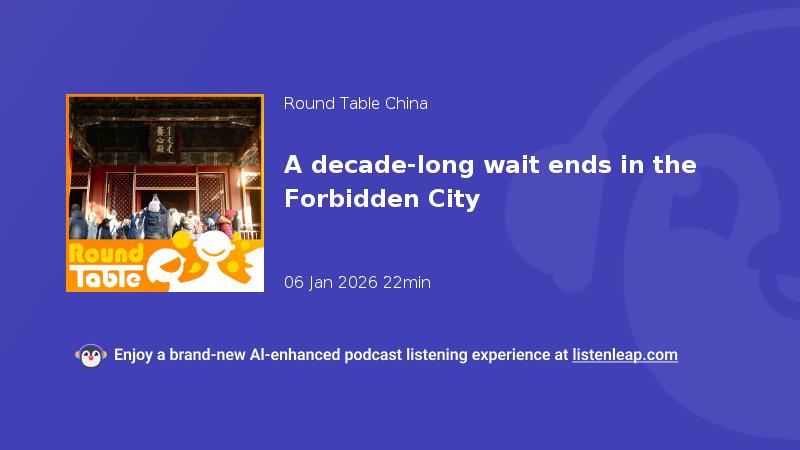
After 10 years of do not disturb signs, the most powerful room in the Forbidden City is back in business.
Want to see where the Qing Dynasty emperors actually lived, worked and gossiped?
The Hall of Mental Cultivation is finally open.
And admit it, you've done it.
You've been digital detectives at some point investigating our partner's X files.
But why do we torture ourselves by looking for things we don't really want to find out?
Let's discuss.
But before that.
The Palace Museum in Beijing has completed one of its most ambitious restoration projects to date a 10-year multi-million dollar overhaul of the Yangxin Dian, or the Hall of Mental Cultivation.
This site served as the primary residence and an obstrative heart of the Qing Dynasty.
The project represents a landmark in Preventative conservation, utilizing 21st century CT scans for timbers, while strictly adhere to 600-year-old traditional craftsmanship.
Today, we examine the delicate balance between public access and heritage preservation in one of the world's most visited cultural landmarks.
Yeah, Yangxin Dian, the Hall of Mental Cultivation.
No thinking about all the history going on inside of this hall.
Well, actually, the Hall of Mental Cultivation is more of a yard inside the Palace Museum.
It was built back about 500 years ago during the Ming Dynasty, you know, the dynasty before the Qing Dynasty.
And it sits to the west of the Qianqing Palace in the Forbidden City.
Which, by the way, if you're not familiar, is also the Palace Museum.
It's the same name.
Yeah, they also have like different palaces and halls inside the Forbidden City.
But this courtyard is relatively small compared to other palaces and other halls.
I think in size, it covers less than 1%, actually, compared in the whole of the city.
And it has a lot of rooms and buildings, but also built very tightly together.
And it's kind of one of the reasons why a lot of emperors choose this place in particular as their bedroom slash, study room, slash office.
Yes.
It's the royal family's official home, which carries a lot of different functions.
And also the royal family in Chinese.
In ancient China, it's a huge family.
It's not only the emperor himself and his wife, Dan.
No, to start with, he would have many concubines.
And also there would be worker, the servant, living also in the Forbidden City.
And because it has functions for the administrative work.
So those who are working in the court would also join in, go into court, the forbidden city, and report to the emperor, which makes the forbidden city a really large place.
And it's a place that you have to visit if you come to Beijing, if you have an interest in Chinese history, which also is the reason that the place is very much visited.
And a lot of the buildings, a lot of the yards would need renovation from time to time.
Yeah, of course.
I was watching a documentary, a CGTN documentary.
I didn't have time to watch the whole thing.
It was an hour.
I was watching it this morning.
And they were talking about the restoration of this particular part of the Forbidden City.
And that it was, I believe, started many years ago.
But when it was started, it was the first time it had been restored in 100 years.
And it was really cool to see the engineers that were working on the restoration.
There were.
There was one woman who was dusting a wall and I thought why is she dusting the wall so carefully?
Well, there were characters inscribed in the concrete under that surface layer she was dusting.
And she was so excited because she said oh, I didn't think I was going to be able to recognize any of the characters, but there was a whole sentence there.
And then they used some type of special paper and were able to lift it off to be able to read that.
I mean, it's really quite incredible.
All the things that have happened.
Yes.
And if you really think about it, with so many visitors going inside, stepping on the floor, reaching or leaning to the wall that has a history of more than several hundred years, it's definitely going to do certain kind of damage to the construction site, to the area, which is why some of the places are closed because they need renovation.
Some of the places are closed because they just want to keep it intact for a while, before the technology required to restore, to maintain the place, making sure that they stay in the same way 600 years ago the kind of technology.
Before the technology emerged, these areas would also be preserved and be closed for a while.
But the Yangxin area is different.
It has a different position, even in a place as precious and important as the Forbidden City.
Yeah, it is the heart of ancient China's politics, really, for, I think, at least 200 years.
Basically every major event happening in the history.
You can find a trace from the Hall of Mental Cultivation from Yangxin Dian happening here.
For example, China decided to face up its opium and crisis.
One of the officials called Lin Zexu.
He actually planned out and reported to the emperor inside one of the rooms of the Yangxin Dian.
And also when it comes to the famous two emperors sitting behind a curtain, you know, ordering around young emperors in the history, that also happens inside.
And also, I think very interestingly, is that right now, after reopening of this hall, the Palace Museum actually restored their different rooms based on different histories.
It's not that you walk inside into the room.
They're recreating a scene from a different phase of the history.
For example, inside the main hall, they recreate what the Emperor Yongzheng's meeting settings.
And in another room, they call it the West Warm Chamber.
They actually recreate Yongzheng and Qianlong's design and layout of their offices.
So you are not walking.
You are sort of walking into different phases of the history of the Qing Dynasty, in particular when you are touring around the whole of mental cultivation.
Yeah, I mean, this was built in 1537 too.
It's crazy to think that.
And now I kind of get how come it took...
10 years for it to get to the restoration because it was seriously damaged.
Yeah yeah, we see the uh structural and conservation risks.
We see inside the conditions were also quite bad and when we talk about the inside, there are paintings and calligraphy works and the kind of decorations in the um, in the whole of mental cultivation area, and it is not that easy to get repaired.
But after 10 years, it's finally done.
Yeah.
Things like beams and pillars had decayed and the painted decorations were peeling.
And obviously you know you're going to be very careful when you're trying to restore those things, which would add to the length of time that the restoration would need.
Yeah, because most of the buildings inside the Forbidden City are made of wood.
So they get decay over time.
And, I think, over one of the documentaries called Masters in the Forbidden City, which is very interesting.
I recommend all of our listeners to have a look at it.
They look at one of the beams inside the Hall of Mental Cultivation, the Yangxin Dian, and they found the bottom part is beyond repair.
You have to replace it.
But the masters themselves are like but replacing a whole of beam, but thinking about all the histories that you can find within this piece of wood, how about is there a chance for us to just replace only a small part of it?
So they borrowed a machine from a university then do a sort of a CT scan of that beam.
And they found that yes, the upper part of that beam is still being, it still can be used, you can still renovate it, you can still restore it, you don't have to replace it.
So they are like celebrating on that, only replacing the bottom part, what's absolutely necessary yeah so, so they also have a look at different beams, different wood structures within that massive rooms and buildings and it's um, I wouldn't say it's painstaking, but it's a very detailed work.
Yes.
If you really think about it, it takes longer than renovating.
Oh, that too.
But I was thinking about renovating your own house, because you need to first remove all the very precious artifacts.
We see there are over 1,000 movable artifacts.
They were carefully removed and cataloged because you want to put them back when you're finished.
So making sure that they're preserved is quite important as well.
And each piece was placed in a custom four-layer protective box to ensure safe transport.
And and there are definitely fragile items there are the kind of items that you, the items themselves, would need uh restoration as well, and after that you need detailed architectural survey, like feifei said.
That's where the ct scan come in place.
We need to make sure, like access the damage and find out the best solution to restore it.
And there are traditional repair techniques that can come up in use.
There are modern technology that you are kind of testing to use in this place.
But think about the pressure testing, the new technique in a place that cannot really afford to be damaged.
You don't want to be the person to make a mistake there.
Yeah, for sure.
And there's also the training in heritage preservation for sure.
And after 10 years, finally, we're looking at it opening again.
But this is not the only case of a area or a sector of a historical site or a historical site architecture being opened or being closed for renovation and then reopened.
For instance, here in China, we see that there are already a lot of such cases in, for example, the Dunhuang Mogao caves.
That caves have.
We see visitors begin with immersive digital films before entering the limited number of physical caves.
Because most of the caves are closed, because now we want to make sure that no visitors would harm the historical murals in that places.
And also in outside of China.
We see this kind of practice happening for different reasons opening up, reopening or closing.
Yeah, even within the Palace Museum.
I remember when I was a kid first visiting the Palace Museum, we were able to go inside a lot of rooms and basically touching the desks, the beds or some of the very thrones of the emperors and empresses.
But after 10, 20 years, I'm not really sure about the timeframe.
But currently most of the visitors are not able to go inside of this room simply because the amount of people going thousands and tens of thousands of visitors touching, breathing out, breathing in air.
Even now, we have camera shots.
These different changes in light, changes in temperature, humidity everything affects people.
These artifacts inside the palace museum.
And also think when it comes to the whole of mental cultivation.
For example, Emperor Qianlong stored a lot of his collectibles when it comes to paintings and calligraphies inside here, which are very delicate.
And once they're damaged, there is no way to restore them that easy.
So that's the reason I think right now, even within the Hall of Mental Cultivation, all of the calligraphy and paintings on disability are basically duplicates, not the real reliquaries themselves.
And that is why next time, if you're visiting a very historical place and some of the area is closed, Do not be whiny about it.
Make sure you understand it's for future preservation.
It's for the purpose that future generation would be able to at least have a sneak peek into the real thing, instead of only able to see the pictures on the catalog or watching the video on your phone.
Yes, we would definitely want to see the development of technology so that one day we can, you know, see the reopening of more of such areas and be able to have a real immersive experience ourselves.
You're listening to Roundtable.
Coming up next, we talk about why we stock our current partner's access.
Stay tuned.
Looking for passion?
How about fiery debate?
Want to hear about current events in China from different perspectives?
Then tune in to Roundtable, where East meets West and understanding is the goal.
This is Roundtable with me, Steve Hatherly, and Feifei.
Welcome to the X Games, a sport where nobody wins.
The stakes are made up, and the prize is a sleepless night and a slightly bruised eagle.
Why is it that we can barely remember our own passwords, but we can remember exactly which cafe our boyfriend's ex-girlfriend visited in 2018.
Today we're talking about the irresistible urge to cyber investigate the past and why our brains are basically programmed to be the worst private investigators in history.
Admit it.
Have you ever done it?
I can proudly say I have not.
Oh.
Yeah.
How can you curb the urge of looking at the past?
There is no urge.
It doesn't exist at all.
We're talking about going on to social media.
You start a new relationship or you've been in a relationship for a while and you cannot resist the urge.
I think it is, Fei-Fei said, I think it happens a lot in brand new relationships.
Yes.
You'll go on to your new partner's social media and you'll scroll through all your pictures, all their pictures, and you know what you're doing.
You're looking for evidence of their past relationships because you are sick.
There's no benefit to this whatsoever.
There's a term for it.
It's called retroactive jealousy.
Now, jealousy in the traditional sense comes from a third party, right?
Let's say that you go to a club and then some dude comes up and he's talking to your girlfriend.
That is active jealousy.
Retroactive jealousy is when you go to their social media sites and you see there's some dude in the picture and your brain starts thinking who's that?
Wow.
No, there's a whole list of problems here.
Who's that?
Is that their ex?
Wow.
He's good looking.
Wow.
He's got a better body than me.
Oh my God, she was happier with him.
Look how happy she is.
Now it turns out that was her co-worker.
That happens.
But this is the problem.
Your brain starts filling in the missing pieces to make yourself feel worse and worse and worse.
And the starting point must be because you're insecure at a certain point.
You're worrying about you're not the quote unquote best choice of your partner.
And the partner is definitely the best choice of yours.
So what is happening in our brains when we are really that obsessed over our partner's past?
Yeah, this is from a couple of different doctors, one named Gregory White and another Paul Mullen, who identified this problem in their 1989 work together.
That jealousy can emerge not because the relationship is ending or failing, but because of a past, trivial thing, a rival that might damage certain qualities in the primary relationship.
Now, that's a quote from their work together.
Basically what they're saying is there's a core emotional mechanism inside of all of us that can be driven by the fear that we are not special enough, And that's the problem with looking at your exes or sorry, your current relationship pictures on social media is that, first of all, you don't know what you're seeing is actually what you think you're seeing.
That's why I gave the example of coworker and you were convinced that's their ex.
But you start comparing and you start seeing the oh wow, look how happy they look in this picture, even if it is their real ex, and you start thinking I'm not good enough.
Now, another problem with that is that it's social media.
Social media is cultivated to capture the greatest moments in everyone's lives.
Nobody puts a picture of themselves fighting with their ex.
Yeah, they could be fighting the minute before this photo or the minute after yeah, but they will be still smiling in that, Yeah.
So just take into account this.
This is my best advice if you're a person who goes onto social and checks your current partner's exes.
They're not together anymore.
And there's a reason they're not together anymore.
They weren't happy with each other.
So don't worry about it and don't waste your time.
You know, as someone who's not that quote unquote healthy mentally.
The only thing I heard from Steve's previous comment was that there is a reason for that.
And now I cannot help but thinking about, oh, what was that reason?
Will that reason cause the departure of me and my current partner?
You're torturing yourself for no reason whatsoever.
For me, that's an important clue.
See?
To what?
To tell what person your partner is.
Why would they break up?
What was the reason?
What's the deal breaker here?
Yeah, is it because something about him?
Is it something that I can also trigger?
Yeah, sometimes.
Or I can also encounter in the future.
Let me try a different angle.
Okay, all right, fine.
Okay, so we're all crazy and we're all going to go on the internet for four hours every day looking at our partner's exes.
Okay, what's your end game?
That's very difficult.
What do you want from doing that?
What's your goal?
What do you think is going to happen by you torturing yourself like that?
So you're going to sit down with your current partner and say so.
Babe, I was on Insta today for four hours.
No, no, I was just...
No, no, I was just obsessing over your old pictures.
So what happened in all of your ex-relationships?
Tell me one by one by one.
That's not going to be a good conversation.
I don't like that conversation.
But what can happen is that if you really want, because I think deep down it's not really about the ex.
It's always about the current partner.
And what you really want to know is what's his preference?
What does he want?
What's the deal breaker for him?
What's in our relationship that he values?
Here's a fun idea.
Ask him.
That's what I'm going to say.
Because sometimes they don't tell the truth.
You can only learn about their, for example, boundaries by looking at their past.
That is another problem your relationship really has and need to be solved.
So again, the idea here is that to talk to your partner they're supposed to be the closest relationship you have.
And communication is always a bit better than cyber stalking.
And make sure that, as long as you have a healthier relationship, maybe this kind of behavior would only happen once a year, instead of every day.
And you know what we changed today?
Nothing.
Because nobody's going to follow anything we just said.
But actually think about it.
And that brings us to the end of today's roundtable.
Until next time, keep the conversations going and the ideas flowing.
I'm Neil Holin with Steve and Fei Fei.
Thank you for listening.
Bye-bye.