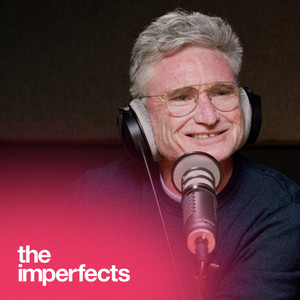
Dave Hughes.
By all objective measures.
You're extremely successful and extremely popular in Australia.
But what do you struggle with?
Over the years, I've struggled with comparison comparing yourself to others, comparing yourself to yourself.
I mean, I'm losing my memory, I'm losing my teeth.
I'm from the country, though.
Your teeth fall out, you get on with your day.
But yeah, I would have times where you're walking down the street with, like you know, Hamish and Andy and you're like, oh shit, what if I have to take the photo?
Welcome to my world.
Welcome to my world.
I was so scared of girls.
I lost my virginity in a brothel at the age of 22.
I was worried about being ugly, worried about not being good looking from really young.
Curious to know how you define ego or how does ego play out for you?
The job is to forget yourself.
We are all just figments of our own imagination.
I have worshipped at the shrine of Dave Hughes since I was about three.
You know, constantly try to make that shrine prettier by achieving stuff.
It is absolute bullshit.
So burn down the shrine.
We're all imperfect.
And on this podcast I'll be chatting with a variety of interesting people who are willing to make themselves vulnerable by sharing their own struggles and imperfections.
I'm Hugh van Kylenberg from The Resilience Project.
And I'm Ryan Shelton from My Mum.
And I'm Josh from Hugh's Mum.
And this is The Imperfects.
Well, who would have thought at the end of the year that Dave Hughes would give us what I think is maybe one of the most spiritual eps of the year, particularly at the end of the chat that we're about to play with him?
It's like I've known Dave since, you know, since Rove days, but like I feel like he's really evolved in a really incredible way.
So that's not a mode you're used to, that kind of?
I mean, I don't know him that well, but I've never heard him speak like that.
Wow.
Yeah.
So it's pretty... I absolutely loved this chat so much more than I already knew I would.
He was in all sorts as well when we did the interview.
If you remember, he'd had his ribs smashed to smithereens in that celebrity football game.
About two days earlier or three days earlier.
Yeah.
And so we went to reschedule the interview and he said, no, I'll be fine.
He just came straight from hospital, I think.
Yeah.
Just...
He was in all sorts.
There was every chance he was high as a kite, but we don't know that.
We don't know that.
But he was very, very... He said some quite profound things.
Yeah, it was beautiful.
It was a really interesting chat.
He talked about What it's like having incredibly low self-worth as a young person, sort of late teen years into his early 20s.
He's really like his confidence with in many areas, but sounds like confidence with the opposite sex was almost zero.
And it's this really interesting journey of going from that low self-worth.
He talks about stopping drinking.
And then becoming really famous and sort of analysing the ego and his ego and how to handle that as now an incredibly successful comedian for what?
25, 30 years?
Yeah.
We should also just point out the fact that, Josh, you've got a little sniffle.
So you've got a little bit of a.
Your voice sounds a little bit different than it would normally sound.
Yeah, I don't feel too bad.
Just sound weird.
Yeah.
Sorry, Hugh.
No, no, I was just saying I remember listening to him back in, it would have been 99, 2000-ish.
I had a part-time job.
There was a gym attached to five tennis courts and I would open the gym and the tennis courts at.
It was 530 in the morning, but his first-.
Great ref.
We've got heaps of emails about that.
Yeah, but Avenue is going to go nuts.
Surprisingly, he's filled with a double A at the end, which I don't think anyone saw coming.
So one of my jobs at 6am, I had to sweep all the tennis courts, all five tennis courts.
And that took about probably close to an hour, maybe 45 minutes.
That's not important.
But I remember Husey and Kate had just started their first ever radio show on Nova.
Nova was a brand new station.
And this was Husey and Kate Langbrook, who we've also had on the show.
They kind of launched the station, didn't they?
Yep.
Yeah.
And I loved it so much that I would put it on the speakers, out onto the tennis courts, because there wasn't, like you didn't have headphones.
People weren't rolling around with headphones and listening to stuff then.
So I'd have the speakers at six o'clock in the morning, which is terrible for the neighbours.
But just listening to Husey and Kate, just so I wouldn't miss a bit, because I just love them so much.
Yeah.
No, he's a legend.
He's just like a legend as a guy, but also like a literal legend of comedy in Australia.
And you and he also got papped together after the interview, if you remember.
Yeah, I walked him down to wait.
We ordered an Uber for him.
And then, yeah, there was like a paparazzi waiting.
I think because of the injury that he had from the thing, he was sort of in the news.
Oh, yeah, it wasn't because he was doing an episode with us.
No, definitely.
Yeah, it's the one and only papping.
Yeah, so I got papped, which was a bit funny, but weirdly rewarding looking at it online.
Speaking of ego.
Yeah.
Speaking of ego, I was like, me?
I mean, to be honest, the shots that they used, I had my back turned to the camera.
But that's cool.
All good.
Unmistakably you, though.
Unmistakably, yeah.
Yeah.
Yes.
Speaking of funny and weirdly rewarding, just a very quick funny one, mainly for Josh, because you were there, Ryan.
Okay.
Yesterday at the airport when you had one of the- Did you call this a quick funny one?
A quick funny one.
Yeah.
Yeah, great.
It is quick.
Yeah.
Not funny, but it's quick.
We'll see.
We'll see.
No, I just wanted to tell Josh and I haven't had a chance to yet.
But when you were busy, when you were in a headlock from the lady at the airport yesterday when you were trying to get the batteries through, you couldn't get them through.
I mean, not literally.
She didn't actually have any headlock, but she was being very forthright with what you could and couldn't do at the airport.
Absolutely.
As you should be.
A rule follower.
Yes.
And that's great.
That's exactly the pep you want working at an airport.
No, we were definitely praising her after that situation.
Yeah, everyone was wrapped.
Yeah, we were wrapped with how much she was following the rules.
It was fun.
So good.
It's fun when you're trying to catch a flight.
It was fun.
Funny.
Really good.
Yeah.
And while you were there having a lovely time dealing with that, we were in a lounge having a lovely time dealing with lounge things.
Yeah.
And they actually had, I hadn't seen this before, but it had crumpets.
And I thought, I saw the crumpets and I saw some honey next to it and I thought, don't mind if I do.
Yep.
It was such a lovely surprise.
And I, it was the, you know, the rotisserie things that you do, put toast on it.
Not rotisserie, but the... Conveyor belt.
Yeah, the conveyor belt, the toasting conveyor belt.
Yeah.
I put a crumpet on there and you know how sometimes they can take a while to even toast toast.
Crumpets.
My gosh.
I did five rounds and it just wasn't, it wasn't even crisp.
This is funny.
Also quick.
And I said to the lady who was watching I said they should build houses out of crumpets, houses in fire danger areas.
Not that funny, but just a thing because she was watching me battle with it.
And she said, nah, they'd never do that.
Bloody nanny state.
She's thought about it and went, nah, they'd never do that.
I mean, you can try what you want, but in Australia, with the laws the way they are, there's no way you could build a house out of crumpets.
It's bullshit.
You know it's absolute bullshit because you look at the material.
It's actually the perfect thing to build a house out of.
They would never.
Oh, council's a nightmare, getting that through planning.
No way.
Anyway, we loved this conversation with Dave Hughes as we alluded to just before.
I think we all have an impression of who Dave Hughes is, but what we got here was something that really surprised all of us.
Yep.
And for those of you who are new to this podcast, we will come back after the interview and I want to talk to you about ego and talk about the best ways to let go of ego.
Wow.
Dave Hughes.
Yeah.
Hughesy.
Every now and again we get icons through the door.
This is one of them.
We've worked together a couple of times, or really one main time when we were doing Rove.
But even before, actually after that is when I sort of came into Nova when you used to be on Nova.
And I'd never done radio before and we'd gone into the In Melbourne Nova studio where you guys were doing Breakfast.
And you were so welcoming.
And I think what you get with a lot of people who are like maybe a little bit older or they've been in the industry for a while and someone younger comes in often, you can get a little bit of pushback.
Yeah.
And you can get a little.
You know, maybe they feel threatened for some reason, or they're Gatekeeping sort of thing.
Gatekeeping.
Yeah, trying to keep them down.
Yeah.
You were just so far the opposite way.
And it really, really meant a lot to feel welcome in an environment like that, which sometimes you really don't feel welcome.
So I think I've messaged you after a long time ago, but...
Just, yeah, thank you again.
No, I do appreciate that.
And that sometimes is a fight against my you know worst nature where yeah, I am jealous and you know, all the time.
Basically,
So I see you guys selling out the Palais and I get jealous, you know.
So that's not anyone.
Yeah, so that is working, sometimes realising you shouldn't give in to your pathetic ego.
Yeah, I'm sure we'll get into that.
I've got lots to say about ego.
But for the two people out there who don't know who Dave Hughes is.
Everyone knows who he is, but there's just some interesting stuff I'd love to give.
I also realise that might have been triggering, saying there was two people out there who don't know who you are.
I'm sure there's not two people out there who don't know.
No, look, there is.
A little while back, I was in my hometown of Warrnambool and a guy, a young bloke behind a coffee machine a hole-in-the-wall coffee machine said what do you want?
Legend.
And I thought, you know, in my hometown I am a legend.
And I said, I'll have a soy latte.
And then he goes, what's your name, legend?
So there's definitely people who don't know who I am.
So, growing up in Warrnambool as a very shy and serious kid, Dave got his first laugh while giving a presentation about historical religious figures in year 11.
Ducks of his high school.
Don't say about that.
And I know I'm interrupting a lot.
Every year, they would bring the ducks from the previous year back to you know, present them in front of the new you know, the new year, to say this is what you're, this is what you are aspiring to.
Except when I got ducks and I never got the invite.
Yeah.
It was the worst year they'd ever had.
And that's not me being humble because I'm not humble.
So that was like I was ducks and, you know, I couldn't get into chiropractic.
You know, so it was not a big year.
But you did receive a scholarship to study information technology, which he pretty quickly found was not for him.
Dave returned to university after a year working in an abattoir.
Yeah.
So I went from IT, which is 1989.
So if you discover, if you want to follow the history of the internet, it's really 1990 where it started really kicking off.
I had a scholarship to do information technology in 89.
So that was right on the cusp of what could have been billions of dollars.
Put it in a tech brochure.
I know.
I was there for six weeks.
I just did not see a future in it.
But it's so boring.
God, coding is boring.
Yeah, I've never done it.
My God, they deserve their money.
It's so boring.
It seems boring.
Yeah.
Only an abattoir after that.
Yeah, so my father's like, you've got to work.
And so, yeah, I went and worked at the local meat works, and that is hard.
Yeah.
Every morning at six.
I used to get eczema in my hands, so my hands would be split open and, like all the sheep, wool sort of oil would go into my hands.
Oh, God.
Oh, it's terrible.
God, that was a hard year, a really hard year.
You went from that, you started studying accounting after that?
I did yeah, because I was at my local university in Warrnambool, so it was a Deakin University yeah.
After a profound realisation about alcohol, Dave quit drinking completely just after his 21st birthday.
He moved to Perth where he bombed only a few gigs before finding his comedic voice.
Gaining recognition in the comedy world, Dave moved to Melbourne to chase bigger opportunities.
In 1998, Dave had his first break on mainstream television, appearing on Hey Hey, It's Saturday, in addition to his brief appearance on Neighbours that same year.
Yeah.
So look back to my.
I did business or accounting at Warrnambool at Deakin University for two years.
I remember failing my last uni exam because I knew no answers.
Like I knew zero on the page and thinking I want to do comedy anyway, so it doesn't really matter.
So that was my thought process.
My mother had a very different thought process.
She's like, what is wrong with you?
So yeah, she really cracked it and told me to get off the wacky tobacco.
Yeah. which I ended up doing, but yeah.
And then yeah, moved to Perth to really I wanted to do comedy and I thought from a long way from home that we know when I know there to see me fail.
Is that the reason?
Part of the reason to go to Perth, yeah.
And what was it like when you bombed?
Do you have memories of that?
Yeah, I do.
The first night, again, so I was only, I think I'd just turned 22.
I'd just stopped drinking completely and the wacky tobacco, so completely sober.
Yeah.
And I was at this little comedy club in Perth and, again, it was my dream to be a comedian.
As I already said, I failed uni and I'd failed a lot of odd jobs as well.
I remember I once got sacked as a dishwasher, which is like when you get sacked as a dishwasher if you're trying, I was trying.
Or if you're not trying yeah, fair enough, you sack me because I'm a lazy arsehole, but I was trying hard.
That was a tough moment in my life thinking I might be unemployable.
And then I got on stage and no one laughed his first night at all.
And that was horrifying.
Just off the back of being fired.
Yeah, absolutely.
So drop out of uni and no one's fired from crappy jobs.
On stage, want to be a comedian anyway.
No one's laughing.
I was talking about being teased at school.
That was meant to be my shtick.
And they just thought it was sad.
They didn't think it was funny.
And as I'm walking out of the room, thinking my life's an absolute disaster.
I'm walking out and there was no backstage, so you had to go through the crowd to leave.
And as I'm walking out, one bloke right at the exit said, they were right to tease you.
And I'm like, oh, that's awful.
Wow, just kicking you on the way out.
Did you feel like a drink after i've given i've decided not to anymore.
So i really weirdly, i'd made the decision very young to not drink anymore.
So i was probably a bit.
I was a big drinker from probably age of 14 or 15 wow, through to 21 and um yeah, binge drinker, always get way too drunk and wake up in, you know, in lock up, not because i was violent, because i'd, you know, fall asleep on the road or something.
So i was a a danger to myself more than anyone.
So yeah, and I had, like you know, I've talked about this before, but my parents are both past now, so I can be a bit more open about it.
So alcohol was a problem in our house.
So dad drank way too much and it was every day and it was stressful for kids.
So yeah, so I really didn't want that to be my life and didn't want to, you know, bring that on to future generations.
So, yeah.
So I really did make a decision.
It was 1992.
It was November.
Me and a mate had just been arrested at the top of a Norfolk pine.
We'd been eating burgerings at the top of a Norfolk pine.
Can't do that.
No, well, you can't steal a ladder to get to the first branch.
That was a problem, one of the problems.
So I still remember coming to and there was police with loudspeakers and divvy vans down below saying come down.
And I'm thinking, I can't remember getting up here, so it's going to take a long time.
Hang on, so there were police, multiple police with vans because you'd stolen one ladder?
Yeah, and maybe because we were causing a public ruckus.
I'm not quite sure why.
But, yeah, so we were a long way up that tree.
And my mate, who was more a farm boy than I was, he was a real cat.
He could get up and down.
He went straight down.
And I'm like, how'd you do that, man?
So I'm like, every branch is like, I needed the bloody fire truck to turn up.
But I eventually got down.
We got in the back of the divvy van.
We spent another four hours in the jail.
And then I think it was that day, I thought, oh, I think I've had enough of this.
So I said to him, I'm going to stop till Christmas.
And that was in November.
It was like six weeks maybe.
I got to Christmas Eve and he said he was going to stop as well, to be honest, and he lasted two days.
And I got to Christmas Eve and I thought you know what, if I start again, I'll just be exactly like I was.
Yeah.
And so I actually made that decision on Christmas Eve in 1992 that I wouldn't drink anymore.
And that's like, you know, what's that, 30 years ago, 32 years, three years ago.
Wow.
So it's never really been a problem.
Once you, like I think, once you really accept something, that's it.
And it's not hard.
It's annoying sometimes, but not hard.
Yeah, and I guess if you do it at a relatively young age as well, you've got more like you don't?
Although you were drinking heavily from 14.
It's not like trying to stop at 35, when you've been doing it for a lot longer and it's more embedded in your sort of social life.
Yeah, I agree.
And I remember thinking, that's every time I drink.
So I must be churning through the cells.
And so, again, partly ego or whatever, I thought that I...
I had something to give to society.
I thought society needs my brain.
What did you think you had to give to society?
Just greatness.
Iconic greatness.
But, in all seriousness, did you have like a feeling, like when you were younger, that there was something, that you had something significant, that you would do something significant?
Yeah, I did.
I had a belief that I could use my mind to do whatever I wanted to do.
So we've kind of moved away from the bio, which is totally fine.
But all that to say, you went on to do.
I wrote here you've done every show and you hosted Breakfast Radio for decades.
I remember listening to it when I was 18, 19 similar stage, trying to work out what do I do with my life.
I was opening up a gym at 5.36 in the morning.
I've listened to you and Kate when you started on Nova back in, it would have been 2000, I think.
Yeah, 2001, the end of 2001 we started.
Yeah.
And so you've been doing this for a long time.
I just wrote something that I wanted to read to you.
I wanted to write how I feel like you are in the Australian mind or how people feel about you.
So this is just to finish out your bio.
Dave Hughes is woven into the soul of Australia.
For decades, he's been more than a comic voice.
He's been a companion, showing up in our kitchens cars, lounge rooms and hearts, reminding us that laughter is what carries us through.
His honesty, his vulnerability and that unmistakable voice has given Australians permission to embrace who we are messy flawed, hopeful and human.
Husey doesn't just make us laugh, he makes us feel less alone.
And for that we don't just admire him, we love him.
I feel like that's how Australians feel about you.
Absolutely.
And that is a lovely thing to hear.
So, yeah, look, when I first started doing comedy, it was like about being on the dole.
Like it's something like if you haven't got a job, you're ashamed.
You know, it's like, yeah, I'm a loser.
And you know you joke about it.
But there's a level of oh God, you'd be at a party and like oh God, I hope no one asks me what I do.
I was like wanting to be a full-time professional comedian.
But when you're not making a living as a comedian and you say you're a comedian, it's sort of embarrassing, isn't it really?
This guy thinks he's funny, but he's just a dickhead.
And so I would – yeah, it would be awkward for me to be at parties and get asked what I did.
And being on the dole was – I felt some shame.
But I would joke about it on stage and everyone would laugh and then it makes it okay.
And I'd actually have people come up to me after doing, you know, jokes about being on the dole and saying mate, I'm on the dole as well and you just made me feel okay about it.
And that's what I really liked that I could – use my own vulnerability and my own failure to get a laugh, but also make other people feel it's okay to laugh at their own situations as well.
So yeah, I do appreciate that statement that you just read out.
But I feel like it's very.
I mean, I just wonder if you now you've done so much and you've been literally so unbelievably busy from the time you started your career to now, do you ever stop and think about that?
Do you ever think back to the shy kid who grew up in Warrnambool?
And with an element of pride to what you've achieved?
Definitely, 100%.
So I did a gig in Warrnambool actually only a couple of weekends ago and I bloody loved it.
But yeah, part of the reason I hadn't done a gig down there for so long was I was worried about what people would think or what if I didn't sell this venue out, or you know, it's just absolute bullshit.
In Warrnambool potentially?
Yeah, like I'd be embarrassed if this didn't sell out.
And like, oh, God.
And then people who I grew up with are going to think oh, he's not as successful as what he thinks he is.
And it's just absolute crap.
So I did the gig and it was bloody great.
And I'm like, why wasn't I here 10 years ago?
Crazy.
I had relatives turn up who I thought were dead.
So, you know, it was like...
Aunty Mavis turned up.
She's 94.
Wow.
94, Mavis.
So I did put on my Instagram a photo with Mavis, who looks great, and I said she's the last of her generation alive, you know.
Then my sister texted me saying, you've got two uncles who are alive as well.
Anyway.
What?
Uncle Ted and Uncle Len, I'm sorry I didn't know you were alive.
So I've got to catch up with them.
I'm sure they're huge listeners of Think Perfect.
I mean, it's one thing to obviously be, you know, worried about what your hometown people will think of you.
But is that, like I know that for me, and I'm sure so many performers worrying about what other people will think can be such an obstacle, such a block or a motivator or something that stops you from doing certain things?
How have you reckoned with dealing with what other people think?
For anyone to do stand-up comedy just to walk on this stage.
Whether you get one laugh or zero laughs out of the audience, you are actually getting their respect, because most of the people in the audience wouldn't do it because they'd be worried about not getting a laugh.
Yeah.
And, you know, the first time I ever did well, really well on stage was my third ever gig.
My second gig I talked about how bad the first one was and Rove was there that night.
Coincidentally, he started comedy at the same time as me in Perth back in 1993.
And he said only recently I did The Australian Story and we chatted about it.
You know my early career.
And he said, look, you look like it took you one week to work out comedy.
It was bizarre.
But he said, like, you were getting a laugh at how bad you were the week before a week later.
And he's like, my God, this guy's already worked out how to do it.
And I was happy to hear.
But that didn't go that.
When I came a third time, I was on stage, I walked on and something told me it was just, I had an epiphany, just because you hear, that's all you need.
You don't need anyone to laugh.
You just, and that was the night where I really relaxed.
And that was again, early 1993.
And I'm still chasing the laughs I got that night because I floated out of the room that night.
I've never really thought this before until hearing you speak.
But is comedy kind of like addictive by nature in that it's sort of like a high that you can get from stand-up comedy and you don't know if it's going to happen each time, kind of like a high from anything of like chasing.
It didn't quite get the high this time.
I need a bigger one.
Does that make sense?
Yeah, definitely.
It's the adrenaline of not being completely sure.
I mean, touch wood, I haven't had a bad one in a while.
But every now and again you can have one, you have a gig where, hang on, these are just sentences.
This is not funny.
I don't know what.
You've lost that magic thing that makes it funny.
So, yeah, definitely.
It's the risk involved, which obviously is not real risk.
And I know, the first night I died on stage, which is obviously I didn't die, but when I walked, I got home, I was humiliated.
But then I thought, I'm not physically hurt.
I actually thought the only person who's hurting now is me, and I'm only hurting because that's how I'm choosing to you know.
Think about this.
And I actually had that thought at the age of 22 of like, I've made the decision to be upset here, but if I don't want to be upset, I don't have to be.
Absolutely.
What do you?
– so by all objective measures.
You're extremely successful and extremely popular in Australia.
But what do you struggle with?
What are the things that you struggle with?
Because I – I mean I've seen the stuff around how you're always working.
You say yes to everything and you have this fear that Monday it might disappear and you might not be there.
But –
Like, I'm interested in the things that you struggle with.
Over the years, I've struggled with comparison.
And you know I only read this recently, but it's obviously been a saying that's been around for who knows how long.
But comparison is the thief of joy.
And I see that.
And again, like living in St Kilda, I drive past the Palais Theatre and So you guys might be doing a show there or other people doing a show there, and I'm thinking, oh God, I probably couldn't sell that out at the moment.
I would struggle with.
Yeah, other people selling more tickets than me, and even people saying oh, I think you're really funny.
I just want to shake them and go, well, have you bought a ticket to a show?
No.
I don't shake them, by the way.
Fuck.
But that sort of thing, that is a struggle for me.
And also comparing yourself to yourself years ago.
I remember once I first did a show at the Enmore and then sold like 10 Enmores in Sydney, which is – that's a lot of tickets.
And now I can't do that now.
So that struggle of comparing yourself to others, comparing yourself to yourself.
And, yeah, so there's always a reason –
To be unhappy, you know?
Is that a like that feels like a really kind of vulnerable thing to say, to sort of like, say almost admit to yourself I think is even really hard that you're not able to sell tickets like you used to?
Yeah, so even saying that, and I have said it and you didn't say it, I said it.
I know, but I don't think I should say it, because I think sometimes you say stuff and you make it a self-fulfilling prophecy.
Well, that's what I mean.
I know.
I know, so I'm stuck in that, being vulnerable and not wanting to you know, secret that into existence.
Well, to share some of my own vulnerability on this kind of thing.
I found that, like in the middle of the year this year, the numbers on the podcast were less than they'd been in a while.
And I found myself thinking like, oh, does that mean we're not good?
Or does that mean like we've lost it?
Or is it all over?
And like sort of catastrophizing going like, Well, it was a good run, but maybe that's it.
And then trying to think actually no, a lot of people are still listening, so I should be proud of that.
But why can't I just be sad?
It's like unless we're growing, I feel like it's a failure, like unless you're not moving.
Yeah, it's a glass half empty situation.
And radio for me over many years was brutal in that way as well.
So every six weeks I would be so – before the ratings came out, like for years.
Yeah.
My wife would go, we don't need any more money.
It doesn't matter.
But my ego would go.
No, I need to have some, you know I need to – I need this sort of that feeling of just –.
Oh, no, you know, I'm going to be publicly embarrassed.
There's going to be an article saying my ratings are down or it's over.
You know what?
And this is true.
I did radio in Sydney for four years, almost four years, and it was a struggle.
I didn't leave Melbourne.
I wanted the family to come up with me, but they just didn't want to leave Melbourne.
So I showed them bloody Sydney.
I showed them the harbour.
I showed them everything they could have had.
I showed them Bondi.
I said, come to Sydney with me.
And they're like, no, we just like St Kilda and hanging out with the local kids.
So I never moved to Sydney, so I pretend to live in Sydney for four years.
Oh, so you were on air saying, I live in Sydney.
Yeah, I would go up there a couple of days a week.
I would not say I wasn't living in Sydney, if you know what I mean.
So I was sort of trying to imply I'm living in Sydney.
Yeah, not lying.
Yeah, but sort of lying through omission.
But yeah, so I was – and the radio station I was on today, which has had trouble since Kyle and Jackie O left.
That whole station's been – just hasn't found its place since then, and they've gone through heaps of breakfast shows.
Really good people.
But, of course, I thought I'll be the one to save the day because I'm a hero.
And then, when it was not – the ratings weren't going up.
What we wanted them to, that was – it was tough for me.
But we eventually got sacked, really.
And it was, like, humiliating for about half an hour.
And then it was, like, liberating.
And honestly, that first, probably real big failure of my life.
I know it sounds corny, but it's actually the – I'm going to say it's the best thing that's happened.
It made me realise – that the ego is an illusion and that you don't have to spend your life worrying about bullshit.
And what you've made, in my own mind, what I've made myself to be is not real.
So it doesn't matter.
What had you made yourself to be?
Someone who can't fail.
Someone who's like just, you know, always... wins in a way.
Which was based really on evidence.
Yeah, well, yeah, on professional evidence to a degree.
Yeah, professional evidence, yeah.
But that failure ended up being the best thing, because my life has been so much more relaxing since then.
And it's like, and the more you're honest and, as you guys know, you've sort of built this out of that really, the more you express your, you know your vulnerabilities, the more people actually do, you know, warm to you.
But it was really about me just giving up my ego.
How's that going?
Good.
Really good.
Honestly, they're not not worrying about what people think and realising people don't think about you.
Even if they do, it doesn't matter.
The deeper you get into that, the more relaxing your life is.
I recently read a.
I don't know if it's true or not, but it rang true to me.
A survey had been done that the happiest people in the world are the people who think about themselves the least.
So real joy doesn't come from you know me telling myself I'm a great comedian, or me looking at my success, or me, you know, looking at the fact I've got a lovely wife and lovely kids.
It doesn't come from that.
It comes from forgetting about myself and just appreciating being alive.
Well, to back that up and I've mentioned this a few times and our resident psychologist, Dr Emily, who comes on a lot, she's done a whole episode on this.
But for new listeners to our podcast, so I'm sure there'll be many to hear you Husey, but there was a study done years and years ago by a positive psychologist.
This guy called Dr Christopher Peterson, I think his name was.
And he was sort of the founder of positive, one of the founders of positive psychology.
He did this sort of set about with his team to do this huge study on what makes us happy and did years of research and interviewed hundreds of people.
And it was this enormous thing.
And the entire psychology world was like bated breath, waiting to sort of see what he publishes, the paper that he would publish.
And it got to the point where he was going to write it and he had all this like research and evidence that piled up.
And when it came time to publish, he only published three words, which were other people matter.
Yeah.
And that was people were expecting this essay and he just wrote that because from all the evidence he found is exactly what you just said.
It's like, if you focus on other people, you'll be happy.
Yes.
Yeah.
So, I mean, we've all heard of the joys in the giving, but it actually is.
Yeah.
Weird, but it is.
That's scientifically proven.
Yeah.
How annoying.
On the other people matter.
It just sparked this memory that I don't think I've ever discussed with you, but in 2021 you were doing radio in Sydney or Melbourne or Sydney.
Yeah.
And you guys had me on and it was all about COVID and things we could do to cope with.
And I'd been doing interview after interview about like these are the things you do during a pandemic.
I mean, I had no idea, but I was trying to do my best.
And that particular night, my daughter had just not slept at all.
She would have been one at the time.
Didn't sleep at all.
And so I'd had maybe an hour and a half sleep.
And then I was in the cupboard at home because we couldn't leave in lockdown.
I'm in the cupboard trying to get good sound quality for you guys this interview.
And you did the interview and then the interview had pretty much finished.
And then you said to me – actually, before you go, we should probably ask you.
We know you're in Melbourne.
How are you?
Are you okay?
Yeah, and that was the first time i had actually in my entire life, because i had this thing.
That's like i'm the resilience guy, i have to be.
I had this thing of like i was telling myself i gotta be okay, i have to be okay, i have to show everyone i'm good right now.
And then you said are you okay?
Because i was in a cupboard in the dark and i was sleep deprived.
And your question i said uh, i'm totally and utterly broken.
And there was like a weird pause and I think maybe Ed laughed and then he went okay well, it was wrapped up pretty quickly, but it was your question.
And then when as often happens with those interviews we had a quick chat afterwards and he said mate, I hope you're okay.
I know it's tough down there.
Maybe you knew because you were there.
That question when you asked me that was, I got out of the cupboard and then I saw Penny, my wife, and she said how'd you go?
And I just started crying and I said, I'm not coping very well.
I said, well, at the end of the interview, I said, no, no, all this, I'm really struggling.
I hadn't said it yet.
I held on to it for a year and a half.
And I started seeing a psychologist the week after that.
And it actually led to the whole second book and me understanding everything.
You just talked about letting go of ego.
Um, it was.
I just realized just then you're the one who actually prompted the whole thing like yeah right, which was i just?
I just thought that just then, as you're saying, you are a hero.
No, that's lovely to hear.
I, i love, i love that.
I said that the other day to a man, one of my managers, and she said well, i'm in hospital as well.
I said, oh shit, all right, so it's not just me.
She'd had a dizzy spell or something, so she'd gone to hospital.
But if i hadn't just said how are you?
It's like you make it all about you.
It's not always about you.
So yeah, Push it back on the other person.
It also takes the pressure off you in a way.
You realise that you aren't everything because you're not.
Yeah, but it's understandable as well though, particularly when you're in a position, like you've been in over your career for so long, where you kind of –.
Everyone.
As often happens in this industry, people are working overtime to make things work for you.
And so it is really understandable how sometimes you believe that you are that important.
I know.
It's ridiculous.
I did my own TV show, Hugh's You Have a Problem, and it did five seasons.
And it started rating well and then the ratings went down and it was pressure on from probably season two.
Really are we going to get another season?
Yeah.
And I was so obsessed with it not failing.
But I would go to school.
My kids are in primary school.
And part of my brain would be like at school, like wondering why people aren't coming up to me asking me about my TV show.
I'm like, guys, you've got a guy with his own TV show.
Public school.
Why aren't you lining up for autographs?
And it's like, it's pathetic.
So it's like, well, these people don't have their own issues.
So that was just lame.
I remember once I was umpiring my son's under 10 football game and I'd really only do that to get him a kick, because he'd just run away from the ball.
I'm like...
The only way I could get him a kick was by umpiring and blowing the whistle and saying he's got a free kick.
So he's chosen basketball now, which is smart for him.
Anyway, so I was annoyed about my ratings.
It was on a Sunday night back then, and I was scared about it.
I was frightened that no one was going to watch it that night.
And I remember yelling at some other kid on the field, and I think I sent him off.
It really had nothing to do with his aggressive play.
It was more about my tension about whether people were going to watch my TV show that night.
So I sent this kid off.
Wow.
But that sort of crack in your head.
You're getting something.
You're getting something with your dream and it's just because your own ego you're turning into a nightmare.
You know it's ridiculous.
So you mentioned your kids there.
Have you managed to get the balance right over the years with family and work?
Uh, look I.
I definitely worked too much early days and yeah, I was doing like the project every night and I was doing breakfast radio every morning.
So again, that's ego again, wanting to do everything.
So yeah.
So that was working both ends of the day, as well as doing standup comedy and a football show.
On the Saturdays a TV show as well.
So yeah.
I would have Friday night off the project actually, and I'd wake up Saturday morning with a cracking headache every Saturday morning and I wondered what it was and after a while I realised that's because I was drinking so much Red Bull while I was doing TV.
Oh, yes.
So I'd wake up Saturday morning with a caffeine withdrawal, you know, so...
But, yeah, so I did definitely miss too much time with my own children back in the day.
But I do like to think they're well-adjusted children.
Their mother's an angel.
And one thing I have done with the kids I think which is good is instill that don't worry about what other people think.
I beat that into them day after day.
It doesn't matter.
And my youngest daughter now is 12.
She'll do public speaking without even worrying about it and she likes to get a laugh.
She's funny.
But I remember seeing her do like a speech at school.
Some of the kids are idiots.
They're not idiots, you know what I mean, but they're like.
They're kids.
They're not focused.
She's doing quality material.
They're not laughing.
They're all with the clipboard.
But she keeps going, which is lovely.
So you know she's like you.
Know you, laughing or not laughing is not going to define me, which I love.
And one more example, my son, like he's got good at basketball now.
We've had many tears on many Friday nights driving home where he wouldn't be on court.
You know like he's playing rep basketball on a Friday night and you might drive to Bacchus Marsh, which is a long way to go when your son gets like five of the available, you know 50 minutes.
That's like not long.
And you're staring at the coach thinking, mate, it's not the NBA.
You can put him on.
You're not going to lose your position.
But he'd be crying on the way home.
And I'm like, oh, we need to practice harder, mate.
So, you know, and I'd try to do the right thing by him, but I would be annoyed, really annoyed.
Yeah, yeah, yeah.
But try not to let him know that.
But then once, a couple of years ago, he was in the grand final and he played really well.
He got a three-pointer to start the game and he was on probably 23 or four points, which is a lot in a junior game.
He had free throws to win the game, win the premiership for his team.
And he was an anxious kid.
He used to go to bloody a psychologist about his anxiety.
So to have this kid who's got...
Two shots with – he was playing Frankston, so they had a big crowd there to win the game you know, to win the premiership, and it's all on his – Oh my God, I'm so nervous.
But you know what?
He laughed before he had the shots, and I saw him laugh, and I think he's going to be okay.
Wow.
Because he's – for whatever reason, he sees that it's funny, that it's all on him.
He sees that it's funny if he misses his, you know, failure, you know.
It's like he laughs at his situation.
Anyway, he won the game.
But I believe he won the game because of the laughter at laughing at his situation and not taking life too seriously.
And I hope that that's me just saying that to him.
And, yeah, so he's always mocking me, always.
Yeah.
And that used to really annoy me.
Like, why don't you respect my career?
Yeah.
Like, we were at the basketball last year.
The NBL was the final series and they have Celebrity Cam, you know.
So in the timeout, who's in the crowd?
And then it's Brendan Favolzi.
He gets a big cheer.
Then Tanasi Kokanakis, the tennis player, is behind us.
He gets a big cheer.
And there's like three or four others.
Then my son taps me on the show and says well, it looks like the camera's not coming over here, is it Dad?
Yeah.
Like at those things when the celebrity cam, it's such a gross thing to talk about, but it's like when those celebrity cams it was like they showed like you know Thornton, like Dave Thornton.
Yeah, yeah, yeah.
And he was with, I don't know, like Tommy Little or something like that.
And I was like, well, the cameras aren't coming here.
And I take it really personally.
Mate, I do as well.
It's terrible.
I would like.
But you should.
But that is fucking weird they didn't show you on the camera.
You know what?
I said to my son, we're too far back.
And he said.
Yeah.
He said Copenhagen because it's behind us.
He said, shut up, mate.
And I know that I don't know if we've talked to you about this Ryan, but I do not like walking down the street with other famous people if they're in my area.
So if I'm walking down the street, if I was walking down the street with Brad Pitt, it's fine.
You see it all.
But you get rid of all, you're not going to, he wins.
But yeah, I would have times where you're walking down the street with, like you know, Hamish and Andy and you're like, oh shit, what if I have to take the photo?
Welcome to my world.
I know what it's like.
So I would avoid those situations.
I'd go, no, I'm not walking down the street with you.
Really?
Yeah, I want to be the most famous person.
Yeah, that's so great.
Terrible.
I've never spoken about this, but it's a weird thing that I do and it's sort of in the ballpark of this.
And I'd be interested to know if you think like this.
But whenever I go to a live show, whether it be stand-up or anything, and I suspect that there's a possible chance that there might be audience participation
Yeah.
I can't concentrate because all I'm thinking is I'm trying to think of jokes or things that I could do if I get picked to go on stage.
Because if I get picked to go up on stage, I don't want to be embarrassed, but I don't want to try too hard.
So I'm trying to think of what's a good reactionary joke that will be impressive or funny and seem like it's off the cuff.
And I can't concentrate on the show because I'm thinking about myself.
It's ego.
Yeah.
Do you think it's possible for and I don't know what the answer is to this but whether like the sort of death of the ego or like trying to minimize or forget about ego, I feel like it's happening to me the older I get.
And I wonder if it's a natural process of aging or it's something you can actually achieve when you're younger.
Look, I think you can be aware of it when you're younger.
And I was aware of it young.
I was.
And partly doing stand-up comedy at all was me, you know, getting beyond the ego.
Because, I mean, I remember walking to school.
I went to a CBC, a Christian Brothers College, and my sisters and brother went to the local tech school, which was co-ed.
And part of the reason I went to the CBC is I was so scared of girls.
I was like...
If I was walking down the street at the age of 14 or 15 and I heard a group of girls laughing, I would think they were laughing at me.
And I was like – I was just so paranoid about being laughed at.
Yeah.
So that was always my own ego.
And early on in my stand-up career – every time I got on stage was really trying to get beyond it.
I mean, this is true.
I lost my virginity in a brothel at the age of 22, but I was so scared before that that I was going to be a loser in life that whenever I got the opportunity to have sex I would bottle it, because I was just like.
It was like oh no, I'm not worthy or I'm not pretty enough to ever have sex with anyone.
So I had girlfriends who I just could not have sex with, which is weird, I know, but men don't really talk about it that much.
Because it was a, so you were sort of self-fulfilling prophecy.
Self-fulfilling prophecy of like, yeah, I don't deserve this.
So I can't do this. said to me, I was in Perth.
I was still a virgin before I moved to Perth.
And no one else knew that.
I was the only one who knew it, because there was girls I should have had sex with and I said I had, but I hadn't.
And they'd never told my secret.
I'd started talking about it, actually.
I already started talking about it.
So I'd sort of given up that part of my ego.
And this guy said to me, we're going to go to a brothel.
I said, mate, this is impossible.
I can't get it done in a weekend with a girl.
How am I going to get it done in half an hour?
But for whatever reason, this young woman who worked at the brothel was so professional.
She said don't worry, I've got this.
This happens.
I'm like, okay.
And...
I was lying down.
I don't know if we're getting graphic here, but I'll keep going.
We can put some music in post.
I was lying down and she was on top.
And before I had a chance to like choke, if you know what I mean or to fail, it was already happening.
So, oh, my God, she got me across the bridge without me realising.
And I'm like, oh, God, it's happening.
It's like getting an injection.
It's like the doctor just talks to you and is like, oh, it's over.
Oh, really?
You know, the amazing thing is that was my first time ever.
And then it was like all right well, it's happening, but now I have to like finish, if you know what I mean.
So I'm thinking, oh God, now the priest is telling me to finish, which is not normally for a young man a problem, if you know what I mean.
It's generally the opposite.
There's a lot going on in your head.
Generally it's the opposite.
But then, yes, we did – a number of positions.
It was crazy.
And my first time was like oh my God, I don't know what's.
Maybe all the films I'd watched had really come in.
But you know what I bring that up?
Because the next, like a Wednesday night was the comedy and I'd just started doing comedy at the same time here and I had some friends over from Victoria who wanted to see me do stand-up comedy.
And I'd never told them really about my issues in the bedroom, but they were going to be in that room on this stand-up comedy gig.
And I decided to tell the story of me going to a – you know, which is – Huge.
Huge.
And if it goes wrong, then I'm not – this is not a fun time.
That's a big – that's a huge risk.
Yes.
Yeah.
But I told the story and they laughed hard.
Like not just my friends, the whole room laughed.
Yeah.
And it was like, right, there's someone – that's – showing your vulnerability.
I think it's really what you touched on.
There is something that I think a lot about in what we do and it's clear, it's in what you do.
But I just think humour is like the absolute – it's like the trick to proper vulnerability for most people is for me anyway.
Like I couldn't live with being purely vulnerable without – that sort of vulnerable level of talking about what's going on with my life without being able to have a laugh at it.
Yeah.
I think the best friends are the ones who you can – something can go wrong in your life and you can ring them and tell them, and they'll laugh with you.
Yeah.
Like people who laugh at your silliness, you know, but laugh with you at it.
So, yeah, I think that's a really good friend.
Yeah.
Yeah, and I mean – there's a bit of a Buddhist thing.
I don't know where I saw it, but for me the wisest people are not the serious people.
It's the people who giggle at it all, who realise it's all silly and you can have your serious moments, but overall they realise the silliness of the whole thing.
Well, that's kind of like your son, like at the free throw line.
There is like if I saw that, if I was one of the other kids playing and this kid's, like one of the guys, has stepped up to shoot the winning and he laughed, I'd be like what do you know that?
I don't know.
Yes.
Like there is some wisdom in that.
Yes.
They say, the wisest are the ones who just put their head back and laugh at the silliness of the universe.
Yeah.
And I've met the Dalai Lama, not to name drop, but I have.
Yes.
And he just giggled the whole time.
And I said to him, can you bless my football club?
Hopeless.
And he said, I can.
I can and I will, but it won't help.
And he was right.
Yeah.
So, yeah, but he's laughing all the time.
So he appears to be anyway.
So I think that is, for me, the wise are the ones who are laughing.
Yeah.
So you mentioned Holly a couple of times.
I'd like to know.
Yes, my wife, Holly.
I'd love to know how you met her.
But then also you said she's an angel.
I'd love to hear examples of what makes her special.
I was 31.
I did have, after my brothel experience, I relaxed more in life and ended up having some dalliances.
But my first real girlfriend I think I was 24, and that lasted about five years and that was a tumultuous relationship.
I'd already stopped drinking by then, and she liked to party.
So that was, anyway, that was.
Sometimes and she would agree with this, I think that you don't break up with people and then eventually you do and you think Why did we keep that going?
What were we doing there?
That was not good for either of us.
So that was one of those relationships in the end.
But we broke up and then I met Holly maybe nine months later.
I had like nine months of being a single guy with a profile, like you know, which changes everything.
When's that book coming out?
I can't remember most of it, which is silly because I don't drink.
But I had, yeah, so I was like, that was my slutty period, I suppose.
And, yeah, I did enjoy it.
I'm not going to lie because I was, yeah, anyway.
So.
And then I met Holly at a bar on a Friday night.
Her friends, she was there with some blokes.
She was 22 at the time.
I was 31, I think.
So she was with some blokes.
I was there with some blokes.
And then her bloke friends were talking to me because they recognised me.
And then I saw her over their shoulder and I thought, my God, she's stunning.
And then I started talking to her.
And my bloke mates were going to leave and her bloke mates were going to leave.
And I'm like, this is perfect.
Then one of my bloke mates had no money and I was the designated driver because I don't drink.
And he's like, well, I'm hanging around.
I said, please don't.
And he said, but I can't get home otherwise because we live together at the time.
I said, you're going to have to walk.
He said, no, I'm not walking.
Oh, God.
I said so I walked down to the ATM with him to give him some money so he could just piss off right, because I was already on radio so I was rolling in it.
And then she walked with us, and then she started talking to him.
And I'm like, oh, God.
She'd just got a job as a cadet journalist at one of the –
Northern newspapers or whatever.
So she'd given me her card of, you know, cadet journals and all that was great.
And then she gave her card to him.
I'm like, Jesus, what's going on here?
And he's a, he was a charming guy.
And I'm like, no, I think maybe she likes him.
So we got to the ATM and then I got money out and then I said, nah, I'm going home.
And I drove him home so that he didn't get with her.
Oh.
And as I'm driving home, I'm yelling at him saying, you really let me down then.
That was terrible.
And he goes, I'm sorry, man.
And I talked about it on the radio on the Monday.
And she wasn't listening, but her friends were.
And she must have talked about me to them.
And she rang the radio station.
Holy div.
Yeah, she can go on air, but she talked to one of the producers.
She was crossing the Baldy Bridge at the time.
She tells me and she said to the producers that she did like me and she was just being nice to my friend.
And then I already had her card.
So I rang her or texted her that day and we went on a date that night to the IMAX in Carlton.
It was one of those, the IMAX used to have like 3D, but you had to wear a big helmet.
Yeah, yeah.
Oh, wow.
And so we both had these big helmets on.
So romantic.
But we went out for pasta, I think, after or beforehand.
I don't know.
It was only a 60-minute space movie.
But we kissed in the back street near Oligon Street as I was walking under a car.
And so, yeah, that was in 2002.
That was a long time ago.
Pulled up the visor and... Yeah.
So it was 23 years ago.
It's our 23-year anniversary from that first date.
I think it was in May this year.
So you haven't got to what makes Holly an angel.
Oh, yes.
She's, again, selfless.
She thinks about herself not much.
I think that's probably...
And she's always, she's a grade six teacher and the kids love her, there's no doubt.
She's always, she's got a, she's happy.
She's generally happy.
So, yeah.
And one other thing I say to people, you can't make someone else happy.
It's a personal decision.
So you can't change people.
You can do all you can. to give them the right environment.
But you can't, in the end of the day, beat yourself up if they're not happy.
They have to make the decision themselves.
And she had made that decision to be happy.
And she said actually that when she was a teenager she actually made the decision to be happy for her friend's success, which I did not make, that decision.
When I was a teenager, not at all.
How did she do that?
I don't know, but she said she really did and I can see that's true that for whatever reason, she must have found some wisdom.
Because if we're happy with other people's success, there's success all around us.
Of course.
It never stops.
But it's really it's sort of easy to.
I find it easy to be happy for other people's success, if it's completely, if it's something I could never do.
Yes, I know what you mean.
But if it's something that I could do, I'm like I'm happy for you, but I'm kind of jealous or envious or now I'm scared that I'm not going to get that, and what does that say about me?
But you are and I am, and I've made this decision to be miserable for a long time, but we are making that decision.
We don't have to make that decision.
We actually can be happy because they won't.
You mentioned in the story about losing your virginity that before that and maybe after, you felt somewhat worthless.
Did that start early and do you have any early memory of that?
Absolutely.
I was like worried about being ugly, worried about not being good looking from really young.
Basically,
And like any time that someone would insult me, I'd remember it.
Like from the age of probably five.
Wow.
Yeah, like I remember having crushes on girls when I was in, like probably kindergarten or, you know, grade one or prep, but never having the bravery to ask them out, because what if they said no?
And then I would prove to myself that I wasn't lovable, you know.
So, yeah, so it was a...
It was a morbid self-love.
It was a narcissism, I believe, is the word which I think.
Narcissism means morbid self-love, does it?
I'm not sure.
Yeah, so it was from, yeah.
So I'd always want to be the hero.
I wanted to be the guy that got the girls.
I wanted to be the guy who was the best at the footy or the best at tennis, or the best at everything.
I wanted to be...
I had lofty goals for myself, but I was.
That you were not, that you were not fulfilling.
Yeah.
But I was probably the king of self-pity to be honest.
So I'm feeling sorry for myself because I wasn't fulfilling these goals that I'd made for myself.
So yeah.
So that was, um, yeah, part of my childhood, big part of my childhood, probably the biggest part.
Yeah, I've never really heard narcissism talked about like that.
Well, it sort of is though, because it's like you know.
As I say to my son, if he's crying on the way home from a basketball game, I said what are you crying about?
He said, I don't know.
I said, are you crying because you feel sorry for yourself?
He goes, no, I'm not.
I said, yes, you are because you didn't get much time on court and you didn't make any points.
That's why you're crying.
And he said, no, I'm not.
I know what it's like because I was that kid.
I remember not making a footy team in the under 15s at school and then going to the toilets at school and just crying for ages.
Really?
I remember a teacher who I was in love with, Miss Dalton, and she gave Pepe Brooks a better mark than me.
It was probably year nine and I just started crying in class.
She's like, what's wrong with you?
I said, I feel sick.
I didn't feel sick.
I was in love with her.
And I just couldn't – it was like that was – It was rejection.
I felt like she'd rejected me.
So I was – yeah, I was concerned about not being lovable for a long time.
Do you reckon it sort of seems like something that's been sort of consistent, you know, in your professional life?
I guess, is this want to be the best, or to win, or to be seen as brilliant, or you know?
And something that you seem to really take notice of is the numbers right, whether it be like ratings or likes or comments.
And I just wonder whether or not like do you equate those numbers ticket sales ratings with how good you are?
Yeah, you do.
I mean, you shouldn't, but you do.
I mean, it's not a fun thing.
It's not fun.
It's such a dangerous game.
It's always...
Time will always beat you.
You know you might be number one, for you know I remember you talking about 1999 and I was on the cusp then of like really,
And now, looking back, I didn't enjoy some of that early success as much as I should have, because you know, whatever reason you get so used to it so quickly,
I do remember once going into the, which I'm embarrassed about, going to the town hall.
Across the road there was a hi-fi bar where they would have the comedians would go over there during the Melbourne Comedy Festival and you know they would hang out and party and they wouldn't let me in one day.
And I literally said to the guy on the door, do you know who I am?
Because that year I think I was the number one ticket seller for the festival.
Right.
And I'm like, mate, I'm basically paying your wage.
And I was a wanker.
It's embarrassing now looking back on it.
But at the time it was ego, you know.
And so that's why I give people who are in those situations a bit of a free pass, because I know what it's like.
But life will humble everyone.
No matter who they are or who you are, you will get humbled.
So, yeah, it's coming.
So, yeah, so if you are –
If you equate happiness to being the number one or yeah, being the best, it is a dangerous game because there's no way it's going to stay.
No one escapes it.
Yeah, no one escapes that before.
Where do you reckon that – for you?
Where do you reckon that comes from?
That want to be the best or that sort of like – Again, it was from – I think probably from my dad, to be honest, who I think had that desire as well.
And my dad was a clever guy who was a good sports person but never really, I think, fulfilled his potential, for whatever reason.
I think alcohol did get in the way.
It was partly part of the reasons.
But I think he used to say to me you won't be as good as me unless you get, you know, this amount of votes in the local best and fairest, which is the local footy club.
He was in a higher football league than I got to.
But I think that was just that his desire to – be seen as being you know the best in a way sort of came down to me and i i took that on board yeah you know but he would also say family is the most important thing dave and at the time i didn't agree i'm like no being number one is the most important thing dan yeah but now in the end i do realize he was right you know family is the most important thing or just having friends whether it's know whether they're blood relatives or not it's that community is the most important thing and it sounds corny but it's true it's true yeah i mean further on from that question about like numbers and all that if you don't have success in your life like if you didn't find success or the success ended for some reason touch wood um do you you touched wood then didn't you i know i did then would you feel like you still had self-worth?
Would you feel like you're lovable as a person?
Yeah, look, this is a good question.
I really am wanting to get beyond...
I want to get beyond – it's sort of a Buddhist thing, but get beyond the self.
Like get to the point where you realize there is no self.
So you don't need all – I honestly think that real success is not how many tickets you sell, or how many downloads you get, or how much money you've got in the bank or you know how many – know people you've been with, or how beautiful your partner is, or whatever, or how successful your children are, or whatever.
Real success and the only success we need in life is to realize that the gift of life is it, that's it, that's it.
You don't need anything yeah, just the gift of life.
If you are aware that the gift that being alive in itself is everything.
Everything else is noise, everything.
You don't need anything else.
Obviously I've got a lot of money and I'm very happy, but, you know, I'm serious.
To be aware of the gift of life and the mystery of life and the majesty of life is everything, and that's all I want my children to have.
If they've got that awareness of the – of the opportunity they have with every moment to to live in awe, in awe of the fact that they can breathe, the fact that they can see, or the fact that they can think, or the fact that they can exist.
I honestly think that's it.
That's it.
Nothing else matters.
That's incredible.
I 100% agree.
I find it hard to believe it a lot of the time.
Yeah look, I think it's a practice and I think I've had 50 years of you know the other way of trying to prove that I'm something to make myself happy and that doesn't work.
Yeah.
But I swear to God and that's what I say to my kids all the time, and they'll tell you this on the way to school.
Every day they tell me to shut up.
Because the sun, we drive east to go to their school, and the sun's just over the horizon.
And I'm like, guys, look at that.
Look at that.
That's the sun.
Without that, you're not alive.
That's beaming from millions of miles away, creating life on this planet.
How exciting is it to be alive?
And they go, shut up, Dad.
We want to put on Taylor Swift.
But I honestly believe that is it.
And I want to live like that.
And I don't want any –
Every other metric is bullshit in my opinion.
Yeah.
So we're talking a little bit about ego here.
I'm curious to know how you define ego or how does ego play out for you?
Well, it plays out – it's my impression of myself.
It's my – I have worshipped at the shrine of Dave Hughes since I was about three.
And so I, you know, constantly try to – make that shrine prettier by achieving stuff.
It is absolute bullshit.
So burn down the shrine.
There's no shrine.
There's no Dave Hughes.
Every moment is itself.
The more we can stay right now, the less.
Here's one thing that I'd say all the time.
Everyone wants to live in the moment, don't they?
You know the moment's where the joy is.
You can't hold a grudge and live in the moment.
So if you live in the moment, you don't hold a grudge against anyone, because that's not in the moment, even yourself.
So you can't beat yourself up for past mistakes.
You can't worry about future mistakes.
If you stay now, which is forgetting yourself.
So the job is to forget yourself.
Forget.
You don't actually...
We are all just figments of our own imagination.
That's all we are.
And the more we're aware of that, I think the more relaxing life is.
First moment, I remember being conscious.
I reckon I was three.
And I just sort of remember... what the fuck is this?
What are we doing?
And to have that all the time is possible.
If you forget yourself and forget the history that you've made of yourself and just leave it to the side and go beyond it, beyond that bullshit that you just constantly are coming back to, where you're trying to have a story of yourself which you don't need to.
You don't need to have a story of yourself.
It doesn't matter.
Such a good reminder.
Awesome.
What do you say is next for you?
Like what are you going to do?
I would love to do more stand-up comedy overseas.
The kids are getting older, so I think there's more opportunity for that.
My youngest is in year seven, so maybe another five years.
I've got to stay alive.
I have to stay alive.
Have you ever had a want to go and like try and I mean I know you've probably performed Edinburgh and stuff and like London?
Well, definitely.
That's another regret for sure.
Like, it's like I just love audiences.
I couldn't care less where the audience is.
And I say to my wife, you know, she goes, oh, you're always trying to avoid the family.
I'm not.
I just want to be where an audience is.
So if I could do a residency at you know John Kane Arena or bloody, you know the Palais or freaking, I don't know
Luna Park.
Luna Park, yeah, or the wheelbarrow, the Alvin wheelbarrow, and not have to move, I would.
I just love doing comedy.
So yeah, the opportunity to do comedy to audiences who don't know me is definitely a desire of mine, for sure.
I hope this isn't delving too deep into something, but when your wife says to you, are you just trying to avoid the family, does that hurt?
It annoys me because I'm not.
I really am not.
So I really do.
Look, I'll tell you what was great bringing the family overseas recently.
We're out all day doing all the bloody tour guide stuff, all the tourist stuff, like going to the Cliffs of Moher in Dublin, or bloody going to the Guinness factory, even though I don't drink, and that was why you're taking me to a Guinness factory.
But anyway.
And then with the family and then being able to go outside and do a gig that night and include them all in my routine and then still come home to them.
That is the real joy for me.
Yeah.
So I said to her recently, because the kids, she thinks ahead way too much.
She wanted to have kids, like, within bloody three months of going out.
I'm like, just relax.
Let's have a fish and chip tonight.
I don't know about kids yet.
But she was saying what are we going to do when the kids are gone, you know, like when they're not at home?
And she wants, like – she wants to put a bloody some sort of caravan in the backyard.
So our son will stay home till he's 47 or something.
So I'm like, he wants to go, he can go.
But I've said to her, I'd love for you to come with me.
Like when, you know, the kids are older and we can just tour the world together.
So she hadn't thought that I would want that.
Oh, wow.
Which is terrible because I do want that.
I love being with her and I reshare.
She's the one I tell all my stories to.
I text her.
I talk to her every two hours.
So, yeah, for her not to think that I want her to be with me is ridiculous.
Yeah.
Yeah, so I do love – I don't want to miss anything with the kids, and even the other day my daughter had a two-and-a-half-hour –.
Music recital, two and a half hours.
That was hectic.
And I was like, when I said it, I said, how long is this going to be?
And my wife said two and a half hours.
She could sort of look at my face.
And I said, when's intermission?
She said, there isn't one.
I'm like, okay.
And then she honestly said.
She said, don't worry, the kids get heaps of breaks, and all on stage at the same time.
And I'm like, not worried about the kids.
What about the audience?
There's no escape.
But I really enjoyed that.
I did enjoy that music.
I love going to their basketball games.
I love going to their ballet.
Sometimes I joke that I don't, but I really do.
I'm their biggest supporter.
My kid getting two points.
Whether it's my son or daughter's two points, they all play basketball or netball.
They're getting two points.
It's a real dopamine hit for me.
I love it.
I love seeing them score.
This has been so incredible.
Thank you so much.
I've loved um as someone who has has admired your work for so long.
I remember seeing you walk out of the um i mean 1999 when you walked out of the commercial club on um in piranha, just done a gig there, yeah right, and someone said that guy's like gonna be unbelievable.
And i didn't.
And it was you um, and from that point on i've just always sort of followed you as because my friend said that guy's gonna be massive, Just to see your work over the years and how much you've done and then to have this time with you today has been so special.
Well, well done to you guys as well.
And you know it's not easy to do what you're doing, and you've done so well and you should be really proud of yourselves.
And, again, well done.
Thanks.
Thank you very much.
Thank you.
Bye.
Just cut the call, cut the call.
There is no one like Dave Hughes.
That is a very true statement.
He is, I mean, I think, like more and more I realise that the people that I really love the most in life are people who are undoubtedly one of one.
And Dave Hughes is one of one in the best way.
So, so vulnerable as well.
Like some of the stories he's telling, I was quite in shock.
But I think that's just how he's always been.
And I think like doing breakfast radio for that long.
He just always would talk about his life every morning.
Like that's just what he's always done.
Well, the thing that stood out for me the most throughout that conversation is something that would be, I think, helpful to address.
I mean, the thing that he has managed to do is let go of ego.
So I thought maybe I could just talk about five strategies for letting go of ego, and Because it's interesting hearing Dave talk about all that, because I related to so much of it
He kind of knows who he wants to be.
Like I wouldn't even necessarily say that.
He would say that he's let go of his ego completely, but he's almost intellectually, knows where he'd like to be but isn't always able to do it.
I feel like I've only ever let go of my ego when it's not challenged.
Like I'll be in a situation where I'm like, oh yeah I'm pretty egoless and then something will happen that hits the ego and I'm like oh that didn't feel good and I realise it's still very much very much there yep what I was thinking of when I was writing this but there are so many different types of ways that our ego can get challenged so it can be if someone says something that we strongly disagree with or we find ourselves in a disagreement with someone or we hear something said about ourselves that we don't like or there's some kind of confrontation or we have a memory that maybe of an area of our life where we feel like we wish we'd done better i just think there's lots of examples when it comes up so you'll have to sort of try and apply this to situations where you feel like they arise in your life so i've done five before i'll say four and a half the fifth one is Slightly tongue in cheek, but like also true.
So number one, letting go of ego.
Pause before reacting.
So, in a situation that someone disagrees with you or someone said something you don't like, A three-second deep breath in and out ensures that you don't respond from a place of ego, which is often either like defensive or escalating the situation.
And instead the pause allows you to, I think, first of all, come across as a really wise person, which is cool, but also make sure you respond from a place of like a calm place.
And that's often really, really disarming.
The example I want to give you is I've thought about this a lot and I see it a lot.
Pat Cummins, who's been on the podcast, the Australian career captain.
Absolute legend.
The biggest.
Great bowler.
Yes.
Great guy.
Really good fast bowler.
Yeah.
What's your favourite delivery that he bowls?
Oh, the pace.
The pace one.
The fast.
Yeah, it's good.
The fast.
That's a good answer.
In-swinging Yorker.
Yeah.
Oh, yeah.
Love an in-swinging Yorker.
Great.
Plum on the foot.
Can't argue.
No.
Hits the foot on the full.
That's LB.
That's something we learnt last week, didn't we?
I've always known that.
You reminded me, Josh.
So glad I threw it to you then.
But I've watched Pat come and do this for a long time.
So often with interviews, especially these days.
The journos are there to try and spark some kind of controversy, get headlines, get them to say something which is going to generate media interest.
There's an example where I think it was the last time the Australian team were in England and in the interview one of the English journalists said to him James Anderson, who's a legendary English fast bowler, was in here yesterday and he said that he watched you bowling the nets yesterday and he thinks that Rabada is a much better bowler than you are.
Which is such a high school bully thing to say.
Like it sounds like high school.
I remember going oh my God, like that would if I was Pat Cummins.
That would really sort of.
Anyway, he just took a deep breath and he paused and he went cool.
That's all he said.
Wow.
That's all he said.
The only thing that would have made that better is if he put sunglasses on after that.
And I truly believe that's also what he thinks.
Like, that's fine, you can think that.
But it was no, he paused, it came across as really wise and it also.
It just fused it completely and everyone laughed and then they just moved on straight away.
So pausing before you react, I think, is a really powerful thing to do.
I really hope all of these are Pat Cummins examples after every single one.
Two, admit to a mistake quickly because ego thrives on defensiveness.
As soon as you said that, I immediately went like, oh, I kind of felt awkward, like uncomfortable.
Well, when you do that, when you admit to a mistake quickly, it shifts the focus from protecting yourself to repairing the relationship.
Yeah.
I have a really good example from about five hours ago with someone in the room our producer Bridget.
This morning I got a message from Bridge and I just said hey tomorrow.
So listeners might not know this, but We see a psychologist.
Our team, the Imperfects team, see a psychologist together and we have group sessions where we talk through how we're all going.
And see who's doing the best.
Yeah.
She ranks it, makes a stand up in order.
Who's the most psychologically sound?
Who's the weakest?
The weakest link.
Yeah, that kind of stuff.
And it's an invaluable session.
It's very important.
She noticed that in my calendar.
Pretty much at the exact same time I had a meeting scheduled with someone from the Resilience Project.
And my first thought was, like I was just thinking of all the defenses I could possibly explain for, like even knowing that this would have been the calendar first, the reasons why.
That was my first reaction.
I think in my first message back I kind of Said sorry, but I also then gave reasons to why it had happened and was quite defensive.
And then Bridge wrote back a nice message.
And I remember thinking, no, this is 100% a mistake that I've made.
I admitted the mistake completely and listed why it would be frustrating for Bridge.
And she sent back a lovely smiley face.
And then she said in fact, I'm going to read it now because it is the perfect example of, if you don't mind, Bridge.
Yeah, go for it.
Okay.
So I wrote, I can't even begin to imagine how frustrating this is.
I'm so sorry.
This is obviously my mistake.
Thank you for signing off with a smiley face.
I'm sure it wasn't the face you made when you got my reply.
And she wrote, haha, you always make me smile because I know you actually care.
And I didn't want to send your rejection sensitivity into overdrive.
In admitting the mistake.
It gave you the opportunity to say I thought about your ADHD in this whole thing and I was thinking of you in the whole.
So it was like a very, it was good.
I would say it was, maybe I'm wrong, but I feel like it was good for our relationship that.
Yes.
Yeah.
That exchange that happened.
But it probably, if I was, went all defensive, which I started to.
In fact, I was just reading it here.
It says, this is actually an extremely important meeting.
It was also booked a long time ago.
Oh, that you said to her?
Yeah, that was my first response.
Oh, interesting.
So I was defensive straight away.
And then, as soon as I apologized and said this is my mistake, all of a sudden I mean, that would have been pretty cheering me make excuses for it wouldn't have helped and would have been probably more infuriating.
Yeah.
Anyway, so that's, I think.
So are you doing the meeting or are you?
Yeah.
Which one have you chosen?
I have to do the Resilience Project meeting.
Oh.
Yeah.
Okay, cool.
I'm happy with that.
I'm fine with that.
I'll just check what else I've got on that day.
It's tomorrow.
Oh, no, I've left it open.
Write a message to you guys admitting my mistake.
I've left the afternoon open for that.
Yeah, all good.
All good.
Hope it goes well.
Apologies.
I made a mistake.
Number three, celebrate others.
When a situation's about you, the ego becomes inflated.
It grows and it just, your ego really feeds off any moment that is purely about you.
And I think if you do something really well and you're getting praise, your ego will undoubtedly grow and grow.
And I think that's a time also to sort of just keep it in check a little bit.
And one of the great ways to do that is is to be quick to look for what's great in others that are involved in the situation.
So a really good example I can think of that came to my strata was actually of a former guest we've had here was Kate Campbell, the Olympic swimmer, who was disappointed in Tokyo with individual performances.
But in the interviews afterwards, just all she did was praise her opponents.
And she praised her teammates and that's all she did.
And so I think that in any situation that is about you, you're getting attention.
Praising the people around you is a really effective way of managing ego.
Number four, it might sound a bit morbid, so I've got two versions of it.
A morbid version and not so morbid version.
But number four, remembering that we're all going to die.
Or Guy Montgomery's version of the comedian who's also sort of been on the podcast.
He helped us get- He helped us get someone on the podcast, yeah.
Little Boy Christmas.
Oh, yes.
Oh, yep, yep.
Guy always says no one's actually listening.
Like no one's actually willing to pay attention.
When you get nervous about your talk or your performance or-
There's no.
It's like we are so quick to think that everyone's paying attention to us and everything's about us and everyone cares and everyone, but no one's really everyone's fighting their own battles.
But I had an example today, which was I spent this morning with my kids.
Well, two of the kids, the two younger kids,
So and we had a lovely morning together today and we went to the park and And the conversation come up in the car we have a dog Vance, and they've already started asking questions around can we get another pet?
Can we get chickens?
Can we get a rabbit?
Can we get a cat?
And I've been saying, hell no.
And then Penny one day said to them well, one day, when Vance dies, maybe we can think about getting a cat.
And in the car today, Patrick said, when are we getting a cat?
And Elsie said, well, hopefully soon, like hopefully Vance dies soon and then we can get a cat.
And I went, no, no, no, no, that would be bad if Vance dies.
And she goes, no, we get a cat.
I said, no, no, no.
It's very half glass full.
Yeah, it is.
And I don't think she quite totally understands death yet.
Well, clearly doesn't.
Yeah.
And Patrick definitely doesn't.
And he said, and I said, Vance won't die from it.
And he goes, oh, what?
So we had a long conversation about what it means to die and how, and then they both became quite sad because I was really trying to label the point that Vance will be gone forever.
So they became quite sad.
Anyway, we got to the park and there's a great slide at the park and they were running, going down the slide, running all the way back and climbing up the slide.
And a boy kept pushing in and deliberately getting away and just stopping in front of them wouldn't let them through.
And they were getting very stressed about it and they were getting quite upset about it.
And Patrick said, it's okay, one day he will die.
Ah!
And I went.
It's actually very profound because so often we find ourselves in, we have confrontations with someone or disagreements with someone, but we're all going to die.
Like one day that person won't be here.
No one's going to remember those problems you have with that person that's gone.
Like that will be gone too.
It's true.
It's true.
Patrick was, yeah, he was spot on.
Profound.
We should get him on the podcast.
And my fifth one, which is slightly tongue in cheek, but it's also true, is have kids.
Because nothing makes you shake your ego.
I mean, today I got asked by Elsie why I have such small legs.
And then in a car on the way, it was just such a nice time at the park.
But I just said to them, hey, guys, can I tell you something?
I said, I just want to tell you guys, I love you so much.
I feel so lucky.
I think I'm the luckiest person ever being your daddy.
I just love you so much.
And Patrick said, I don't love you.
I love mommy.
And Elsie thought that was so great that she joined in and I chanted it.
I don't love you.
I love mummy.
There was a chant all the way home.
I don't love you.
No, we don't love you.
We love mummy.
Oh my God.
Nothing ensures you drop your ego quicker than having kids.
And that is just examples from the last two hours of my life.
Jeez.
So if you really want to go like ultra level, like it may be a huge move for you to have kids purely just to drop ego, but it would- It might not be the thing that gets me.
In fact, it sounds shit.
Yeah.
Yeah, but also just with ego.
I think the person when I first discovered Eckhart Tolle he was the first like reading his stuff was the first time that I really understood and related to what the ego is and how it presents in our life.
Like much different than what I thought it was.
Um, i'm pretty sure it's in his book called a new earth, like that book is brilliant yeah, and actually, if you don't want to read the whole book, we link to oprah.
Years ago did like a series of episodes with eckhart tolle and they talk about each chapter from that book and even if you just listen to the two ego ones, it makes it really simple to understand.
Awesome, it's really really good.
Right yeah great, yeah.
Oprah winfrey yeah yeah, and david hughes And David Hughes.
Yes, yes.
Both Australian legends.
Anyway, thanks so much.
Yeah, we love that chat.
He's amazing.
Yeah, he's awesome.
Big thank you to Dave Hughes.
But also, this is the end of the year almost and our last like sort of quote unquote, normal episode, I guess, of the year.
So we just really wanted to take this opportunity to thank you guys, everyone listening so so much for supporting this show.
Um, uh, it's been like a massive year of lots of big things that have happened.
Yeah.
Like for us personally.
Uh, we've all gone through different, like significant things that we've spoken about on on the show.
Yeah, and it's really nice that we get such supportive messages and even if you don't message, just to know that there's people listening.
It's good for the ego.
It's good for the ego.
Yeah, but it does.
It feels like a very safe space here, and that's because of you guys, and that we are able to keep talking about.
What we talk about is because you guys all seem very open to it.
Yeah, absolutely.
Yeah, so thank you very much for that.
And also to thank you to everyone who has gone the extra mile and subscribed to our A Little More Imperfects show, which is our extra show, through Patreon or on Apple Podcasts.
That actual financial support has been really, really amazing.
I'm so grateful they do, but it's wild to me that people are doing it.
And it's just the best.
It's a really lovely place.
It is.
Where we delve a bit deeper and do all sorts of things.
And because of those subscriptions, we can do this work.
This can be our job, which we love so much.
So thank you.
Yep.
Thank you to everyone that works on this show, everyone that we've worked with.
It's been a great year.
The year is not over though.
Yeah.
We have one.
As people have been listening for a few years, you'll know that each Christmas...
We get hooked up with the most incredible guests.
We've had Santa Claus who did a Vulnerability House.
That was a huge thank you to Glenn Robbins.
We had Mrs. Claus who Ursula Carlson put us in touch with.
We've had little boy Christmas, as you said before, thanks to Guy Montgomery.
But next week... is a massive episode.
I don't want to give too much away.
Do we want to give anything away?
I feel like we could say that Becky Lucas has been working really hard to get in contact with someone through the space-time continuum.
Yeah, comedian Becky Lucas, she's hilarious.
And anyone who's a friend of Becky's is a friend of ours.
So, yeah, we thank Becky for that.
That's next week.
Yeah, other than that, got lots happening over summer.
Have a great break if you're having one.
We love you.
See you soon.
Lots of love.
Hugh, Ryan, Josh, Bridge, Bella and George.
Bye.
See you soon.
See you next week.
See ya.
Hugh, it's Ryan.
I just wanted to call and just touch base because I just really wanted to talk about how great that was with Hughsy.
Like, what an awesome chat.
And I feel like I resonated with so much in that, particularly like all that stuff about you know letting go of the ego and just like realising that it's not you know all about you or all about me.
Um...
Yeah, there's just so much in there.
I feel like I'll really get a lot from that.
Also, I have been meaning to ask you, I'm just putting this thing together.
Do you mind writing down the top ten funniest things I've ever said and sending them to me?
Just as soon as you can.
And in order would be really helpful.
So one being the absolute best piss funniest thing i've ever said, and 10 being the 10th best.
So i know it might take a while and i know it's not not an easy task but um yeah, if you could do that that would be, that'd be great.
Thanks, it's ryan shelton from from the podcast to call back.
Press two two to replay message.
Press one to reply.
Visit patreoncom.
Slash theimperfects.
The Imperfects is hosted and produced by Hugh van Kylenburg, Ryan Shelton and Josh van Kylenburg.
Our executive producer is Bridget North East, assistant producer Bella North East.
This episode is edited by George Martin with music from No Mono.
The Imperfects is not a licensed mental health service and is not a substitute for professional mental health advice, treatment or assessment.
The advice given in this episode is general in nature, but if you're struggling, please see a healthcare professional or call Lifeline on 13 11, 14.