This message comes from NPR sponsor, Capella University.
With Capella's FlexPath learning format, you can set your own deadlines and learn on your schedule.
A different future is closer than you think with Capella University.
Learn more at capella.edu.
You're listening to Shortwave from NPR.
What's up, Tutorinos?
It's Emily Kwong.
And Burleigh McCoy.
Today I hear you recently embarked on some late-night reporting in the woods under the cover of darkness.
Yeah.
So is this your way of telling us you're a spy?
Would a spy reveal that?
Okay, my thoughts exactly.
But seriously, what were you doing out there?
Well, Burleigh, I was on a night hike.
So in about two minutes, we'll get started.
Meanwhile, enjoy yourself.
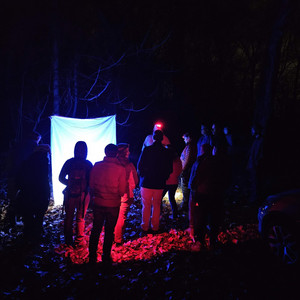
It was a tromp through Patuxent River State Park in Maryland, hosted by a group of naturalists, people trained in gathering observations and educating people about the environment.
Now, naturalists lead hikes all over the world, but not all of them.
Like this crew hand out homemade banana bread.
That was pretty cool.
And UV lights provided by our leader.
Hi, my name is Serenella Linares.
I'm the facility director at Mount Rainier Nature Center and the program's chair of the Mycological Association of Washington DC.
Okay, so Serenella is a mushroom expert?
Yeah, along with other fungi.
She's been leading nature walks since 2013, and tonight...
I really wanted to see the forest through her eyes to know what flaps and flutters and fluoresces when the sun goes down.
In winter.
It is a night for nature magic bioluminescence, fluorescence of fungi and lichens, of insects that fly in the night and are attracted to the bait that we have set up.
So i should really like try to listen very closely to everything we will have, and that's what i want to do with you today, burley.
I want to just get real quiet and listen to the sounds of a winter's night when everything is dead or dormant.
Or is it?
Okay.
Today on the show, we are taking you on a night hike through the Patuxent River watershed in search of owls and salamanders and maybe, if we're lucky, a bioluminescent mushroom.
You're listening to Shortwave, the science podcast from NPR.
With NetSuite by Oracle, you can put AI to work today.
NetSuite is the number one AI cloud ERP
Right now, get their free business guide, Demystifying AI, at netsuite.com slash shortwave.
Public media counts on your support to ensure that the reporting and programs you depend on thrive.
Make a recurring donation today to get special access to more than 20 NPR podcasts.
Perks like sponsor free listening, bonus episodes, early access and more.
So start supporting what you love today at plus.npr.org.
All right, Emily.
So you went on this night hike last month.
Set the scene for us.
What does this park look like?
No idea because it was so dark.
And we don't have half of these critters night vision.
Okay, this makes sense.
But I know that the park because I looked at a map sits along the Patuxent River, which flows into Maryland's Chesapeake Bay.
We were bundled in our winter coats and the first stop along our night hike was a patch of lichen growing along a tree just off the parking lot.
Remind me, what are lichen exactly?
Yeah, lichen is that stuff that grows on trees.
It kind of looks like seaweed, but it's actually a hybrid colony of fungi and algae in a symbiotic relationship.
To show us, Serenella dramatically shines her flashlight up the tree trunk.
Nothing out of the ordinary, right?
That blue-gray lichen color, everything looks pretty much the same.
Until... Serenella then flips on her UV light, and the patch of green lichen totally changes.
You want to tell us more?
And it suddenly glowed.
Neon yellow.
The lichen, one particular part of it was fluorescing.
So absorbing the ultraviolet light from the flashlight and emitting visible light.
Oh, and I'm just looking at the pictures you just sent me, and this is like neon, neon yellow.
Yeah, it was like the Las Vegas strip.
Natalie Howe, an ecologist with the U.S.
Department of Agriculture, steps forward and shoves her face into the tree bark.
If you come up real close, you can sort of tell that there's a lot of diversity there, because there's some that are a little yellower, some that are a little grayer.
There's a lot of diversity.
She sounds so excited.
So we take a UV light and get up close to that tree to look.
And pretty soon, Serenella shouts.
Oh, Natalie.
What did you find?
Oh, orange.
That's true.
We barely ever see that orange one.
They just sound so excited.
This sounds like my kind of group.
Okay, so like what do the different colors mean?
Yeah, okay.
So the yellow lichen is called Pyxene subscenariae.
And the orange lichen is Pyxine ceridiana.
And both have chemicals in their tissues which allow them to fluoresce.
Okay, but like why?
Natalie explained to me that lichen fluoresce as a protective response against ultraviolet light damage from the sun.
Oh my gosh, I wish we could do this.
Okay, that's so cool.
So like these lichens are carrying their own sunscreen.
Yep.
So the group starts to branch out at this point, away from the lichen depot, drifting into pockets of the forest, swinging their UV lights and headlamps up trees.
Everyone's kind of getting into it now.
And they're breaking up books to try to identify what they see.
And suddenly it just feels weird to step on anything.
Because, like, everything is alive.
Yeah, except where there's trash.
Oh.
Once I actually got too excited about finding, like, a soggy piece of toilet paper.
Because it reflected weirdly.
Okay.
Oh my gosh.
Okay, so what did you see next on your hike?
Well, there was this gigantic piece of fabric that one of the naturalists had hung up and lit with mercury vapor lamps.
So those are lamps that emit this very broad spectrum of light and attracted all these different kinds of moths, just like clinging to the fabric.
Come on over here if anyone wants to get a quick photo of the fall canker worm.
I want to see a photo of the fall canker worm.
Yeah, this moth, along with all moths, use the moon and stars to navigate, so lamps are a good way to draw them out of the shadows.
Then Matt Felperin, a roving naturalist with Nova Parks, the regional park system of northern Virginia, makes an announcement that he will be quote doing owl calls intermittently.
They're very defensive of their territory, so they will frequently come and check out who the potential rival is in their territory.
So what's the best way to call a barred owl?
There's a mnemonic for it, and the mnemonic would be, Who cooks for you?
Who cooks for you all?
Matt learned how to do this while prowling for owls during the Great American Campout.
What is that?
It's this nationwide campaign that happens every June to get people outdoors in a safe way.
And this was a really common theme among the naturalists.
They're all involved with some kind of community work.
Anna Kahanui is the co-founder of the D.C.-based nonprofit Capital Nature.
I found her crouched over a log inches from the dirt taking a picture with her iPhone.
Oh, my gosh.
What is that?
It's a snow fungus, so it's a jelly fungus.
Yeah, so I want to get a picture of it.
There's fungi that are jellied?
Yeah, let me show you a better picture of it.
It looks like slime.
So you got Matt making owl calls in the background, Anna face in the dirt showing me her iNaturalist.
Okay, so iNaturalist is that app that helps you ID things in the natural world.
I use it all the time for things like flowers and trees and one time a spider in my garden.
Yeah, Anna's like a prolific user of iNaturalist.
Well, you have 5,107 observations.
That's incredible.
I do make a lot of observations.
Wow.
5,100.
That's a lot.
Yeah.
I have, I don't know, a few dozen.
But I have realized that learning to identify and name and even just notice the life forms around me is one of the best ways to deepen your relationship to land and to nature.
Anna says you can also look up a bird count or some other bio blitz in your area.
That's what they call like these nature searches.
One of the biggest ones is the city nature challenge.
It's basically a four-day sprint around Earth Day.
Cities who enroll are tasked with identifying as many of a certain type of species as possible multi-generational.
So because you know mom and dad and grandma and grandpa and the kids can go out and the kids are low to the ground.
So did that owl ever show up?
Never showed.
Gave us the cold shoulder.
But at this point in the hike, owl cameo didn't really matter.
I mean, over the course of the night, just watching these grown adults act more and more like kids was so amazing.
Like sticking their fingers in dirt and Rolling over wet logs, jumping and shrieking when a tiny crustacean like an isopod appears.
I love it.
Oh no, it's like a little shrimp.
Or a tiny fungi shaped like a fan with an incredible secret.
Gizofilum comune doesn't have two sexes, doesn't have four sexes.
Give me a number of how many sexes do you think?
Six?
Eight?
Higher.
Twenty-seven?
Twenty-seven? go so much higher than you think is possible for how many sexes an organism can have i mean 27 was the highest you know like what hundreds 20 000 this fungi has 20 000 different sexes amazing it's very successful very abundant and found almost everywhere take a look and then there were life forms that were moving quite actively like we got salamander So I got low, you know, army crawling and peering through everyone's legs, hovering beneath this like chaotic cloud of science facts.
Yeah, it's like orange and black and slithering.
It looks kind of like a snake.
We have an eastern redback salamander.
Yeah, copperish.
One of the most interesting things I picked up was the fact that redback salamanders will bury themselves, sometimes a foot deep in winter to basically be surrounded by decaying roots, to stay warm and wet, because the salamanders need the moisture to absorb oxygen through their skin.
Yeah, and there's so many adaptations for winter when you really start to look for them.
Sometimes that looks like a change of location.
Sometimes that looks like energy conservations.
Okay, give me an example.
Yeah, this was towards the end of the hike.
I hear Serenella calling my name in the dark.
All people look the same.
We don't overlook the stick.
The stick with the mushroom.
With the mushroom.
Wait, wait, is this the bioluminescent mushroom?
That's right.
That's right.
This is the one Serenella spent the whole hike searching for.
It is a honey mushroom.
Our final observation of the night.
So in the summertime, honey mushrooms produce a green light known as foxfire.
They glow in the dark all on their own.
No flashlight required.
And we call this phenomenon bioluminescence.
I am really sad to say I've never seen bioluminescence in nature.
But honestly, I usually imagine it's like a frog or some kind of plankton doing the bioluminescing, not a mushroom.
Yeah, I had no idea that mushrooms bioluminesce either.
Scientists don't entirely know why, but as Serenella explained to me and my husband Duncan, it might be the fungi's way of attracting nocturnal creatures.
You know, the glow is basically an advertisement saying...
Come get me.
I'm delicious.
And by the way, take my kids away.
So how do you advertise your Burger King at 2 a.m.?
?
Like, you need a knee inside that people walking by say, oh, yummy.
Hungry animals, so birds, rodents and insects, eat the mushrooms and poop it out later, which may help with spore dispersal.
But that's not what I saw, Burleigh.
No?
No, it was winter, and apparently the honey mushrooms will shut down all bioluminescent business.
They will not glow at night.
Bummer.
You did not see the green glow.
Nope.
Just a stick of happy brown caps that were not bioluminescing at all, which I think provides a nice life lesson for wintertime.
You know about not spending energy when you don't have to.
Honestly, Emily, this hike is reminding me that that's what winter is all about, right?
At least according to nature.
Slow down, rest, conserve your energy.
And you can consider this hike your permission slip.
Thank you so much for this night walk.
Any time, Burleigh.
To join the City Nature Challenge or the Great American Campout, check out the links on our website.
Make sure you never miss a new episode by following us on the podcasting platform you're listening from
And if you have a science question, send us an email at shortwave at npr.org.
This episode was produced by Jessica Young and Hannah Chin and edited by our showrunner, Rebecca Ramirez.
Tyler Jones, check the facts.
Jimmy Keeley was the audio engineer.
Beth Donovan is our senior director and Colin Campbell is our senior vice president of podcasting strategy.
I'm Emily Kwong.
And I'm Berlin McCoy.
Thanks for listening to Shortwave from NPR.
There is a lot of fear these days that AI could be a bubble.
So, Nick, is it?
I don't know.
Right.
It is hard to tell.
But there are some clues that economists say might kind of sort of help us predict bubbles.
On the Planet Money podcast, the dark art of bubble detection.
Listen on the NPR app or wherever you get your podcasts.
Cognitive disorders are common among criminal defendants.
Many of them would struggle with a basic explanation.
And it wouldn't even be, did they do it or not?
It would just be like, where were you that day?
Hear about one pioneering effort to address the needs of those with cognitive disabilities in the criminal justice system.
The Sunday Story from the Up First podcast.
Listen now on the NPR app.