Discussion keeps the world turning.
This is Roundtable.
China's got a new high -speed train that just might be the fastest thing on Earth.
And that ain't just a train.
It's a rocket on rails.
So, what's behind such lightning -fast speeds?
And from unforgettable experiences to life's little joys, we're spilling all the feels in Roundtable's happy place.
Join us for your weekly dose of sunshine.
Coming to you live from Beijing, this is Roundtable.
I'm He Young. For today's program, I'm joined by Steve Hatherly and Yuxian.
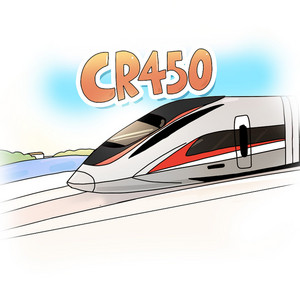
First on today's show, China's new CR450 high -speed train, Released at the end of December 2024 can reach speeds of 450 km per hour, about 100 km per hour faster than the Fuxing high -speed trains currently in service.
The new prototype could just be the fastest high -speed train in the world.
And we'll talk about the secrets behind such lightning -fast speeds.
So tell us a bit more about this technological marvel and a potential world record contender.
Yes, Ho Yang, so like you said, this new high -speed train prototype came out just last December, and it's known for boasting a test speed of 450 kilometers, which equals 281 miles per hour, and also an operational speed of 400 kilometers, or 248 .5 miles per hour.
So this CR450 is on track to be the world's fastest high -speed train once put in commercial services.
So right now, it's still undergoing numerous tests.
It has undergone more than 3 ,000 simulations and over 2 ,000 platform tests in order to meet the rigorous demand of commercial operation.
And also further line tests and rain refinement are needed to ensure it meets all necessary standards for commercial operations.
And that's according to the China State Railway Group.
Right. We're still at the prototype stage right now, as you said, and it was announced in December.
But this is awesome.
I mean, this is awesome.
450 kilometers per hour.
And I was looking up because it's fun to search about the fastest things in the world anyway, but I was looking up the fastest trains in the world.
And when this is officially launched, China will have the three fastest trains in the world because now number one is the Shanghai Maglev, which runs at 460 kilometers per hour.
But that's not connecting city to city or anything like that.
That's just from the airport, the Pudong Airport, to an area in the city center.
So we're not talking about the same things here.
But still, then the current one, the current high -speed rail in China, the one that everybody uses going from city to city, that's going to be number three on the list.
And therefore, when this new train is launched, they'll have one, two, and three fastest trains in the world.
Yeah, this is really exciting news.
And could we please compare with the predecessor of this CR450 and the current one we're quite used to?
The most well -known route is the high -speed rail that connects Beijing to Shanghai and vice versa.
And that's the CR400 Fuxing high -speed rail.
So what are the technological advancements from the current model?
I mean, the most notable one is definitely the speed.
Because as we mentioned, the CR450 prototype surpasses its predecessor, the current one, which debuted in 2017, which is eight years ago, about over an extra 100 kilometers per hour on speed alone.
So that's one of the most biggest highlights for this prototype that everyone is looking forward to.
And also there is this higher efficiency as well because the CR450 is designed for a greater efficiency as it features a 22 % reduction in operational resistance and a 10 % reduction in weight comparing to the CR400.
So this is achieved through a streamlined design, which is a use of lightweight materials like carbon fiber composites and also magnesium alloys.
Magnesium alloys, yeah.
Alloys, yeah. So that's some sort of composed metal that's supposed to be lighter once put on the train.
And also there's advanced engineering techniques as well.
So these are all this new stuff, technological -wise, that's reducing the train's weight so that it can move faster.
Yeah, it can move faster, but it brakes very, very well.
So the braking performance to complete a stop from 400 kilometers an hour in 6 ,500 meters, that's the same braking distance as the CR400.
So the braking response time of the CR450 is approximately 1 .7 seconds.
So despite the increase in speed, we're still seeing, or we will see, tremendous braking performance, too.
Yeah, and we're just citing numbers, but I don't know if people can really wrap their heads around what a major technological advancement this really is.
So many engineers and those who devote their blood, tears and sweat into designing this bad boy, you know, and so many hours that have been put into this and the trials and eras to make something like this happen.
I mean, a lot of, I fully believe that there should be this like multiple episode documentary that can go into, you know, just following the design process.
But of course, a lot of this is trade secrets.
You probably don't really want to reveal that.
But also, you know, just this process, it's so fascinating.
The amazing thing too, you know, we talk about the CR400 like it's ancient.
It's not ancient. It was only, you said 2017 when that was launched, so that was less than a decade ago, and here we are coming out with a new, faster model, and it's going to be just as powerful, more powerful, as a matter of fact.
So it's going to utilize permanent magnet traction motors.
I don't even know what that means.
It just sounds awesome, though.
What it does mean scientifically is that it has increased energy conversion efficiency by over 3 % compared to the CR400.
The stronger power output will enable the train to run faster.
More power, go faster.
Yeah, and we talked about how the braking system remained to be as good as it used to be from the CR400.
I'm not sure if all of our listeners have had the experience of riding on a high -speed train here in China, but that braking feeling is like, there's a description I read about online before that if you put a cup of water just on the little table on the high -speed train, it will not move, like the liquid
will not move much from the beginning of the braking until the end when it stops.
So that's how it feels like on the train.
And that's also part of the passenger experience enhancement on the high -speed train as well.
And speaking of passenger experience, the new prototype CR450 also offers that as well.
And even better, it reduces interior noise levels by 2 decibels comparing to the CR400.
So less noise, even though I didn't really sense too much of a noise there.
I was going to say that as well.
I think we've all been on the CR400, right?
It's a wonderful travel experience.
But yeah, talking about how noisy it is or how noisy it isn't, the CR400 isn't, I wouldn't call it noisy at all.
You just hear things that you would expect to hear on a train when you're on a train.
But this one, the CR450, is going to be even quieter.
Also, great things for passengers.
It itself, the train itself is going to be slightly lower in terms of its overall height.
But for the passengers, there will be an increase of 4 % in terms of space.
And for your luggage, this is good news too, They will have double the luggage storage capacity.
That's really great.
And also, this is not a new thing, but I just like to highlight it because I, right before the show, I checked out this short video done by a British vlogger.
And he was making the complaint.
Well, in the UK, actually, they do have a very nice railway network, but it's quite a bit older compared to China's.
And then on all Chinese high speed rail trains, even for the regular seats, the seats are adjustable.
You can move it up or down and you have quite a bit more leg room compared with the British one, as according to that blogger.
Because he was saying that even with the first class seats, which is expensive, but the seats weren't adjustable, not like on the flights.
But in China, you know, we have these comfortable seats and also for first class seats, which is a bit more pricier than the regular seats here in China.
Well, anywhere. You have these like egg shaped luxury capsules, which you can fully lie down just like, you know, travel and style and luxury.
Yeah, really nice. So, yeah, that kind of sums up the high speed rail experience here in China.
Also, adaptive lighting in the CR450 and the restrooms are going to be fully touchless, which is a nice addition, I think.
It's very considerate.
You know, on a train or anywhere in public, people can be picky about that.
So that will further enhance that experience.
Yeah. Don't really want to touch anything unless it's absolutely necessary.
Right, right. Exactly.
And also, the time -sensitive network transmission is really important, actually, especially with all kinds of these public transportations.
Having the signals transmitted in lightning speed.
Real time. Yeah, that also ensures an extra level of safety for people.
Yeah. In fact, they're improving that efficiency tenfold, as a matter of fact.
And that improves communication between different train stations and it optimizes control precision and just the overall performance of the train in the network.
Yes. And so we've given you the latest on this bright and shiny new prototype, which you can't get tickets to try it out just yet.
But I really look forward to the era when you travel on high speed rail in China when, you know, there's always this running little message telling you in the compartment how fast the speed is right now.
Currently, we're in the 300 range, but in the future, we'd be going to the 400 kilometers per hour range, and that is just very exciting.
I'm very curious to know what that would feel like from a passenger's perspective, whether you can know.
It's 100 kilometers an hour difference, but I wonder from a passenger's perspective whether you can feel that 100 kilometers an hour difference or not.
I have no idea. There's no way for us to know just yet.
We'll need to try it out when it does come online.
And Steve, you did mention just now, and we tend to forget this, that the high -speed rail history in China is actually surprisingly brief because it's such an everyday part or commonplace part of the travel experience for people here.
So give us a recap on the brief history of high -speed rail in China.
I mean, for the very start, China's high -speed rail system was actually inspired by the Japan's Shinkansen, I hope I get it right, and also France's TGV, which is train TGV, which pioneered the development of high -speed and high -capacity railways across Europe and Asia.
And in China, a key milestone for the high -speed railway development was actually from the approval of the Medium and Long -Term Railway Plan in 2004, when freight volume was growing rapidly.
But in the meantime, the low speed of the existing railway system back then kind of limited the competitiveness in passenger transport.
So the need rises. That's when we started to actually modify it and have this total plan of trying to get this high speed railway system on the go.
So the plant set up a goal that by 2020, the national railway infrastructure would grow to 100 ,000 kilometers, of which 12 ,000 kilometers would be high speed and four horizontal and four vertical corridors would be established to link all major cities.
So that's around 20 years ago, that's when it all started.
And also in the early stage, the construction was pushed forward under technology transfer agreements with some European countries like Germany and France as well.
So we were borrowing some of the technologies from European countries, which, like you said, Ho -Yang, had a longer history of building railways in their respective countries.
It's really impressive.
When you look at foreign media outlets and what they have to say about the railway advancements here in China, the consensus is China is the undisputed leader in the world.
And the impressive thing is that it's all so recent.
Yes, investment began even as far back in the 1980s, and that kind of led us to where we are today.
But the country continues to move forward and it's really, really impressive.
One example, this is from a China Daily report in 2021, the Beijing Tianjin Intercity Railway.
And Beijing and Tianjin, those are neighboring cities that are about, well, if you drive, it would be maybe an hour, an hour and a half.
Is that fair? If you take the high speed train, I actually I was looking at going there in the in the next couple of weeks and the train travel times are either 35 minutes or 50 minutes depending on where in Tianjin you're going.
But anyway, that intercity railway, that was China's first train line with a design speed of 350 kilometers per hour.
That was completed in 2008.
And then at the end of 2020, China had 37 ,900 kilometers of operational high speed rail.
And that accounts for 69 % of the world's total.
The world's total. It's really, really impressive.
Yeah. And also, we talked about in 2017, there is this current CR400 model.
But actually, for the past two decades, China has been investing in high speed railway all the way from the 1980s.
And this investment led to the introduction of CR400 in 2017, which was marked as a significant milestone in China's high speed rail development as well.
And also, as Steve mentioned, the Beijing Tianjin railway part is actually the first train line with that speed.
So nowadays we see more and more smaller parts of the railway being connected, connecting smaller cities within provinces.
So it's a provincial map or between provinces.
So that's how it's mapping out nowadays.
Yeah, and everybody takes the train, right?
In 2024, China's National Railway, they handled a record 4 .08 billion passenger trips.
Daily traffic reached a high of nearly 21 .45 million.
That's a statistic from China State Railway.
But that just is a testament to how popular it is here in China and how many people use it.
But not just for vacations or business.
People use this every single day.
Right. So one thing that I found personally very impressive is that nowadays when we talk about high -speed trains, it's not just for traveling, but also it's become a vital transportation artery of sort for the whole nation because nowadays China operates the most extensive high -speed rail network in the world
with more than 24 ,000, almost 25 ,000 miles of operational lines.
And that's according to a 2023 report from the International Union of Railways.
So basically, it's like an artery that's sending people and also cargoes from the artery into the veins to each and every part of the Chinese regions and cities and everywhere.
Well, yes, you guys talked about construction, but let's also talk about societal and economic implications.
Once you've got this huge and very convenient transportation infrastructure in place and gradually we're still building on top of it, how does that change the overall sort of lives for people?
Oh, it revolutionized.
Sorry to interrupt.
It just revolutionizes the country, doesn't it, in so many different ways.
And one of the ways is connectivity and accessibility.
When you have a rail network that allows people to travel between cities in such a greatly reduced amount of time, it allows people to live in different places.
You know, talking about how close Tianjin and Beijing are, I asked that question when I first moved here.
And I was asking lots of questions about the surrounding area of Beijing.
And when I learned about Tianjin, I asked, oh, so because it's so fast to come, do some people live in Tianjin and work in Beijing?
And conversely, and the answer was, oh, yeah, absolutely, because it's just so convenient.
So accessibility, connectivity, and also mobility of people, too.
It just changed everything.
Yeah, and one example would be the newly addition that's putting three different cities together in eastern China's Zhejiang province that would be included high speed rail lines connecting Hangzhou, Yiwu, and Wenzhou.
These three places are all located in Zhejiang province, and each of these places are notably renowned for their local exporting products.
So for Hangzhou is the silk, and for Yiwu, we all know Yiwu is a top place for retailing, and also a lot of the commercial centers are located in the Yiwu as well.
Sorry, just to quickly jump in, Yuu is the world's capital for small commodities.
And also for Wenzhou, I just interviewed a colleague from Wenzhou who said that for Wenzhou, their biggest exporting industry includes the manufacturing for clothing and leather products and also small electronic devices as well.
So you can tell that by linking these different places that has iconic pillar industries in the realm of manufacturing together, it's definitely going to boost local economy or regional economy in a faster and more efficient way as well.
So that's one of the iconic examples of how high speed rails are connecting all these together as a big economic boost for China's economy.
Yeah, 100%. The trade and investment that can take place that wouldn't have taken place before.
Also tourism. People have the opportunity to get to different parts of the country in a much more convenient way.
And of course, when you have people visiting places that maybe wouldn't have gotten a lot of visitors before, that has an impact on the local economy too.
Yes. And also to provide a couple more really vivid examples of how this is impacting everyday people's lives.
For example, if you live in Hong Kong SAR and you want to come to Beijing in the olden days, the train will take days or the flight will take hours.
And that's also, you know, you need to count in the hours of getting to the airport for a security check and coming out of the airport can be a pain a little bit from time to time.
But anyway, with the super fast, high speed rail, it's about like eight hours.
And this is according to one traveler, John Lin, a 40 year old Hong Kong resident.
He said that about eight hours on a clean train is much more comfortable than a flight, especially with family.
And also you can get the really nice seats.
Well, the regular seats are nice enough for my taste.
Can get a sleeper compartment, too, probably, I would think.
On those trains? You ask a question that I'll need to double check.
Yeah, because we just buy the regular seats as regular passengers.
And also the Beijing to Shanghai high -speed rail line, that is commonplace for people.
So common for people that would travel in between these two cities just like a business trip, but just a one -day business trip.
And this is one very profitable high speed trail rail line.
And also, I mean, it's probably not news that high speed rail is hugely expensive to build and it takes years to recoup the investment.
And not all Chinese high speed rail lines are making that profit.
But when you look at the Beijing to Shanghai line, because of such close connection and such huge business volume of transportation between these two megacities, then it really has shown that high speed rail is the way to go.
And it's also apparently very sustainable in comparison to some of the other more traditional travel modes.
Better for the environment for sure The reduced carbon footprint And not only because It's green energy but Also because people Will take that train more and if they're taking the train More it means perhaps they're relying On their car less As well It's a win -win we talked about that didn't we That Beijing
to Shanghai line and how It's almost turned into an office Working train Where everybody's on their computers kind of clacking away, and it just goes to show, right?
You can go there in, what is it, four and a half hours, I think, with the high -speed train.
Or even less. I mean, for them, taking the train is more or less like taking a subway.
You can just take a train and maybe work on the train and then get off, because the train has a high volume and everything, and it's really convenient as well.
Oh, yeah. And the CR400 is part of China's broader vision where a spider web of high -speed rail routes has already revolutionized how people live and move.
As this new speed train comes into action at some point, it promises to connect even more people, making travel quicker, easier, and more sustainable, bridging distances and opportunities in ways we never could have imagined.