I heard this great saying recently, choose your hard.
The idea behind it is that every decision in life has a challenging outcome, you just have to decide which challenge you're up for.
So for example, being a product manager at a fresh startup is hard, but so is running in circles at a feature factory.
Finding product market fit is really hard, but so is giving up and having to find another job.
Then scaling that startup?
Talk about hard, that is a ride.
But, well, you get it.
So let's say you've decided to go the path of leading the product at a startup, finding product market fit and then being instrumental in scaling that startup from a 10 person team to a business with a $730 million valuation in five years.
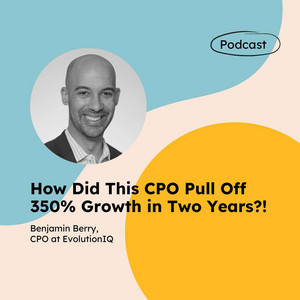
Then you might be my guest today, Benjamin Barry, the CPO of Evolution IQ, which is a company that offers AI powered solutions for the insurance industry.
You're about to hear the leadership decisions Benjamin deployed to find product market fit, enable the business to scale sustainably, and then go on to achieve, wait for it, 350 % growth over the past two years, despite the volatility of the AI product market and having no insurance background himself.
Toward the end of the conversation, he also imparts over the strategies he used to prioritize and pursue the market opportunities that help them get there.
Let's jump in. Welcome back to the Product Manager podcast.
I'm coming here today with Benjamin Barry.
he's the CPO at Evolution IQ.
Ben, thank you so much for joining us today.
Hi, it's a pleasure to be here today, Hannah.
So, we'll start it off the way we always do.
Can you tell us a little bit about your background and how you got to where you are today?
Sure, I studied computer science in college.
It was a software engineer in the Boston area for about a decade, moved down to New York with my now wife and stumbled into product management, which I've been doing for about a decade.
Six different startups in my career and couple of success stories, including I'm really proud of what we've on at Evolution IQ.
Yeah, and that's exactly why I was really excited to have you on today because we'll be exploring some leadership strategies, in particular, that drives successful AI companies, which we, you know, everybody wants to be an AI company right now but not everybody can do it well.
Let's start off this way.
When you joined Evolution IQ, there were fewer than 10 people and since then, you guys have gone through some pretty incredible growth.
Can you walk us through your approach to establishing a product vision in those early days and how that's looked as things have progressed in the company.
You know, I would say as a product leader, it's a mix of coming in and having a point of view.
I had been at another AI company right before working in kind of a subspace, I think it was decision intelligence using artificial intelligence to prioritize decisions.
That really allowed me to kind of hit the ground running at Evolution IQ with a kind of point of view on how this could work, how this could impact people.
Of course, you've got to adapt that to what's local to your market.
So I didn't know anything about insurance, So it was really important, especially in those first three months, to just drink from the fire hose, learn everything I could about the insurance world.
The beachhead market that we chose, which was disability insurance, all the way from how do they make money to the nitty -gritty details of our users, what their day is like every day.
And then synthesize all of that into a strategy that allows you to accomplish things today, but also steer towards a long -term goal.
I think when you're that early, it's more important to kind of be strategic than to have a fixed strategy.
So much can change when you're a company that small.
You know day -to -day, week -to -week, that if you get too tied into, like, a strategy, you know you'll make bad decisions because you've got to constantly be updating it.
But you do have to figure out a strategic mindset so that as things happen, you can navigate them quickly and not have to rebuild all your thought process with scratch.
Yeah, it makes sense.
You have that flexible, but strategic sort of mindset.
So you mentioned the product market fit was really critical in your early success.
How did you ensure that the product stayed deeply involved in sales and delivery during this phase?
And what impact did that process have?
I think of product market fit.
It's the definition I heard first from the Intercom guys early on, but being able to have a product that you can sell the same way, deliver the same way and get the same result.
I think it's products responsibility to be involved in making sure the company can sell your product the same way and deliver it the same way.
The way that manifested, especially when there were fewer than 10 people and most of them were engineers, means I was on sales calls.
When you're fewer than 10 people, you don't have a sales engineer.
I'm the sales engineer.
You don't have a CS team.
I'm out there with one of our founders who is doing the selling.
He and I, we're the CS team, we're doing the delivery, bringing in the engineers as it's appropriate.
and so bringing that ethos not just to the first sale, but over and over to get to the point that you can sell the same way.
That's when product can kind of step out.
To get to the point when you can deliver the same way, that's when product can step out, and if you do that that means two things.
One, product will be helping, you know, implicitly establish the strategies of sales and delivery, but you're also building trust with those functions so that even if you step away they'll come back and pull you in.
Hey, someone is asking for a slightly different value me than we usually pitch.
Like, what do you think about that?
You know, I see product people struggle with that all the time.
How do I get sales to bring me into the conversation?
Well, if you are providing value to them, they're going to bring you into the conversation so frequently you're going to have to tell them no, right?
And so making sure that you're providing value, you know, to those functions in those functions, which I think is the responsibility, you know, in terms of getting the product market fit of, you know, great product management, will make sure that you are influencing them and tied into those prophecies.
We're going to get into the meat of the conversation, which is really focusing on the scaling.
This I think is such a really interesting part of your guy's trajectory.
You guys have scaled so rapidly over the last five years.
I think where a lot of companies, AI or not really struggle is transitioning from that small team mindset and those scrappy processes into something that's going to really help the organization to grow sustainably.
Let's talk about that second phase of bringing on your first team members, building culture and establishing those processes that it doesn't scale as the organization as it grew.
What did that look for you at Evolution IQ?
I can't say enough about the co founders of evolution IQ, but one of them, I would say, very disciplined on the business side.
And so we were always very disciplined and hiring, which was great for our cash flows.
But at times meant that we were hiring people for just in time, maybe a little later than you might have wanted them.
The first person I was really bringing in to help me cover.
I said, I'm helping in sales.
I'm helping in deliveries.
I'm also defining what an excellent product looks like.
I have a lot of responsibilities to the engineering team.
When that became 120 percent, you spoke my day.
It's like, oh no, I need another person to help here.
I think a lot of our scaling list like that was driven by need, rather than projecting ahead, which I think is good business.
But that often meant that I didn't sit down and develop a 12 -week detail week by week scaffolding program.
It meant the biggest part was in the hiring, trying to find people who have been in a startup culture.
You bring in someone who's not in a startup culture, and they're like, ''Hey, where's the onboarding materials ?'' I'm just like, ''No, no, I need you to get on this customer call right now.'' Bringing in people who have worked in B2B before as well.
B2B is so much more focused.
What I love about it, I feel like you're so much closer to the users and the customers than B2C, which is almost counterintuitive, but B2C, you've got so many users.
You can just sit back and A -B test your way to success almost.
So finding people who had that, finding people who are going to be comfortable with data and AI.
You talked about AI being the hot thing right now, and it's very different from building software where I think you can just if I understand the data type.
So I'm going to have a form, it's got some small fields and big text fields, it's I need to date here, you know, an AI, if you don't understand the kind of content very particularly people are going to put that form then verify that that's going to work.
You're not going to deliver products that succeed.
They're going to look good, you know, in the lab, but when the users are using them day to day, it's not going to work.
So finding people who have that in the details in the data mindset and then bringing them in and really just loading them up with the responsibility, seeing what they could do.
And that, you know, that to be totally transparent, I think led sometimes to a little bit of trial and error, we bring in people who I think were really excellent product managers and didn't thrive in that context.
But brought in some great folks who really did thrive.
And then you can disguise the limit for that, right?
Because you know from day one that you can give them a lot of ambiguity and you just need to give them goals and coaching and they can succeed.
I want to talk about some of the more unique challenges around scaling AI businesses.
And this is really interesting since we didn't come from an insurance background before and it really had to learn this market from scratch and still managed to succeed in this space.
So in general, I think it's pretty clear that enterprise focus kind of like you said you know, B2B but especially AI B2B companies, they're facing unique scaling challenges compared to the B2C landscape.
So given all the research that you had to do, all of these kinds of decisions that you had to make, how did you tailor your product organization and approach, specifically for this insurance market that you're serving in the midst of having to learn about it as you go?
Sure. Everyone who joins the team, there's an expectation that you're going to be client facing.
That's not a fit for everybody.
I've met product managers who say, I want to be with the engineer.
I want to be in the data, but I'm not really, I don't want to be out there in the field.
Everyone's got to be client facing.
Especially, we're mostly hiring people who don't have an insurance background.
Being client facing means, that's how you shoulder to shoulder understanding the challenges and opportunities for our users and our customers.
Even AI is fantastic, but the basics of product management are still all about delivering value to those people, and most of those people today don't really care if it has AI in it or not.
So you still have to understand what are their challenges and your opportunities to improve for them and with them.
So I think step one is making sure that everyone in the product org understands that we're putting the customer first, the user first, and we're giving them the exposure to the customers and users where when they're in a room internally and we're debating something, they're not just saying, I think this is better.
They're saying, I just talked to Sarah over at XYZ Insurance carrier and this problem is crushing her.
If we fix this for her, it's going to change her day and be able to bring that in.
And then we talked about it a little bit, but it's not just data fluency.
It's not about can you get into the SQL and look at it all?
But it's really an urge to kind of both understand the data an aggregate." Okay, we're seeing these big patterns in the data and being able to ask great questions because you can even always find an engineer or data scientist, we've got a ton of them, who can kind of help you answer the questions, but can you ask the right questions, and then look at ...
when you start to build those answers can you look at specific examples and confirm that that's working.
It's very easy, I think, of when you're building a machine learning model, what you're training on kind of very precisely defines the answer fit you get.
If you think about just going from idea down like a funnel to value, it's really easy to lose value in this implementation funnel.
If you build, still a great model, I can't tell you the number of times I've had, engineering build a model and it's like, look at the precision and recall on this, it's fantastic, this is the best model we've built.
Then you look at the details and it doesn't actually solve the customer problem.
You start to untangle why.
I'll give you a great example here.
one of our products, in disability, unfortunately, some people end up being disabled for a long time, and the great news is I've got insurance.
But every year, there's some of those folks who actually recover enough, where circumstances change, in the market enough, where they could return to work.
So, one of our products helps uncover which of those folks, there's the most opportunity to return to work.
And so, you end up training that on claims, historically, that have resolved, where the resolution of the claim means it closes, and you could just take all the claim closures and train your model and what you'll inadvertently do is now you've got all the people who returned to work, but all the people who passed away as well.
And if you're really sick and disabled, that might be more likely.
And identifying those people doesn't help.
If your business challenge here is let's find the people who have the best opportunity to return to work and help them return to work, finding the people who are actually the sickest in my past away doesn't help you.
You might build a fantastic model at identifying that total set, but unless you understand What are all the closures, which ones match the business problem, and which ones don't, and making sure you're only using a positive class that matches your business problem?
If you don't do that work, you just end up losing all the value as you're building your AI.
Those are the two things I've really focused on, setting the expectation around capabilities, and growth, and culture as we scaled the product management team so that everyone could work on, again, it's dynamic, fast -moving company.
We need to move people around and say, hey, can you fill in on this product?
It's growing faster than we thought.
Everyone needs a pretty broad and flexible skillset.
It's a very sad but very succinct example of exactly how that works.
I'm glad that you mentioned the changing of roles and stuff.
As we expanded beyond oversight of product management and had to pull in things like design and marketing, what are some of the leadership challenges involved with that?
As the role expands and you have more oversight, what was that like and how did your role evolve during that transition?
Our product organization includes product management, product design, and product marketing.
So, I think, you know, a couple of things.
One, it's always, I think, a challenge for any leader once you start to lead people with a job that you didn't personally do.
And that can create, I think, a few different challenges.
I think with product managers, the great news is you've got a natural skill set to think about one of the kinds of challenges.
Think of these new people as your customer.
What's important to designers?
You know, what will help, you know, them thrive, like, you know, understand that in the context you are going to invest of your company.
Then designers of different relationships to their stakeholders, and different cross -functional stakeholders.
Make sure you've mapped that out too, and understand what those people need, and help your team understand it.
I can't help them necessarily be a better designer, but I can help them understand what their stakeholders are expecting from them, what engineering is expecting from them, like a small company, so sometimes we're helping marketing now.
Let me help you understand what marketing is expecting.
That also then speaks to either don't enter it thinking, I've got to be the best product designer to help them.
You're a leader and you have that expertise, but don't overstep your expertise in their domain.
When I'm giving feedback to designers, I always trying to think, hey, I was hoping the product would feel like this or create this reaction.
Because I can be an expert on that.
Then leave it to them to figure out, great, here's the revision.
It's not that I don't have any ideas.
Maybe there should be a radio button instead of a drop -down.
It's just that they don't need me to do that.
As we grew the design team, It's important then to bring in someone who can lead the team in that way and is an expert in that domain and can lead and grow people.
But as you hire the first person, I think you want to set them up for success.
Again, think about helping map out their customers, help them understand that, and then figure out how you can coach them without trying to push knowledge of that domain on top of them.
The other thing that's important is to understand why does it make sense to have these people in your team.
Of course, it's always flattering to grow your team.
And so, I think product design is maybe a little bit more obvious, but product marketing, the fewer customers you have, naturally, that means those customers are gonna be higher values, higher ACVs.
That also means longer sales cycles, a lot more time past the awareness stage of the funnel and into the stages of the funnel where they're considering your product, and you're making sure they understand.
That means your marketing aggregate is going to lean a lot more on product expertise and the ability to inform the market that you deeply understand their problems and that you have a product that helps with their problems.
Also dealing with more stakeholders, there's just ends up being more translation of your value propositions to different folks.
That leans a lot more to, hey, instead of having product marketing really tied in, they're going to bridge this regardless.
But the dial could charge way towards our product marketing is really focused on our brand to really focused on our product expertise.
And yeah, I think closer you go to smaller customer bases, bigger enterprise deals, the more you're leaning on product expertise.
And so that means better to have them kind of, you know, in the tents with the product managers working on the value propositions, and deal with kind of the friction between between that and marketing than the other way around.
I think it was a D2C company, I would say, hey, don't put product marketing, you know, in here with product management, like, they should be really focused on the brand, and how that's the awareness state of the funnel.
We can teach them about the product.
We owe them that, but that's where most of the work's going to be.
Having a point of view, what belongs in your origin?
Why, and it's going to be local to your company.
Doesn't work the same everywhere.
Then we talked a bit of coaching and setting up teams that aren't from your background for success.
I would really like to dive in into that developing leaders thing.
You touched on a little bit of developing people into leadership positions.
Do you really need that in order to up, grow and scale effectively no matter what business you're in.
What's been your experience finding and developing leaders within the organization or external to the organization, and how did you figure out who could take ownership of different product functions, and what was the best development path to put them on?
Every leader is so shaped by their environment, and I think for me just coming up, I'd seen so many times where people really grew within an organization, and then the organization, it can be hard to see that I think because it's easy to think about people, the day you hired them and forget.
They've grown three, four years, and then now you bring in someone over them, because, oh, we need more leadership.
Then that person leaves and you end up with a leader who's maybe shaky.
They might be great, but they're new to this context, and will that work out?
You've lost your best people.
I always try to really think about, can I grow someone internally into a leader?
Again, that's probably just the reaction of it to my environment.
But in terms of how do you do that, I'm a pretty hands -off leader.
I tell people I'm always willing to spend all day talking to you, coaching you, working through a problem with you, but I'm not going to come knock on your door and be like, hey, walk me through every step of all the details of what you're doing.
I'm happy to do that.
But I'm not going to micromanage what you're doing.
That makes it actually, in some ways, really easy to figure out who can grow because you give them some responsibility and they crush it, and so people might struggle with that ambiguity.
Then you give them something bigger and something bigger.
There's a gentleman on my team, Matt Gillespie, which just promoted him to VP, and he joined a Senior Technical Product Manager.
He's climbed the ladder quickly as the company has grown.
Every step of the way, as we've given him a little more opportunity, he's knocked out of the park and it's like, great, let's give him the next stage of opportunity.
That always helps me because every time I'm doing that, I'm taking something off my plate.
I'm letting me focus on one other thing.
And so that's kind of, I know that was pretty broad.
So feel free to ask me for more specifics, but that's my answer.
I mean, broad is good because not everyone's going to be in this niche, it's always great to be able to kind of transpose what your leadership advice is and development advice to kind of what our individual situation is.
So broad is good. I'd like to actually switch gears just a little bit and talk a little bit about product strategy and market selection.
So how does your approach to identifying and prioritizing work and communities contributed to the growth of evolution IQ over the years Think about it, maybe at at two levels So we you know when the company was was founded the focus was bringing AI to insurance Taught it to this is a little bit before I joined But I know that they talked to a lot of different people and found you know a first ideal customer within disability Insurance and then kind of followed the playbook that you know if you if you crossing the castle if you read that book right like Hey Obviously vision -wise TAM -wise going
to pitch to a VC. Let's talk about the impact AI can have about claims handling and insurance trillions of dollars in the US alone.
We get to a pretty big TAM pretty quick, but you can't actually function that way.
So we drill down to disability insurance and that was our focus.
Until it became clear we were going to be the dominant players with AI claims guidance and disability insurance and then kind of set the horizon bigger.
In terms of how do you pick them the next horizon, We looked at a lot of different adjacencies.
You could take AI to other parts of the insurance.
We focused on claims, but there's selling insurance, underwriting, so that's one degree away.
I'm still selling to the same person or same organization, but to a different function.
Or you could take what we're doing in disability, which drives those claims bodily injury.
Okay, let's take AI bodily injury.
Are there other claims like that?
Yeah, there are over in workers compensation insurance, right?
So those are just two different degrees of freedom.
So we mapped out a ton of different opportunities and then we looked at everything that was one degree of freedom away, thought about one of the pros and cons of making that switch.
Staying within the same org, great.
I get to use the same MSA for contracting, but now I've got a whole different set of logos, I'm potentially competing against.
I'm walking into a problem set that I don't know anything about, and these are deeply expert users.
So that's pros and cons, and then we looked at what were the sizes of those, And then you just spreadsheet out some math and you're like, we think these are the best ones, but the proof is in the pudding.
You've got to then go out and start having those conversations and validate that all of your assumptions are right and that the universe works the way your hypotheses did.
That's the macro of market selection.
I think, in the micro, we try to map out all the challenges and opportunities we think exist for our users, and then build for insurance, claims come in and they go through almost a funnel, there are fewer claims over time, And they go through these stages and different things are happening.
So making a kind of just an abstract map of those stages and understanding how much value there is and claims tend to cost more over time as well.
So how much of that development happens in this stage versus that stage?
And then thinking about my solutions and how do they map onto that.
That helps you size what you think all your solutions are and then just picking the highest value once, which isn't always.
Then you've got to go back to your customers and validate that you can sell that to them, it's interesting.
Cuz if you just go to them first, and you're like, on being customer driven.
The challenges are top of mind are often not the most valuable challenges, but then when you come back to them and you're trying to pitch them these most valuable challenges, sometimes you might have to give them a little bit of what they want.
Like, okay, I know this broccoli's most valuable for you, but I got a little cheddar cheese on top of it to get you to eat it, you know?
And so that's kind of at a more tactical level how I think about growing within a market.
As a toddler mom, I appreciate the broccoli and cheddar cheese.
Just to kind of wrap things up here because I know that it's a broad question to talk about the most successful leadership decisions that you've made but I think that would be really good to kind of drill down if you could really think about some of the most important leadership decisions that have differentiated the growth journey that you guys have had at Evolution IQ over others when so many AI companies are really struggling to scale successfully and sustainably.
What would you credit as being your most important decisions as you think back at the last few One, even though AI is exciting, it's always, keep the customer first and understand the market and react to that.
I mean, that's the basics of product management and that can always be true.
On the AI side, understanding that this is a paradigm shift and it's not just, hey, are there new AI tools I could use, chat PRD, all these exciting things that I might use, but think about how developing AI products is going to be different.
What that changes about what your product manager need to do.
And your engineers need to do.
And thus what the handoffs are between them, you know, the same thing for design.
I'm asking my designers to build something that's not deterministic.
Now it's stochastic and the expectations of the users are different.
So I need to make sure I'm bringing in designers that can do that.
The thing is, because it's so new, because of this paradigm shift, there really aren't a great set of tools where I, you know, here in 2015, and you're building a SaaS workflow product, there's 15 years of great templates and tools and you can kind of go by the numbers a little bit.
Here, there's a brand new space and you've got to be willing to think about that and map that out to drive success.
The last thing in all these decisions is, let the context of your business come to you.
I would say, you asked me a lot of questions about scaling, and I talked a lot about product emphasis, and giving people a lot of freedom.
As a result, I don't abstract level, I would love for the standard to be higher.
But when I play back why it isn't, it's because when I brought people in, my focus with them was, be in front of the user, help sales, help delivery, that's a lot to put on someone's plate.
Then also why aren't your PRD is perfect.
It was I'm not spending 40 hours a week on them.
That person teaches the next person and on and on.
So now that we are at scale, we can go back and work on these things and make everything be really polished.
But it would have been a mistake to go back three years ago and say, we got to drop everything and make sure all these PRDs are our top shelf.
Not that it didn't have any challenges, but, you know, I, instead of doing that, we were doing things that were helping us grow the business every day.
And that was important for our business, but that'd be different for another business with a different customer base.
Even within enterprise B2B, you know, you could be selling to franchises, right and you've got tens of thousands of potential customers and what you're doing is just very different.
And so making sure that you don't just kind of apply, you know, the lessons you learned at the last place, or you learn at the last conference, but you really think about which of those lessons are appropriate for the context that I'm in here, the company I have, the talent that I have, the market that I'm in, that I think is the biggest thing.
And it's, you know, what I love about evolution IQ is it's not just me, I think all of the leadership, you know, in engineering and sales, I think we've all been really flexible in that way.
And that's been the biggest driver to succeeding quickly is, you know, always adapting to, I like sports, right.
So you think about your, your playing basketball, I like LeBron James and he's a fantastic player and he just said, Luca Donk should have joined his team.
He changed how he played and I think that's what makes him really great as he could have just said, Luca, you've got to fit into my system.
But he said, no, for me to get the most out of Luca, I've got to fit in, I'm going to change my game to work around him.
Now, the Lakers are doing amazing.
There's a lot of things, very complicated, a lot more to the net.
But, LeBron's ability to adapt to what the situation is I think, it's what's made him be in all -time great with an incredibly successful 20 -year career.
That will allow you to be successful in any context.
Thank you. That was a very beautiful example.
I was a little nervous when you switched from sports from broccoli cheese because I'm much more familiar with the broccoli cheese situation.
But the LeBron James story is definitely, that's a really cool way of putting it.
Thank you so much for joining us, Benjamin.
Where can people connect with you online?
You can find me on LinkedIn is probably the best way to find me.
It's just Benjamin, Barry, B -e -r -r -y.
I will respond to messages there.
I'm sure I'm on other socials, but that's where I spend the most time.
Sounds great. Well, thank you so much for making time today.
Thanks, Ann. Have a great weekend.
Thanks for listening in.
For more great insights, how -to guides, and tool reviews, subscribe to our newsletter at theproductmanager .com slash subscribe.
You can hear more conversations like this by subscribing to The Product Manager wherever you get your podcasts.