Discussion keeps the world turning.
This is round table.
Hello, welcome to Roundtable where we serve up piping hot debates on the issues that sizzle in China and beyond.
I'm Niu Honglin.
In the world's largest rainforest, where rivers braid across ancient forest floors and clouds drift like slow-moving caravans.
Nations gather with a shared hope that the future can still be negotiated.
COP30 is a reminder that the climate story is no longer abstract.
It's a story rooted in forests, oceans, megacities, and livelihoods.
And within that story, China's climate commitments from expanding forests to building low-carbon partnerships add both weight and responsibility.
Today, we'll take a closer look at the ongoing COP30 as well as China's effort in the past decade.
For this episode, I'm joined by Yu Xun and Steve Hatherly.
Now grab your virtual compass and follow us to the heart of the discussion.
At the heart of the Amazon region Belém, Brazil.
The world's most important climate conference COP30, is about to conclude.
And this year, it's not just another environmental meeting.
It marks the 10-year anniversary of the Paris Agreement and a critical deadline to deliver on its promises.
With the world aiming to move the 15 degrees Celsius goal from scientific vision to concrete action, all eyes are on the major players.
So what outcomes can we expect from this conference?
What new initiatives and plans does China have as a strong contributor to global climate actions?
What are some successful examples that China has already provided?
It's going to be a very eventful conversation, even for us today.
But to start everything, exactly what is COP 30?
Yeah.
First of all, COP stands for Conference of the Parties.
And this is the 30th Conference of the Parties to the UNFCCC, the United Nations Framework Convention on Climate Change.
And it is taking place in Belém, Brazil, from November 10th to 21st, 2025.
And it is an annual United Nations Climate Summit where world leaders, represent Policymakers, civil society organizations, knowledge institutions and also companies gather to negotiate measures to combat the climate crisis, and usually held in November or December.
The key objective is for governments to take new steps to limit the climate crisis and also work toward the goal of keeping global warming to a maximum level.
1.5 degrees Celsius.
Yeah, the parties that you mentioned, the 30th Conference of the Parties to the United Nations.
The parties refers to the nearly 200 countries that have signed up to the original UN Climate Agreement of 1992.
And this is a big event in terms of what is happening with our climate and what will happen with our climate.
World leaders are there.
The Prince of Wales is there attending on behalf of King Charles, the UN Secretary General, the European Commission president, all in attendance to hold very important meetings and make some very important decisions.
Over the course of time, we've, with our very own eyes, witnessed the progress, the challenges human beings face when it comes to climate change.
And we see the issue or the agenda slowly moving from the sphere of our maybe in different international stages and gradually moving towards the center.
Now, no matter if you're talking about economic development, technological development, you can't ignore the fact that we're living in this day and age where climate change issue is started to become more and more stark.
But this year is still with special significance.
This year marks the 80th anniversary anniversary of the United Nations and also the 10th anniversary of the Paris Agreement, which is a quite pivotal moment.
And, by the way, the Paris Agreement is a global climate pact in which nearly all countries pledge to limit global warming to well below 2 degrees Celsius, and preferably 15 degrees Celsius, by reducing greenhouse gas emissions and strengthening climate resilience.
And with last year, COP29 under the UN Framework Convention on Climate Change, having finalized frameworks for climate finance and carbon markets.
And this year, the core task of COP30 will shift from negotiating rules to actually delivering results.
Yeah.
So whether countries can submit more ambitious climate action plans, whether they can fulfill their financial commitments.
Money is a big issue.
We're going to talk about that, pardon me, a little bit later.
But also, can they launch a global carbon market that will determine, And all of those things will determine, the fate of that goal, that famous 15 degrees Celsius temperature goal, which and again we're going to talk about this a little bit later might be hard to achieve?
Well, definitely.
Though this year, we are looking at some positive results.
We are looking at different countries trying to provide their own solutions.
They're a little bit test in different areas, and they saw some positive results.
Still, we see definitely structural gaps the world still faces.
For example, the action gap we see here.
Even if all pledges are fulfilled, UN assessments show global temperatures still rising by 25 degrees Celsius to 28 degrees Celsius, well above the Paris target, which was 15 we mentioned several times.
And also for global south, including the host country Brazil.
Climate finance is the burning issue.
For sure, development nations have not yet delivered the funds they promised, and some that now looks trivial next to the 13 trillion US dollars needed annually by 2035.
That number, by way that 15 degrees celsius, that that's the pre-industrial levels that they're, that they're looking at there, and the reason they want it below, well below, two degrees is because there's a lot of strong scientific evidence that the impacts of climate change where we're talking about extreme heat or sea levels rising that would be far greater at 2 degrees or above than it would be at 15 degrees Celsius.
That's why they set that number there.
Yes, as a goal.
And there's also the bigger picture.
We see the geopolitical tensions, unilateral actions from certain countries and green trade barriers.
All these make the crisis of a...
I think it's a looming problem that's shadowing on top of our head, all of us.
And no matter what we're doing, there's this background noise of the global climate crisis that's still, you know, quietly but shouting over there.
Because the current situation of the whole world and the climate is facing a lot of challenges.
A new report released by the World Meteorological Organization on November 6th shows that extreme heat continued to define weather patterns in 2025, and 2025 is expected to become the second or third hottest year on record, with 2024 being the hottest.
And another report is showing that from January to August 2025, the global average near surface temperature was around 142 degrees Celsius higher than the pre-industrial average, as you mentioned, Steve.
Greenhouse gas concentrations and ocean heat content reached new record highs in 2024, and preliminary data indicate that both key indicators will continue to climb in 2025.
So we are still facing a lot of challenges.
And we have to say, many of the goals that we are trying to achieve is hard to achieve.
Yeah, tough to achieve.
And then for countries.
This year is, I think it's the deadline year for countries to submit a new round of more ambitious what they call nationally determined contributions or NDCs.
So what these are, you're probably maybe not familiar with that term.
These are defined by each country and they respect national reality and sovereignty and they explain the actions that each nation intends to take to respond to climate change.
So this year, the deadline year, and they're asking what more they can do to achieve their individual goals.
All that problems and challenges, they're not there to... today.
They have been there for quite a long time, which makes the conference even more important.
And we see the agenda on these different conferences changed or evolved even a little bit, year by year, because we're looking at the issue in different ways and different lenses.
And now there have already been different scientists addressing the climate issue in different perspectives.
We see the voices of our human beings should cut back our emission.
We should definitely live a greener life.
And there's also people saying, yes, that's very important.
But at the same time we should find a way to adapt to the growing temperature, or every day growing to a little bit higher level temperature that we currently face.
So adaptation as well as changing our behavior have all been the key issues.
Yeah.
And that's why this is a A huge challenge because this isn't just a government problem.
This is grassroots, too.
This involves you and I and Yushin and everybody listening on steps that we need to take collectively to make these types of changes.
But it also includes governments.
And this is from a report from the BBC.
You know, ahead of COP30 we talked about those changes, the NDCs that countries individually were supposed to come up with.
Ahead of the conference, countries were supposed to have submitted updated plans detailing how they would cut their emissions of planet warming gases.
But according to that report, only a third of those countries had done so by the end of October.
And I had said that 1.5 degrees Celsius is a difficult goal to achieve.
The UN Secretary himself, Secretary General Antonio Guterres.
He warned that quote overshooting 15 degrees Celsius is inevitable, given how the target is and how high emissions remain to this day.
Yes.
But all that said, there are still some highlights that people are looking at of this year's COP30.
We are looking at good results coming out from the conference and conversations.
Yeah, a global carbon market is finally taking place.
Rules were agreed last year first of all, but now countries need to turn them into something that actually works.
And Brazil is pushing a plan to connect different carbon pricing systems worldwide.
And nature is becoming the center stage, especially when the meeting is in the Amazon area, right?
Hosting COP 30 in the Amazon rainforest sends a message.
Protecting nature is essential for protecting the climate and forests.
Biodiversity and nature-based solutions are major topics this year.
A lot of forums and discussion, high level discussions are happening and many big decisions are making.
Until today, they have also wrote out three major documents which are quite interesting if you really take a look at them.
The first one is Declaration on Information Integrity on Climate Change, because it's a very complicated issue and there are different ways to measure, different types of index, different ways to see whether or not this industry is really going green.
And there have also been fake news stories about different accident or different achievements.
And the Declaration on Information Integrity is quite important, so that everybody can be on the same page.
Of course, all these documents are still under negotiation and countries continue to decide on whether or not they'll sign all these documents.
But the other one is Ministerial Meeting on Urbanization and Climate Change.
Urbanization, also something quite important when it comes to climate issue.
And also, below Declaration on Global Green Industrialization.
So these are still ongoing documents waited there to be signed or to be further negotiated.
One of the great things that came from this year was Brazil's Tropical Forest Fund.
They launched it.
It's called the Tropical Forest Permanent Fund, TFFF.
It's from brazil, it's by brazil.
It has an initial one billion dollar capital injection.
They're looking for a total fund size of about a hundred and twenty five billion, and that was one of the big announcements this year.
Uh, it symbol, and you said that.
Uh, we talked about that a little bit, but that's an amazonian state and it's also a center for indigenous rights and it was really highly notable because brazil also declared this the for indigenous peoples through indigenous activists, and they expressed their feelings perhaps that were unheard before during other formal discussions.
So that was a big deal.
And I mentioned before too that money is always a big deal, because developing countries they need trillions of dollars to to fight climate change, but current funding commitments cover only a fraction of that.
So what they're doing this time at COP 30 is they're trying to find new innovative ways to mobilize large-scale finance.
They talked about this at last year's COP 29 and that's where richer countries committed to giving developing nations at least 300 billion a year by 2035 to help them tackle climate change.
But they do say that that is far less than poorer countries actually need.
It's a tremendous amount of money, but that's exactly how much.
It's shocking to know how much is needed to fight climate change.
The agreement at that time also included aspirations to raise this to 13 trillion from public and private sources.
So ahead of this, Brazil published kind of a roadmap detailing how that 13 trillion could actually be achieved.
Through the one year of our reporting, going to different places, talking to different people, my feeling is that all a lot of industries here in China are going green.
Maybe that's because of the motivation given by strategy makers and also policymakers.
Maybe it's because certain places have already seen the positive results from going green.
And all these are happening in China.
We went to many different places and we see new energy taking off in these different places.
And we also see people trying to find out greener solutions for the kind of technology that didn't even exist 3 5, 10 years ago, like how to make coating greener.
These are all very interesting.
So I want to know what are China bringing to the table, to the table of COP 30.
To the COP30.
Of course, China has demonstrated commitments and undertaken significant actions in a lot of areas like environmental protection, both domestically, and also promoting cooperation internationally.
China has its own NDC, too, doesn't it?
Its own commitments.
Yeah.
Their own plans that they want to do over the next 10 years.
Of course.
China announced a new NDC, a goal by 2035, China's net greenhouse gas emissions across the entire economy will decrease by 7 to 10 compared to the peak, and aiming to do better, which means we're trying to even achieve better than that.
This goal is kind of historic because it shifts the focus from carbon intensity control to absolute emission reduction and covers all greenhouse gases.
Yeah, China's also conducted 81 different low-carbon city pilots.
And that goes back about 15 years ago to about 2010.
And that effort has been really effective in controlling urban CO2 emissions.
And 95 of those pilot cities that I mentioned significantly decreased their carbon emission pretty significantly.
And they've been able to reduce those numbers.
Also, there's a focus here in China on carbon sink.
Are you familiar with that term?
Carbon sink is kind of anything that absorbs and stores more carbon from the atmosphere than it releases.
So think of like a sponge in the atmosphere.
So forests would be an example.
Oceans, soil would be an example of that as well.
And China's forestry and grassland systems.
Those are really important for achieving global Yuxin.
Those goals, those 2035 NDC goals that you mentioned, those are including the forest stock volume.
They want to increase that to over 24 billion cubic meters.
And also they want to enhance the ecosystem so that they can increase that ability, or carbon sink capacity, if you will.
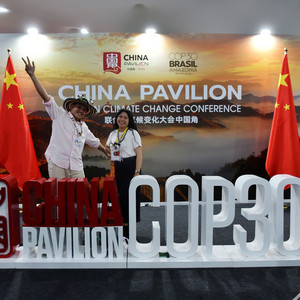
There is a China pavilion in the COP30.
They brought not only policymakers, but also scholars and even different enterprises, representatives of different companies, especially those who are working in green development industries to that pavilion to share their experiences.
And they have unveiled a 25 casebook on climate at adaptive cities, and they've rolled out a mazu early warning tool which is warning about natural disasters, and also there's a global public data set for ai driven weather forecasting.
And what's fun about this place is that the tables and chairs are made from upgraded, biodegradable paper-based materials, so even the pavilion itself is quite um environmentally friendly, and also the disposable cups are modeled from rice husks.
And it's I think it's a it's a cute iconic kind of example showcasing that, yes, while we are talking about going green, we go green here in the pavilion.
You kind of have to set it up with plastic tables and chairs that might not be such a good look.
But yes, it is a wonderful thing to have your entire pavilion be biodegradable.
Yeah.
And also, we've talked about so many policies and measures that China has been like taken.
And another thing is that I think these are the things that we can observe through our daily lives, like sponge city that we mentioned before it is the plan that we discussed and a lot of these cities are trying to develop into a mode of sponge city to create more green area and can absorb as much co2 as they can.
And another thing is that we mentioned that this year the global or international carbon market is in its shape and i actually traveled to wuhan to observe the development of china's carbon market and it has been doing for quite a long time more than 10 or 15 years and it's been expanding the range of industries getting into the system.
And what we can see is that, of course, these enterprises huge enterprises that maybe will have a lot of emission they are joining this kind of a system to trying to cut their emissions by using maybe, technologies or different environmental friendly ways, like using household waste as the fuel to generate electricity.
And another thing is that a lot of SMEs, like small and middle-sized enterprises they are also trying to get daily or ordinary citizens into this kind of activity or campaign of promoting and advocating ordinary people to join the group of saving electricity, something like that.
It's important because you can have the country's initiatives or goals...
But if the citizens of the country don't know how to help achieve those goals, then it makes it all the more difficult to achieve.
Yeah, domestically taking a lot of steps.
But China also does a really good job working with partners internationally.
The country signed 55 different climate-related agreements.
And they did that with 43 developing nations.
And they trained more than 10,000 people from over 120 countries.
And they also signed a memorandum of understanding, an MOU, with the UNFCCC secretariat.
And the goal there is to boost capacity building, support for developing countries and the capacity to respond to and to address climate change within those countries themselves, offering assistance from things that China is good at to those countries that perhaps might need a little guidance or assistance.
I'm not that surprised about what China is doing, because I also interviewed some experts and also scholars in this regard and they say China's role in COP 30 is relatively, in the sense that it has multiple layers.
It is a key member of the global south, the world's largest producer of renewable energy and a major adopter of green technology.
For example, if we take solar power, for instance, over the past decade, China's rapid industrialization of photovoltaic Voltaic,
Thank you.
Voltaic helped to push global solar generation costs down by more than 90, making clean energy accessible for beyond its border, far beyond its border.
And also we see through Belt and Road Initiative kind of initiatives and partnerships.
China shares experience without political conditions.
Helped fellow developing countries craft pathways.
And he said a lot about what we had already been doing internationally.
But from a young person's perspective, we are more interested in knowing the actual cases.
What exactly did we do and what are some results coming out of it?
Yeah, there is one flagship cooperation project.
It's called clean cooking stove project And it is not that kind of metaphor.
It is actual cooking stoves.
Yeah, literal stoves that you cook with.
Yeah.
So China formally announced and launched this Clean Cooking Stove flagship project aimed at developing countries at COP30.
And this project is a specific action to implement the Global Development Initiative and deepen South-South climate cooperation.
And first... partner of this project is Tanzania.
And China and Tanzania signed the first cooperation document for this project.
And over the next five years, China plans to aid relevant countries by jointly constructing 100 demonstrated villages and supporting the cultivation of 1000 technical experts and aiding in providing 100000 clean cooking stove advices.
Uh yeah devices, so you might.
So you might think um, you know what's the big deal?
Cooking stoves how's, how's that going to help?
Well, that's expected to benefit nearly a million people, and which is wonderful.
But the effect on, or the impact on, the environment?
They're looking at a reduction of approximately 1 million tons of carbon dioxide equivalent emissions in those partner, And it also aims to protect the health of vulnerable groups through this initiative as well women and children and also reduce deforestation.
So something seemingly you know, maybe doesn't seem like it would make that much of an impact, is making a tremendous impact.
What a wonderful idea to come up with a clean stove initiative.
Yeah.
And I think it has something to do with the way we understand the issue.
That is yes, it is a crisis, but at the same time, it should not be the excuse for any societies, any communities, to stop seeking happiness, to stop seeking a better, higher standard of living.
Yes, climate change is real and it's very important.
But the reason we're addressing it is not because the nature cannot take it, it's because human society cannot take it.
It's about human beings' life would suffer or would downgrade because of it.
And the final or the ultimate goal is to make sure human society, society or any community around the world, their life would not be as severely affected by climate crisis or would not even be sacrificing the improvement of their lives because of climate crisis.
So the core issue a lot of people believe the core issue is still to develop.
Against this background,
So yes, having clean stove, making sure that people need to eat and when they cook they do not cause more trouble for the nature, is part of it.
Yeah, I mean, I feel like we talk about this every time we discuss the climate, but getting people to maybe realize that doing things that are better for the planet doesn't necessarily mean making decisions that will impact the convenience of your own life.
But again, it's a challenging... thing to do because it's not entirely tangible for people.
They can't see the difference they make when they turn off the water, when they brush their teeth, for example.
You don't see the impact on the climate there or on the planet.
So that's why it's such a hard thing to convince individuals to make changes on a daily basis.
But we also need you know, the people in charge to be holding up their end of the bargain too.
So I think we as individuals need to make better choices.
Governments need to do a better job of keeping up their end of the bargain.
And then together we help to close that gap.
Yeah, and I think it's, again, a complicated issue.
That's why every year, every COP would face problems like prolonging the discussion and trying to even though they're in a relatively arduous negotiation process, they're still trying to bring everyone on the table again, back to the table or reaching to an agreement.
And as for China, I think our clean cooking stove initiative or early warning systems in Africa remind us that climate solutions must reach kitchens farms, rivers and villages.
Climate governance becomes meaningful only when it improves lives.