You're listening to TED Talks Daily, where we bring you new ideas to spark your curiosity
every day.
I'm your host, Elise Hugh.
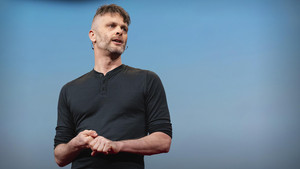
Playwright David Finnegan made a bold choice about a decade ago.
He created theater about climate denial.
And in spending a lot of time with climate deniers, he learned one key way in which they're
actually quite right.
Taking the TED stage, he shares his journey to this understanding.
And after the talk, stick around for my interview with David.
It was one of my favorite interviews I conducted at TED 2024.
It's all after the break.
Like TED Talks?
You should check out the TED Radio Hour with NPR.
Stay tuned after this talk to hear a sneak peek of this week's episode.
And now our TED Talk of the Day.
Hi, I'm David.
I'm a playwright from Ngunnawal country.
The unceded lands of the Ngunnawal people in southeast Australia.
I come from a family of climate scientists.
And in 2014, I wrote a play entitled Kill Climate Deniers.
The play follows the story of a group of ecoterrorists who take over Australia's Parliament House
during a Fleetwood Mac concert.
And hold the entire government hostage, demanding an instant end to climate change.
So the story is ridiculous, but I wanted the play to start a conversation
about what happens when the unstoppable force of climate change meets the immovable object of politics.
Okay, so obviously the title, Kill Climate Deniers, is provocative.
But just to be clear, when I wrote it, I wasn't targeting anyone real.
Now, thanks to the work of journalists and scientists like Naomi Oreskes,
we know how climate denial began.
Oil and gas companies recognized the issue of greenhouse gas emissions back in the 1950s and 60s.
They set out to cast doubt on the science.
They funded lobby groups, marketing firms, politicians.
They astroturfed an entire climate denial movement into being.
So now there's this industry of pundits and journalists who make a living denying the reality of climate change.
When I made the statement, Kill Climate Deniers, I expected outrage from these people.
But I did not expect pushback from the general public.
I figured there are no real climate deniers.
If there are regular, normal people who don't believe in climate science, they can't be that passionate.
So I was very wrong.
Now, to begin with, the play received exactly the attention I expected from exactly the people I expected.
When the first production was announced in 2014, a conservative politician in my hometown of Canberra called for the play to be shut down.
There were angry articles in the Murdoch press, Breitbart, Infowars, all the usual suspects in the right-wing media machine.
Some of these pundits accused the play of being an incitement to terrorism, and they referred me to the police.
Their argument was that people would see the show and be inspired to take an entire government hostage to end climate change.
Now, the theater company didn't have money for lawyers or a crisis communications team,
so out of concern for the actors' safety, the production was cancelled.
But I didn't like backing down. It didn't feel good.
I felt as if giving up on the project was like agreeing with the people attacking it.
And I did not agree with them. The play was not an incitement to terrorism.
But no theater company was willing to take the risk of being referred to the police.
I couldn't get it up as a show.
So instead, my musician friend Ruben Ingle turned it into an album.
Ruben sampled dialogue from the play and wove it into a series of original electronic tracks.
We toured that record around Australia.
We couldn't get into theaters, so we went to nightclubs. We held dance parties.
Then we launched an unauthorized covert walking tour of Parliament House.
People downloaded a special version of the album on headphones and listened to the music and the story
while walking around the real-life setting of Australia's Halls of Power.
Now, all of this helped to build up an audience for the project.
But even more importantly, there were no real-life copycats.
Not one government building was taken hostage by eco-terrorists during a Fleetwood Mac concert.
So, four years after the original production was cancelled,
the play finally made it to the stage in 2018 at the Griffin Theater in Sydney,
followed by productions in Prague, London, Los Angeles, and so on.
Obviously, I was very happy.
And in one version of the story, that's where it ends.
This project just joins a long list of things right-wing commentators have found to be outraged about.
Alongside Elvis, smartphones, twerking, Miley Cyrus, Fortnite, The Beat Generation,
Skateboarding, Woodstock, Woodstock 99,
Sugary Serial, TikTok, Gay Marriage, NWA, Feminism, The Twist, Dungeons & Dragons,
Live Journal, Shopping Malls, and Women Reading Novels.
But as the play made its way into the world, something else started happening.
I started hearing from climate deniers.
Not fossil fuel pundits or right-wing journalists, real climate deniers.
Regular, normal people.
Now, I couldn't get my head around it.
Like, why did they care so much?
Like, if you're an ExxonMobil executive, then you have a financial incentive to downplay climate science.
But if you're a high school teacher in Queensland, or a massage therapist in Massachusetts,
why would you spend your nights and weekends desperately trying to debunk Earth science research?
Now, it turns out that although climate denial began as an astroturf movement created by fossil fuel companies,
it caught on because it connects with a certain group of people in a very real way.
I got emails. I got physical letters. I got phone calls.
They started showing up to performances of the play.
And as the show got bigger and bigger, there were more and more of them.
And they were passionate.
Now, I wanted this play to start a conversation.
And it did.
It just was not the conversation I thought I was starting.
I ended up speaking with hundreds of climate deniers over the course of this project.
Now, some of them wanted to insult me and threaten me.
Some of them wanted to tell me variations on the same gag.
Like, what if I wrote a play called Kill Climate Scientists?
But some of them were interesting.
These deniers wanted to explain to me why climate science was wrong.
They had a whole world view.
They said, the reality is, David, that climate change is a made-up excuse for a huge program of top-down intervention.
What climate activists really want is to stifle our freedoms.
They want to control what we eat.
They want to choke the life out of rural communities.
And they want to throw the doors open to massive global migration.
Now, I wanted to respond to these people and say, I'm sorry, you're wrong.
That's not what it's about.
But the more I talked with them, the more I realized, they're right.
They are completely correct.
I mean, they're not correct about climate change being a made-up excuse.
That, sadly, is not true.
But the consequences of climate change?
Yes, diets are going to change.
Yes, a lot of communities in exposed locations will be forced to leave.
Yes, there will be huge movements of people within and between countries.
They're right.
And we don't even realize how right they are.
I believe in the science of climate change.
But more often than not, we go about our lives as if it's not real.
We plan our careers.
We build houses.
We educate our children as if the future will look like the past.
But the world we're educating them for no longer exists.
At one degree warming, we are already on a planet unlike anywhere humans have ever lived in the past.
And our systems are starting to buckle under the strain.
Now, whether you believe that we are sleepwalking into disaster,
or if you think we're going to turn things around through high-tech solutions or massive social movements,
whatever climate future you believe in, our lives are going to radically change.
Our future will not look like our past.
We accept the science, but we haven't processed the consequences.
We don't explicitly deny climate change.
But in our actions, we're like soft deniers, stealth deniers.
I'm one of these people. Maybe you are too.
I keep my carbon footprint as low as possible.
But then I got on a plane to give this talk.
I read research reports about which cities will be vulnerable in future decades to climate shocks, resource shocks.
And then I forget all that and think, I just want to buy a flat in my hometown.
If you believe something, but you act like you don't believe it, do you really believe it?
Climate deniers understand the consequences of the science, so they don't accept the science.
They know what it means if it's true, so they won't allow it to be true.
I think we can learn from climate deniers.
I want to be more like that high school teacher in Queensland, that massage therapist in Massachusetts, because they live what they believe.
You and I, we think we know better, we're the ones in denial.
And I know deep down that the longer we deny reality, the harder the shock when it hits.
Thank you.
That was David Finnegan at TED 2024, and now here's my special conversation with David, recorded at this year's conference.
When it comes to where we are in the realization that our planet is burning, how's your morale?
Okay, so this has been an interesting few years.
I first became aware of what was then called the greenhouse effect back in the mid to late 80s.
My dad is a climate scientist, so I grew up with that conversation happening around the dinner table.
My dad was sort of on that first round of climate scientists to be attacked by the nascent denier industry in the late 80s.
So that was my coming to grips with this as a very young person.
And for the 30 or so years following that, say 1988 to 2018, I would say the feeling was frustration and dread.
And that dread is a sickening feeling.
The sense that something horrific is coming down the tracks towards you, but no one in a position of agency is acknowledging the reality.
And post, call it 2018, I'd say something broke loose for better or worse.
Everything shifted.
A new wave of climate activism.
I mean, the US sort of centered around Sunrise Movement, Green New Deal in the UK, Extinction Rebellion,
but a much more extreme and a much more urgent wave of climate activism that was really facing facts in the face.
Things were put on the table that were more extreme than had ever been discussed before.
In politics, post-Paris Agreement and a wave of commitments in business, in politics, denial shifted as well.
We moved from that old school sense of denial, it's not real to the kind of predatory delay.
It's real, it's terrible, and we'll do something about it in a minute.
And then, of course, the impacts themselves escalated way faster than any climate model had imagined.
So things became, in a lot of ways, far worse, but also just we acknowledged it.
The last six or seven years has felt like, okay, now there's actually a sense of action and momentum.
You no longer feel like you're just tied to the tracks with the train coming towards you.
You mentioned in your talk that you have, over the past 10, 15 years, talked to so many climate deniers.
What do you think is the motivation of this particular position to take?
Yeah, I mean, if you want to get attacked by a sort of wing of the right, climate deniers is the one you want.
They tend to be older white men aged 50 to 70.
They're relatively educated, but they're not PhD level.
They tend to be middling professionals.
And they're people who feel that they've been forgotten about.
They're people who feel resentful.
They feel that they know more than they've been given credit for.
They would send me these death threat emails.
But bless them, they would forget to get rid of their email signatures,
which would have their personal home addresses and phone numbers on them.
It sucks, but also you're being, like, gummed out by these old men with no teeth.
It's never a great feeling being attacked en masse.
And there is a sort of body of people who have more agency and authority in that space,
making kind of money off that wave of climate deniers.
The deniers themselves, I'd say, are not that threatening.
And mostly you felt sorry for them.
But there is this legitimate sense that they have that actually what's being put forward
by climate change and climate activists is a radical restructuring of all of our society
and a removal of a lot of the things that they and we take for granted.
All right, let's go to the play.
You describe Kill Climate Deniers as an action movie wrapped in a TED Talk.
We are at TED.
What is the TED Talk component of the work?
The play, and most of my work is just trash.
So the play is a kind of action movie.
It's a delight.
Because you have this sort of ridiculous plot and this ridiculous sort of genre and comedy,
you can actually have a lot of thoughtful material kind of hanging from that scaffolding.
There's room for that.
There's space for that.
Because everyone understands the kind of plot beats.
And as long as those plot points are delivered to you in a satisfying and unexpected way
when they arrive, then you've got a lot of room and flex in that night to say,
OK, well, let's pause for a second.
The kind of TED Talk element actually emerged over the course of the writing.
When I first wrote it, it was this quite simple, ridiculous comedy.
But very quickly there came this backlash.
The first person to come at me was this politician who called for the play's funding to be revoked,
called for the play to be shut down.
And it so happened that I had already pre-written a kind of fictional politician speech
opening the play, which was talking about how this play needed to be shut down.
Wow, that's so meta.
You had already predicted what was going to happen.
Yeah, he then quoted that opening speech almost line for line.
And you were like, dude, that was satire.
Obviously, you call something Kill Climate Deniers.
And you're putting a statement in the world that you can't control.
Any performance work of art exists at least on two levels.
There's the experience of the audience in the room.
And as a theater artist, you can control that to a pretty significant degree,
what the lights are doing, what the people at the stage are saying.
And then there's this world of outside that, the conversation that's happening around the work.
And you have very little control of that.
That's happening in reviews.
It's happening in publicity.
It's happening on social media.
In the case of Kill Climate Deniers, the conversation around the work was vastly bigger than the work itself.
And 99% of the people who were talking about the play were talking about the title
and their idea of the play without ever seeing the play.
Of course, the theater show is pretty limited in terms of how many people get through the door.
Maybe it's a few hundred, a few thousand people come and see this show.
Thousands or millions of people hear this title and talk about it online.
I could choose to be, oh, people just needed to see the play to understand the depth
and complexity of all of my intelligent points.
But in reality, of course, the statement Kill Climate Deniers was far bigger and more direct
and no kind of claim of, oh, it's a very intelligent satire, the play itself.
None of that matters.
What was said was Kill Climate Deniers.
That was the conversation.
And so very quickly, that conversation moved outside of my control.
And any conversation around the work of art exists outside of the artist's control.
Very quickly, it moved to being, okay, this is something that the Murdoch press is debating.
This is something that pundits and journalists are talking about.
This is something that Alex Jones' Info Wars has their own stance on.
And then the Guardians having their response to what Info Wars have to say about the work.
The only option you have as an artist is you're either in that conversation or you're completely removed.
And I just wanted to remain in the conversation.
Yeah, and you prefer to be in it.
You have very intentionally chosen to engage and, in fact, incite a response.
Why?
I mean, to see, right?
Like the Guardian Commentariat were very much like, no, actually, you've done a bad thing.
You have caused harm.
You have actually made the world a worse place by putting the statement out there.
I'm not actually that interested in defending myself in the work.
I think there is a much more interesting question.
If it is the wrong thing to do, that's probably more interesting.
And I'd be more curious to find out what you can learn from making that mistake.
One very simple way of reading the Kill Climate Deniers project is I made a mistake,
and the whole rest of the work is me trying to reckon with that mistake.
But some works of art have a very clear intent,
and other works of art you might think of as like a rock thrown into a pond,
and the ripples from that rock splash reveal the shape of that pond.
And what Kill Climate Deniers revealed was the contours and dynamics of this kind of climate culture war
that was operating in the sort of mid 2010s when this all happened.
So you did throw the rock in the pond.
And what kind of understanding do you feel like it ultimately led to?
The summary that I came to in the journey is actually where this TED Talk started.
It's this notion that climate deniers actually understand that the consequences of the science,
and therefore they don't accept the science.
They know what it means if it's true. They can't allow it to be true.
Whereas we, and I say myself, people like me, often accept the science,
but perhaps haven't processed the consequences.
But in that sense, they do believe that climate change is happening and that it's real.
They're certainly the stakes for them are incredibly high.
They're passionate because they know that everything right now is at stake,
the way we organize our society in the coming decades and centuries.
Okay. Playwright David Finnegan, thank you so much.
Thank you.
If you're curious about TED's curation, find out more at TED.com slash curation guidelines.
And that's it for today.
TED Talks Daily is part of the TED Audio Collective.
This episode was produced and edited by our team.
Martha Estefanos, Oliver Friedman, Brian Green, Autumn Thompson, and Alejandra Salazar.
It was mixed by Christopher Faizi-Bogan.
Additional support from Emma Toppner and Daniela Ballarezo.
I'm Elise Hugh. I'll be back tomorrow with a fresh idea for your feed.
Thanks for listening.
Jennifer Vail studies friction and how to deliver just the right amount of it,
like when you get a flu shot.
If friction was working against you so much that that needle is having to be pushed multiple times
and harder and harder because the stopper is getting stuck, you would definitely know.
The hidden role of friction in our lives.
That's next time on the TED Radio Hour from NPR.
Subscribe or listen to the TED Radio Hour wherever you get your podcasts.
PRX.