From The New York Times, I'm Michael Barbaro.
This is The Daily.
In a dramatic vote on Tuesday, congressional Republicans overwhelmingly approved a bill that President Trump spent months trying to kill.
That will now force his administration to release all of its files related to Jeffrey Epstein.
Today, the story of how a rebellion started by a handful of Republican lawmakers became a party-wide mutiny against the president and a defining moment of his second term.
It's Wednesday, November 19, good morning, a little chilly.
Coming from florida, not used to it, i know everybody sees us today as grown adults, but we are fighting for the children that were abandoned and left behind.
This is who you're fighting for.
This is who congress is fighting for.
This is who the house of representatives are fighting for.
I want to kick this off right and i want to address.
I was a child.
I was in ninth grade.
I was I was only 14 when I first encountered Jeffrey Epstein.
And my daughter is now almost at that age.
At 14, what we endured was real.
The truth has been buried in sealed files and hidden records for far too long.
Alone, yes, we are afraid.
But together, we are feared.
Emotionally, this process has been distressing.
First, the administration said it would release everything.
Then it fought to release nothing.
Let me be clear.
This is not a hoax.
I beg you, President Trump, please stop making this political.
It is not about you, President Trump.
I voted for you, but your behavior on this issue has been a national embarrassment.
Because survivors spoke up, because of their courage, the truth is finally going to come out.
And I also want to thank the courage of two of my colleagues in particular.
Both of them have suffered, as you know, extraordinary political consequences for what they did.
And I want to hand it over to my colleague, Representative Thomas Massey.
I want to start by thanking the survivors.
I mean, they're giving everybody hope in this country.
We're going to get justice for them.
That's going to happen today in the people's house.
We had long odds, but we had some brave women on the Republican side.
They were pressured in ways that you cannot even imagine, and they stood strong.
My colleague Marjorie Taylor Greene is one of them who's here with us today.
These women have fought the most horrific fight that no woman should have to fight.
And they did it by banding together and never giving up.
And that's what we did by fighting so hard against the most powerful people in the world, even the president of the United States.
And he called me a traitor for standing with these women.
I wasn't a Johnny-come-lately to the MAGA train.
And I'll tell you right now, watching this actually turn into a fight has ripped MAGA apart.
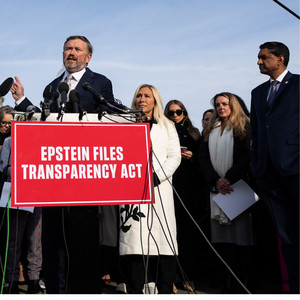
It's about 10 a.m. on Tuesday morning.
We are standing outside the U.S.
Capitol where this really emotional news conference is now wrapping up.
And it featured victims of Jeffrey Epstein and this bipartisan group of lawmakers, Republicans and Democrats, who have forced the Trump administration to back a measure that would require it to release all of its Epstein files, something President Trump has fought tooth and nail.
So we're not going to go inside the Capitol to talk to our colleague, Annie Carney, about how these lawmakers persuaded President Trump into reversing himself and backing this measure to release the Epstein files.
And then we're going to watch as this bill in a couple hours we think, gets passed, perhaps unanimously.
Annie should be back here.
Hello.
Hello.
Welcome to our humble abode.
It is about as humble as it gets.
This is our very exclusive closet that we get to sit in every day.
Well, thank you for making some space at your little closet here for us and for making diapers in general today.
Of course.
So Annie, just to start, this has been extraordinary few days at the Capitol.
That brings us to Tuesday's vote.
And I'd argue that this vote feels like a major moment, not just in the Epstein story, whose victims have pleaded for it, but for the entire second term presidency of Donald Trump, because of how ferociously he fought this vote ever happening at every turn and with every available tool, until suddenly he gave up, which he very, very rarely does in a political fight.
So tell us the story of how, over the past few days, President Trump concluded that he had to give up the fight here.
I think where the most recent chapter of this starts is when the government shutdown ends and Mike Johnson, the Speaker of the House, is forced finally to swear in this Democrat from Arizona, Adelita Grijalva, who won a special election a few months ago and he was slow-rolling her swearing in.
And that was going to provide the 218th vote on this petition.
The petition, which we should just say as a reminder, harkens back, like, months.
Yes, months ago.
Thomas Massey, a Republican, and Ro Khanna, a Democrat, paired together to start this discharge petition.
Discharge petitions are just something that any member can do.
You have to get 218 signatures.
And if you do... Not nothing.
No, it's hard.
It's hard to get these things off the ground because that requires bipartisan support.
If you do, you can circumvent leadership and force them to bring a bill to the floor that they don't want to bring to the floor.
Right.
So they started this months ago.
When they first rolled it out, dozens of Republicans were saying they were going to sign on.
When it became clear that Trump... was opposed to this, that support drained away.
And there were only four Republicans left.
Thomas Massey, who was the leader of the movement, and three women hardcore MAGA Trump loyalists Lauren Boebert, Marjorie Taylor Greene and Nancy Mace.
Right.
Some of the biggest names in the MAGA movement.
Kind of the neon-like names of it.
These are like the warehouse members that regular people who don't follow this all the time might know these names.
And know to be exceedingly loyal to President Trump.
They say, we will stick with this petition.
That was immediately sort of interesting that it was just the women who were holding strong.
And you know a few of these women have talked a lot about their own experience with abuse and assault.
Nancy Mace has.
Lauren Boebert has.
Marjorie Taylor Greene has not.
But they were driven by personal reasons and made that clear.
But still it was a question mark of if Donald Trump continues to pressure them—and he was— would they stick or would they try and remove their names?
Right.
So let's get back to the part of the chronology where suddenly because this congresswoman-elect is finally sworn in their votes really matter.
Right.
With Adelita Grijalva, it has exactly 218.
And the pressure really intensifies on Boebert and Mace and Green.
Trump personally calls Mace and Boebert and is pressuring them himself.
We learn that Lauren Boebert is invited in to a meeting in the Situation Room with Pam Bonney, the Attorney General, and Kash Patel, the FBI Director, for a briefing on Epstein-related matters.
Wow.
Which is just kind of unheard of to sit in that room with one member of Congress.
Right.
This is a room, a Situation Room, that we regard it cinematically as the place where the Cuban Missile Crisis is being overseen and where bin Laden's killing takes place, is being watched by Barack Obama and Hillary Clinton.
Right, that famous photo that we all have seen.
So they bring Boebert into that room of all rooms and presumably make the case to her that she should not remain a signatory to this petition.
Right.
I mean, we don't know exactly what was said in the room, but Lauren Boebert's probably never been in this situation.
Just the whole staging of this was clearly, you know, shock and awe of the treatment she's getting in this moment when she's a critical voter.
It doesn't work.
She does not remove her name from the petition.
And in fact, the extreme pressure campaign on her actually made her dig in more.
She started to get even more conspiratorial about why they were so adamantly opposed to this.
And an interesting dynamic that unfolded during the shutdown was Mike Johnson recessed the House for a month.
So all these members were home.
And what I heard is Lauren Boebert, Nancy Mace, Marjorie Taylor Greene—
All they heard from constituents for a month was you're brave, hold the line, stay strong.
We're with you on this.
None of the feedback they got from voters was that there was any repercussions for going against Trump on this issue.
Right.
It starts to feel like the truest expression of MAGAism to these leaders of MAGA is to back this measure.
Correct.
Is to give supporters of this movement the transparency they want.
Yes. when it comes to Jeffrey Epstein.
I think they become incredibly passionate and feel like they cannot move.
So these four House Republicans are digging in.
They're back from their districts.
They are determined to stick with this discharge petition.
And it feels worth saying that at this point, because the 218 signatures are on that petition and this is going to keep moving forward it's eventually going to become a bill on the floor of the House that Trump is now asking the entire House Republican caucus to make an impossible choice, because and correct me if I'm wrong, Annie he is asking them now to hold the line against this bill.
He's like sure, maybe we've got this discharge petition, but everybody else needs to stay with me, which means he's asking them to choose him over the victims of Jeffrey Epstein.
It's the ultimate Trump loyalty test.
Totally.
I mean, this was shaping up to be a terrible vote for Republicans.
Not only choosing between Trump and the victims themselves, but Trump and their own voters, who have been demanding this release.
So, after Grijalva is sworn in, it's just a matter of what day Mike Johnson is going to schedule the vote, because it's an inevitability at that point.
And he decides to do it rather quickly and just get done with it.
So Speaker Johnson says he's going to schedule the vote for early this week.
And it becomes clear internally in the conference that many Republicans are going to vote for it.
So, when it comes to this impossible choice, many House Republicans are going to be choosing against the president.
Correct.
So they start telling the president this.
Members themselves are talking to him.
And over the last weekend, he was in Florida.
And he's hearing that there are going to be many defections and that the vote is inevitable at this point.
And he realizes he is going to lose.
Mm-hmm. and he does not like to lose.
Another thing that he heard from members was that the more he was fighting, the more it looked like he was trying to cover something up.
So on the flight back from Florida on Sunday night on Air Force One, he drafts this Truth Social post, doing a 180 and telling House Republicans to vote for the release.
This was great news for House Republicans who were saved from this awful choice.
And we immediately saw even the most hard-right Republicans, who had said they are a hard no, that it's a Democratic hoax, they would never vote for this, suddenly say like yeah, of course I'm voting for it.
Trump told me to, literally.
That's what Troy Nels from Texas told me last night.
Yeah, Trump said to vote for it, so now I'm for it.
So once Trump reverses himself and backs this bill—
Everyone has permission in the Republican Party to back it, and it sounds like almost all of them are backing it.
Yes, it's expected to be a unanimous or near-unanimous vote to release the files.
No one wants to be on record saying they don't support transparency on the Epstein issue.
Even if just hours before they were.
Correct.
And Trump goes even further.
In the Oval Office on Monday.
He says that if it passes the Senate and comes to his desk he'll sign it into law.
Just a reality check here is that if he really wanted to compel the Justice Department to release these files, he actually doesn't need Congress to tell him to do so.
He could just do that, and he hasn't done it.
So there are still questions on what will a release really look like, what will actually be released?
But for now, it's just a total change of tune.
So, in summary, what really happened here over the past week or so is that a mutiny that was started by these four House Republicans became— kind of a movement against Trump that forced him to recognize that this time, congressional Republicans were going to be the ones calling the shots.
And in that sense it does kind of feel like a real ground-shifting moment, a real before and after moment in this administration.
It does.
It feels like it is indicative of a splintering that's happening in the movement that we're seeing on multiple fronts in this moment, a realization that the base and Trump are not totally aligned.
And I just think enough cannot be said about the fact that four hard right Republicans stood up to Trump in a way that we have not seen any moderate or center-leaning Republican do in 10 years.
And they break with him on something incredibly important to him.
I mean, the story of this Congress until today has been that they have willingly ceded all of their power to the executive branch.
And today is likely to be the first time that we see Congress dictating the terms of engagement and Donald Trump having to cave.
Lainey, thank you very much.
Thank you to the break a conversation with one of the four House Republicans who forced the president to cave.
We'll be right back.
So a couple of minutes ago I texted Congressman Massey and said you don't know me, but I would really like to talk to you about your role in all of this.
And I invoked our colleague Katie Edmondson, a Times congressional reporter who knows the, And he just texted back and said can you meet at Cannon Rotunda in the next 15 minutes?
And so we're now walking underground from the Capitol to the Cannon office building to talk to Congressman Massey about his role in this very big vote.
Do you guys know what floor the Cannon Rotunda is on?
Two.
No, it's three.
It's three.
Four, three.
Going up.
This is y'all.
Thank you.
Thank you.
Have a good one.
You too.
Okay.
Cannon rotunda.
And Congressman Massey.
I got to go write a speech at some point.
Okay.
Give me a second.
Look.
Is that a national debt clock on your shirt?
Yes, it is.
But please, my eyes are up here.
Yes.
Okay.
Congressman Massey, thank you for making time for us.
I know it's a huge and important day for you.
This all very much feels like you're doing what's happening today, along with Congressman Ro Khanna.
You're kind of singularly responsible for getting this all started.
I guess I just want to start by asking you, how does it feel to have originated this all?
Well, a lot of people— And be where we are.
A lot of people said in the beginning this was a quixotic effort that was doomed to fail.
And most discharge petitions do fail.
But here we are.
The vote's going to happen today. and they can't do anything to stop it.
You had to fight, if you'll forgive me, like hell to get to this point.
The president has basically politically disowned you.
He's backed somebody back in your district in Kentucky who may or may not end up running, but he's disendorsed you and he's trying to get you out of the House of Representatives.
How do you explain why the president would oppose what you have described as essentially a transparency act, an act of justice for young victims of sexual abuse by Jeffrey Epstein?
Like, have you ever really settled in your mind why he opposes it?
He's been, until this week, tenacious in his opposition.
It makes you wonder if he's worried about himself.
But I've always maintained that he's probably not criminally implicated in these files that he is taking up for friends and donors of his and people who were in his social circle in the 90s, long before he was president.
And people who may be giving him money now, my friend Ro Khanna.
You think he is covering for some?
Oh, absolutely.
Absolutely.
These are people that he knew.
He claims and there's evidence to this that he disavowed his relationship with Jeffrey Epstein at some point.
But he has colleagues and friends who did not and donors who did not.
They're what my colleague calls the Epstein class.
Rich, elite connected individuals who always have thought they're above the law and if they ever get in trouble they'll just buy a politician.
And in my district, they're trying to buy a politician.
To the degree that this has become a political story, versus what you've always seemed to want it to be, which is a story of victims and documents becoming public.
It feels like it's become the story of you all making an end, run around the president, when he fought this, and Congress, in a very real sense, rebalancing power that it has ceded over the past year to Trump and to the executive branch.
Is that how you see this?
Is this an overdue correction?
It is an overdue correction.
Of power balance?
But, you know, it's the House that has ceded the authority to the president.
The president didn't come and— Your house, your party.
Yeah.
Speaker Johnson.
The president isn't acting outside of the Constitution.
He is getting— the Congress to do nothing in the face of what he does.
And I wouldn't say this is a victory for the Speaker of the House because he has been fine with doing whatever the president wants to do.
So who's it a victory for?
It's a victory for the people who exerted enough pressure on the members of Congress that I think they went to the speaker and to the president and said we can't do this.
You can't make us vote against victims of sex trafficking.
And ultimately, the president and the speaker can do math.
They saw they were going to lose this vote.
And then they backed it.
And then they decided to back it.
If there's a cost to this all.
I think your colleague, Congresswoman Marjorie Taylor Greene, just identified it out there at that news conference.
She says this is ripping MAGA apart.
Do you agree with that?
And to the badly about that?
Or is it just the cost of forcing the president to reckon with what the people want here?
If there's a cost, it's self-inflicted by the president.
He disavowed and disowned the portion of his base that wanted these Epstein files released.
He said, you're no longer one of my friends if you want to release these files.
And I think that's when he lost a large degree of support.
It's hard to say he's getting bad advice.
Some of the things that he's done that we don't agree with on the Republican side.
We've chalked it up to bad advice.
But at some point, he's accountable for his own statements.
Self-inflicted wound to MAGA from the president is what you're saying?
It's clear as day.
That's what happened.
I'm glad now that he's joining the effort.
Let's just make sure that they don't derail the effort some other way.
You said something a couple days ago to your colleagues who remained pretty frightened about voting for this bill before the president reversed course, looked at the math and said I got to get behind this.
You said that the president's endorsement in your district.
Sure that's going to help you in your district in the next cycle.
But the memory of this vote is going to live a lot longer than the president's legacy or his political influence.
What did you mean by that?
Well, the president's giving out presidential endorsements to Republicans like Pez Candy over there at the White House.
But the deal is that you'll always vote with him.
And so he set them up in a situation where they were all going to take their endorsement and then walk the plank politically.
On Epstein.
On Epstein, put themselves at odds with their own constituents.
And so ultimately, I think he realized he'd given them a bad choice, one that frankly, could cost us the midterms and could really diminish the party position.
You know ultimately, I think it was a political calculation that he made and he released them from their obligation to walk the plank.
But you're also telling fellow Republicans not to be afraid of saying when he strays.
Absolutely.
Nobody should be afraid.
I wish there had been more than three Republicans who joined me.
But maybe we've got a message here today from the rest of my colleagues, which is, When you're on the right side, when you're on the side of the people, especially when you're on the side of the president's base, then you can take that position and keep the president honest.
Maybe he'll come around.
You are what I like to call the tallest tree in the forest right now.
It's a short forest.
And when Donald Trump sees a really tall tree in the forest sometimes, he wants to knock it down.
And he's been very successful at it.
Is that a worry you have?
I'm not worried about it.
I mean, there's already been $2 million spent in my primary, and it's not until May.
I've got the support of the people in my district.
But even if I lost, I'd rather lose and do the right thing up here than make the kind of tradeoffs that you make when you're scared to stay elected.
Yeah.
And the vast majority of my colleagues have been making.
Well, Congressman, thank you.
Thank you.
Appreciate your time.
All right. gentleman from Kentucky is recognized.
Mr. Speaker, today's an extraordinary day in this chamber.
If my colleagues will vote for this measure, we'll see justice triumph over politics.
Truth will triumph over deception and obfuscation.
Transparency... The gentlelady from Georgia is recognized for five minutes.
Thank you, Mr. Speaker.
I proudly rise today in a bipartisan effort to release the Epstein files.
Finally, Mr Speaker, I move to suspend the rules and pass HR.
4405.
The clerk will report the title of the bill.
H.R.
4405, a bill to require the Attorney General to release all documents and records in possession of the Department of Justice relating to Jeffrey F Steen and for other purposes.
On this vote, the yeas are 427, the nays are 1.
Two-thirds being in the affirmative.
The rules are suspended.
The bill is passed.
And without objection, the motion to reconsider is laid on the table.
So the voting in the House is now officially over.
The measure, what's being called around here the Epstein Transparency Act, has officially passed.
427 to 1.
It was almost unanimous in the end.
A single House Republican voted against it.
And now that it has passed, we wanted to talk to one of the smartest minds on Washington here at The New York Times, Carl Hulse, to make sense of what this vote means, well beyond Epstein and really even just this moment.
Carl, just walk us through how you're thinking about the vote that just happened today in the biggest possible context.
Yeah, I think what we're seeing is, not just with this vote but with some other developments, the glimmers of lame duckism for President Trump.
Just explain that.
So in my experience generally you know the lame duck status for a second term president comes after the midterm election and they generally lose.
Which is a year out from now.
Right.
Which is they generally lose and everyone goes, oh, they're done.
Right.
It's coming a little earlier because the election earlier this month, resounding Democratic victories bigger than we anticipated and up and down the ballot.
And I think this is being processed in real time by members of Congress.
And I think Thomas Massey said something interesting about this.
He said, you know, this vote is going to be remembered longer then Trump's in office.
You're literally you're reciting the line that I recited back to him today because it felt very memorable.
That is a very incisive comment that he made.
And it's not just this vote.
There's some other things we're seeing.
Trump was really determined to get the Senate to back off on the filibuster.
During the shutdown.
And they didn't.
They held firm because guess what?
They need that filibuster beyond President Trump.
That's a case of seeing beyond Trump.
Right.
I think the redistricting in some of these states are resisting Trump, even though you know there's like we're trying to do it.
You're talking about, for example, Indiana.
Indiana.
Where the president went to them and said, OK, it's your turn.
And there's reluctance because these are longer term things.
And to me it's important to note.
People thought that Trump was is a totally different politician and he's not vulnerable to the things that we saw.
Right, that lame duckness would be obsolete.
Right that he's never going to be a lame duck because of his use of the bully pulpit as a real bully right.
I think you know this is just the beginnings and Trump is still a real powerhouse, especially among Republicans.
But I do think there's real cracks in this coalition.
And once the cracks of lame duckness duckery, whatever we want to call it, lame duckism start to show, I wonder how much they can't be papered over and people want to start poking their hole in it and testing it.
And it just kind of creates an opening that has to be exploited.
Yeah, I think it's just the nature of politics, right?
There's no stronger... emotion in politics than self-preservation for most of these guys, right?
They're going to do what it takes to preserve themselves.
And if they see that Trump is weakening, they're going to make the moves they think are going to help themselves.
And it's true.
Trump is not going to be around forever.
Right.
And for the longest time, self-preservation for a congressional Republican meant only one thing.
It meant doing what Trump wanted.
And now what you're describing is self-preservation starting to necessitate breaking with him.
Right.
I think you're exactly right.
And I think we'll start to see more of this.
It'll be gradual, but I think the trend is in that direction right now.
The fear of Trump was paramount on Capitol Hill for Republicans.
That drove everything.
Now they're starting to have a little fear of voters and that can make a difference how they align with Trump.
Well, Carl, as ever, thank you very much.
On Tuesday night, not long after we spoke with Carl, the Senate moved quickly to call a vote in support of the Epstein bill, which now puts the bill on track to pass the Senate by Wednesday morning.
If that happens, the bill could be signed into law by President Trump by the end of the day.
We'll be right back.
Here's what else you need to know today.
During a meeting in the Oval Office on Tuesday, President Trump offered the Crown Prince of Saudi Arabia, Mohammed bin Salman, lavish praise and dismissed a report from US intelligence officials who found that bin Salman was responsible for the murder of a journalist from The Washington Post, Jamal Khashoggi.
Your Royal Highness, the US intelligence concluded that you orchestrated the brutal murder of a journalist.
9-11 families are furious. that you are here in the Oval Office.
Why should Americans trust you?
And the same to you, Mr. President.
Now, who are you with?
I'm with ABC News, sir.
You're with who?
ABC News, sir.
Fake news.
ABC fake news.
One of the worst.
Before Ben Salman could answer a question about the murder from a reporter, Trump interjected and defended the crown prince.
You're mentioning somebody that was extremely controversial.
A lot of people didn't like that gentleman that you're talking about.
Whether you like him or didn't like him, things happen.
But he knew nothing about it, and we can leave it at that.
You don't have to embarrass our guest by asking a question like that.
And in a major blow to President Trump's efforts to redistrict his way to victory in the midterm elections, a federal judge has blocked Texas' newly redrawn congressional map from going into effect.
Over the summer, at Trump's direction, Texas Republicans had redrawn their maps to create up to five new Republican-leaning seats —.
But two federal judges, including one appointed by Trump, found that the new maps were unconstitutional.
Texas Governor Greg Abbott said he plans to appeal the ruling to the Supreme Court.
Today's episode was produced by Anna Foley, Mary Wilson, and Michael Simon-Johnson.
It was edited by Rachel Quester and Rob Zipko, contains music by Marion Lozano, Pat McCusker and Dan Powell, and was engineered by Alyssa Moxley.
Special thanks to Julie Davis, Megan Manero, Robert Jimison, and Edward Isaac Dover.
That's it for The Daily.
I'm Michael Barbaro.
See you tomorrow.