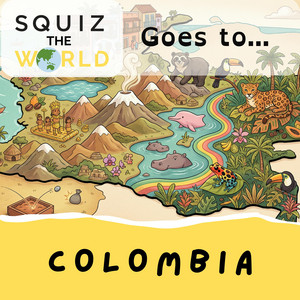
This is a Squiz Kids podcast.
Your fresh take on what's happening in the world around you.
Each fortnight, we give the world globe a spin and see where we land.
Then we take the kids of Australia and the world on an audio excursion to visit that country and its people.
I'm Christy Kidgerina, and today, on Squiz the World, We're visiting a country with more bird species than any other country on Earth, that produces some of the world's most famous coffee and where, long ago, a ruler covered himself in gold dust, sparking a legend about a lost city of treasure.
Can you guess?
Strap yourselves into the Squiz Kids Superfast Supersonic Jetliner as we take off and take a squiz at Colombia.
Just the facts.
Colombia sits in the northwest corner of South America.
It shares a border with Panama, Venezuela, Brazil, Peru and Ecuador.
And here's a geographical flex.
It's the only country in South America with coastlines on both the Pacific Ocean and the Caribbean Sea.
The country's name comes from Christopher Columbus, the Italian navigator, whose last name inspired Colombia.
And the capital city is Bogota, which sits high in the Andes Mountains, at more than 2600 meters above sea level.
There are around 52 million people living in Colombia today.
Geographically, it's dramatic.
The Andes Mountains slice through the country and split it into three ranges.
In the south lies part of the Amazon rainforest.
In the north, there are warm Caribbean beaches.
And on the Pacific side, thick rainforest tumbles down to the ocean.
There are also wide plains called Llanos and rolling hills in the coffee growing region known as the Zona Cafetera.
There are also snow-capped volcanoes because Colombia sits along the Pacific Rim of fire, where tectonic plates meet.
All that variety makes Colombia one of the most biodiverse countries on Earth, with more than 1900 bird species.
Jaguars roam the forest sloths are hanging lazily from branches.
Spectacled bears they just look like they're wearing glasses wander mountain slopes, poison dart frogs glow in bright colors and yes, pink river dolphins swim in Amazon waters.
Wow.
Not so well known is that Colombia is often recognized for its healthcare system, which is ranked highly across the Americas.
The quality of care does vary across the country though.
And after quite a significant history of violence In recent decades, the country has introduced progressive laws around gender equality, LGBT rights, animal welfare and human rights.
Colombia today is a modern nation that continues to evolve.
But long before modern cities and mountain cable cars, people were already living on this land.
Let's do some... Time travel.
Indigenous peoples inhabited the territory that is now Colombia as far back as 12,500 BCE.
Over thousands of years, early hunter-gatherer communities gradually transitioned into farming societies.
Permanent settlements were established, pottery appeared and by the first millennium BCE, organised societies had developed political systems led by chiefs.
One of these groups The Muisca people lived mainly in the highlands near what is now Bogota.
They farmed maize, potatoes, quinoa, and cotton.
They traded gold, emeralds, textiles, and rock salt with neighboring groups.
And gold was deeply spiritual, not just for decoration.
When a new Muisca leader was chosen, a ceremony took place at a sacred lake.
And according to later accounts, The ruler covered himself in gold dust and sailed out onto the water on a raft offering gold and emeralds to the gods.
Spanish conquistadors arrived in what is now Colombia in the 1500s.
Conquistadors were Spanish conquerors who travelled to the Americas seeking land, gold and power and claimed territory for Spain.
They heard the Muisca story and misunderstood it.
They imagined a whole city made of treasure.
They called it El Dorado, the golden one.
For years they searched rivers, mountains and jungles for a golden city that never existed.
Spain ruled the region for centuries, shaping its language and religion.
And in the 1800s, independence movements led by figures like Simon Bolivar helped Colombia break free from Spanish control.
Today, Colombia's rich cultural heritage reflects all of this.
Its languages religion, food and arts show the influence of indigenous civilizations, Spanish colonisation, African migrants and later immigration from Europe and the Middle East.
Spanish is the official language, but dozens of Indigenous and regional languages are also recognised.
And we're not stopping there.
Colombia is full of even more surprises.
Believe it or not.
Nowhere do all those blended influences throughout Colombia's history come together more spectacularly than in the Caribbean city of Barranquilla.
The Barranquilla Carnival combines indigenous traditions, Spanish celebrations and African rhythms.
They fuse into four days of music, colour and dance.
Costumes shimmer, drums thunder and the streets burst with energy.
It's one of the largest carnivals in the world.
Also from the Caribbean coast comes global pop star Shakira, whose music carries Colombian rhythms around the world.
This diverse country is also home to a river called Caño Cristales, that's often nicknamed the River of Five Colors.
At certain times of the year, special aquatic plants turn the water vivid shades of red, yellow and green, and it looks as though someone tipped a giant paint set into the jungle.
And that's not all.
Colombia's national sport isn't football, it's tejo.
Get this, players throw a heavy metal disc at a clay board fitted with tiny packets of gunpowder.
Hit the target just right, and pop probably won't be trying this in pe anytime soon though, but it hasn't all been smooth sailing for colombia during a difficult period.
In the late 20th century, an infamous drug lord named pablo escobar built a private estate that included a zoo that he filled with exotic animals, think giraffes, zebras and elephants, amongst others.
After his death, most of those animals were relocated, but some hippos remained and multiplied.
With no natural predators and plenty of river habitat.
Today, there are well over 100 hippos living in the wild, and they're considered an invasive species.
From rainbow rivers to carnival drums to hippos, Columbia keeps surprising us.
Now, after all that exploring, let's get down to business because it, Time for school.
In Colombia, education is compulsory from early childhood through the mid-teen years.
Public schooling is free, although private schools do operate.
Students move through preschool, five years of primary school and then secondary education, and uniforms are pretty standard.
The school day usually runs for around six hours.
In many cities though, schools operate in shifts because there aren't enough classrooms for all the students at once.
One group attends in the morning and then another in the afternoon.
And getting to school can look pretty different depending on your geography.
In cities, kids might walk or take buses.
In the steep valley city of Medellin some students ride cable cars, called Metro Cable, down from mountainside neighbourhoods to connect with the metro system.
Imagine gliding above rooftops on your way to school.
In rural regions, children might travel by motorbike, colourful Cheever buses, on foot or by boat along the Amazon River.
In remote mountain communities, schools can be small, sometimes with mixed age classes all learning together.
Just like in Australia, where you live shapes your school experience.
If you're anything like me, after a long day of learning whether you arrived by cable car or canoe, you'll probably be ready for something delicious.
I think it must be First up for the adults listening.
Colombia is one of the world's largest producers of coffee.
Beans grown in cool mountain regions are exported across the globe.
Yeah, it's mostly a grown-up's drink, but it's a huge part of the country's identity.
For kids, you're more likely to tuck into arepas.
Warm cornmeal patties split open and then filled with cheese, meat or egg.
Empanadas are another favourite.
They're crisp pastries stuffed with savoury fillings.
If you're feeling especially hungry, which I definitely am right about now, There's bandahaya paisa, a generous platter piled high with rice beans meat, egg and sweet plantain, a fruit that is part of the banana family.
This is the kind of meal that feels like a celebration on a plate.
So, from golden legends to snow-capped volcanoes, from cable cars in the mountains to carnivals by the sea, Colombia is a country bursting with colour, resilience and rhythms.
Time for the quiz.
This is the part of the podcast where you get to test how well you've been listening.
Question number one.
What is the capital city of Colombia?
Is it A, Cartagena, B, Bogota or C, Lima?
Nice listening if you said B, Bogota.
Question number two.
This one's a true or false question.
Colombia has more insect species than any other country in the world.
Is this true or is it false?
That, my friends, is false.
In fact, it has more bird species than any other country in the world.
Question number three.
Colombia's national sport, tejo, involves throwing a metal disc at what unusual target?
Is it A, a moving llama, B, a floating coconut, or C, a clay board with small gunpowder packets?
What an interesting sport.
The answer is C, a clay board with small gunpowder packets.
Well, that's all we have time for today.
Thanks for staying curious about the world and joining me on this incredible trip to Colombia.
Now get out there and have a most excellent day.
Over and out.