This is our glass of This American Life, each week on our show.
We choose the theme, tell different stories on that theme.
All right, I'm just going to stop right there.
You're listening to an NPR podcast.
Chances are you know our show.
So instead, I'm going to tell you we've just been on a run of really good shows lately.
Some big epic emotional stories and some weird funny stuff too.
Download us, This American Life.
You're listening to LifeKit from NPR.
Hey everybody, it's Marielle.
Any fans of the great British Bake Off here?
If so, you know there is nothing simple about those bakes.
So mine is a Black Forest Gato, which in the layers it is chocolate genuis soaked in kush with a morel of cherry reduction on that.
And then a buttercream on the outside.
There is some a bit of the cherry syrup in that and a bit of almond extract, just to give it a bit of flavor.
Bake Off is known for its technical challenges and the elaborate show stopper cakes painstakingly constructed by contestants.
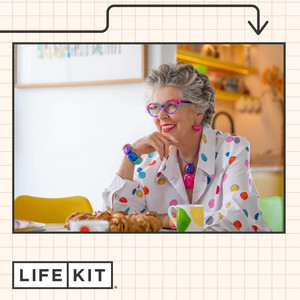
But in her new cookbook, Bake Off judge, Prue Leith, wants folks to focus on the basics of cooking and baking.
It's called Life's Too Short to Stuff a Mushroom.
And it's filled with recipes, of course, but also cooking hacks, tips from Prue on how to do basic things in the kitchen quickly and easily.
Like how to cut in onion, peel garlic, prevent your muffin liners from getting oily.
Because if you've never learned this stuff, it's easy to feel discouraged and to give up on cooking.
A lot of my friends who are foodies and cooks and things said, why are you putting all these absolutely basic things in this book?
You know, everybody knows how to do that.
Actually, they don't.
And if you can't do something, it makes you anxious and quite cross.
And you think, why should I bother?
Well, if you know how to do it, it's actually quite a pleasure.
Prue stopped by our studio during a visit to New York.
And I gotta tell you, we had a great time.
I gave her some spooky baking stickers.
Thank you. You're welcome.
They're really good.
This is a Halloween -y one with ghosts.
She shared all kinds of wisdom.
We talked about cooking and baking and herbs or herbs.
If you do put in basil, you should only put a tiny bit basil, as you call it.
I like it your way.
Tomato, tomato. Do you say tomato?
I say tomato. Had to fact check that one.
You could say anything you like.
On this episode of LifeKit, Prue Leith shares some of her best cooking hacks with us.
If you're a regular listener of the LifeKit podcast, you probably listen to some other NPR podcasts too.
With NPR +, you'll get perks like sponsor free listening, bonus episodes, early access, shop discounts, and more for more than 20 different NPR podcasts.
So start supporting what you love and stop hearing promos like this one at plus .npr .org.
On shortwave, we know the human body is this amazing singular thing.
Capable of facing down all kinds of infection and disease, from managing UTIs to cancer to long COVID, our show is dedicated to stigmatizing our relationship to our bodies.
Listen to the shortwave podcast from NPR.
On the Code Switch podcast, we think about race and identity all the time.
On a recent episode, we tried to make sense of the devastating violence in Gaza by turning to James Baldwin, the writer and intellectual who thought a lot about what was happening in Israel during his lifetime.
His words speak to the present in unexpected ways.
Hear how they might help you think through it too, on the Code Switch podcast only from NPR.
Okay, so I've never stuffed a mushroom before.
I'm assuming that it's long -winded and entails a lot of hard work.
Well, to be honest, if I'm really honest, you can make a perfectly delicious stuffed mushroom and probably quite quickly.
But it's a phrase that a friend of mine called Shirley Conrad used years ago when she wrote a book called Superwoman.
And her whole thesis was that you should not waste your life doing things that are taking up lots of time and not giving you any pleasure.
And because my book is really about, you know, cheating when cheating doesn't compromise the quality.
I don't think you have to make your own puff pastry.
There's a perfectly good product called frozen puff pastry.
I don't think you have to make your own mayonnaise.
Of course, if you like making mayonnaise, which I do and I have a very good machine that makes it quickly, then yes.
But you can take shortcuts, you can do simple recipes that will give you just as much satisfaction and look lovely and please your friends and family without breaking your bank and without making you miserable.
So, yeah, that is actually one of my favorite parts of the book, was that you had all of these handy hacks throughout that can save you time.
And a lot of the time it's the things that maybe no one ever taught you how to do, but you do all the time if you're cooking, like peeling garlic or cutting an onion.
Tell me about peeling garlic.
You take a pig of garlic, you know, a little clove of garlic, cut the two ends off, the root end and the tip end, and then take anything a jam jar will do or this flat blade of a knife and just squash it.
And as soon as you hear that sort of crack, the skin breaks, then you'll find the skin will peel off perfectly easily.
It's so much easier.
Someone taught me that not too long ago and it's been game -changing.
Otherwise you're scratching around with your nails trying to get hold of the skin and it doesn't come off easily and you end up with your hands really smelling horribly of garlic and not so easy.
I love that, it's so simple.
You had something in there too about feta, how to prevent the feta from going bad?
Yes, you know feta goes rancid very quickly, doesn't it?
It's because it's so fresh.
Feta needs to be kept under salted water if it's to be kept for a long time.
Either that or eat it straight away.
So what I suggest you do is just put the feta in a plastic container.
It doesn't have to have a lid on it even, but just in water with a tablespoon of salt added to the water and it'll keep for weeks.
It's a terrible feeling when you just bought something like feta, which can be pretty expensive and then you use it for one recipe and it's gone bad.
And then you have to chuck the whole thing.
Yeah. I know. And also if you see it there, every time you open the fridge door and the feta is lying there in its bath water, you think, oh, I'll use that.
Mm -hmm. Because you see it.
Yeah. Okay, so Thanksgiving is coming up in a lot of holidays and I know a lot of folks will bring a side dish to a family gathering.
One of the ones that caught my eye in here was the sweet potato and parsnip bake.
Delicious, isn't it?
Yeah. That's very autumnal too.
Mm -hmm. And it looks very good.
What I did was I just cut up carrots and parsnips, equal quantities, into roughly the same sort of rounds.
I had carrots and parsnips, which were sort of the same size, and I just cut them all into slices and then I put alternate slices standing up on the edge in a concentric circle in a little baking dish.
The baking dish was buttered and then I put melted butter with lots of different kinds of herbs, all chopped up into the melted butter.
And buttered the top, you know, yes, it's a little bit of a fiddle arranging them.
It would taste just the same if you just chuck the slices in any old hour.
But somehow, if it's something like a Halloween party or something and you're bringing it to a friend, it's worth taking the trouble to just stand the slices up and arrange them in concentric circles.
And they look lovely.
Yeah. So you also have a recipe in there for a grilled, spiced monkfish with a pineapple salsa.
And I love looking at pineapples, but I have never caught one because I'm too overwhelmed by this idea.
How do you actually cut it without injuring yourself?
Take bottom and top of it off, push them to the side, then stand the pineapple up, hold it from the top and just slice down the sides.
To get the four cheeks off.
You know, straight down.
You need a big knife.
And then cut them the opposite way and you'll end up with little dice.
But I love a pineapple salsa.
Yeah, it sounds great.
I will try. The exterior of a pineapple just looks so unwelcoming.
It does not want to be cut.
At least how it looks to me with all those spikes on it, you know?
You should try it, honestly.
Have a go at your pineapple and you'll find it's easy.
It's very easy. You've got a big sharp knife, it'll cut incredibly easily.
I have an embarrassing question that you didn't answer in the book, but now that you bring it up, how am I supposed to sharpen my knives?
To be honest, I think the answer is buy a decent sharpener.
I've just bought a new one, actually, which is absolutely brilliant, but I don't know what the name is.
It's an electric one.
It's quite expensive.
It costs about 30 pounds or something.
When you think how much a knife cost, a good knife costs, if you're saving your knives, and your— I mean, I've still got knives that I had at cookery school 50 years ago, and they still work beautifully, but then be careful because your knives will be very, very sharp.
If a knife is really sharp, you don't need any pressure to carve anything or to cut anything because it just goes through like butter.
Mine right now are what I imagine pre -historic humans were working with.
Like, they're so blunt at this point.
Prehistoric humans sharpened their knives on a thing very— Oh my god, you're so right.
—except they did it by hand.
You're so right. My grandmother used to sharpen her knives on the back step.
Oh, wow. With a stone step, very, very well worn and smooth, and she just would, you know, pull the knife one way, slightly at an angle, about a 45 -degree angle that way and 45 -degree angle that way.
I don't know why I thought of it now.
Like, why I waited until I had, like, a very well -known chef in front of me to ask me—ask someone this question, and I didn't just Google it before now, but, you know, sometimes—sometimes we just don't know everything.
No, of course you don't.
That's the reason why you should.
Yeah. Thank you for that.
Okay, so we have to talk about dessert, obviously.
There was a recipe I liked in there, the Passion Fruit Yogurt Cupcakes.
First of all, love Passion Fruit, especially love it with dark chocolate.
Those are, I feel like, a really beautiful pair.
But yeah, you had a tip in there for preventing muffin liners from getting oily.
It's simple. Yes. You just put a bit of rice in between the muffin liner and the metal tin that it's sitting in.
So you put a few grains of rice in the bottom, and then you put the cupcake liner, and then you pour the mixture in.
And that rice absorbs any kind of grease or fat, and it's extraordinary, but it makes it come away smoothly and slightly.
Love that. You also have a tip for how to rescue overwhipped cream.
You can only do that if it's just overwhipped, you know?
When you—if you overwhipped cream, it just suddenly gets a bit too stiff, and you almost don't dare take the whisk out, because it's obviously about to be too overwhipped.
But if you add a bit more cream to it, or milk and stir it in, you can sometimes bring it back.
But it only works if it's just overwhipped.
If you've gone too far and you've already got lumps of what is, in fact, butter, and it looks wet, the wet part is the whey and the lumpy bits are the butter you've just made.
So don't go that far.
Can you use it as butter?
Yeah. Maybe at least you got something out of it.
Don't throw it away.
Just keep stirring and it'll become more like butter, and then you can chuck the whey and keep the butter, and you've made butter.
You add a bit of chopped herbs to it, you've made sort of tell butter.
You can use it on top of your steak and say, I made the butter.
I love that. Silver linings.
Okay, you also had one on how to rescue hardened brown sugar.
Oh, yeah. That was, you know, I put that once as a hack on social media, and I had more response and delight and people were so pleased with it.
And it's such an obvious thing.
You know, the reason that brown sugar goes solid as a brick sometimes is it's because it's become dehydrated.
If you've got it in a jar, let's say, if you add a lemon and close the lid, within a few days, sugar will absorb some of the moisture from the lemon.
And it goes soft and perfect like it was when you bought it.
You know, I wonder if your work on Bake Off at all informed this book.
And I say that because I feel like the contestants on the show, they are very focused on getting things technically right and making showstoppers.
But then if they fall short, you see a lot of people just supporting each other and having a laugh about it and not putting too much pressure on themselves.
That's one of the reasons that I love Bake Off because I think it's such a lovely, friendly, relaxed program.
And I think that's what the audience like about it.
They know they're not going to be stressed out by lots of blood and violence and drama and misery.
They know this is going to be perfectly happy and the worst that can happen is somebody's chocolate's going to melt or they're going to drop their cupcakes or something.
It's quite pleasant stress.
You just quite enjoy watching the drama.
But I think you're right in a sense that so many people think chefs are a breed apart, that they do all these amazing things all the time.
Actually, if you ate with them at home, they'd be eating hamburgers and hot dogs like the rest of us and they'd be making very simple food.
And they love good, simple stuff.
I don't think cooking should be intimidating.
And I think it doesn't have to be grand.
It just has to be delicious.
Yeah, you say it should be a pleasure, not an endurance test.
Yeah, exactly. I'm very conscious that people at the moment are very stressed and they are very short of time and they haven't got the skills.
So I wanted to just say, look, it's not that difficult.
You can do it and it'll be delicious.
And it's really satisfying to cook for other people and it's just the most satisfying thing because they are obviously appreciative.
And there's something great about seeing people tucking into the food you've cooked.
It just does your soul good.
Okay, y 'all, one more tip for the road.
If you're a smoothie lover, like me, you might throw in a banana.
Well, guess what? You can eat the skin, too.
Prue has a recipe in the book that she borrowed from a chef friend.
Which is when a banana goes manky and black.
What you should do is you cut two ends off because they're a bit hard.
And then you liquidize the whole thing, including the skin.
Then add milk and cinnamon, lots of cinnamon.
And it makes the most delicious smoothie.
And if you really want to treat, you put a blob of vanilla ice cream into it as you use it up.
By the way, lots of fiber, polyunsaturated fats, and amino acids in the skin of that banana.
Also make sure to wash it first.
You may also want to buy bananas that haven't been sprayed with pesticides.
Okay, time for a recap.
Here are some of our favorite tips from Prue's book.
An easy way to peel garlic is to press down on the clove with a flat edge of a knife.
Then the skin will come right off.
If you want to keep feta fresh, store it in a container covered in water with a tablespoon of salt mixed in.
Prue says pineapples are not as hard to cut as they might look.
First you'll lop off the top and bottom, and then stand the pineapple up, hold it on top, slice straight down the four sides to get the cheeks off, and then dice it up.
Keep muffin liners from getting oily by putting a little bit of uncooked rice in the bottom of the muffin tin.
If you've overwhipped cream, you can try to rescue it by stirring in a little extra milk or cream.
If you think it's gone too far, keep whipping, and you'll get butter.
If you notice that your brown sugar is hard as a rock, you can rescue it by putting it in a container with a lemon, closing the lid, and waiting a couple days.
Lastly, remember cooking doesn't have to be grand for the food to be delicious.
For more LifeKit, check out our other episodes.
We have one on how to get a good night's sleep, and another on how to cultivate your chosen family.
You can find those at NPR .org slash LifeKit.
And if you love LifeKit and want even more, subscribe to our newsletter at NPR .org slash LifeKit newsletter.
Also, we love hearing from you, so if you have episode ideas or feedback you want to share, email us at LifeKit at NPR .org.
This episode of LifeKit was produced by Sylvie Douglas.
Our visuals editor is Beck Harlan, and our digital editor is Malika Garib.
Meghan Kane is our supervising editor, and Beth Donovan is our executive producer.
Our production team also includes Andy Tagle, Claire Marie Schneider, and Margaret Serino.
Engineering support comes from David Greenberg.
I'm Marielle Segara.
Thanks for listening.
On the TED Radio Hour, on December 24th, NASA's Parker Solar Probe will touch the sun.
The spacecraft will hit the closest approach ever to the sun.
Astrophysicist Nora Wawafi leads the mission.
We will be making history.
To this day, it's still like magic to me.
Ideas about the sun.
That's on the TED Radio Hour podcast from NPR.
The ocean floor is abundant with minerals needed to power electric cars and other green technologies, but mining those minerals may harm coastal communities.
These metals that are going to dig out of our ocean will not benefit anyone from it.
On the Sunday story from Up First, a look at the opportunity and dangers of mining the ocean floor.
Listen now on the Up First podcast from NPR.
Joe Biden's on his way out, and Donald Trump's on his way back.
Want to know what's happening as the presidential transition is underway?
The NPR Politics Podcast has you covered with the latest news and analysis.
Listen to the NPR Politics Podcast.