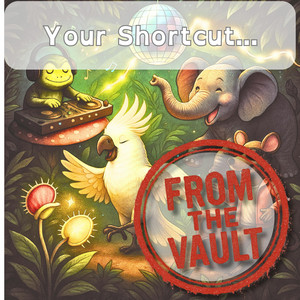
Sunday again, and that means I'm coming to you from the Squiz Kids vault dusting off one of our favourite shortcut episodes.
And with Frog ID Week kicking off, I thought that it's the perfect time to revisit our shortcut to clever critters.
From frogs that pretend to be insects to elephants that work together and even plants that can count.
This episode celebrates some of the cleverest creatures on Earth.
So grab your headphones and hop on in.
It's time to get smart about the animal and plant kingdoms.
This is a Squiz Kids podcast.
Your fresh take on what's happening in the world around you.
Rats that save lives.
Frogs that pretend to be insects.
And plants that can count lives.
This is your Squiz Kids shortcut to clever critters a podcast where we dive into the who what when where, why and how of the big news stories.
I'm Amanda Bower.
And I'm Bryce Corbett.
Recently on Squiz Kids, we've heard about cluey cockatoos that have taught each other to open solo bins, genius border collies that have learned the names of hundreds of objects, and precious pigs keeping us safe in the skies.
Mm-hmm.
There's definitely more to our furry, scaly and feathered friends than we think.
There certainly is, Amanda.
And today we'll take you through why some animals have these amazing abilities, how humans are using clever critters and what we know about plant intelligence.
Listen carefully.
There's a squeeze at the end.
Why?
Bryce, I'm no zoologist.
That's a person who studies animals for a living.
But I think there are three main reasons why some animals have developed incredible abilities.
Oh, yeah.
The first is to stay alive.
Uh-huh.
Have a listen to this.
What do you think that is?
Oh, sounds like insects to me.
And that is exactly what Peter Frein Amoensis wants you to think.
What?
That is the name for the world's smallest...
Frog, also the world's tiniest vertebrate.
Vertebrate, meaning, of course...
Any animal with a spine.
Exactly.
Now, these vertebrates, which were first discovered in Papua New Guinea in 2009, are smaller than your tiniest fingernail.
Wow.
They've evolved to have two very clever behaviours.
So the first is that they make this call that sounds like an insect.
So any predator hungry for a lunch of frog's legs passes on by.
Second, they can jump 30 times their body length.
So if something does get close, they leap away quickly.
Now that is smart.
Sure is.
There's a video in your episode notes.
Now the second reason I think that some animals have special abilities is because it just makes their lives easier.
Like those cockatoos we've talked about on Squiz Kids today.
One kind was making tools to open up fruits to eat.
The others had learned how to open up wheelie bins and taught their friends too.
Well, I know I'd rather be eating fruit than rubbish.
There are lots of examples of animals using tools, even though not that long ago, we humans thought that was what made us special.
But my favourite story about animals making their lives easier is about elephants figuring out how to work together.
Which, of course, is something that smart humans know too.
Tough jobs are easier when they're shared.
Exactly.
So imagine this, Bryce.
There's a low table with two bowls of delicious elephant food on it.
But the table and the food are behind a barrier.
There are two ropes attached to the table and the ropes stick out past the barrier.
Okay, so the only way to get the food is to pull on the rope and slide the table under the barrier.
You are thinking like a hungry elephant.
Nice one.
Now, the problem is if only one elephant pulls on the rope, it becomes unthreaded from the table.
I see.
The only way to get those bowls of food past the barrier is for two elephants to cooperate and pull at the same time.
Exactly.
Now, not only did elephants quickly learn that they had to work together.
If they arrived at the barrier on their own, they waited for another elephant to come along.
Ah, that is cool.
What clever critters.
You said that there was one more reason why animals do clever things.
Yeah, and this I have to say is my favourite.
They do clever things to have fun.
Oh, cool.
I have put the best video in your episode notes of a clever cockatoo called Snowball, who is the first non-human animal to have been scientifically proven to be able to dance to a beat.
Love it.
Snowball has 14 different dance moves.
His favourite tunes are the Backstreet Boys.
Of course.
And some animals will do a dance to attract a mate and others to scratch an itch, but not in time to music.
And scientists have spent a lot of time with Snowball and they reckon he's grooving out just because it's fun.
Now, we all love a bit of fun, but you mentioned that some of these clever animals are being used by humans.
You know what I'm going to ask next?
Don't you been to the airport, has probably seen customs officers using super smart dogs to sniff out banned items?
But bryce, did you know that rats are used to sniff out disease?
Wow, rats have a reputation though, for spreading disease.
That's true, but in africa, giant pouched rats are better than at sniffing out tuberculosis, which is a really serious lung disease, than the standard medical screening test is.
Not only that, but a human scientist takes all day to identify tuberculosis or TB, and a rat takes seven minutes.
That is amazing.
And is tuberculosis a big problem in Africa?
Yeah, huge.
More than 1,000 people die every day from it.
Oh, wow.
Yeah, and the sooner it's diagnosed that means detected by doctors then the better your chances are at treating it and recovering from it.
I've popped a video showing how giant pouched rats are going to rat school in Africa.
In your episode notes.
I want to go to rat school.
That sounds cool.
Now, what are some other examples of how clever animals help humans?
Well, rats are also being used to sniff out unexploded landmines, again saving lives.
Wow.
And I don't know if you're going to believe this.
Llamas are being used as guard animals.
What?
Guard llamas?
Sounds crazy, right?
So llamas are very sociable creatures.
And if you put them in with other animals, they bond with them.
So farmers will put them in a paddock with sheep or other herd animals, and they'll instinctively protect them.
And as an added bonus, they like to eat weeds.
Win-win.
Now, speaking of plants, what do we know about their intelligence and abilities?
You'd think that intelligence only exists in creatures that have brains, and plants don't have brains, but some of them do some pretty crazily smart things.
Yeah.
Take, for example, the Venus fly trap.
Oh, I love it.
It's a carnivorous plant.
Meaning that it eats meat.
Exactly.
And as the name suggests, it likes to trap flies.
Mm-hmm.
But it uses a lot of energy when it closes its trap, so it doesn't want to do that if the fly has already buzzed off.
Right.
If it uses that energy to snap shut, it needs to know that there's more energy coming from the dinner trapped inside.
So what does it do?
Well, believe it or not, it kind of counts.
The fly trap has delicious nectar to attract insects and then six tiny little hairs scattered around the inside of the plant.
Mm-hmm.
If an insect touches a hair while it's eating nectar, a 30-second timer is set.
And if another hair is touched within those 30 seconds, snap, the trap shuts over the insect.
Hang on a minute.
I'm sorry.
A plant that can count to 30 seconds?
Well, it's not exactly counting like we think of it.
Scientists have finally figured out how the Venus flytrap does it.
They figured this out last year, and it's pretty complicated stuff.
But basically, when that first hair is touched, it causes the flytrap to release atoms of calcium.
And in all living things, calcium works as a messenger between cells.
Wow.
A second touch of the hair releases more calcium.
And if those two hairs are touched within that 30 seconds, there's enough concentration of calcium in the fly trap to send the message that the trap should shut.
Wow, that is amazing.
So it's the chemistry of the plant that's doing the counting.
Exactly.
It's not really learning numbers and it's definitely not able to learn words, unlike many of the incredible animals we've talked about today.
Time for the quiz.
This is the part of the podcast where you get to test how well you've been listening.
Question number one.
What's the disease that's being sniffed out by rats in Africa?
That's right.
It's tuberculosis or TB.
Question number two.
Which large animals learned how to cooperate to get food?
You got it.
It was elephants.
Question number three.
What kind of bird has 14 groovy dance moves?
That's right.
It's the cockatoo called Snowball.
That's all we have time for today.
Thanks for joining us as we explored the who, what, how, where, when and why of clever critters.
Now get out there and have a most excellent day.
Over and out.