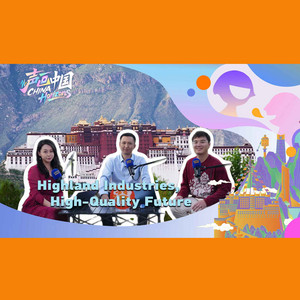
Hello, welcome to Roundtable's special series, China Horizons, where we take you to different places in the country to see the beautiful view and listen to the voice on the ground.
This is Niu Honglin, and today I'm with Lai Ming and Yu Xuan.
Hello, everybody.
Hello, everyone.
Hello!
We are today in a very special place, even compared to all the other episodes in our special series.
Here the sky is extra blue, the clouds are extra close to the mountains and the air is extra clear, with a little less oxygen in it.
Oh yeah, a little less enough to make you breathless.
We are in Xizang.
Yeah, we are in Xizang and we feel the oxygen deficit in the air.
Yes.
If at any point we feel out of breath, that's because we are at altitude 3,700.
3,700.
I get why you're making that typo on your tongue.
Oxygen deprivation.
Yes, and also in Beijing, the altitude is only 100 meters above sea level.
Oh, wow.
We're being spoiled.
Super, super high here.
And for those of you who are watching the show instead of listening to it, you already know we're in Xizang because right behind us you get to see one of the most important iconic sites here in this autonomous region.
That is... The Potala Palace.
Potala Palace.
It's right behind me and it's...
Sanctuary of Tibetan Buddhism, very important, influential, tons of tourists there.
One of the most revered historical as well as religious sites that for some people, it's a place where they have to visit.
Sure, yeah.
And for us, we are in quite a special place as well.
We are in the Nanshan Park.
The reason that I find it so special is because just in 2010, it was not a park.
It was a relatively bare mountain with not many trees or grass, but here now we have over 100 different types of plantations, different types of trees and grass and beautiful flowers here in the mountain and yeah, and people come here to enjoy the natural view, a little more oxygen because of the plantation and definitely the amazing view that we are enjoying, like right behind us right now looks like any ordinary park elsewhere in the country, but I'm sure you can see the very significant Potala Palace behind us and that really adds the allure to the background where we are recording the show.
Yeah, and this kind of image and view can absolutely be one of your desktop pictures.
Yes, it can.
You take a picture directly and it's already there.
But for Yusheng, it's extra special because this is her first time here.
Absolutely.
But anyway, you know when I was getting here, and it was the first time for me to be here in Xizang, right?
And everything is so exciting and I would say clean and new, especially the environment.
The sun is incredibly burning sometimes and the clouds are crystal clear, as you said.
I even feel like my vision is getting a little bit better when I was arriving here, because I can see further.
Because it's more clear here.
When we're just going through all of these mountains, I feel that we, being human are just so small compared to them.
We're just a little tiny dot in this nature and we should be in this kind of environment and respected.
Yeah, it is a little overwhelming at altitudes 3,700.
Every breath you take, every step you go takes a toll on your health.
You feel shortness of breath and exertion when you seek to jog or lift something heavy.
So it does lend some perspective when you do anything with your life.
Could be a football match, could be just a casual walk in the park.
So that kind of feeling really makes you reflect.
I would say that the weight of life and the weight of our being on this planet.
And when it's this beautiful and takes this much effort to enjoy it.
Definitely it is a mysterious and also magical place that many people want to visit.
It's kind of on the bucket list of a lot of people here in China and outside of the country for sure.
But for those of you who have not that experience, abundant knowledge about Xizang.
This autonomous region actually covers one-eighth of the entire land area of the country.
Oh, yeah.
The annual average temperature is around six degrees Celsius.
And there are 47 nature reserves, covering about like 34 of the land area and, as we mentioned before, the air quality is super good.
Over 99% of the days each year have excellent air quality.
Well, the population was around a million in the 1950s and now it's increased to about 36 million, according to the population census in 2021.
One thing I have to mention is that most people here, like over 80 or even 86 of people here, are the Zang ethnic people, which means that they're still speaking the Tibetan language, which means I cannot understand them.
I feel extra hard because when I talk to them, most of them know how to speak easy or simple Mandarin.
They can still talk to me when I'm, I don't know, buying a bottle of water or a popsicle in this really hot summer day.
But when they communicate with each other, oh, a totally different language.
And they're so fast.
And it's a beautiful language I want to understand.
But the only thing I can say is just jelly.
Oh, yeah.
Blessings and best wishes.
Yes, which is a formal blessing in the local language.
It's a way to give the best blessings, which is something I always do.
That is, when I land to a place where the language used by most people are not Mandarin.
I would choose to learn one word or another to show that I'm really enjoying and appreciating the local culture.
Right.
There are so many things about Zhejiang that you will find fascinating.
And, for example, here we are here already several days and we've already visited the Baku Street area, which is also an area with a lot of people, with Zeng ethnic group, also Han ethnic group and Hui ethnic group.
So many different ones.
In fact, around 20 different ethnic groups and they live in different local community areas, community districts.
So many of these districts over 120 of these districts are the district with multi-ethnic group people, which means that they're communicating in mandarin, mostly because if they're using their own languages, people in the same neighborhood would not be able to understand each other.
But at the same time, the backward street area is also one of the most popular tourist destinations.
Oh yeah Yeah, I have been here, for this is the fifth time.
And every time I go there, Bagua Street is a must go.
And every time I go, I see it takes on a different look.
Back in the days, I think it was 2012.
That was the first time I was here.
It was very vibrant.
A lot of peddlers promoting or trying to sell germs, precious stones and artifacts and paper made in Tibetan style.
So a lot of stuff to show off.
And this time in particular, I think, even though this is the first time you're here, I think you recognize something that's unique, but also something that you also see elsewhere.
Absolutely.
I was going to say that, you know actually, in that like tourist destination area, we were going through some of these little shops and boutiques.
Of course, the you know the culture, the building, the structures of the buildings, they're quite unique and in the way that's so attractive to people and that is why a lot of people are going to that area to visit.
But something that i found that is so familiar to me that i can see like mostly everywhere here in china, is that a lot of these shops souvenir stores, toy stores, fast food, everything you can see them everywhere, i mean here in xizang and also another like in other cities right, and that is why having that kind of impression of this area or this city you know, it is kind of a blend of both tradition and modern and making you feel that This is so fascinating.
That was what I was trying to say because, comparing with my past experience, I see a district of the city, and also the city per se, becoming vastly and quickly modernized.
If 10 years ago, the sceneries around the Bab Quo Street might have been more raw, a lot of the very characteristically and uniquely Tibetan style.
Can we call it authentic?
Yeah, sure. authentic and raw, you have to be there to feel that.
Especially in comparison with nowadays, the storefronts and the businesses surrounding the Ba Kuo Street, especially the photography.
Ten years ago, obviously, there were people who were very interested in Tibetan costumes.
They would try and get dressed in those, and they would suddenly take some pictures.
But back in the days, it was more like cameras, professional cameras.
Now we see more young girls, middle-aged women and even young men really dressed up and then posed in front of a professional cameraman.
So the question that I had before coming to Xizang was that how do people bring bread, or even highland barley bread, onto the table?
What do they live for?
Because my imagination was that this place is with high altitude, the oxygen is scarcely contained in the air and also it's quite cold during the night, but very, very shiny, to the point that you feel like it's scorching hot during the daytime.
So I would imagine that people mostly do agricultural activity for a living, like it's a vast land.
So you see yak walking around, you see Tibetan sheep and goat walking around.
You can even raise a little hurdle of Tibetan pig, which is delicious.
I had already tried it myself.
But still, husbandry and agriculture is supposed to be the major, let's say, industry in Xizang here.
Gain a grain production stable above 1 million tons for the ninth consecutive year.
So it is still one of the most important industry.
Yet when I came here, I realized that people do agriculture the way that I didn't imagine.
Yeah, that was actually another shocking point to me.
When I was thinking about why it was so hard to develop agriculture here in Xizang.
Of course we know that high altitude is one thing, and oxygen in the air.
Average temperature.
Yeah, average temperature and ultraviolet light here is really strong too and making it so hard for vegetables, especially these leaf vegetables, to grow, which can be really important for people's daily meals, right.
And also the soil, the high altitude just cannot be as fertilized as the one in lower areas.
And when we were getting to that greenhouse.
That is something that I was absolutely going to mention later.
But when we stepped into the greenhouse, I was purely shocked.
That whole environment is not only just perfectly designed in an aesthetically way, but also in a way that they are using so many advanced technologies to make everything look so peaceful and tasty.
Yeah, so shocked.
We will go through the list one by one, because we're doing a relatively special show, because most people come to Shizang to talk about the beautiful site Scenery temples, holy lakes, holy mountains.
But we want to take a deeper look at the industries in this place, because we can imagine the kind of hurdles people have to jump.
But we also cannot imagine the kind of hurdles people have to jump to bring modern technology to this place, even to the industries.
That was considered something rather traditional, rather simple, rather raw.
For example, we mentioned yak on the ground.
Of course, that's still happening.
But do you know that many of those farmers still doing farming industry with the yaks and with these type of animals in Xizang the Tibetan sheep and goat?
They are using smart technologies already.
Some of them are using Zhuang. to monitor the situation of their hurdles.
And some of them are developing different technologies to transform the product of the yak of the sheep into the kind of finely produced product, that with much more added value.
And that is definitely the improvement we want to see for people here.
A fun example was that there is this geological indication to this specific yak product.
And according to the manager of the company, they say that Dang Xiong Yak, which is the geographical indication, was accepted by all of the customers in the inland area of the country.
And their sales has increased over 40% just last year.
Wow.
I'm sure a lot of work has to go into the way yaks are being raised, as compared to perhaps, a traditional way of feeding them and keeping them healthy.
Now, a lot of efforts have to go into whether they're having the right food, whether they're being exposed to the safe environment, whether the meat is processed in a healthy way, whether the grass or whatever food they're taking are organic.
That is very important.
Because of that specific reason previously for a yak to mature and be able to produce meat.
Well, that sounds a bit cruel, but yes, it takes around 8 to 12 years for a yacht to be mature.
But with better food, with better environment and better technology.
It takes around 3 to 4 years to do that.
Meaning that people would spend much less time doing so and having the same profit.
Again, bringing very delicious barley bread onto the table.
Sure.
Speaking of barley, it is a very important staple food in this part of the country because, unlike other crops like rice and wheat maybe some wheat might survive in this region, but other crops they are picky about the environment, they grow and but barley they well, they are picky in a different way.
They only survive on altitude above around 2000 meters.
2,500 meters to 4,500 meters.
Okay.
So it only survives on high altitude.
Also, speaking about the temperature, it can only grow in a very cold environment.
When temperature goes above 25 degrees Celsius, it stops to grow.
And therefore, barley becomes a very important crop in this part of the country.
But even so, there's a lot... that we can do and farmers and scientists can do to improve the yield.
And I heard that people are developing different kind of products based on barley, right?
Barley beer, barley bread, different types of healthy kind of thing.
And another thing is that it is not only I mean, people are not only thinking about barley, of course it is more like staple food here, but Nowadays we are thinking about more creative and more versatile.
I know what you're talking about.
Because just the other day we were enjoying a little bit of yak milk yogurt in that little restaurant.
And the bread that they were only developing these years.
Well, this year was decorated by barley, because barley was so iconic, is so iconic for Xizang, for this area.
So not only are they using it, the reason we're saying this was because we visited Xizang Museum and there we saw this little barley bag.
People would carry Zangba in the bag which is produced, which is made by barley.
It's barley flour.
It's barley flour.
It's a staple food.
It's a powder.
It's the most important staple food in Xizang for a really long time.
And back then, it was the staple food.
It's what people survive on.
And now it's becoming this iconic product that added a little extra fun to the food, a little extra taste, a little extra vibe to the product.
And these kind of products are not only popular here in Xizang in China, but also around the world, especially in neighboring countries.
A lot of research has gone into making barley more tasty, or tastier, because barley in its original form is low in gluten and therefore it can taste a little dry for the untrained tongue.
Now the local sounds healthy sure, Of course.
But then to make it more attractive to the regular palate, the local businesses have been trying to work with research institutions like the Chinese Academy of Agricultural Sciences and Jiangnan University to improve the taste of whatever product they're making with barley.
That's the thing.
People lived on barley for so many years.
Yet now they are looking at an abundant of diet choices.
Some are healthier, some are tastier, and some are more sweet.
And they're looking at these choices that are produced locally.
We talked about this in some previous shows.
Even in 1990s around that time, people living in Suzhou would have to import vegetables most of their vegetables and fruits to the region so that they can enjoy.
Well, they get to enjoy them for sure, but since you're would have to import them definitely is not as fresh as just picked from the branch and it can be a little bit costly.
But thanks to the greenhouse that you should mention already, the situation is changing.
But let's look at the greenhouse first and then to the delicious products in the greenhouses.
Yes, you know, the thing that actually surprised me is that how advanced, or I would say how commonplace, it is.
Cool.
It is you know when we're seeing all of these mechanisms and systems that they're using in these greenhouses.
And one thing that I saw and really shocked me is the one called aquaponics, or another name is um, or you can like understand it as the coexist coexistence of fish and vegetables.
So basically, when the fish have that excrement in the water tank and the water in this water tank turned into super fertilized water and the water just go, you know, flow underneath all of these vegetables.
And you know we talked about a lot of these.
You know intelligent, like monitoring the greenhouses and like smart agriculture everything on our previous shows.
But the exact moment that I stepped into that greenhouse, is absolutely you know feeling so differently and when i was seeing that um that actual vertical plant kind of thing wow it's it's you know like in the future it's not like in the future that kind of a sci-fi sense but in the future in that people are making these kind of things so realistic that we are thinking in mind and um i was truly amazed and um don't oh yeah don't forget those space bread pumpkins you have to go watch that video that i made that was huge and that pumpkin can grow up to like 150 kilograms each i cannot even you know hold with my hands it's basically just astonishing i have to say and um you will absolutely need to see and how to see how advanced like people are right now.
Yu Xuan is already talking about the state-of-the-art technology in the greenhouse, the most advanced ones.
The coexistence of fish and vegetables would be put in place around October or August this year.
So the fish is not just in the tank yet.
They're still developing the technology, but this is not the first technology or the only technology in the greenhouse.
It's not new at all.
New in the country, but it's definitely new here in Xizang.
And they have been brought in a lot of different technologies to the high plateau.
One thing that we have to say, but maybe you already know if you're a loyal listener of Roundtable we've talked about this.
That is, building a greenhouse in this harsh environment is hard.
Trying to cultivate different vegetables, different types of fruits, watermelon, cherries.
Peaches, lemons, strawberries, grapes.
It's hard to bring them to the environment because the environment is drastic.
But all of those has already happened here in Xinjiang.
Well, we talk about these technologies a lot on Roundtable and other shows, vertical farming and...
Hydroponics, we talk about these often on the show.
They do exist and they are adopted in many parts of the world.
But it's not every day that we see them.
Like when we live in Beijing, we don't see them very often.
I'm from a small town in China.
I don't see them.
Where I come from, it looks like they live such technologies, they live in demonstration zones, they live in pilot programs, but they do make a lot of difference when they are introduced in real life, and that i believe that is the part that's most shocking about our trip this time to shizan, and that is, we are seeing such technologies and such research being put into real practice.
Even though it was a demonstration zone that we saw, it was a demonstration park.
Oh, the watermelon is real.
They are delicious.
Yeah, but we've heard examples of what this business has been doing for more than a decade.
The species, the plants, the vegetables they bring to the plateau and the adjustments and the experiments they do to the plants and the hope that they could maybe grow and develop plants that can adapt to the environment outside of the greenhouse.
And that's something that really opened my eyes about what one man or a group of people can do to change the fate of many people in the environment that is particularly harsh and inclement for, if not thousands, of years.
Definitely.
It is safe to say that things are happening to the traditional industries that has been thriving on this plateau for thousands of years, if not longer.
But something also fascinating is that new industries are coming to the plateau.
Despite all the odds, they are here and they are happening here.
And we already talked about how fascinating it is.
Well, actually, you shouldn't talk about it.
That is seeing the city being very modern, Quite new, the facilities, quite up-to-date.
It is cool.
But something I noticed was that there are a lot of electric cars on the road.
This is definitely different from four years ago when it was the fourth time I was here.
First time for me.
Yeah, if I have to compare, then my first time was in 2012.
And back in the days, we have to... carpool, even when we held a taxi.
The driver would pick on and take on other passengers, even as we are on the way to our destination.
And we pay the same price.
It's not like when you're carpooling, you pay less.
We all have to pay the same price.
This is because business wasn't thriving, exactly because of the sparse population in this part of the country.
But then this time around, I'm surprised by the number of electric vehicles around, especially the electric vehicles as taxis.
Earlier this year, two taxi companies have introduced around 300 electric cars as taxis, and so their goal is to also introduce car battery replacement facilities so that drivers can have their batteries changed rapidly and efficiently so their businesses don't get affected when with other, for instance, if they were using other regular new energy cars.
Definitely, we see here electric vehicle penetration has advanced with the introduction of 320 fast swap battery taxes in lhasa, like limey has just talked about, and that featuring multi-model recharging in over 500 kilometers range, fostering low carbon urban transport.
So yes, here in lhasa, I think just several months ago, 300 new vehicle or new energy vehicle taxis were put onto the road for operation here in Lhasa.
Yeah, when you have a growing number of electric vehicles, it's important to have the necessary infrastructure to go with it.
And this is even more challenging when you're talking about a high plateau environment with sparse population, because the cost is going to be not as evenly distributed when you consider the siting and also the cost of sending people to staff them.
So, which is why it's very important that I mention a very pioneering project, that is the, Along the route from Sichuan to Xizang, the Sichuan-Xizang National Highway, the locals have managed to build about two dozen supercharging stations.
So they have the ability to charge electric vehicles at around 600 kilowatt capacity and they can fuel your electric vehicles for 200 kilometers in terms of range, within just five minutes.
And they've managed to build one such ultra or super charging stations at the Chumalama National Park, which is the highest in the world.
It's a demonstration project, but it's also a very important signal to be sent to other businesses so they can have the confidence also to customers as well to potential car buyers.
One might say here in Xizang, you have super, super long sunlight hours.
I think it's around 3,500 hours of sunlight annually.
And here it is very scarcely populated and you have this vast land.
And because of the ecosystem of the place, and also because of the drastic and also harsh environment, we do not see a lot of trees, especially when the elevation goes to a certain level right, so it's the perfect place for wind farms to solar farms, to decorate the landscape.
Is that so now, much more than that, to provide power, essential power, to whoever needs that, because we are talking about a place with harsh environment and winter gets very unbearable.
So if we had a way to heat the households in the region, then that's a blessing that anyone would could wish for.
Oh yeah.
And you know, this kind of a clean energy has been one of the most important electricity supplier in here in Xizang.
And they are not only, you know, generating electricity for their own region, but also transforming these electricities to other part of this country.
That is what we called Xidian Dong Song, right?
So transferring the electricity from the west to the eastern side of the country.
And this is a whole huge program that this country is developing.
And we are seeing the development in recent years has been so great.
And the thing is that it's not only something that we're talking about in LA like national level, it's a policy or something.
It is actually benefiting the local people.
And before the show, we were talking about these kind of things.
You know, only was saying that they were actually using these kind of technologies to make these vast grassland even a little bit more profitable.
You know, of course, when we're seeing these kind of grasslands they're not that flourishing in the ways that it is not really suitable for grass to grow up, but they will just get out the surface part of this grasslands and then put the photovoltaic panels onto it and then get these um a little bit fertilized grass back and then a huge ocean of both grass and photovoltaic panels is there and um, actually the local people live there can benefit from that, because when you own that grassland or you live in the area, you can actually get paid by, like um, Let's say, putting the photovoltaic panels into the area.
When we talk about the natural resources of Xizang, of course the wind energy resources are mainly concentrated above 4800 meters elevation and covering about 30 of the region's area, which means that's approximately 180 million kilowatts in theory.
And also in theory we talked about Xizang enjoys over 3500 hours of sunlight annually and with the radical solar capacity in the hundreds of millions of kilowatts, ranking definitely among the highest solar energy development potentials worldwide.
But talking about it is easy.
You start a wind farm in the middle of nowhere.
It sounds natural and sounds reasonable.
And then you put some solar panels on a place where no one's using, when grass find it too hard to grow.
It sounds reasonable, but it's so hard.
If you want the wind farm to hold on the plateau of Xizang, you have to first make sure that, because you cannot really produce all of the equipment the huge, huge wind turbines in Xizang you have to do that in other places.
And then you would have to transport all of that facilities to Xizang, but not together, not assembled.
We've seen them on TV.
Yes, it's even... They're massive.
They're massive.
And some people would even assume that there are some parts of a spaceship.
No, they're huge wind turbines.
And when you successfully move them to season two, the high plateau, you have to make sure the workers have enough strength and also oxygen supply to assemble them.
And with all that, it's hard to imagine all that have already happened.
A lot of these wind farms are already operating here in Xizang.
And this has happened and will continue to happen.
It will continue to happen.
And that is part of the reason that, since 2015, Xizang began exporting clean electricity to eastern China.
By the end of 2024, cultivative green power exports exceeded 15.8 billion kilowatts.
It sounds like a big number, but it's much, much smaller than the number in Xinjiang, because transporting the electricity from Xizang to the outside of the region, to other provinces, is also still too hard.
Because when we talk about the transporting of electricity, the waste of the transporting, the cost, And the cost is mainly because of the power grid system.
And the reason we're seeing this improvement in these years is because the improvement of the power grid system.
So, while China is big for its infrastructure construction and now we see why not only the infrastructure, but also technology.
We talked about ultra high voltage power transportation on Roundtable before.
Imagine power like is water.
When there's more water, when water is high, it goes it will run to where water is low.
The same goes for electricity.
When electricity is generated with wind turbines or solar panels, it's not a high voltage.
You have to technically raise the voltage of the power generated so that it's on a high plateau and then it can flow to other parts of the country.
Wow, interesting.
Yes.
So one example that I have to mention is somewhere quite near my heart.
It's a place near Zhikaze.
It's a little county.
And in order to go to that little county, in fact, it's a little village.
In order to go to the village, the Dexia village, you have to go over three mountain peaks.
That is as high as 4500 meters.
You go over three of those mountains and you go to that village.
It was one of the most poverty-stricken villages village in xizang.
But now, because they started to put all of these solar power panels in the village, not only are they enjoying the electricity generated with this technology, they're also selling the electricity outside.
So they get a lot of money and they say when the sun is out, the money is in my hand.
That is a saying they're enjoying and i find it warming to me, and This kind of technology is definitely changing Xizang, or changing the face of industries here in Xizang.
So it's being cleaner and it's also being quite advanced.
Absolutely.
And I can totally see that not only these kind of grid webs and the Internet webs is also developing so fast.
And One thing I have to mention is that the e-commerce broadcasting industry.
In Shizhong as well?
In Shizhong as well.
In Lhasa specifically, they are building up a whole new platform for the whole industry.
And Lhasa has made significant achievements in live broadcast platform construction, primarily through the establishment that I just mentioned.
So this is more like a base, live broadcast pilot base.
So this base aims to help local enterprises to conduct live e-commerce operations, also expand sales channels and also increase the online retail sales.
And so if you are a barley beer company or a yak meat producer, you can apply to join this business.
So professional live stream hosts can promote your products to buyers around the country.
Absolutely.
You know, local specialties is one of the biggest, I think, products in these platforms.
But also I would like to mention is that some other enterprises from other regions are also joining this platform to open up a market here in Xizang.
So yeah, we're always seeing, okay, this region is developing e-commerce.
That is only the way that you can sell their products outside.
But actually this is such a huge promising market that people outside of Xizang would like to develop.
Commodity sales through live stream reached 20 billion yuan in the year 2024.
There was an increase of around 80%.
And this year, they've just hosted the second live stream competition.
They're inviting professionals and non-professionals to compete as to how well they can promote products.
And apparently such endeavors continue locally, has encouraged around almost 80000 people in the business.
This competition is actually held by this platform I just mentioned.
Competition again.
Yeah.
So I was reading a lot of the news and talking to the manager of these platforms and they were telling me they are actually developing this.
We're calling it a platform, but it's actually a building right.
When you step into this building And they have a floor of the public area for all of the broadcasters and doing the live broadcast at the same time.
And when you step into that floor it feels like you are getting into a supermarket, because there are so many different types of products that are selling online and they are actually selling there.
So basically it is a supermarket.
So they're developing that kind of new way to making it a real brick and mortar store to welcome, like local people, of course, or like tourists to get into that building to maybe experience the vibe of this district.
It's called Duilong Deqing District, where the platform is.
So basically they're not only developing the e-commerce side but also the brick and mortar like real store side.
I have to ask, They are selling here in Xizang, but also online.
At the same time, are they transporting the products from Xizang to the outside, let's say, places?
Or are they only using this as a live streaming platform and the actual transportation of products are happening elsewhere?
I think both, of course.
Some of the enterprises are just companies there and they are just selling products, maybe delivering from the eastern side of China.
But thanks to the logistics industry here in Xizang as well.
So they're not only developing their own business, but also developing the whole industry of logistics.
And what I saw is that some of the huge brands are also getting into that industry.
As we say, I interviewed one of the companies, it's called Chengtou Logistics Company.
They are like cooperating with some big brands like JD.com, which is a huge e-commerce platform.
Yili, the very giant.
So and I saw in the warehouse they're actually using these kinds of high technologies like robotics, to transferring these packages.
Put them in different categories.
Yeah.
So all of them are using technologies to make their work so efficient and make the logistics industry here in Lhasa so efficient.
This is a vivid example of how these new forms of business is coming into Xizang and coming to Lhasa, where we've just visited, but definitely all around the autonomous region.
Another one that I read about didn't have the luxury to experience just yet, but will do when I'm in Linzhi is the low altitude economy people at such a high altitude for so long.
I just really love it, because in the high plateau you get to be in a hot air balloon and go to the as high as you can in the sky, and i have to salute to these people who are there to do that.
Definitely you've climbed more than 3 000 meters and you want to climb even higher, even higher, but definitely that is not only for the purpose of sending your home into the highest.
As high as I can go.
It's also for the purpose of doing a little bit of patrolling in the sky and also emergency medical care and definitely the transportation we talked about using low altitude economy in such a high altitude place.
It's quite productive in all these different aspects.
Yeah especially, i remember, in these mountainous areas, drones are more efficient than actually human labor when we're delivering maybe small packages, and we know that nowadays, With all of these delivery sites and apps, we can order food or everything basically within 30 minutes to your doorstep.
And in these mountainous areas, with drones help, you can be even easier.
Drones can come in very handy.
Just last night we experienced some kind of accident or emergency when it started raining and just as we were beginning to order takeout, the restaurants phoned in and said oh, there's not enough delivery men around, so you're expecting your deliveries in 19 minutes.
So it was, although there's 19 minutes.
People are moving in.
We spoke to a local the day before yesterday.
She described to us how people are moving from the rest of the autonomous region to the capital city.
But even with that concentration of population, there's not enough people to man all the positions.
As such, I think, with the geographical challenges and the environmental challenges, I think it makes a lot of sense in case of emergencies, not like when we are starving, but when somebody is having a very healthy emergency, then I think it makes sense to have drones to deliver stuff, lifesaving medications.
We talked about the new things happening to the old industries.
We talked about new industries being brought into the place.
And all that, in my opinion, has to definitely thanks to the fact that the infrastructure situation is getting much better here in Xizang, with better roads, better highway, better railways and the power grid we talked about and the Internet connections.
And that kind of changes are not only happening, but fastly happening or greatly happening in these couple of years.
Yeah, because we talk about live streaming, we talk about electric vehicles.
A lot of them will have to depend on the infrastructure.
Even though other businesses might find it handy to promote their products using these platforms, you still have to find a way to have the products delivered to the buyers.
10 years ago, we were talking to a beer manufacturer who described to us how they were using trains to deliver their products to customers elsewhere.
Now I imagine it is much more advanced than 10 years ago.
Now we are talking about cold link transportation.
That makes it possible for the rest of the country to enjoy yak meat, which previously was a treat, only when you travel here.
Cold chain industry is absolutely helping.
A lot of you know no matter if it's the agriculture or sub-industry are developing not only to other cities here in China, but also even exporting to other countries.
And with all of the infrastructure that we just mentioned, of course, with other infrastructure that has been building, like Lhasa Gongar Airport has been upgraded to an international airport and some local ports becoming national logistics hubs, the business from Xizang is becoming even more international as well.
So one example is that in April 2024, more than 23 tons of apples from Ningxi were exported to Nepal and marking the first time that locally grown fruit from Xizang were exported.
And another one is in September, 13 tons of highland barley liquor.
Wow, we just mentioned it.
And whiskey worth more than 15 million yuan, that's about 209000 US dollars, were exported to the United States, which is also one of the kind, or first export of its kind, here in Xizang.
So we're seeing a lot of things going on here in Xizang, going on.
Yes, because Xizang's geographical position has a gateway to South Asia and enables increasing international trade engagement.
Like Yusheng has just said.
In fact, in 2024, Xizang's international trade volume exceeded 7 billion yuan, growing more than 15.
And another very cute story that I heard about was that because Xizang is neighboring these different countries, here we see that people actually living in the border area they have a buffer zone.
They enter the buffer zone.
It's kind of in a tax-free zone because they live in the adjacent area.
And people say the process of doing business in these buffer zone is also getting easier because for the hardworking people living nearby they are the practitioner of husbandry, they are farming in the land, which means one local actually said that previously when i cross border and do business i have to register my fingerprint and because i work too hard my fingerprint get blurred, they wear off, and now they've updated the business to official recognition which makes the process so much easier.
See how real technology is changing and improving real people's life.
For those of you who are watching the show again instead of listening, you can see that the beautiful sunlight in Shizan is getting a little bit dim because it's already around nine o'clock on the plateau.
It's still quite forgiving already for us to do the show.
And the beautiful Potala Palace behind us is getting even more mysterious and amazing.
Magnificent. magnificent and you have to come.
Xizang will always be the land of snow-peaked mountains and beautiful lakes.
But now it's also transforming to a place with all these modern technology and all these industries that are benefiting the local people and generating great profit.
And Roundtable will always be here to observe all these advancements and development.
I'm Niu Honglin with Lai Ming and Yu Shun here in Xizang.
Thank you so much for watching.
We'll see you next time on Roundtable Special Series China Horizons.
Bye-bye, everybody.
Bye.