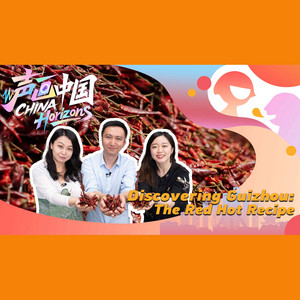
Hello, welcome to Roundtable where we serve up piping hot debates on the issues that sizzle in China and beyond.
I'm Niu Honglin with Lai Ming and Yu Shan, and we're saying hi from Guizhou Province.
Hello, everybody.
Hello.
For those of you who are listening instead of watching the show, you can have a little riddle.
Take a guess where we are now, and I have three hints.
First of all, it is a market.
Second of all, it is a really, really, really hot market.
And third, people sneeze and cough and share a little bit tears in the market.
It's a crying market.
It's a crying market, not because we are so moved because we're making good deals, but because it is a dry pepper market.
For those of you who are watching, you can see the dry pepper all around us.
And it is the typical market where people negotiate a little bit, talk to each other, find their best deals.
But something different in the market is that, instead of having a variety of different foods fresh food, vegetable fruits They only sell this one, or they only sell this one type of vegetable, that is pepper, dry pepper, different types of dry pepper, different shapes, different color, different level of spiciness, definitely different price.
And they are all very, very hot.
And if you had a chance to watch the show, you'll see.
We are surrounded by piles beyond piles, and bags upon bags of red pepper.
And these are dry and this is a place where people are in action, kind of like the fairs that people host in rural areas that are not very populated.
So this is a very busy day and action already started before daybreak and we had to wait until the action settles down a bit.
But still, people are walking around, they're bargaining, they're packing and unpacking.
Whenever there is action, the air, it gets disturbed.
And you know, the tiny particles of red pepper will somehow drift into our nostrils, will irritate our nostrils.
And we apologize in advance for any interruption or any... impolite behavior on our part.
Yes, I'm pretty sure I'm going to sneeze and cough a little bit, because I've been doing this since I'm in the market.
It is quite a cool experience.
I've visited many fresh food market and i cannot name all the products in the market, but here in this one i know they're peppers for sure, but there are too many types of peppers.
Local people grown pepper for a living and they sell pepper for a living.
They process pepper for a living, they create new ways to consume pepper for a living and that is why we're coming to this place.
Those of you who know that roundtable has been in guizhou province for a while.
We are doing china horizon special series and we've been visiting the qian dong, nan miao and dong prefecture and we've moved to guiyang, which is the provincial capital, and now we're in the city of zunyi, which is also a very important and famous city here in guizhou.
Sure it's historic.
In fact, in the history of the Communist Party of China there was a very important historic meeting.
That's how I learned about the city when I was a kid.
Yes, people must know the city from that part of the history.
It was a very important meeting leading to the foundation, in fact the very basis, of the political system before the founding of the People's Republic of China.
And now, many years have passed, and now the city is taking on a new look, a different kind of red from the red peppers.
Indeed, I was interviewing several people that's working inside the pepper industry here in the city of Zuni.
So, apart from the say the red tourism and also historic tourism here in Zuni, they're also very much known and popular for eating pepper, and in fact that has over 400 years of history right here in the city of Zuni as well.
So it's really exciting to you know, just not eat chili pepper as a seasoning, but sniff it, feel it and embraced in an environment that's full of it.
So that's a new experience for me as well.
City of Zunyi is definitely the home of peppers.
But the county of Xiazi.
The Xiazi county is the heart of the whole industry, of the pepper industry in Guizhou and probably China throughout the entire country.
And you think this is a town of only 60,000 people around that?
Around that.
And it has the ability to influence the entire pepper industry in China.
It even has the privilege of setting the price tag or giving the indicator of different types of special, yet delicious and also maybe really, really spicy peppers for the entire market in guizhou and also in china.
And we were really trying to figure out the story.
How come, what happened?
Why are pepper lovers all around the world, all around china, come here to get their pipers?
How come industry insiders decide that this little town, just this little county, just has it?
It has it for the industry.
What happened?
And that's why we're here, even though we're sneezing and coughing all the time we want to, we want to make sure that the story is told, is discovered, and we've talked to some people before doing the show, so we've got some answers.
Maybe we can share those answers, but before doing that, i have to ask this first do you like to eat Spicy food?
Is it your thing?
I mean, from a foodie or a food lover's point of view, I do like eating spicy food.
But if it's my body or general health answering this question, it's totally no.
Because somehow my digestion system cannot handle the fiery feeling after you swallow the spicy food here in China.
I know the Chinese spicy food, some of you might not have tried it before.
It's very different from the spicy sauces in North America or the seasonings in European countries.
So it has this fiery side.
So for those of you who are like me, we will probably just try to stay a little bit away from spicy food in general.
Really?
How about you, Lai Ming?
I would borrow the internet jargon in Chinese, 人才影大, describing someone who's not really an expert or very well-versed in handling something, for instance, playing certain games, but they're quite addicted to the game.
So likewise, my relationship with spice and peppers is such that I'm from central China's Jiangxi province, where we tend to use little peppers and spice in our cooking.
Oh, Limey is being modest.
Jiangxi is famous for spicy food.
It is, but it doesn't run in my family.
I mean, it's a prevalent trend throughout the province.
But sadly I'm the Ren Cai Ying Da kind of guy who used to grow up without a strong sense of spice in our cooking.
But seeing as I'm from the province and haven't been accustomed to the diet, I tend to look for spices wherever I go.
That's what I was about to say.
Because both you and Yushan, you say that you do not enjoy spicy food.
Come on.
I've seen you putting in spoons after spoons of spicy oil, a little bit of dried pepper and also different types of sauces.
There are the chopped ones, the chopped pepper with other ingredients.
They are quite moist and wet.
I know, yeah. the juicy kind, and there are the dried pepper.
The dried pepper are always or often combined with some other ingredients.
You put them or you include them in barbecue, in hot pot, and also there are the spicy or the pepper oil 辣椒油.
It is also something you want to A little drizzle of it in the soup.
I've seen both of you doing that.
So stop saying you do not do pepper.
You do pepper quite well.
I know.
My body may be resisting my temptation to take more spice.
But again, my body also seems out of control when I reach out my hand to that spoon or something.
Well, talking about my experience with spicy flavor, I have some experience.
For instance, I think spicy oil.
It's very good with noodles.
You can blend them with the broth.
They will permeate with the noodles, so the flavor is all saturated.
And then you use dry pepper powder.
Powder.
Yeah, with boiled meat or ribs.
Barbecue.
Yeah, barbecue.
Yeah, that works too.
That works.
Barbecue with kebab.
Barbecue works as well.
And then if you have plain pig ribs...
Boiled with clean broth.
And if you want to add a little flavor, you can use a broth of spicy spices.
So in Guizhou, it's called zhan shui.
A liquid kind of seasoning.
It's kind of a dipping sauce, but a really spicy one.
Yes, right.
And that is the thing.
According to a couple of years ago, a research a couple of years ago.
According to a research a couple of years ago, the research was conducted by the food delivery platforms, which is definitely with good foundation and with good data.
Good indicator of what people are ordering.
And people are saying well, actually it is the platform that is saying that those who enjoy pepper or enjoy spicy food account for nearly one-fourth of the entire people who are ordering.
And those who do not specifically say no, no pepper at all, account for only around 6%.
And on the platform, it is the Sichuan cuisine and Hunan cuisine, which are famous for being very spicy, but spicy in different ways.
We'll explain a bit later that are most popular.
So people around the country are enjoying spicy food, and it's no longer an original thing.
It's no longer which type of cuisine enjoys spiciness. spicy the most kind of thing.
It is definitely a national thing.
People would have a taste of spicy food a little bit here, a little bit there, but definitely a little bit in their life.
We have this Chinese saying that people in the southwest prefer the highest volume of spiciness, while people from the north or the eastern side prefer the higher level of mild spiciness, taste or sweetness in their food.
So here in Guizhou and the surrounding regions in southwest China is the perfect place to grow the chili pepper and also for people to enjoy very spicy food as well.
So yeah, I think it has a lot to do with the weather here, because it's such a humid place.
After we arrive here, there's no need for any say, body lotion.
On me personally, because I am from Beijing and that's a place where, even back in summer, we have to apply body lotion because it's still kind of dry.
But here I do not feel like I need it because there's humid in the air and it's constantly rainy in all different seasons.
And yeah, it's a perfect place to grow pepper and also people here.
They absorb a lot of the dampness in the air, which makes eating something hot and spicy, in a way helping them to get rid of the dampness inside their body and to make them feel Back on their feet so that they're not always so drowsy, so tired.
It is also the original reason how come people in, for instance, Sichuan province, Hunan province, enjoy spiciness?
I remember watching a documentary talking about the introduction of pepper into the Chinese nation.
It was around the 1400 to around 1500, the pepper was introduced.
And back then, people living in Guizhou province, living in China Sichuan Province.
They were not very wealthy people.
They do not enjoy the abundance of food and variety of ingredients like today.
Even salt was in shortage.
Yes, that was precisely the reason.
People cannot get access to enough salt and they also would occasionally have the kind of food that are not very fresh anymore, but they need a little bit of ingredient and sauce to cover that Not going bad but unpleasant smell.
And then they discovered pepper and they realized the spiciness can somehow be kind of a replacement or substitute for the lack of salt.
And that's when the level of spiciness increased and increased and keeping increased here today.
And they enjoy, and later on they found what Yushan said, that is, when they live in a relatively damp and wet area, if you consume a little bit of pepper, it is actually really good for your body.
It makes you feel comfortable.
When I was visiting, I think, Qinghuangdao when I was in college, it was a study trip.
And at the fourth or fifth day i went to a local grocery to buy the pepper kind of snack.
I don't know if you tried it deep fried pepper accompanied with peanuts, and they are in a paper bag and in that bag you are not eating those as a dish or as a kind of condiment.
You have it as a snack.
Yes, kind of like potato chips.
It's a popular snack where I come from as well.
Yes, it's very crispy, and it's really nice.
And the reason I was looking for those was because it's really It feels so wet and I realized ooh, I can borrow some wisdom from ancient people in the places where it's really wet and I can get a little bit of comfortness from the pepper.
So yeah, pepper.
Right.
So Guizhou people and peppers, they really hit it up.
They really clicked, really.
There was a connection, because you sort of mentioned this to a certain extent earlier.
That is, the climate here is very good for growing peppers.
The average Rainfall every year is about 1,200 millimeters.
And the average temperature is around 15 degrees Celsius, not too high, not too low.
And also the place is always sunny, almost always sunny, even though there's a lot of rain and it gets cloudy sometimes.
But the frost-free period lasts about 270 days a year.
So it's a very good place to grow pepper, for them to prosper and grow, to perfect places, perfect shapes and perfect flavors, which is why Guizhou has become the place with the largest amount of peppers grown.
We are talking about, in Chinese terms, about 5 million mu, which translates to roughly 133000 hectares.
Yes, China currently plants over 30 million mu, that is, approximately 2 million hectares of chili peppers annually, accounting for around 10 of the country's total vegetable growing area, making it one of the top-ranked crops among all vegetables.
And as for Guizhou, it's definitely in the first place when it comes to the area of land growing peppers.
And from the perspective of seed use.
95 of the chili seeds used in China are domestically produced and only 5 are imported.
And I don't know if I've shared this already, but both of you said you do not love pepper, yet you eat something really spicy occasionally.
I love pepper.
I love different types of peppers.
I love different types of spiciness, which explains the relatively less sneezing and coughing of me compared to those two very brilliant hosts next to me.
But what I'm about to say is that I noticed something different for Guizhou pepper.
Right. or Guizhou cuisine's spicy type.
Because in Sichuan Province, for instance, you go to Sichuan Province, you go to Chongqing or Chengdu, you enjoy hot pot, very delicious, very hot and very numbing, because they include the green pepper, which are essentially another type of ingredient.
No, it's not pepper.
Pepper, it's a different kind of plant exactly that introduces a sense of numbness in the dish, and the numbness is blended perfectly with the spiciness in your tongue.
It feels like, instead of you eating them, they are eating you alive, in a way.
That's that's a scary thing for me.
I like it.
I find it very exciting.
It's like watching a horror movie.
Instead of you watching it, it's your tongue and your lips watching it.
And after finishing the hot pot, the very authentic and spicy one, I can see my lips twice the size.
So that is the spiciness in Sichuan province.
And then I also traveled to Hunan Province.
My feeling is, the taste of spiciness in Hunan Province is also quite nice, but it's also quite salty.
I think they add the flavor together a little bit.
And then in Anhui, for instance, I've tried the best...
No offense to Jiangxi province.
I've tried the best chopped pepper sauce in Anhui province.
I find it really tasty.
And it's also very, it's a mixed flavor.
It's complicated.
It's fermented.
Sure.
And I'll leave Jiangxi to you, your province, your pepper, you can share that.
But when I'm in Guizhou, my feeling is that the pepper or the sauce in Guizhou is very complicated.
You've got the sour and spicy kind of sauce.
You've got the chopped and dried type of powder as sauce.
And you also can enjoy a little bit of fermented beans paired up with pepper together.
That adds the flavor, yeah.
I love Guizhou.
I mean.
One thing that my interviewee told me yesterday that really shocked me is that we know chili pepper is a type of seasoning, but chili pepper from Guizhou is the seasoning of chili peppers.
It adds flavor to the chili production.
Whether the chili comes from say, other pepper-growing regions in Xinjiang Uyghur Autonomous Region, or in Inner Mongolia and northern China.
Wherever that pepper is coming from, they can get a little bit of you know, just dried Guizhou pepper inside to enhance the flavor, to mix it together, to get it even tastier.
And that's also why the Guizhou pepper, they are sold at a relatively higher price as well.
As of my interview yesterday, the price was about 24 yuan per kilo, which is about 7 to 8 US dollars per kilo.
But comparing with that price in, say, the pepper from Inner Mongolia, that would be 7 yuan.
So that's... $1.
That would be 14 yuan per kilo.
So that's about $2.
About $2.
So it's almost like twice the price of pepper from other place.
That's also determining on the fact that the Guizhou pepper has its own unique flavor.
It features lighter skin, which makes it easier to be dried, and it has bigger seeds.
That contains maybe, a bit more flavor i i don't know the chemical term for that but yeah, it harbors more flavor and fragrance inside the seed and also all that adding up together make the entire pepper production line more say um, sophisticated right here in guizhou.
So that's why guizhou is really a nice place yeah, a tasty place, for spicy food lovers.
I know this is not a competition, but when we begin talking about prizes, and expensive prizes of peppers, then I proudly have a story to tell, because in Jiangxi we proud ourselves for being able to take very spicy food, spicy duck with blood and then duck with beers.
And then what's what's more?
There's a lot of spicy dishes that people like to take on as a challenge.
魚乾辣椒 Is it a place?
魚乾 is a place in our province.
And they are home to the special type of peppers that's very fresh.
And that's very, you know, it's soft.
And it's not very spicy, but it's very good, tender.
And you cook them with sliced pork, with heavy fire, with hot pot.
Sounds delicious.
Yeah, very, very, very delicious.
It's becoming very popular throughout the country.
But the pepper that we talk about.
The first batch of the pepper every year can fetch up to 400 yuan per kilogram.
That's about 60 US dollars.
That's crazy expensive.
I know.
It's like pepper luxurious goods.
I know.
It's the luxury brand of peppers.
I have to say, it's not only here in China people enjoy pepper.
In South Africa, for instance, chili peppers are used to make Zulu sauce, a very spicy sauce made with hot chili peppers and tomatoes.
In Mexico, chili peppers are deeply embedded in its cuisine and its culinary culture, and they are used in a wide variety of dishes, such as moles, salsas and sauces made from different chili types.
And also in India, chili definitely is one of the most consumed spice in India.
And in Italy, chili peppers are used in sauces, different types of sauces.
And beyond cooking, Italians have cultural beliefs involving chili peppers as a decoration at home.
It's a sign of protection and it introduces good luck.
And even in the United States.
Chili peppers are commonly consumed in hot sauces added to a wide variety of foods.
And I think it's a little like China.
It's a growing trend of people enjoying more and more spicy food.
So it's definitely a thing for the entire world, not just for China.
Yeah.
In the US I've seen such a live show, live TV show that features inviting celebrities onto the show and try out different levels of flavors spicy the chicken wings they call it the carolina reaper wings or the buffalo wild wings, and sometimes for the for the first bite some, you know some celebrities will might be like crying and i can't take any more.
Or sometimes they can eat all the way to the most spicy level that was provided on the table.
I wonder just how spicy those are.
But Lai Ming, before the show, Lai Ming told me that there's something similar in Jiangxi province that can kind of match with this kind of let's try, who can take more spiciness competition.
I know I can't stress this enough because my people they like to brag about their ability to take spicy food and in my hometown we are trying to promote the Jiangxi cuisine with the brand Jiangxi La Jiangxi Spice.
And so, in order to do that, they have similar competitions or challenges organized for people who can take spicy food.
And they do it in such a fun way.
They arrange for people to, you know, to be dipped in hot springs.
And in the hot spring, I think I've seen that.
There will be red peppers floating on the surface of the water.
And the contestants are tasked with taking as many peppers as possible within a matter of a minute.
And I think, according to one story that I saw, the winner was able to finish 20 spicy peppers within one minute.
Do they have to drink the bath water while they're in it?
I only saw pictures.
I have no idea.
Maybe that's an option.
It's like swimming in hot pot juice.
It's like a dare-adventure.
Daredevil adventure.
It is, yeah.
Wow.
And here in Guizhou.
In fact, the chili pepper planting area in Guizhou accounts for approximately one-tenth of the global total and one-sixth of China's total.
So here in Guizhou, I can see people having that competition here in Guizhou, particularly here in the city of Zunyi as well.
Han Yushan mentioned a little bit about different level of spiciness.
We are in the China chili city, which is also CCC.
And in CCC.
Not only can we see the very lively market here in this huge hall or exhibition center, there is also a demonstration area that we visited yesterday.
There was this picture showcasing different level of spiciness.
I know from the not very spicy one.
We've also seen a demonstration area showcasing different level of spiciness.
From the playing around kids can taste kind of spicy to be very, very super spicy.
You remember the super spicy one.
It's not even a food anymore.
The ultra spicy one is used as, or the chemistry from the ultra spicy spicy, spicy spicy pepper that is not good for human consumption is used as a painting ingredient.
And it's painted under the bottom of huge crews.
So when the cruise is traveling in the sea, other sea animals would not get attached and destroy or harm the bottom material.
The hull.
Yes, of the ship.
Yeah.
So say no to freeloaders.
We apply a spicy ingredient to the bottom of the ships.
Definitely.
And the other is like death.
The second most spicy pepper that There's something with the letter of Si Shen or Grim Reaper involved.
Oh, yes, yes, yes.
The God of Noblo or something?
Yes.
Well, but I think it's because of the spiciness.
Definitely there are different level of spiciness, but they all come from this one magical vegetable, pepper.
And here when the dry pepper market I keep calling it that because we've visited the market, some other parts of it besides the demonstration area.
They can also help process a little bit store, a little bit transport a little bit of the dry pepper.
And they're not only doing matchmaking among different enterprises and different companies, they are also introducing different level of different types of services.
Right behind us you can see this huge screen showcasing something kind like the curves and also the indicators of a stock market.
It's quite like that.
The dry pepper index.
Buyers and sellers around the country.
They look at this information to decide when, where and at what price they would like to sell the stock of red peppers.
Because, to be more specific, where we're sitting at right now, the CCC, the China chili city, is not really a city, but rather an operational area.
Yeah, the operational center of the local pepper industry or chili pepper industry.
And right now we're sitting in the drying and packaging market.
But outside of this particular area, there are also cold storage.
There is the automated drying processing lines.
There is the warehouse where more pepper are being stored.
Also places to keep the fresh pepper separated from the dried ones.
And also like agencies of the companies.
These are all part of the scenes that together put forward this CCC, the China Chile City.
China Chile City.
It's quite fascinating.
We've been visiting some of the production lines.
It's not that complicated if you think about it.
You got the pepper, you dry them and you remove the stem from the pepper so that they are the product, but they're not the final product.
They kind of are already the product that you can sell, but you also have to put them into different categories depending on the quality of the pepper.
You've got this one type of pepper and you take it in your hand.
You decide whether or not it's big enough, whether or not it's red enough, whether or not the skin is tasty enough, whether or not the seeds inside have enough number of seeds in the pepper so that it's spicy enough.
And all that was previously done by manual labor.
People sitting down selecting the pepper, figuring out which one is the first class pepper, which one is the second class pepper, which peppers can only be shredded and made into pepper powder, and maybe not the most pricey ones.
But we visited the production line and all those can be accomplished by machines.
And think about how interesting it is, because different peppers I mean different types of peppers are quite different the size of it, the color of it and also the texture of it.
They are different.
Yet with this just one machine, if you put in the parameter of different aspects, you would be able to get them sorted out and no matter which type of pepper you're talking about.
Sure yeah, after all, this is just a place of packaging and sorting out.
I actually saw the local workers.
They were cutting the stems yesterday and I tried to get my microphone closer to catch the sound of that sound.
It was really lovely.
And they were like looking curious at me because they didn't understand what I was doing.
But still they were really fluent and quick with their hand motions of cutting the stems and picking out those black looking or dark looking, overheated over dried pepper products.
In fact, right in front of us, there's a pile of those that's considered to be waste.
And the good ones are being backed into those bags, those white and green bags behind us.
And these are the ingredients that's going to be shipped to the say, different companies or different restaurants as the ingredients to be further processed into pepper products and those that you've noticed might be the very best ones, because I talked to people working in the factory.
They say that they would sort the peppers out by machine as the first step and then, from the very best peppers, they would try to pick out the best out of the best which can be sold in higher price.
And those who were determined on the price are what they called the chili broker.
So the role of a chili broker is more like the middleman between the buyer of the chili products and the say, the seller of it.
There are overall around 3000 to 4000 of those.
That's calculated by the China Chile City officially.
And there are some that's right here in the Shazi County, in the city of Zunyi, while many more are scattered all around the country.
They're walking around in different pepper planting regions in China to negotiate price, to bring the Guizhou pepper outside of Guizhou to all over China to be served onto your table, even though you're not really right here in Guizhou.
And some of those brokers, they, well, my interview shared a story to me.
A lot of these brokers we see today, they are the third generation broker.
For over 60 years people in Zuniz have been doing this kind of businesses, dealing with pepper products and bags and bags of pepper to be shipped outside and negotiate the price.
Nowadays they call themselves the third generation because their grandpa were doing what they are doing now.
Differently.
Because 30 years ago, it was a different way of doing business.
Now we talk to staffers at the CCC, China Chili City.
They told us that about 80 of the peppers that they process here they are grown at massive farms, not individual farmers that live in rural areas.
But back in the days, the Chile brokers, they were small, very small businesses.
They were daredevils, like to quote the word you used earlier.
Many of them.
They were individuals who thought this is a good idea to go and work in the pepper industry.
They would collectively, three or four of them, would rent a car or invest in a truck.
They would rent a truck or they would invest in a truck.
And they will drive the truck to the doorsteps of farmers who used to grow peppers.
They would collect the peppers.
But back in the days, the roads weren't as good as they are now.
And Guizhou also is a very mountainous area.
So they sometimes have to pack the peppers up to the, what do we call them?
They sometimes have to fully pack the trucks. so that they have no place to sit.
They have to sit on top of the piles and piles of red pepper.
So it can be very dangerous back in the days for the first generation of pepper brokers.
But now for the third generation, they will play the capital game.
They will pool their resources and their connections.
They will try and establish some control or some say over a particular type of peppers throughout the industrial trade, the upstream and downstream, so they can sort of gain a level of say in determining the prices.
To some extent there are good reasons for that because previously you can imagine, people do not have cell phone, they cannot communicate instantly, they do not know whether or not my precious pepper that I spent a year growing would go for a good price, would get me some delicious meal that I have been looking forward to for a really long time.
So what I can do, I wait for these pepper brokers to come to my home and they will give me a price.
I can't compare the price with previous years, but what do I know?
I do not know how other people are doing this year.
So I would definitely go to the chili pepper broker that I trust and I give them the entirety of my stock, all of my peppers, and that was it for my entire year.
And we even heard from people working here that previously the best time for selling pepper or the busiest time for pepper dealing was during around August or September, because These families would send their kids to school and it's the start of school year.
So they have to pay the money for the entire term.
They have to get their kids some supplies and also books and also pay for the tuition.
So that was the busiest time.
But that situation has changed, definitely for today, because we have that huge screen right behind us.
The price is almost instantly updated.
You get to know different price for different type of pepper on your cell phone.
Now pepper people, we call them pepper people because they deal pepper for a living.
They have that application in their phone, each and every one of them.
So they know the price. and they know when to stock a little bit and when to sell a little bit.
And they can even send their peppers into a fridge-storation here in the market.
And with a relatively cheaper price, the market would help them.
By saying the market, I actually mean the China Chili City, would help them store the pepper so that they do not have to worry about the pepper go bad.
Yeah, it's really interesting you were mentioning about the price variety each year, because the China Chili City it was built ready to be put into businesses in 2017, around that time.
But before that time, people in great job, they still grow pepper, they still sell pepper, but just in a say, a group trading way, not in such a systematic well-organized, centralized way.
So, before the ccc become that invisible hand in the market, the price each year may vary from very high to very low because maybe one year more pepper planters they realize oh, it's really profiting for me to grow peppers, so I'll grow more.
And then for the next year, that growing more from previous years is going to lead to a price drop in the next year.
So the price is always waving, and people cannot guarantee a very stable payment.
But after the China Chile city become say, the major pillar of the local pepper industry they, combining with investment from different corporations and companies, and also with the support from the provincial government and also from the bank, they now have the cold storage where they can get the pepper and store for one to two years as say, even a currency, to maintain its value, so that the pepper that's bought from the, the planters themselves, are not going to cause them to lose money over the years and then, when they sell it, they can still maintain the pepper to be fresh, in a good shape to, you know, be served to the food market in in the future.
So yeah, that's the say, the very important role the china chile city is playing in recent years, especially after 2017 2018, where they are hosting this.
They call it the chili expo every year, where people from all over China, from all over the world even, come to Zunyi, to you know, walk around, pick what type of, what variety of chili pepper they prefer, and bring their products to further regions outside of Zunyi.
And that's how we see all the data and the price surges.
And even though they've changed every once in a while, it's still within a relatively balanced manner.
And that's have the whole system to think, and it's also a good thing for the buyers as well.
For the buyers when they were buying peppers previously, they have to think about whether or not the pepper they buy can accommodate or can meet their needs.
So they have to stock the pepper a little, which means that their currency would not be that liquid in the company.
They need more cash or they need more flow of cash to maintain, to expand the production line, to find good marketing campaign and maybe to invest in creating or to doing research in some new types of pepper sauce.
They want to do research, for they didn't used to have the money, but now, not having to or not being forced to stock more raw ingredient, they can actually do all those things that we talked about.
So it's a good thing for the pepper buyers as well as the pepper sellers.
But I was kind of worried for the brokers.
I mean, they've been doing this for quite a long time and they have the eye for the best type of pepper.
I was told that For us, when we have, for example, my personal favorite hot pot, I see the pepper floating, happily swimming on the broth.
They're just pepper.
They're just pepper.
They're, you know, shorter, larger, beautiful red peppers, and they look delicious.
That's all I can tell from the pepper I see.
Yet for the pepper brokers, they get to see which exact type the pepper is, which one's better, which one's more expensive, which ones are chopped up and made into sauce.
That are you know for their taste, not for me.
I love all the peppers.
So I was worried for them.
Will they still be able to find a way of living to support the family?
They have this great eye for pepper, yet machines are replacing them, are they?
Now, obviously the way of life and the way of work have somehow evolved over time for the paper brokers over the years.
We talk about how the first generation of paper brokers they used to risk their lives renting a truck or buying a truck to do transportation.
But there was a time when price wasn't transparent for everybody in the game.
So they had a huge space to manipulate the prices.
They can push the price down when they negotiate with individual farmers.
They can push the price up when they talk to buyers in urgent need.
So the space was open.
The profit was huge for them.
But then, with the advent of the CCC, the information on paper prices has become immediately available to whoever that's in the business.
So the room has become narrow for them, but the game has changed its rules for them.
The CCC not only provides the pricing tax for people in the industry, they also serve as a form of verification or certification.
So we're talking about Guizhou, but also other places in the country.
They grow peppers because of the name of the CCC here is so influential.
People have to sometimes transport their peppers to hear CCC to get certified whether there's level one, level two, level three.
And then, once they get that certification, they find it easier to sell them to buyers across the country, if not around the world.
So the game has changed for them.
Over time, the CCC is also looking to expand its business.
Now they're a service platform in real terms, in the real world.
They're looking to expand their service, the scope of their service, by putting it to the cloud, putting it online.
They're working on improving their service system so buyers around the world, they don't have to travel here per se.
They could use that platform to shop online, much like what you do with Amazon or Taobao in China.
So buyers and sellers, they can log on to this platform and there'll be even some financial support services provided by the platform.
So maybe that's the the rule for the third, if not the fourth fifth, generation of paper brokers in the making.
I actually met a short video yesterday when i was browsing the internet.
I've seen several pepper brokers talking in a short video, selling the pepper and talking about their occupation and talking about how come that with their specialty they get to have access to multiple different types of peppers.
Because, if you think about the farmers, they are definitely expert in the exact spice or exact type of pepper they grow.
And for the buyers, they would search for the pepper that they need to use for their product.
But it is the brokers who actually know almost all of the different types of peppers.
The advantages and disadvantages of one aspect and also The other aspects of the pepper.
They know everything.
So for buyers, they can help you find the peppers you're looking for, that you didn't even know exist previously.
So they do still have this huge advantage in the industry.
They still have the knowledge.
They have the sources of buyers and sellers.
Which is why, for the third generation, if not fourth, many of them have already started to organize their own plantation.
They talk to the farmers, the planters that they know of, and they get their farm sometimes.
They would hire workers to grow in the farm, grow the type of peppers that they want.
They can also cooperate with the farmers, give them information, a bottom line, a safety net for price so that they do not lose their passion in growing the peppers.
So many things are still happening for the brokers.
After talking to people working here i i was reassured a little bit and i was happy that to know.
At least in the industry of peppers human beings are not replaced by ai just yet.
Yeah and um, speaking of passion, As far as I've been hearing from you know my interviews, and also the companies and also local people here people, they have faith in this whole industry, that the majority of them here in Zunyi are participating right now.
Because, as of 2024, the total volume of transactions in the market here in the CCC in China, Chile City, reached over 500000 tons, with a trading volume of 10 billion yuan.
That's over 1.3 billion U.S. dollars.
And that's just within one year.
And also my interviewee mentioned that here in Guizhou province almost every county inside the whole province are more or less participating in the planting or processing or the shipment of chili pepper products.
So it's more like a provincial, all participating kind of industry that is not easily given up just simply because automation is everywhere.
And also one good example to show how passionate people are about this is that you know Guizhou as one province.
They have a very high volume of dry pepper production because they have a very sophisticated automated drying processing line right here in Guizhou.
I think in the city of Zunyi there are over a thousand of such drying lines.
Some are say, state-owned.
Some are just supported by just local government or just individual companies.
Previously we mentioned how July, August and September tends to be the busiest time for the local people to process chili pepper.
That's when they harvest the most.
That's when usually the local drying lines work the busiest.
24 hours.
Yeah, 24 hours.
But during the rest of the year, it's always resting.
But during the pandemic years in the past few years, provinces nearby in the south from Guangxi and Hainan provinces in the west, the Sichuan province in the city of Chongqing, and then on the eastern side with Hunan and Hubei province, they all have fresh chili pepper grown but failed to dry on their own.
And due to the pandemic, the transportation were kind of limited.
What the local government did was that the whole southwestern region of China, they cooperated to have the majority of the fresh pepper to be shipped here in Guizhou and get dried and get stored here in the CCC in the China-Chile city, so that the laws from other provinces regarding their Chile economy is not that bad during that time.
So that's one example of how people are passionate about this whole industry that they're participating in and that they're fully supporting as well.
So it's not something to be easily replaced by AI for sure.
And it is very assuring to see.
And it's also, I think that's the beauty of having an entire industry from the upper stream to the lower stream, all of the industrial link. is relatively concentrated in a smaller area so that the upgrade of each and every industrial link can happen faster and that happening or that change can affect other industrial part and also people can get to talk to each other easier they get to communicate easier and these kind of information platform get to be built easier which would definitely be a huge impetus for the development of the entire industry, at least here in Guizhou, and definitely affecting the industry in China.
And we see that the global chili pepper market size was valued at approximately US12 billion in 2024 and is expected to grow at a compound annual growth rate of 64 to reach almost 18 billion US dollars by 2030, driven by increasing demand worldwide.
Though we talk to people here and they say that they are still trying really hard to meet the needs of the well domestic market because their peppers are just so good and domestically people want Guizhou pepper.
So they're not doing too much with the overseas market, but definitely they are selling product to certain companies in outside of China already and with this kind of growing trend I can see them opening the international market quite soon.
So yeah, now they think it's about the time for see the local government or the local pepper operational centers to start to host maybe some something like pepper or chili pepper tourism, or to put on more efforts on introducing their local pepper culture to other parts of the world to welcome people, to recognize that right here in southwest china's guizhou province we have such a pillar industry of chili pepper that's Not so much comparing with what you guys add in the Buffalo Wild Wings, but still it's very famous locally and it's very tasty, as affirmed by the majority of the Chinese people.
And also, we can still find different ways to eat pepper.
You know, there are very trendy and popular ice cream in the flavor of the Lao Gan Ma pepper.
I gotta try that.
And also you can have pepper-flavored chewing gum.
You can have pepper-flavored, of course, different types of snacks already quite spicy.
They use pepper already.
So even in the area of food, of snacks, of trendy product that has a label on it, that is collaborated from a pepper industry with another I don't know 20 toy industry, can also happen in the market.
These traditional pepper industries are also doing all these things to cater to the needs of the younger generation, making it fun and spicy and hot for the younger generation.
But I have to say, Lao Gan Ma is no longer the go-to brand.
Or it is still one of the most popular ones.
But over the years, I've tried so many different types of different brands of chili pepper sauces.
And they are inventing, they are trying to be more healthy even.
Because for Chinese people, we believe that one, the chili pepper sauce is good.
You have to add a lot of salt in it to make the flavor heavy and rich and sophisticated enough.
Yet it's not considered something so healthy, which is why a lot of chili pepper sauce company are doing the research to reduce the level of salt in the sauce and still have the same flavor that you used to be able to enjoy.
Still, because people nowadays would like to have a healthy lifestyle, healthier lifestyle.
That is why these trends are also happening in the pepper industry and with more and more companies and enterprises doing more research and trying to create a better product.
I get to see the thrive and booming of the fiery industry.
And that brings us to the end of today's roundtable.
Roundtable is here in Guizhou province and we're doing a special series, China Horizons.
Hopefully, in the future, we can take you to more places and looking into those fun and interesting and inspiring stories that we have been shared today.
So thank you so much for listening.
Thank you so much for spending this one spicy hour with us.
We'll see you next time.
Bye-bye.
See ya.