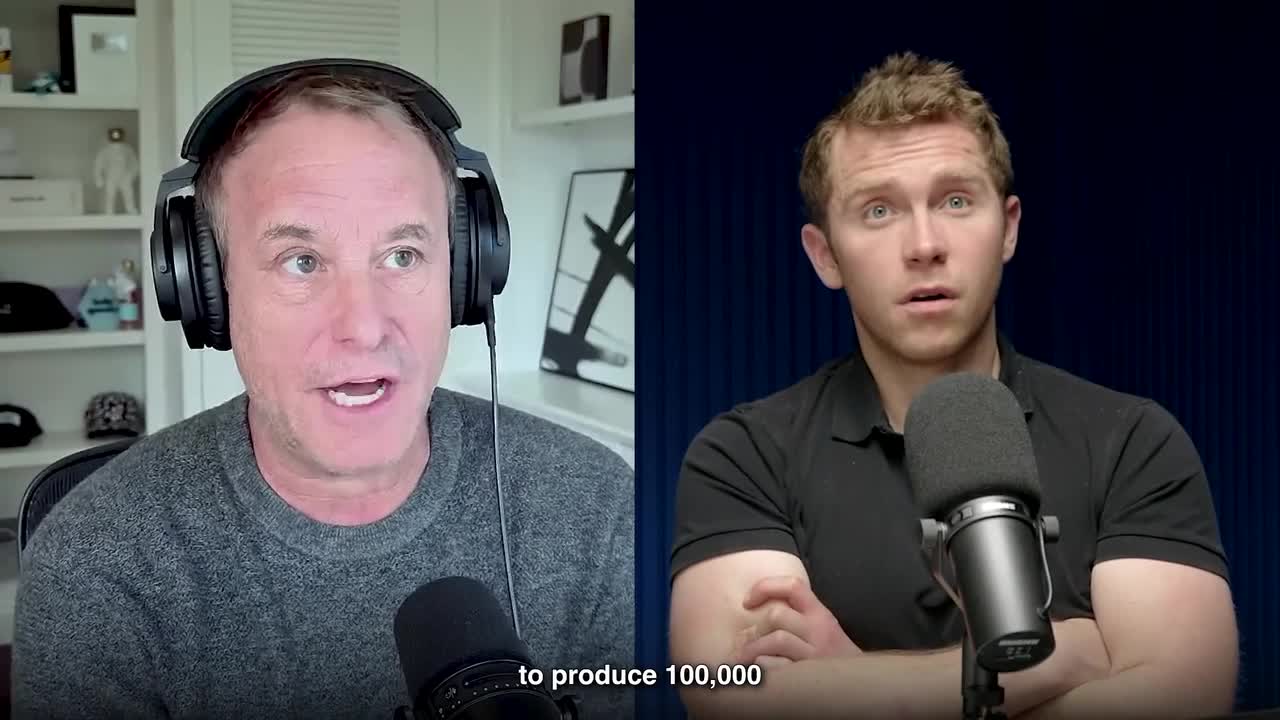
Maybe the Pentagon is wrong and they need to buy more Anthropic and just point it at the enemy.
It'll bring China to its knees, right?
This is 20VC with me, Harry Stebbings.
This week we analyze Anthropic's security release, Figma's earnings breakdown and, of course, the Cetrina research piece, which wiped billions off the stock market.
When you are priced for perfection, anything less than perfection will be a kick in the nuts.
If you look at all the publicly traded B2B companies, there's only one that has a competitive agent.
It's Palantir.
I'm going to say we're going to produce 100,000 deck of millionaires out of these AI leaders, okay?
Almost all the B2B software we use today is terrible now because AI software is so good.
If the only thing that's impacted here is the B2B software industry, my suspicion is the rest of the world will go.
Yeah, I'm willing to lose those guys.
Here's the greatest dislocation if I look at the public stocks, right?
Ready to go?
Boys, it is so good to be back.
I love this.
We're going to start this week in Anthropic with some news on Anthropic, surprisingly.
Security review feature wipes out 20 billion from cybersecurity stocks.
Obviously Anthropic released their latest security products or product, and it massively hit some of the biggest players Cloudflare CrowdStrike, to name a few.
Is this a dramatic overreaction from public markets or is there underlying truth to this?
Well, I'll tell you the interesting thing to me.
This is kind of shows where the markets are and where our mass panic is, although I think our panic is is well grounded.
I think we should be panicking.
But most of this already exists.
You can go to Cloud Code today.
And I literally did this on the plane flying back last week.
I did it inside of Replit.
And you can say, run a detailed security audit on my code.
And it will already do it.
It will already run a total static code review.
And if you're live, if you're on Replit or Lovable or Vercel or something it will actually do penetration testing and everything for you.
Literally, it will do everything.
It can already do, I think, better security audits and testing than a mediocre board engineer will ever do.
So what I mean is it's obviously the pace at which things are getting better.
I mean, each week we can't keep up on this show.
But it's also interesting that conceptually, just like reviewing COBOL code dropped IBM 10, it already existed.
We're panicking about features that have already been in cloud for months in many cases.
Now, is this a sign that it will go more aggressively into the space?
Of course it is.
Of course it is.
But I just want to point out to folks that aren't doing it.
So much of the stuff that we are panicking about, I think is worth panicking about, but a total nothing burger, in the sense that if you're paying attention, this is months old news in some ways.
The first comment, the just general comment, is you know Anthropic, you know markets itself, as you know the nice AI company.
And for a nice AI company, it sure creates a lot of damage and kills a lot of stock portfolios.
Maybe the Pentagon is wrong and they need to buy more Anthropic and just point it at the enemy.
It'll bring China to its knees, right?
It's an astonishingly destructive thing.
Incredibly destructive.
Incredibly destructive.
Have a press conference clip 20 billion or something.
But let's do security first.
Because in this case, from a technical capabilities perspective, no surprise.
Second, from an adoption in the enterprise perspective, I don't see Entropic eating up CrowdStrike's business.
I just don't see that.
People are going to have a security layer.
There was a great I think it was an HSBC report out today after the Citrini madness, which we'll talk about in a second that basically said software is the means by which AI will diffuse into the enterprise, which I thought was a wonderful quote.
I think it'll be true for security also.
In other words, these capabilities like code scanning will diffuse into the enterprise, probably by means of companies like CrowdStrike and other companies like them bringing it to bear.
So at that level, A, no new news, and B, it shouldn't be such a big panic.
But and this is the big but Unlike some of these other sectors, CrowdStrike and the security companies were effectively trading at a price that assumed nothing could ever go wrong.
Even on Friday after the correction, I went in to look.
I was stunned.
It's 22 revenue growth, projected 31 cash margins and it was trading at 16x revenues on Friday after the first hit right.
The thing is that when you are priced for perfection, anything less than perfection will be a kick in the nuts.
Right?
And that's what's going on here, right?
I mean it's entirely separate when you're dealing with the companies that were priced at six times revenues and they've gone to four.
That's a separate discussion we'll have later.
But I think what's happening on some of these super high priced stocks is The occasional reminder.
When you're priced to perfect literally any little thing, any increase in tail risk of you not being the winner logically corrects pretty substantially.
So I think that's all that went on here.
I don't think CrowdStrike's obviated by this.
I think it'll totally be fine.
It'll continue to be a business.
But when things are priced at extraordinarily high prices it doesn't take a lot to knock the narrative off kilter.
Would you say that CrowdStrike with the repricing is now fairly priced or underpriced?
It's actually a very good question.
To make it more general, are you saying do you prefer the stories where the AI disruption is perhaps a little remote but the The values are still pretty lofty, like CrowdStrike?
Do you prefer the ones where there are some of these stocks that have corrected to six, seven and eight times 2026 EBITDA, where you go just on a value basis?
That's wrong.
I was thinking about companies like Toast.
I was thinking about one of our own DocuSign.
At seven or eight times revenues, these things are absurdly cheap.
Whereas CrowdStrike is still not yet cheap.
It's just modular, but it probably has more clarity on the way the world is going.
I probably and I'm doing this on the fly and I reserve the right to change my mind next week I probably, even though it's I probably err to a bit of value.
In other words, I just say to myself buy the things where you.
Yeah, the cash flow alone makes it easy.
Would you rather have your money in CrowdStrike, which is still priced well, or Monday priced at one and a half revenues?
I'd like a basket of one and a half times revenues, not an individual stock, because I think at the level of individual stock it's hard to say because it's very idiosyncratic.
At the level of the basket.
If you buy 20 stocks at an average of three times revenues, eight times EBITDA, I think you'll do just fine.
I don't know, man.
Just last week, you kind of mocked me, and I can take it.
It's good.
You mocked me for saying Shopify is at partial risk of disruption.
And I said it's not at total risk of disruption, but the fact that whoever builds the agentic layer, more and more value is going to accrete to them, is you only have to have a partial deceleration to your numbers.
You only have to have a partial risk.
You only have to see more of the value of of HubSpot or DocuSign flow to an agent for these stocks to do worse.
Look, I'll give you an example for e-signature.
I know this space, DocuSign.
It's a great company, great CEO.
We both know this space.
And a lot of folks were saying oh, this is going to be destroyed by Claude, because all you're doing is creating an image of a signature.
No, this is a very complex enterprise workflow system that also is a partial system of record.
Someone has to say these contracts are true and valid and someone has to route it through 100 steps in transformation and negotiation and all this stuff, right?
That is not going to be destroyed inside of a cloud chat, but Some of that can be done by an agent.
And an agent that truly auto contracts for a business.
Let's say it does all of your commercial transactions.
That could take enough of the value away that these companies are maimed.
And I even think it's logical for CrowdStrike.
Obviously, Cloud Code Review is not doing endpoint security.
But can anybody be maimed by Klot?
It just launched an entire enterprise agent solution today.
You say you think anybody can't be.
I think anything.
This is how i think about it.
Claude is like inverse um, sorry.
What's the game?
Where you land on the, where you fall out of the sky onto the, onto the um uh, onto the uh island and it keeps shrinking.
What's that game called?
I used to play it.
What's the game?
Everyone plays the game, the video game, where it keeps shrinking right and so I'm sorry.
OK.
But that's like your territory keeps shrinking.
Claude keeps consuming more and more of you.
And you're stuck in this smaller and smaller island that you've got to own more and more market share of.
Almost everyone that's public, your surface area is shrinking because of Claude and AI.
And the question is, how much?
You know, I don't know that we've seen the bottom of these impacts.
I think the impacts are accelerated.
And that's why Anthropic Today had to publicly say hey guys.
Their head of AI said listen guys.
On the one hand, things are accelerating, so it's bad for software.
On the other hand, we're best of friends of software. on the day they launched Enterprise Agents.
We're best friends.
We're enabling them.
But the pace of change is so fast.
So I want to believe there are these safe islands.
But I believe the agents are going to own enough of the value that just owning less of the value in your space can create terminal decline.
Terminal decline.
Put me down for a strong disagree.
Give us the rest of the year.
You're going to come around on me on this one.
You're going to come around.
Just give me the rest of the year.
Literally on the plane last week, I did a security audit in Replit, which is using Cloud Code.
I mean, some of that is Replit.
We could talk about it.
I don't want into the details.
But it's great.
And I literally sent it to the Replit team, the entire technical team, because I'm like do you see how good this is?
And they're like, we didn't even know it was this good yet.
We didn't even know our security audit had become this good last week.
It's so good and so much better than before.
And they didn't even know.
And so to think that we're in some sort of static world for the rest of the year?
I don't even think like literally we could delete some of our podcasts from four weeks ago.
They're so dated.
So let's try not to be like that.
So a comment here.
Intelligence will infuse all software over the next decade.
That intelligence is generated by foundation models like Claude and like OpenAI.
I think that's a given agreed.
So what we're really are saying is how much of that do they do themselves?
That intelligence has to get to the enterprise and it.
There's probably four ways it can get there, lemma.
One is they buy it from claude directly.
Everyone buys all the software from claude.
The second is that they build it themselves.
They they, they construct every enterprise construct its own agents.
The third is they buy it from existing incumbents who integrate ai.
And the fourth is they buy it from gazillions of new companies, all of whom are leveraging at.
You know the hobbies that go with all these companies who are building on top of foundation models.
You're founded post 22 right and, And you have to figure out which of those scenarios you believe in.
And actually the post I read and I actually agreed very much is I think it's three and four.
I don't think, I don't think enterprises are going to digest, are going to build their own systems on top of Claude directly.
And I don't think Claude's going to build all these focus systems for everything.
So I think there's going to be this software mediation layer between them.
And that's the opportunity.
Here's the thing.
If you look at all the publicly traded B2B companies, there's only one that has a competitive agent.
It's Palantir.
No one else has seen a single ounce of revenue acceleration due to their AI agents.
And yet the companies we talk about each week have jaw dropping acceleration.
It's not just Anthropic because they have built the agents that matter in their space.
It is not sprinkling AI dust on top of their analytics software.
There's not enough value there.
But let's talk about that kind of fourth category.
You would also be that there were many privately held, recently founded companies exploding in revenue also.
Let's talk about like do you think it all goes to the model companies or do you believe any of these companies, like you know, that are raised?
I mean you mentioned you know you guys talk about Replit and Lovable a lot.
Do you believe that's defendable?
It might not be defendable.
You know, they even might not be defendable in the rate of because cloud code.
Just last week, just since we did the last show, cloud code launched the ability to see apps inside of cloud code.
So for a lot of product people, you don't need rapid and lovable anymore. as of last week.
Now you can change Cloud Code and visualize your app inside of Cloud Desktop and inside of Cloud Code.
You don't need to do that anymore in a third party app.
And so they're all being, but my real point is, sorry, and Harry, you're the boss.
I just I've talked to three founders over the weekend of like public and near public companies and they're all and this is the advice I gave them.
Your agent is not great.
You're being disrupted by the agentic layer.
Now I hope that.
I hope that that that ServiceNow builds these great agents, and I believe AgentForce has a shot and I believe others, but they're all being disrupted in real time.
And that's why the folks Harry interviews on 20VC are stressed as F.
They are stressed as F because, no matter what they say, they know they are not.
They do not have the dominant agent in the space, no matter how many LLMs they stick inside of a feature.
When I see what many leaders of top, public and private, and our hundred nine figure unicorns are saying, it's lip service.
I see it on LinkedIn all weekend long.
I see we're adding AI to our email feature.
We're adding the ability to process emails more efficiently.
You're going to go out of business.
And you're not going to fail because your customers are going to renew, but your growth is going to fall so far that you become irrelevant in two years.
And that's why I'm going to buy my four stocks.
Don't get me wrong, but I'm already changing my mind since last week, because things continue to.
The panic is overdone and real at the same time.
So you made a very clear statement that we have not seen any of the public providers make great agentic use cases, work and have a meaningful impact on revenue.
I'm very naive.
Why?
Toby's a brilliant CEO at Shopify.
You know, Mark is trying with agent.
Why have they all failed so far?
Well, I'll give you two reasons if you want.
There's a long list of reasons, right?
I'll give you two practical reasons.
One is it's a lot of work, man.
And no one wants to do this at these companies.
No one wants to.
You don't.
Let me finish.
Every agent.
Here's the problem today, and this will change in the next two years.
It is not true today.
Every agent is essentially custom.
OK, every agent needs to be trained.
Every agent needs to be onboarded.
If you want it to be great.
OK, every agent needs its data cleansed.
And so This is a vast amount of work for organizations that already think they're overworked and working too hard.
There is huge institutional momentum to overcome.
The second is what I just said is true.
You need a massive amount of forward deployed engineers and trained workers that are technical enough and smart enough to train and deploy an agent.
One, the workers don't exist in most companies.
Your average customer success person that shows up with a green yellow, red light dashboard cannot train and tune an agent.
And two.
Then there's a meta challenge for the Shopify's Monday's, HubSpot's and Toast's and others, which is you can't afford the human to do it.
And that would be fine if you have, so what we're at a niche level, we're seeing it with startups.
We're not seeing with publics.
Hyper niche agents work really well because they have a small set of things to do.
Okay.
As soon as you get to spaces like Shopify or, even worse Monday, where you have a hundred verticals Right.
It's very, very hard to build a very specific agent automatically that does everything that churches need and basketball courts need and refrigerator businesses need.
They're not all the same needs.
And so the agents aren't good enough.
And in fact, a lot of these leaders that I just tried, they're in beta.
They have six people using them, 60 people, because it's too hard for them.
So they're gonna get killed by the startup that does it.
They're gonna get killed.
But that's the key, that a startup that does it.
What it's not going to be is the foundation model directly selling to the church, directly selling to the thing.
They will provide the raw intelligence, but there will be software opportunities to build compelling software companies in most of these verticals, just as there was in SaaS.
Right?
So maybe we're more in sync than we think.
Let me just say this clearly.
I think intelligence-led applications are the only applications that are going to sell and grow quickly over the next 10 years.
Non-intelligent led applications will at best be flat to mild growth if they're not obviously disrupted by intelligence, and at worst be down.
Right?
Yeah.
And I would argue for example, I'm picking on Toast because I'm not an investor, so I have no emotional connection.
I think that's a good one because I don't think there's a ton of agent work to be done.
And it's a lot of payments and restaurant kind of organization.
It's fairly durable, we can argue, but yeah.
Whereas something like Monday, it's very knowledge workery.
I can see much more disruption story, right?
But that's the incumbents.
But your point, what you I think we're now in sync and saying is that those opportunities can be grabbed by standalone companies, perhaps built, you know started, founded 21 22, leveraging directly on top of the foundation models.
What you're not saying is all that revenue just accrues to the foundation models, correct?
No, I think just people are going to be maimed even more than they think if they don't own the agents in your category.
You got to own the agents in your category.
And whether those agents are owned by a startup or whether some version of that agent can be done inside of Claude, they're going to maim you and it's accelerating.
Jason, I want to be very direct with you, and you'll give me a direct answer.
You're better at direct than Roy's sometimes nuanced answers, which people love also.
But will Claude Code make Rappler and Lovable weaker in a 12-month period?
Do you think they will meaningfully enter their space and take market share?
I think it will do everything that it can do.
Going to Rory's point, anything that can be done either inside the browser or inside the desktop Cloud will do.
That's what we've learned this year.
Anything it can do.
So right now, if you go to design something in Cloud Code, you'll laugh.
All the crappy Cloud Code websites look the same.
They have the same artifacts, the same icons, the same purple color scheme.
You can laugh.
But can all of the design, all of the parts of Figma that are designed be done within the code?
Of course it can.
So I believe it will aggressively attack parts of Figma this year, even though they're key partners.
Replit and Lovable, it continues to do more of them.
Now, will Cloud Code want to host entire websites?
Will it want to go into, will Claude?
The only thing that ultimately will protect them is this is all their teams do right.
And that I don't think they want to build databases and build production websites and host domain names.
But if they change their mind, there's no reason.
An agent, there's no reason they can't.
They can't license Supabase or Neon or fork their own Postgres.
They're pretty good there at Test Company.
They can build their own database.
They've already got plenty of servers.
They can spool up a few more to host websites.
If they want to, they can.
And I just think Fortnite's the game.
At the end of Fortnite, the circle gets.
And so if I'm at Replier, Lovable, or even Figma, I would be worried.
Figma, the circle's just starting to shrink.
But I think many companies, that circle's shrinking.
And I have two investments I made last year.
I love them.
Those products no longer have a reason to exist today because of Claude.
I made two investments.
Now, it's not going to bankrupt the fund.
And they've tilted.
They've evolved.
But these were standalone investments last year, I'm not going to go into it that were great, that blew up in the early days.
And they just have no reason to exist today in that prior form, just no reason.
And when we turn around and all of a sudden, you can preview your entire app inside of Claude, which you couldn't do last week.
If I'm any of these Figma Replit Lovable Vercel.
All of them, all of them.
I love that, just the Fortnite circle shrinking.
So, you know, you got to like, you got to do something about it, right?
And will it stop?
Like at the end of the game, it does get pretty small though, right?
It's stressful, but the flip side is, if you nail the agent, look how much revenue these guys did, building essentially an agent on top of Cloud Code.
They built a billion dollars of revenue building the agent that didn't exist.
So that's the flip side.
That's our job is to build these billion dollar agents.
If you can do something that is extremely high valuable, that could not be done before, you can close millions of revenue your first week.
It's never happened before in the history of software, right?
I do just want to stay on Anthropic.
And I wanted to discuss.
They've lined up 5 billion to 6 billion for an employee share sale at a 350 billion valuation.
Obviously, there's people queuing up out the door for this.
This was following, obviously, OpenAI doing the same a couple of months ago.
Have we ever seen liquidity at this scale?
When we look at the number of millionaires minted from OpenAI, soon to be Anthropic, when we look at the Nvidia millionaires that exist already.
Is anyone going to be able to buy a house in the Valley?
There's a lot of things that seem silly in AI 12 or 18 months ago.
But if NVIDIA has 20,000 decamillionaires, now I'm going to do a wag.
But based on the math, I'm going to say we're going to produce 100000 decamillionaires out of these AI leaders.
And Rory's better at the math than me, but NVIDIA already has 20,000.
So if that's the case, that would be great, if everyone was at full employment and we were all full of companies with six-figure employees making money.
The worry is I don't want to spend too much.
The worry is that we do see this concentration of wealth at the same time as everyone else gets leaner.
And will Jevons Paradox create more employment in tech or not?
I believe it will create.
I don't believe.
I believe we will need more engineers than ever, like when we talked with Michael Cannon Brooks.
I don't know if it will create more employment.
Listen.
The knock-on effect of that is bluntly, what has shaken markets so much.
When you look at Citrini or, however you want to pronounce it, its 2028 global intelligence crisis, which was a piece written forward-looking or predicting the state at 2028.
I broke down some of the core elements there.
And I think we can start with actually one that you kind of mentioned there Jason, which is kind of ghost GDP disconnects market from the real economy.
So you have AI boosting productivity and corporate profits and market caps of companies, inflating headline economic figures, but actually consumer income doesn't scale with market cap and enterprise value.
How do we analyze and assess that?
I'm going to call bullshit here.
Okay, great.
Right?
I love the Noah Smith descriptions, a sub stacker I follow in economics a lot.
He called it basically scary bedtime reading, right?
And you know.
But I think, if you want to have a conversation about it, I actually think The way you need to break it up is to I'm trying to say how to have, because I knew we're going to have this one right.
And I saw your seven points, and it's too much detail, Harry.
Big picture, I would suggest we approach this in the following fashion.
The first thing you have to figure out is and I should know you is micro macro, at a micro level, for each of the things he says are going to happen, do we believe they're going to happen?
In other words, is ai going to replace coding?
Is ai going to replace doordash?
Is ai going to replace amex?
Right, in other words, and the wonderful thing is, i think that's something this group is well equipped to do, because we're all investing in venture companies, who are the tippy point of the spear in terms of adoption.
I'm allowed to have an informed opinion on question one, which is micro level are these changes going to happen?
Then the second big picture question, lumping all the other things into the other, is what are the macro consequences of this right?
In other words, if you assume that there's a high level of AI adoption over a short period of time, then everyone and that's, as I say, what we can talk about because we understand then everyone gets to pontificate on global macro, which is what you were starting to do there, right?
And I'm fine coming back to that, right?
I think he was, on the show, in other words, and revisiting this in a few minutes.
But I think, jumping straight to the oh my God, the GDP is ending with no thought process to.
I even believe that basically he was hypothesizing a two-year adoption cycle of almost everything, such that everything from ServiceNow to DoorDash to Amex gets rolled over in two years.
And I think if you believe that's happening, going to happen very quickly, then you do graduate to the global macro question, and i still think he's wrong about that.
But if you don't think the adoption is going to be that quick, you can literally ignore the rest of the piece.
Does that make sense as a framing?
First of all, it totally does.
Why don't we start with the micro then, where you think we are seasoned and responsible enough to have an informed opinion?
Well yeah, let's break it up.
He points about software development, about SaaS apps, about companies like DoorDash and then companies like Amex.
In other words, interchange.
Let's do the stupid ones first.
DoorDash.
The idea was you're going to want to delegate to your agent purchasing of an optimizing, for there's going to be six different versions of DoorDash and your agent will do between them.
And the only reason that you don't do this today is because, quote unquote, friction.
And if it was automated, you'd let the agents order your pizza.
And I just call bullshit on that.
I mean, at the consumer level, I mean, I don't know how you felt when you're organising it.
When you're buying pizza on a Friday night, you're talking to your wife and you said honey, you know we had the fricking kimono last time.
I say we go with the pepperoni.
She's like, no, I don't like it.
I told you we want to stick with the two salads and the pizza.
It's not something we want.
No one wants to delegate to an agent how to decide what food they get, and then have the thing come up.
Good news, I save you two bucks.
Bad news, you like the high end pizza, but I got you the crappy little pizza dish.
Yeah, but Rory, can I add just one thought?
Here's Andy Fang, CTO of DoorDash.
We strongly believe agenda to commerce will be transformative to our industry.
He believes this.
I believe it, as I have a large investment exposed to the space and I can see agents and AI ripping through it.
I don't mean to interrupt but, like I think the examples we think are safe, this is CTO, saying we need to earn the right to service customers, agents end to end discovery ordering, delivery and support.
We need to earn the right in the new world.
So to think that these spaces aren't just, it only has to be maimed.
It does not have to be.
The idea that we're going to vibe code our own DoorDash is stupid, right?
It is stupid.
Yeah, it's not good.
And he's trying to get people millions of views, right?
So the whole idea he started with is stupid, but keep on extrapolating.
But the threat that an agent can decide for you here The CTO says it's real.
That's the threat.
But he didn't say, OK, you caught me.
I'm going home.
If you want to make more automations around a recommendation, say hey, there's three different pieces.
But do you really think it's going to be?
I just think the level of customer inertia on the consumer to have this vision of five different DoorDash competitive companies being enabled in this world, I just don't see it.
DoorDash is a combination of a huge amount of logistics, a huge amount of customer aftermarket service, a huge amount of signing up restaurants right.
And the only thing that's changed.
So what's allowed?
You know they beat off four or five other big competitors to now have some kind of stable oligopoly with Uber order.
And there was one other smaller player in the US, right?
What in software is going to allow a new?
Talk me through the new competitor emerging and taking market share in a high fixed cost business like this.
Well, I mean, the most simple one is that a new competitor can decide whether Uber Eats or DoorDash is the right thing for Uber Eats, DoorDash or Direct?
You have three options in the US, OK?
Nothing else really exists, right?
The agent may make that decision.
In fact, I would prefer that, because I don't want to figure out which one to use DoorDash Uber, Eats or Direct.
I would prefer that Uber Eats does my favor.
And I'm just picking one example.
But this is a real threat today.
This is what Andy's saying.
It's a real threat.
We don't need to decide which is the best place for us.
The agent decides which is the best deal between these options, which is the best source for me, which is the best for my family.
That makes the decision.
If the agent is who we go to.
As long as the agent is who we go to, rather than the first party, it just risks disruption.
It doesn't destroy the company.
It doesn't destroy it.
Yeah, it doesn't destroy the company.
OK. tracing through the unrealistic statements there.
Let's go to an existing example today, Netflix.
Yeah, but I'm right about DoorDash because Andy Fang said the same thing.
Why are you dodging the one that everyone thinks is free from disruption, when the CTO says the ground is shifting underneath his feet?
He literally said it this week, the CTO.
Okay, no one's going to say.
No one's going to say when the CEO of a public company, I don't believe that stuff.
They're going to say we're on it because that's the message you got to say, right?
But I don't think they're saying, oh my God, three more companies are going to displace me, right?
Our job as investors is to be kind of analyze the facts and try and come to our independent conclusions.
So I'm just going to take the idea.
I think two of the most personal things at the consumer level are the food you eat and the TV content you watch.
Right,
Now, the good thing about the content you watch is we've had 10 years of AI already.
The Netflix recommendation engines.
Let's be clear it is a massively useful tool to them because, at the margin, it helps them predict what people want.
So I do agree there is core value in knowing people's preferences on the aggregate.
But how often?
What percentage of your content viewing do you base entirely blindly, on the recommendation engine when you sit down on Netflix?
5%, 10%?
I think it's light.
Sorry, but DoorDash is barely in B2B.
What the Netflix point is.
I'll answer your question if you want the answer, but I'm missing the point.
Do I think AI can disrupt Netflix?
Netflix thinks AI can disrupt Netflix because we're all watching short form content.
And, as of the last 45 days, you can watch an incredible short on YouTube that was entirely AI generated, where you can watch Star Wars stories that are better than the crappy last three movies that are AI generated.
That's utterly disruptive to Netflix.
Utterly, utterly.
They're so panicked they have to buy a studio.
I'm breaking it apart into two separate things.
And I think that's actually useful.
If you can generate content using AI, that's very disruptive.
I was trying to focus on recommendations because the idea was I'm just looking at the idea of the idea is for consumer preference.
You will entrust your decision making to an agent who will quote unquote know what you want.
That's what you're saying about DoorDash.
And we're trying to prove something that hasn't happened yet.
So I was making the point content is another thing that's quite personal.
And Netflix has had this agent running for the last 10 or 15 years, the recommendation engine.
And at the margin, it does a good job of predicting on aggregate what people want.
But if you had two choices, one program that gave you exactly what they recommended, and then the other program that allowed you to pick, I'm going to tell you you're not going to go with the recommendation engine.
You're going to say, I didn't like that recommendation last week.
I'm done.
In the same way, I don't believe I want to entrust my eating decision entirely to an agent.
I think we're just caught up in this.
Anything could happen, right?
But dude, YouTube is the number one way we consume video.
And it is entirely based on a recommendation engine.
And it is the best recommendation company on planet Earth.
There are no channels on YouTube that matter anymore.
Followers don't even matter anymore.
Nothing matters.
Every day I log into YouTube and it gets better and better at knowing what I want to watch.
Every day.
It is epically better than anything else on the planet and utterly disruptive to how we view things.
Good argument.
I'll give you that.
Everyone is stressed today.
It's a good thing.
Everyone is stressed.
Because the further you go, the more folks are at risk of being maimed by AI, just maimed.
Except George at CrowdStrike.
He's fine, but everyone else is at risk of being maimed by AI.
Even if your growth goes from 31% to 20%, that's a big deal.
That's a big deal.
Agreed.
But do you really believe that you want an agent to recommend you food?
Well, listen, I have the data.
I have an investment in this space.
I already know the answer is yes.
It's not my opinion.
I have data from over 10,000 restaurants.
I know the answer is yes.
Roy, if your agent, in all the historical context, on every pizza order you and your wife have made, and you know the price point, the location, so you know the delivery time that you're estimating, and it can also analyze every TikTok to Instagram review as latest food trends and tell you about the latest within that price band with that crisp topping that your wife likes, because it already knows that because you left a review or because you said it in a WhatsApp, so it's got open floor, and was able to deliver that to you.
I think most people would.
I'd love it.
But Harry, I think that at the margin, yes.
I'd be sitting there on DoorDash going.
I get a 5 extra satisfaction rate and selection rate from this.
But do you think AI is so disruptive that it can warrant the creation of an entirely new company that says basically what you're saying is All the investment you made in restaurant relationships logistics, the app, consumer price right are as nothing because this new thing is disruptive enough, just because the recommendations are 5.
No one said nothing.
I don't think anyone said nothing.
So do you really think?
Let's put it on.
If all these SaaS apps become dumb databases and Toast just becomes a POS system, they're not going away.
But they become more and more commodified.
And more importantly, the real issue is they don't capture enough of the incremental value.
It's the incremental value we're investing in.
Jason, I wanted to deal with the easy ones first, right?
Do you really believe that there will be a direct competitor to DoorDash enabled by AI?
Well, listen, we all agree that that is clickbaity, OK?
But and so is all of it.
But listen, even let's talk about GDP for a minute, OK?
I admit I'm living on the bleeding edge, OK?
Let's concede that I'm a laboratory.
But we have gone from 12 people to two people on my little team.
OK, that not only does investment, it generates eight figures a year in revenue.
And that is GDP.
Those folks that are gone, that value, the profits that are left go to two people or three people.
Define GDP for me.
GDP is that this productivity is not going to human workers that then spend it.
That's the fear that we are creating this productivity but it is not going to any.
There's no humans to spend the money.
It's great that I can spend more money, but that doesn't.
I don't think that's great for the economy if I get a little bit richer.
Like we lost eight people on our team right okay yeah, stop when, first of all, i agree we're now doing macro because and i, in this case, we can do macro because we agree we can only do macro once we've conquered micro and in this case, you've conquered micro you've said it has happened.
I have 12, i had 12 people, now i only have two.
10 people no longer have jobs.
What does that mean?
Or at least whatever.
They have other jobs.
But the value that we're creating, this eight figures of value it's accruing to fewer and fewer people.
And there aren't as many people to buy handbags and to buy shoes, and to buy t-shirts and to buy Netflix.
Even just to buy Netflix, there's less people.
That was the point of the ghost GDP in this inflammatory, annoying article.
But I don't think that these things are wrong.
I think he's just trying to claim everything's going to happen in 18 months, that it's not going to happen in 18 months.
But implicit in that and you have to be logical implicit in that is productivity gains, which have been the engine of growth for the last 200 years, are bad.
There's some buried statement here is that it is bad that Jason is now able to do something with two people that he was hitherto for only able to do with 12.
Right, and i'm going to say something across the arc of the last 200 years since the industrial revolution, productivity gains have been good.
Right, because the other 10 people who used to be wasting time writing slop for jason can now do other things, and the sum total of human achievement will contain the extra work that those people do.
In the long term, I don't think you can argue.
But that productivity gains are good right, we used to have 80 percent of people working on farms.
We now have 10 percent of people working on farms actually four percent of people working on farms and we have so much food that we're all fat right, and those other 85 percent of people are doing other.
Across the scope of history, productivity is freaking awesome.
It's the only thing that's made us rich.
So I want to say that so clearly.
Because then, all these arguments, these macro arguments that I was hoping to ignore, are basically some version of even though productivity is amazing in the long term because you can't disagree to that something bad is happening in the short term.
And then the onus is on you to say what that is.
What is it?
What's so bad about constant change and the fact that jobs go away and new jobs emerge?
What's going to happen that's so bad?
A softening of consumer spend.
With a concentration of wealth to fewer people, there are less people to spend money across different parts of the economy, and that impacts a large amount of people.
And to your point on how does productivity actually lead to a worsening in the economy?
You only need to look at Japan in the 1990s and the need for Abenomics.
And actually you saw massive productivity increases in the 1990s with massively improving mechanical infrastructure that they brought in.
And actually, it didn't disperse to a huge amount of the Japanese population.
So there's very recent precedent now.
If you want to see a sat, a dystopian version of this, go to Japan and meet with B2B founders.
I was at a dinner last November with all from IPO, 20 million and up only.
It was a VIP dinner put together.
It was great.
It was the best of the best.
Okay.
And they're all talking about how inherently their seat base shrinks.
This is not just the AI topic we're talking about today about seat-based risk.
This was last year all talking about how, just each year, their seats shrink because their economy is shrinking.
It is just to Harry's point.
There is, I think in the short term this is all great for us as investors.
It's terrific for us to get more productivity.
Well, we're going to make money out of it and we should put it in the bank and flee to Miami or Monaco.
But I'm not sure it's good for everybody.
I'm going to call bullshit on that.
There's two or three different things.
Disaggregate and deceit-based comment, right?
Are you making a comment on Japanese depopulation, which I don't think we can blame on AI?
It's been a trend for 30 years.
I just think there's a loose parallel to this ghost GDP idea to Harry, brought up of the depopulation.
Well, there's different ways you can depopulate a worker force even if the humans are still there.
But it's a structural headwind to folks buying stuff.
Our 10 agents at Sastr generate millions of revenue, but they buy nothing.
Our agents buy nothing.
They work all weekend long.
Repli, Arti, Quali, Mani.
They're good kids.
They create a lot of noise.
They're a lot of work, but they buy nothing.
Nothing.
Nothing.
Except tokens.
That's the only thing they buy are tokens.
And they buy millions and millions of tokens.
For real, right?
For real.
That is a little different than the past.
Productivity increases are only good if the consumer wallet is dispersed and they are able to spend money.
If that shrinks, that is not a good thing.
Yes, but so what do you do?
Ban productivity increases?
Good news, we're all doing fine.
Bad news.
We're all 1790 and we're all you know, one bad harvest away from starvation.
But yay, we're all fine as long as nothing goes wrong, right.
It's not a credible argument.
Look, i do agree at a very micro level.
You could argue if and this is why we actually have to go back to the micro if the disruption happens extraordinarily quickly and people don't have time to adjust, then in the short term you will have some element of structural dislocation that will result in definitely some form of recession, GDP slowdown if those folks can't be digested in new jobs quickly.
So I do agree.
So my point is this.
In the short term, you can articulate a thesis like you're just saying, right?
If all the 45-year-old programmers are let go at the same time and there's 6 million programmers on the street and there's no other work for them, and it happens in a month, then in the short term there would be this GDP hit.
While I'm still correct, over the medium and long term, GDP growth builds us all out.
So that's why it does go back to the micro, is do you think it's all going to happen so quickly?
Do we think that all these things are going to be displaced extraordinarily quickly?
I don't know.
When I look at Kapathy talk about the evolution of how much of his work has gone to AI in the last six months, I do question it.
Okay.
What do you mean by that?
I think more and more of labor will be replaced by AI.
We will see the concentration of value to a fewer people and fewer consumers will have money to spend in the economy, which will lead to problems and a shrinkage of that economy.
150 odd million people working in the US, right?
So what's your estimate for displacement?
I'm just trying to get a sense of it.
Like, you know, you have... It depends on the time horizon, but I'm not feeling that great about it.
I mean, if we look at the most obvious, which is customer support, legal bookkeeping, that doesn't look great.
If we want to add in Waymo and what it'll do for self-driving within a four-year period gosh, I think you could see 30 to 40 million people-.
Waymo's a good example.
I mean, you look at the projection.
I mean again.
You look at the projections 10 years ago when people talk about self-driving, and you can find all the you know the Citrini articles of then saying it's all going to happen in four years.
It's over.
Here we are today.
And even though I think Waymo is amazing, they're doing $350 million.
I think they have single digit thousands numbers of automobiles. you know, in a few cities, right?
Steady rollout started to increase.
Probably you know I don't know how many years you're talking about before it gets to kind of further mass scale.
So it's a very long, almost every, all diffusion takes longer than you think.
I think we massively overestimate the pace of adoption here.
And you massively underestimate human adoption.
Does it ever take you shorter?
Because everyone always says about the pace of diffusion and they use the industrial revolution where you had to buy machinery, transport it train.
When it's a nano banana pro and it removes an entire industry, Well, Facebook is much quicker.
In my life, it's shorter.
And the thing that is stressful on this and it's a way to make money the stressful thing is that, if you're and again, I don't want to endlessly talk about vibe coding apps, but I have so much experience right.
I'm shocked.
Everything is faster than I would have ever and better than I would have ever expected.
We started this about security, right?
If you told me when we started this podcast that today I could just talk to a vibe coding platform and it would do like an A tier security audit while I was on an airplane and I didn't have to do anything.
I would have said, guys, it deleted my whole database.
There's no way it's going to do a frigging enterprise grade security audit.
Yet here we are.
And then we turn around and everything Anthropa can do this year is faster and better and bigger than we thought.
I'm not saying at some meta level everything isn't slower than we think, right?
Certainly that dumb article, right?
DoorDash being disrupted by base 44 next week is dumb.
God, this acceleration, it's so fast.
In practical terms.
I'll give you the practical ramification.
Almost all the B2B software we use today is terrible now.
It's terrible.
I can't talk to it.
I can't like I can barely bring myself to use the WordPress.
I can't change anything in WordPress.
All these products are terrible.
A lot of the ones that that we, the founders, we love that Harry talks to.
The products are terrible now because the software is like AI, software is so good.
Blow your brains out to input data for two hours into your system, right?
It's terrible.
And, if nothing else, that is accelerating so quickly that the leaders cannot keep up with the fact that their products are so dated.
They're so dated.
I think that broadly true.
And I think when you narrow it that's why I said when you narrow it down to the micro of the impact of AI on the million to a million and a half workers in the US in the software and tech industry, broadly defined, could be way more disruptive.
I think that's actually a useful conversation, but it's worth pointing out that plus or minus 5 7 of all jobs in the US are disrupted every year.
You know this is 1 less than 1 of all jobs, maybe 1 15 of all jobs.
If the entire software industry got nuked right, it still wouldn't be the same as losing the car industry 10 or 15 years ago.
So my point is again, differentiate the micro discussion of are B2B software companies in trouble and how much are they in trouble, is a really good discussion.
And if you make your living investing in B2B software comes, it's the only thing that matters, right?
But jumping from there to saying civilization as we know it ended is just, as you say, Jason, clickbait, and we should just ignore it, right?
The truth is I mean I'm going to put it even more directly we didn't bleed in silicon valley when the car industry went down the toilet.
Don't hold your breath thinking they're going to come for us and say if the only thing that's impacted here is the b2b software industry, my suspicion is the rest of the world will go.
Yeah, i'm willing to lose those guys, right?
So i think we discard the macro and.
But then i think you're right the question is, who wins, who loses in the 2 of GDP software business with AI?
And I think that's a valid, that is the question.
Is all that software, all that software is crap and looks outdated today.
A lot of it.
That's what you're basically saying.
Also, one other point.
We talked about Toby before from Shopify is about the best of the best, right?
And I think Shopify is on top of these things.
It has the same number of employees it did three years ago.
It has not added a single net headcount in three years and has grown 50% at $12 billion in revenue.
That is, at a meta level, that is a decline too.
It has grown its revenue 50% to 12 billion and not added a single net headcount.
That already is an economic loss to the tech lifestyle we lived just a couple of years ago, right?
I was literally talking with a group of, B2B CEOs at scale the other day.
And I made a statement that everyone thought was a joke at first until they thought about it.
I said, one of the leaders in the next 12 months is going to do an Elon Musk and just cut half their team in one day.
They're going to lay off half the entire company.
We thought Elon was crazy at x, but it stayed up.
And one of these folks that is not making a big transition to the new world is going to realize they're just going to go from 4000 to 2000 employees and be fine.
So this trend could accelerate, even if Shopify is the same for three years.
Anyhow, listen, just for fun, then we could break.
I asked Claude.
Who isn't that crazy guy on Twitter trying to get views?
Going to my point, what would happen if with AI we were able to reduce tech headcount by 50%?
Just reduce headcount by 50% because of AI.
Claude said the short version, $600 billion to $900 billion in GDP impact.
4 to 5 million total jobs lost, including all multiplier effects and local economic devastation, in five to six cities where tech is concentrated.
It would be one of the largest economic shocks in US history outside of a world war or pandemic.
I'm not saying it's true, but I just asked Claude to parse the data if we lost. half our headcount.
Now, here's where I'm not smart enough.
Even in some ways, not growing headcount for a decade is losing headcount too, right?
Because the revenue will grow so high, right?
But go back to your thing.
I think you are right about one thing.
I think the number of companies will do that kind of dramatic headcount reduction.
And I think the most obvious place will be all the levered PE-backed, highly levered SaaS companies, because if you're not levered, if you're public, if you have time, you can do the Toby thing and just hold headcount flat, rely on growth.
You don't have to do traumatic surgery.
You'll just be able to become steadily more efficient.
If you owe six times EBITDA on debt and you bought the thing for eight or nine times and now it's trading at four times, you have to start paying down that debt and there's no growth.
So I think a lot of those guys will look at very draconian expense management structures.
Expense structures
Yeah, that's a good point.
If you are a Toma Bravo with Cooper and Anaplan.
I'm not picking on I didn't mean to pick on that, but I'm using them as an example.
So please, your answer is not dependent on Cooper and Anaplan, but that ilk.
And you're growing at 20% with no founder CEO.
So hired CEO, P run, growing 20%.
What do you do?
I think Rory is making a more brutal and cogent point, which is there's folks like that are growing 6 that are out of massive debt leverage.
They have no choice but to shrink.
The math doesn't solve any other way.
20%, at least you have options.
You can probably do the Toby playbook if you're north of 20.
Probably the math barely pencils out at that level.
That compounds to enough growth over four to five years to pay off your debt.
But in the single digit, all these blue owl and friends, they're just upside down on this debt.
They can't pay it off.
What happens?
I think if the debt is upside down, hence the blue aisle thing, then the equity is gone.
I think a lot of these folks, they're not just going to roll over and die.
They're going to do exactly what Jason said.
They're going to try and cut expenses.
And, you know, knuckle down to a very.
You know the debtors will extend the debt because they won't want to crystallize the loss.
The equity will run the business and try hard to pay down cash.
They will reduce headcount dramatically.
There'll be much less attractive place to work.
There'll be much less attractive vendors to supply to you because they won't be investing in R&D.
But and this is the sad comment I think the inertia in a lot of software contracts is such that it'll take a long time in dying.
So it'll just be a steady, nasty grind.
Right.
I don't think it'll be the cataclysmic, you know, all going wrong on Friday kind of thing.
I think it just be a long five year grind.
But yeah, my guess I don't mean to go off top.
I hear where you thought more about this and probably you have areas.
My guess is we will end up seeing more and more five to six to eight startups at 50 to 100 to 200 million in revenue mashed together at nominal prices of two times revenue or less.
They'll just be all mashed up.
Everyone knows it's not the best idea.
Everyone knows that the 11 companies Clary has bought do not have perfect synergies, right?
But it's the best idea we have for these companies at two X one and a half.
I know it's probably not even an error multiple, but one and a half to two times.
People will just say, you know, enough already.
It's time.
One and a half, one to two times revenue will capitulate.
And you'll see these sort of Frankenstein B2B companies that have.
There are many constellations or whatever, but it's the best play left.
And you'll bring in professional management that will have 20 products.
We'll see 20 unicorns merge into one thing that will IPO in 2027.
Agreed, except the last sentence.
They'll try and IPO in 2027.
But you're right, Jason.
I think that's a great thing.
It's the best idea they got.
You've got this $50 million revenue thing with no acquirer.
Maybe if you had five, 50 million revenue things in roughly the same market, you could build a 250 million thing that would be profitable enough and or get some growth at scale.
It'll be a miserable way to consolidate all that debt.
But yeah, I mean, that's the toughest.
Those are going to be the most impacted by this kind of decline in the perceived value of recurring revenue companies.
We can either talk about Figma's earnings or OpenAI's spending increases next.
Which one do you want to do?
I don't know.
I want to know from Rory when he thinks the OpenAI gravy train ends.
I mean, what is it, another $110 billion?
We've all had this board meeting.
Guys, you walk in.
There's good news and bad news.
The good news is.
We're making up more hardware and other revenue three years out.
The bad news is I need another $110 billion to get there.
Okay, let's ground it in numbers then.
OpenAI is doubling spend to 665 billion by 2030, but they're upping their revenue forecast by 27 to 280 billion based on products that mostly don't exist today hardware ads, everything else.
Roy?
At one level it's been interesting just watching the conversation that Claude now gets the benefit of the doubt and people believe it can kill everything.
And OpenAI, which was the darling, now gets no benefit of doubt and almost like it's a clown show.
And I think the truth is probably no one is ever as good or as bad as they seem, right?
Look, open AI is still the winner.
I mean, I think it's pretty straightforward.
Open AI is still the clear winner in the consumer space in terms of mind share.
I think what they're grappling with is how much do they have to?
How ambitious can they be in these capital markets?
And they clearly still want to be ambitious. and they're still getting funded to be ambitious.
But you're right, it's that when you have to, when you run the math out and it's, you know it's the consumer product that does exist, then you add onto it the enterprise product that exists but is not doing as well as Entropic.
And then you add on to that agentic products that don't, yes, exist yet.
And then you add on that quote unquote consumer monetization beyond subscription of 30 to 77 billion, which is basically ads and other stuff.
What you recognize is you know.
The truth is you're spending a large amount of current real dollars that Nvidia and all these other people think they're going to collect in anticipation of a whole bunch of future anticipated dollars, which are entirely credible to believe.
But there's a lot of, there's a lot of leaning into the future here.
And so far, as long as people believe some version of going back to the Citrini memo, as long as these companies are perceived as so powerful that they can destroy everything, they will be able to get money.
Because the truth is, if you believe you're the thing that can kill everyone else, then the only rational response as an investor is oh my God, if the models are going to take over the world, I better get me some models.
So all this fear-mongering is good for both of them.
Do you think Sam is right to be as aggressive as he is being on all fronts?
Hardware ads, discovery codecs, health.
Or will it be a better play being much more focused in the Dario mindset of enterprise coding He's expanding more and more as we're seeing, but it's still enterprise focus and more specific.
Jason had said this.
But just pragmatically you've got to say that if you were 10x ahead of a competitor and now you're only 3x ahead of a competitor, at some level you did allow them to gain market share and the objective of the game is to beat the other guy, so you've allowed the other guy some room.
So you'd have to say it wasn't the right play this year or last year right to allow entropic so much space in the enterprise and maybe perhaps doing all the things you were trying to do, took your eye off the ball and winning the two or three things that you must win.
Now it's, You also got to say this team and this man has created the single most valuable exciting AI company on the planet Earth.
So I'm not going to sit here with a little minnow criticizing him.
But as yet, what you can say pragmatically is 23 and 24 were good years for open AI and 25 was a good year for Anthropic.
If it's a 10-year race, two years up, one year down, you know, bring on the next year.
Rory, don't put yourself down.
You're a GP at scale, okay?
You can take some.
Fuck that.
I do think I'm confident.
Going to Rory's point, I'm confident that I mean Sam's got one of the best benches in the world, right.
So I'm confident the bets they're making are the right bets to make today.
Right, given the plan, given the fact that they've committed to an insane growth number, right that they need to raise an additional 110 billion of capital, I'm confident it is the right a plan.
And also, honestly, if it doesn't work out, he can dump the hardware business in a heartbeat.
He can dump all this stuff.
He can dump anything if it doesn't work.
And they will ruthlessly dump it if it doesn't work.
They're not committing everything upfront today.
So you've got to pick your three to five best bets at the start of the year.
Maybe in the age of AI, you've got to change them every week.
But these are the best bets.
It's just.
The funny thing is it's just, I mean, and granted, the OpenAI slides were leaked to the information right.
So it wasn't presented publicly.
It just feels so much like a startup board meeting.
You see where you walk in at the start of the year and someone's got these things.
There's a stacked chart that looks beautiful, but three of the colors have never been done yet.
They're aspirational.
And so the good news is Rory and Harry were raising our forecast 30%.
And we just need another 80 million to do it.
It just felt like that on steroids.
But I think he was, I think those slides were for the believers.
Right.
So the believers, the soft banks and others will give them more money.
I think that's the point, because you're not going to believe in those that the revenue from hardware and ads and research are real unless you want to believe.
If you want to believe, you'll believe it.
Right.
If you're a skeptic, you're going to like, you're going to take your marker out and just delete those bars.
But man, it felt like a couple of board meetings I was in in December.
Yes, except, as you point out, with three zeroes attached to every number.
We just need another 111 billion.
You got to say these are the two fastest growing companies in history.
That's just a statement of fact.
Jason, you said last week that essentially Lovable and Ratplist Rise was a fault on Figma and their ability to do 300.
400 was a take from Figma.
Maybe just a missed, a theoretically missed opportunity in their sweet spot.
Just theoretically missed.
Yeah.
Okay, a theoretical miss.
Figma came out with their Q4 2025 earnings.
They were very good.
Accelerating growth at 12 billion in ARR, growing 40 year on year versus 38 year on year in Q3.
So up there.
Amazing retention of $10,000 plus customers, 97% GRR, 136% NDR.
This was great.
This was a great quarter for Figma all round and the stock up 15% after earnings.
How did we see these numbers?
Talk to me through this.
This is a company whose leader was clearly saying, I know what I got to do.
I'm not in any doubt.
I've got to add AI capabilities.
I got to go from design all the way to coding and I got to add that and make it happen and they seem to be getting decent adoption of it.
This is what winning looks like in SaaS, in a sector where it's very credible, very credible perhaps more credible than most that an ai native product could disrupt you.
Right, i would argue.
Something like accounting you're five years away from ai native being disruptive in something like you know, design and cogen creator and cogen.
It's here right now.
So this is what fighting back looks like, with a generational talent entrepreneur, a company still at its peak ie not stale and clearly trying to punch back.
So if this was a boxing lineup in Vegas, this would be one of the marquee headline events.
In the right corner, Dylan Field, heavyweight champion of the world.
In the left corner, lovable, ringman Jason Lemkin.
So what do you think, Jason?
How's the fight going?
Look, I think it's tough because it was a great, there's nothing to not love in the quarter.
It was epic, right?
Epic company, epic quarter.
We've just given up on the present.
We're all panicked about the future and you get no credit for a great quarter, right?
You get no credit.
And you know, I read one analysis of Monday, who we all love, and the criticism Monday was you're constantly beating and then, but then lowering like we want.
You have to constantly be beep, beep everything we're looking for.
10 quarters of AI dominance.
And so it's just tough even on Figma.
I guess at a meta level, it's a race.
Listen, I'm not as big an expert in Figma as I am say, in DocuSign, but there's a similarity between the DocuSign and the Adobe sign and Figma, which is that the products are much more workflow oriented.
They're much more systems of collaboration and they're much more less just about getting a pixel perfect designs created, but
I would just be shocked if, at some point in the next 8 to 18 months, a cloud code can't automatically make designs that are as elegant, as beautiful as a designer can.
Because you already can in some custom LLMs for images.
You can build epic images.
The Delta, you literally can mock a website that Cloud Code would build from a design perspective.
I find it hard to believe at the end of the year we're going to mock it.
I find it hard to believe that every GPU on the planet Earth can't create genuinely custom artistic artisanal, beautiful designs.
I would be shocked if that's not possible at the end of the year.
And what do you think?
What does that mean for Figma?
Exactly.
I mean, that's why it's hard to be bullish.
That's why I'm going to make our bets, but it's hard to be bullish on anything right now.
From the past
It's hard to be bullish.
I know it's the job, but man, it's stressful.
I would love to know how stressed Dylan is.
Maybe it's a two, but I'd be stressed.
Most of the CEOs I talk to are pretty stressed, right?
Some of the executive teams aren't, they're checked out, but most of the CEOs are stressed.
I sit in the investment committee this week and I said well, there's two areas where I find value in security.
It's one where there's deep integrations partnerships, which are difficult and they'll never do.
We're an investor in Airwallex, we've discussed before.
They have hundreds of banking relationships and partnerships with Southeast Asian Indonesian banks that no one will ever have in terms of anthropic or open AI.
And then the second is where there's deeply technical, complex coordination challenges like Fuse Energy another one of our investments which own end-to-end, from energy supply and creation to delivering it to a consumer's home.
So that's where I put my bets.
So there is areas of secure value still.
I think you're talking past each other because, of course, you're right Harry, because the two examples you cited are a financial company and a physical power company.
And even the most deluded AI believer doesn't think that they're going to take over fintech and doesn't take over energy.
So I agree.
Let me be clear you can invest comfortably in those two areas and not have to spend a ton of time about AI.
I think, when Jason says it's hard to be comfortable with anything about the past, perhaps the more precise version of that which is the core question it's hard to be comfortable with anything in the past in core B2B software.
Maybe in core software.
I mean it's funny when Adobe tried to buy it yeah, at the time it seemed like they were overpaying because it was a big drop at the time, right.
But at least they're buying a 20-year business.
OK, Scott was Scott Belsky was paying twice what anyone else would pay to get shit done.
Kudos to him, actually.
Kudos to him for putting his job on the line over paying.
But so what?
You were buying a 20 year position like Creative Cloud and Photoshop.
Fast forward today.
Figma says one of their biggest growth drivers is integration with Cloud Code, and Figma Make that it's natively integrated.
And if you go into Replit, and I'm sure it's true and lovable, you can natively integrate Figma too.
But it's like Fortnite.
What if the native integration, it just overlaps more and more at the rest of the year.
And then sometimes, I'll integrate Cloud Code and Figma.
But some other times, I'll just have Cloud Code do the whole design.
It's getting pretty good.
It's pretty good.
It can design.
It has ingested every single website and mobile app on planet Earth.
It can reproduce an iterative version of that that's just as good.
Why can't it?
It's only because they haven't focused on it.
So Jason, I'm going to push you.
Would you be a buyer or seller of Figma today?
If we finish this bet, I've decided, and listen, I'm terrible.
I'll give you an example of my incompetence here next, and it'll partially resonate with Rory.
But I thought about this, and I actually vibe-coded something to help me make the decision.
I think I'm only going to bet on the winners right now.
I'm going to do the...
Andreessen version, the Thrive version.
And Figma may make it, because I'm looking, what are the stocks that are actually up?
And they're ones you might not want to buy, but they're basically Palantir Figma Mongo, Cloudflare and Shopify.
Those are the only ones that are up over a year.
Those are the only five that are up over a year.
You can find other esoteric ones, but these are the core ones.
Those are probably the ones I'm going to buy.
So I don't know, maybe 18 months ago, I decided I was going to go bargain shopping on public stocks.
But that seems paradoxical, where you said that you would see Claude being able to make and design in the same way that many are using Figma today.
Then you would buy.
Yeah, because there's so much uncertainty.
I'm going to be a momentum investor here.
There's just so much and so much uncertainty.
I'm going to bet on the ones that are winning, because I believe success will beget success, that the best people will continue to go.
And I just in an age of uncertainty, I don't want to bet that The ones that are down, I mean, GitLab's a great company.
It's down 59.62% the last year.
I don't want to make that.
That's for somebody else.
I've already made those bets in the past.
I lost money on all of them.
I just don't want non-founder-led companies.
I know, but I just, I'm going momentum.
I actually think Harry, I actually think Jason's answer was utterly coherent, in a sense autological.
I see what you're doing, Jason.
I'm just going to, you're exactly right, it's a momentum play.
And all the data says and I always struggle with this in the short term, over kind of six months, in a public market, six months to 18 months, momentum plays work, value plays don't.
And over a five-year period, value plays work and momentum plays advantage goes away.
There's askings, there's a whole bunch of people have published on this, right?
And of course, the trick is to figure out when you're transitioning from one to the other.
And you're effectively taking that risk.
You're calling the market right now, it's a momentum market.
That's what you're doing when you do this.
And so far, you've been right, to be clear.
At least I'm saying when everything is in a state of just flux.
I'm going to bet on whoever has the gravitas.
And momentum is gravitas, because momentum, at least for a little while, does build on it.
This isn't just fake hype of marking up around.
This is real momentum.
So what about this comment?
Because now we're getting to genuine, actual investing, because it's actually been the right play right.
It's been the right play in the public markets.
It's been the right play in the private markets.
The companies that had good rounds have good follow-on rounds, right?
So you have to ask yourself, that logically is not extensible forever.
Right, because, you know, trees don't grow out of the sky, as they say in Wall Street, right?
So let's take Palantir, right?
Massive momentum play.
As yet over the last six months it's been hit not quite as hard or the last three months anyway, not quite as hard as the boring-ass SaaS stocks, but it's been stamped pretty effectively over the last three months, correct.
Yeah, it's down 27%.
I mean, if you're a momentum player, how do you respond to that information?
Because at some point something that's trading at 40 or 50 times revenues I mean it's down from 70 to 46 times revenues has probably got risk of blow up in it.
How do you think about the risk of blow up versus wanting to still be in the momentum play?
Just to make it really practical, i just decided to.
For me, a year is the right measurement point.
There's all different if you do year to date.
Three months, one week, one hour, i feel like a year is.
It shows the endure durability of this, at least looking backwards.
Um, i don't know.
I'm going to pick from those five.
It would have been different than last week where i would pick favorites and try and find dislocate.
Like here's the greatest dislocation if I look at the public stocks, right?
Klaviyo versus Shopify.
OK, these are Klaviyo is essentially a derivative of Shopify.
It's essentially just a derivative, like almost 100 percent revenue attached.
Yet in the last year, Shopify net is still at least up last year, 2.63 percent.
But Klaviyo is down minus 58 percent.
And so if I'm a bargain hunter, I'm going to go I'm going to go to Klaviyo.
I'm not going to buy Shopify.
I'm going to buy Klaviyo.
It's got to be a bargain.
Interesting.
No, I think actually funny enough, because I often tend to value, but in this case I would argue your instinct is correct.
Because, bringing it back to the CEO of Shopify if Shopify is going to thrive and that guy looks like he wants to thrive he has to build agents on top of his stuff.
And fundamentally, he has to take the market cap that currently has accreted to Klaviyo onto.
He has to take that business to him.
Yeah, and so i actually think you're right in that case i mean again, i'm genuinely trying to seek knowledge here right, i think in that case the bargain hunt would be a mistake because the adjacent competitor, namely Shopify, who is less dislocated than you, he probably has to kill you in order to survive.
And provided they execute well, they're going to take some of your revenue.
OK, what about this one?
Palantir last year, even with its ups and downs, last year up 41% in the last 12 months.
The worst performer, one of our personal favorites, Atlassian worst performer of last year, down 7485.
So with just those two data points, which one, which one?
I mean, Atlassian does not have the direct disruption risk that Klaviyo has with Shopify, right?
I can still argue it's oversold.
Klaviyo, I can argue it's oversold that disruption risk.
But minus 74 versus plus four.
This is the greatest bargain.
This is the delta is over 100% here.
This is actually very illustrative, and this is something I've been thinking about a lot.
What you're doing here is momentum investing.
You are just looking at the price action, independent of the valuation, and you're saying do I go with the momentum?
Yeah, what you're not saying is, is there a price at which you own Atlassian?
And by the way, that's not a criticism.
I think in the short term, momentum has been the only play that worked, both in the publics and the privates.
I believe we've been in a momentum market in the private side also.
It's too hard to find new shit.
Just find the shit that's working and pile on, because the next round is going to be in six months and it's going to be 2x, the last round independent of value.
So to be very clear, I think that it's not a criticism, it's a positive comment.
But if you said to me, should you buy the stock that's up 44% or the stock that's down 71%?
If I'm a momentum player, the answer is buy the 44.
If I'm a value player, the correct answer is I don't know until I see the numbers.
And then I got to look at the value relative to growth.
Well, Atlassian's accelerating.
A year ago it was growing 20%.
Now it's growing 23% at 6.3 billion .
It's accelerating, and yet it's the biggest decliner of the entire group.
And it's accelerating.
This is not down to single-digit growth.
That's my point.
So therefore, I might argue, perhaps wrongly, and again perhaps wrongly, that you'd start to nibble at that one, versus being afraid to catch in the one at 43 times revenues, even though it's had the momentum.
But I'm also humble enough to say the momentum plays what's worked.
Yeah.
That's why the state is hard.
But I, you know, I think what you see in the where we started the conversation, is the problem with perfectly priced momentum plays is it doesn't take a lot to knock you off kilter.
God, I need to get thinking about these picks.
Fuck me. yeah uh jesus uh okay i yeah i love mike by the way i think he's awesome yeah i mean as arm if we're if we're if we're abstracting away from everything else this is the best pick on the list because it of the of the ones that have been beaten down the most, it's the one that's accelerating.
None of the rest are accelerating.
So if you had to be simplistic, what's the greatest dislocation in the market?
Stock price down the most, but with the most revenue acceleration.
That's still above the fold per our conversation.
As armchair value investors, you couldn't do better than Atlassian.
You literally could not find anything better that's accelerating and is beaten up.
Also, if your concern is revenue durability, you know the increasing portion of multi-year contracts with large enterprises relatively answers a lot of those concerns.
Yeah, if there's any humans left to buy the product, of course, but you're right.
Of course, of course.
Going to the prior point.
Listen, I want to finish on one, which I think is very interesting from a venture perspective.
We saw Jack Altman, who raised last year $275 million for AltCap.
He's a wonderful dude.
I'm sure everyone loves Jack.
No one in the Valley dislikes Jack.
He made the move to benchmark.
Very big move leaving his firm or kind of shutting shop on his firm, to join the great GPs that are at Benchmark today.
How did we analyze this move?
Is this symbolic of the further consolidation of venture?
What did we think about this move?
Because it was a big surprise to the ecosystem.
I think it was a clever move by a very shrewd firm.
I think it's been their MO for 15, 20 years, which is we have a very compelling offering to make to NEGP.
We'll make you equal in a very successful partnership with a lot of autonomy, and therefore you can have your pick of proven talent you're not in the you're not in the growing talent business you're in the picking talent business and in general you can make people a compelling offer that most people are inclined to take right this is just an extreme version of that Yeah, to me, the more interesting thing at a meta level, if he really took his last fund, he raised like $400 million in two years.
And if he took his last $250 million fund as an essence of solo GP, forget how it's structured.
It is him.
It is Altman.
It is him.
And he gave it all back to the LPs.
That is not a minor give.
And even if you're made whole because I was offered to be made whole a couple of times in the old days
It's made whole with asterisks and daggers.
You got to stay.
You got to deliver.
And maybe it's made whole no matter what the Lord brings.
But so, if you're confident, you can triple 250 and retain massive economics in it in terms of carry and fees.
The interesting thing is there's so many GPs who would love to have what Jack had.
There's so many folks stuck at venture firms, stuck working for people.
And they're like my God if I could have 400 million in two years to invest in whatever the F I want.
And Jack gave up the dream of 95% of folks stuck in venture.
I think again, Jason, you're on a roll at the moment.
That is.
The other interesting point is that most people are swimming which, by the way, is an implicit and embedded compliment to benchmark.
Yeah.
I think, I think it might be more than that though.
Cause you have to ask yourself why he would do that.
But I remember on the old days and I'm sure Harry got similar offers and those may more.
But in the old days I got a mega firm that I didn't even know what that made that offer to me.
Cause I just raised my first fund and they said, well, we'll just make us come here, do SAS.
We'll make you whole, we'll make you everything.
And they're like, and honestly, you've only raised 70 million for your first one.
That's like nothing.
It's like we'll just like.
We can guarantee you you're gonna make 10 million off every exit we have and we'll pay you two to 3 million a year and you don't have to do any like.
We'll make you whole.
But I'm like, who do I have to work for?
I didn't sell my last company to go work for somebody.
It wasn't even like a 10 minute conversation.
It was like, I can't even get it to work in my head.
Yeah.
Jason has enough self-knowledge to know he is destined never to work for another human being again.
And humanity is grateful for that.
For someone that I'm in love with.
I mean, not, not, I mean, don't mean personally.
I mean, if I so, so respect the CEO and they would let me work in my box, it's not true.
I would do it, but it has to be in that special, you know, special situation, right?
For someone that you just respect so much.
But so he gave up a lot.
That's just the interesting.
He gave up a lot and that it was worth it to him to be part of this entity, this brand.
And I just think I don't know what it says, but it says a lot about 2026 that you would give up the dream of 95 of venture, that you would give it up, right?
Worst case.
You know, I mean Not to be tacky on this pod, but even if as a solo GP, even if you just manage the fees on 400 million, it's like not terrible lifestyle.
You can still afford to eat at a pretty good restaurant from time to time.
You might even be able to rent an apartment in Harry's building.
I think people that successful aren't correctly into minimizing the downside.
I mean, I'm sure the attraction is work with a great group of people, build a great fund.
And yeah, you're right.
I still wonder.
Most people would say, many people would say I'd prefer to be on my own, especially if you've already gotten on your own.
But you know it's a compelling offer.
Jason, would you leave SaaS to do a 500 million fund with me and Rory?
I wouldn't do it because I don't think I would be successful.
Why?
Look, this is a very niche industry, right?
This is as niche as it gets, right?
I could paint a picture to you Jason, that actually this could be the next greatest five years of your investing career.
The insights that you have as an investor today because of your proximity to it, make you better than ever as an investor, i would argue, and i think rory would probably agree.
It should be.
I think you're right, it should be.
It should be right.
Whether it will be remains to be seen.
Right, it should be right, and so you should be more aggressive than ever, not less, would be my argument to you.
I just don't know if I could sit in Monday partner meetings again for four hours.
I don't think I could.
I see you out there Harry, on the road, with all your portfolio companies on LinkedIn and celebrating their series.
Like I am the most loyal person, the founders I invest in, but that's not me anymore.
Like I done that S I just not, I can't do it.
I can't.
I told my LPs and COVID, I'm not doing this.
I'm not doing any more AGMs.
I'm not standing up there with like, here's the numbers.
I'll go talk to you.
Like I'll drop by your office, but I'm done with this performative all day circus of an AGM.
Not that I think there's anything wrong with it.
I actually think AGMs are very important.
I'm just not going, I'm just not doing one again.
If you want to work with me, as long as I don't have to go to the AGM, maybe it's OK.
But if you're going to do something like this, you have to be sure, especially if the person has a perspective, or you have to be able to leverage their strengths and backfill their weaknesses right.
So my particular strengths are deeply know everything around this agentic, go to market and have a large group of founders that I've helped that believe in me.
People do trust me as Harry knows.
You just had a conversation about it, right?
But I'm not good at some other stuff.
And most venture is kind of going to Harry's point of benchmark should be five flat partners.
There's this certain genericism of most of venture that if you don't fit into those things you might not thrive at different entities, right.
There's still a little bit of solo hunting and meeting on Monday and weird consensus driven outcomes where everyone's not that happy about Rory or Jason's deal, but I got to do it because Harry wants to do his deal.
It's just a niche thing.
And I think if you want certain people that are talented, you got to let them do their thing, nothing else.
That's the key.
And i think adventure it's harder to do that than an anthropic to tie it all together.
An anthropic, they're going to find you your niche.
If you're off the charts right, they're going to sort of although even there i wonder boys, it's a wrap.