Chat with Traders is sponsored by Plus500.
Ever thought about dipping your toes into futures trading, but felt lost in all the jargon?
I get it, trading can seem overwhelming at first. But here's the thing, with Plus500's futures platform, you don't need to be a financial expert to get started.
With Plus500, you can access a wide range of markets.
S &P 500, Nasdaq, Bitcoin, Natural Gas, Forex, Metals, Crypto, and more.
It's like having the entire financial market in your pocket, since you can also trade right from your phone.
Open your account with Plus500 and start trading with as little as $100.
That's right, Ian. And if you don't want to risk even a penny, Plus500 offers an unlimited risk -free demo account packed with real charts and tools to help you practice and build confidence before jumping in with real money.
With over 20 years of experience and over 30 million global customers, Plus 500 is your trusted gateway to the futures market.
Click on the link in the description to open your free account.
Trading in futures involves the risk of loss and is not suitable for everyone.
Not all applicants will qualify.
Chat with Traders is brought to you by Trade the Pool.
Becoming a funded trader means trading with a firm's money instead of your own.
At Trade the Pool, you first complete an evaluation by hitting profit targets while managing risk.
Once you pass, you get access to up to $260 ,000 of buying power.
You keep up to 80 % of your profits while the firm covers the risk.
It's the perfect way to trade big without risking your own funds.
Are you ready to become a funded trader?
Join Trade the Pool.
Trading in the financial markets involves a risk of loss.
Podcast episodes and other content produced by Chat with Traders are for informational or educational purposes only, and do not constitute trading or investment recommendations or advice.
Active traders, as you know, probably the more you trade, the more likely you are to lose money.
Trading is not easy.
Unfortunately, active traders tend to have, in general, they're very emotional.
They tend to lose and struggle.
They can't follow strategies because the news scares them out and they've skipped trades or don't want to get out of a loser here because they don't want to be proven wrong.
They won't get out of a winner because it's working.
I built up enough wealth that I'm like, you know what?
I just want to manage my large amount of capital in the easiest way possible.
Where I have the fewest trades per year, I can make the highest possible return with the lowest risk.
Really, I only have 5 to 12 trades a year.
It allows us to all just live our life, do the things we want, and pull money out of the the market without all the emotions and without the news and the stress.
We could care less with what the president does and tariffs and the Fed does and all that stuff.
It doesn't matter because we just follow the price section.
Our strategy says, hey, things are getting weak.
Move out of this asset.
Things are getting strong.
Move into this asset.
Here are the targets.
Here's how we manage portfolio allocation.
One ETF or two ETFs, I can manage my entire portfolio.
I like those those big moving beasts because they're liquid.
There's more to life than just glued to a screen and working, you know, trying to make day trades.
Markets, speculation, and risk.
This is the chat with traders podcast. And we're back on chat with traders.
I'm Tessa, your co -host, and we're in episode 303.
I hope you're having a great summer so far for those in the Northern Hemisphere and thank you for tuning into our show from all over the world.
We really appreciate you.
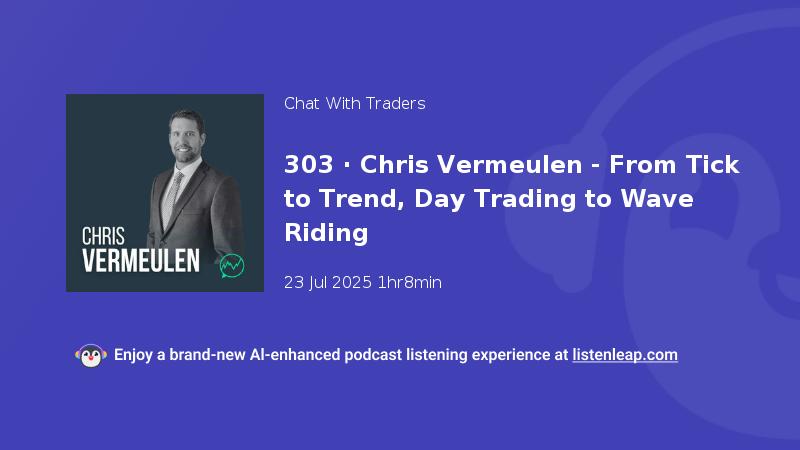
In today's episode, my co -host Ian chats with a position trader, entrepreneur and author.
What happens when a teenager growing up without TV in rural Canada stumbles across CNBC in a college dorm and sees people making up to $100 ,000 in a day.
For Chris Vermeulen, that moment changed everything and kicked off a 25 -year -long journey of trading triumphs, painful losses, and profound strategy shifts.
Chris has been through the tech bubble, the 2008 financial crisis, and everything in between, but he doesn't chase headlines or hype.
he follows price, momentum, and something most traders overlook entirely, market vibration and cycles.
From blowing up accounts to walking away from day trading altogether, Chris now rides the market's waves with a calm, calculated edge, making just five to 12 meaningful trades a year, knowing when to sit still and wait for the right wave. His approach might challenge what you you believe about risk, emotion, and diversification.
Ladies and gentlemen, we're so pleased to introduce Chris Vermoulin from Canada.
Well, Chris, I'd like to welcome you to Chat with Traders.
Thank you very much. I appreciate being here and yeah, I'm excited to talk to markets and trading.
Fantastic. So where are you now and where did you grow up?
I am just north of Toronto.
So I'm in Canada, about an hour and a half north up on the Great Lakes and beautiful, beautiful country.
Lots of fresh water and mountains and hiking trails, fishing.
Oh, good, good. And what initially attracted you to the markets?
It's an interesting story because I grew up in the country and we never had TV.
My parents had a satellite dish, but they never subscribed to it.
So I grew up playing in the woods, hunting, fishing.
I lived out in the country.
We had ponds and I played a lot of paintball and other sports, but never really had TV growing up.
And so when I graduated from high school, I went to Toronto to college for business administration and I got hooked in my dorm room on TV.
There was speed vision and there was CNBC and both of them were awesome.
I used to of build and make stuff growing up so i love to love to invent stuff but uh i got hooked on this and this is watching people on cnbc and day traders making 5 10 100k a day in some cases i was like this is this is what i want to do um so that that's kind of like a high level how it kind of somewhat got hooked on it but how i actually really got hooked on it was in when i was 16 in high school this was the initial hook that got me into it actually which was my dad had got this package from Larry Williams, which is a it was a marketing booklet on how to trade futures, you know, pork bellies
and all that stuff.
I had no idea what futures were, but I read this and I grew up in an entrepreneur family.
So I look at everything.
I'm like, how can we make money?
I used to have my own little landscaping job in the summer as a kid.
And so I read this thing on futures like 10 times, if not more.
And I told my dad, I said, Dad, we have to get to trading futures.
We can make like 50 grand a week.
It's super easy. It's super fast. And of course he kind of laughed and he's like, yeah, he's like, no, we're not going to get into futures.
He's like, I'm going to continue to do what I do, but he's like, keep learning.
And so I kept learning about the markets.
And then it wasn't long after that in high school, we had a finance class where we had a stock market challenge.
And back then all the tickers were printed off of the newspaper.
And so you go through the thousands of tickers and we'd randomly pick one as a classroom.
We made like one hundred and eighty thousand dollars in a semester with play money.
And that opened my eyes.
I'm like, OK, well, you don't need to do futures.
We can just do stocks and we can make a ton of money, like one hundred thousand dollar account.
We made a ton. So that got my teeth wet.
And then that led to when I graduated from high school from that finance, one of those classes.
When I got to college, I got stuck on CNBC and And I just couldn't shut it off.
That was my TV show.
That was like my game, my sport, my hobby, my passion.
And so I've been doing this since I was 16 years old.
And yeah, I've just come full circle of trying almost every style of trading there is and kind of learned to where I am today.
Did you have any other friends that were doing this at the time?
Or were you kind of the lone wolf?
And what did your dad think of your enthusiasm?
and was he investing in the markets?
Yeah, my dad's never invested in stocks.
He's never been into the stock market at all, still doesn't to this day.
He runs his own businesses.
He was big into real estate.
He had about 1 ,600 doors at one point, had dental clinics, had hearing clinics.
Him and my mom had a bunch of good stuff going on.
So they never got into the stock market.
It was totally new.
He didn't know anything about it really, nor did I at the time.
So he thought it it was interesting.
I mean, he's always motivated.
Both my parents have always been like, follow your heart, do what you love.
And I grew up learning to work hard and I'd always help my parents.
My sister and I would help my parents run their businesses and stick flyers in the doors and go to events and work the booths with them and all that stuff for their various businesses.
So my dad just was like, you know, keep learning.
He's always like, just keep learning.
And so I grew up, my dad always had cases of cassettes in his car back in the day.
And of course, all the motivational speakers and all how to make money on real estate.
So I was kind of like drowned in motivation.
My parents used to drag my sister and I to Zig Ziglar in Toronto.
I got up on stage once with Zig Ziglar when I was like 12 years old.
So I grew up in, I would say almost like a perfect bubble in terms of surrounded with entrepreneurs, starting businesses, helping them, seeing how much work and effort goes into it.
And then also understanding you need mentors and you you need motivation.
You need all of that stuff.
And it just creates that, a perfect breeding ground for an entrepreneur.
So when, when did you first open up your very first trading account?
I was 18. So I was my first year of college.
I turned 18. It was with E -Trade and I had my, I had to get my dad to co -sign because I was underage.
I'd saved up $2 ,000 and we're, we go to Florida.
We have a place in Florida every year for Christmas and New Year's.
We You go for usually three to four weeks.
And I bought Palm Pilot.
This was like back in the tech bubble.
And I put all my money into it.
I'm like, this is it.
The charts are like, and I came home on holidays, never even looking at it because I was just like, I'm just going to buy it and go on holidays.
I came back and had like $8 ,000.
I was like, this is amazing.
I sold it. I cashed out.
I was like, you know, that's almost the worst thing you could do as a trader is have a grand slam on your first trade because now it's like sets the wrong expectations.
but anyways, I took, I took that money and I, I took courses in Toronto.
I went to weekend seminars on trading.
I met some people I'm still working with today, um, uh, in trading and stuff that I learned at these, um, uh, seminars on how to invest and how to read charts and all that stuff.
So, um, it was really good.
So, uh, after that, uh, first, uh, victory, uh, what did you move on to then as far as trading did you jump into a bunch of other tech stocks and what what time frame what year was this exactly uh what year was it i think it was year i think it was 1999 or 2000 i can't remember what okay what year it was i jumped in and traded it so that was a random trade i just remember seeing palm pilot on cnbc they're like it has a pen on on it.
You can write on your phone.
I mean, it was earth -shattering back in the day, right?
So I just bought it because their ads were like, I'm like, this is going to change the world.
So I bought it because it was pure emotional.
I just liked the product and I wanted one.
But really, I had no real core strategy at that point.
So I took that money and I put it into taking a course.
I spent like $2 ,000 on a course from another company in Toronto.
and it was based around a lot of like technical indicators how to how to use specific indicators moving averages how to identify like finding the best stock to buy that's in an uptrend and then selling covered calls on it and so I did that for quite a while while the stock market was still ripping higher you could make back then with a covered call I mean geez you could make eight to fifteen percent every month you lose you lose your shares but you make it on your on on your option trade, right?
It was amazing. So I kind of got into that strategy because that's what I learned.
That was the first thing I learned from like educated, you know, professionals, it ended up backfiring and the tech bubble unfolded.
I blew up my account.
I had no idea how to trade a falling market.
Everything looked like it was a steel and you buy it and it keeps falling until you lose everything.
And so I was buying and part of this course I bought this program I took was to buy really solid companies on fundamentals.
So you do a fundamental search first. Their software was really good.
You find a company that's growing quarter after quarter, sort it out, figure out which one you like, and then you go to the technicals.
You look at the indicators.
Is it in an uptrend more or less is the basic thesis.
If so, then put it through the software, look at the covered calls, which one can provide you the best return each month with the covered call based on the current volatility.
And then we put those trades on.
So it was deep Deep down, it was still fundamental based with a little bit of technical analysis and then with trading options.
So when the markets rolled over and everything went down, a long -only strategy doesn't really work.
You end up selling covered calls.
You still have your shares, which have dropped dramatically in value, 20%, 30%, 40%.
Some of them fell even more than that.
And so it doesn't really work.
So I went from believing in buying strong companies to going, I really don't care anymore more, what the company does or how strong the fundamentals are.
I just want something that's going up in value.
And so I follow price action.
I follow momentum. And if something's going up, I'll take advantage of it.
If something's going down, I'll find a way to take advantage of it as well, or I just don't hold it.
So, I mean, all of this was a big learning curve.
I lost, I blew up my whole first account.
Thank God I spent a lot of it on education.
I bought a lot lot of CDs and DVDs on trading courses.
I took day trading courses and you name it.
I just spent all the money on education because I've always been taught, learn.
The more you learn, the better you are, the more rounded you are.
It will never hurt you knowing too much information.
So I always put money into trading courses.
And I did, believe it or not, the first course that I bought, I had met met a group of people at this this weekend presentation in toronto about how to trade i became really good friends with these they're much older than i was i was only 18 and they were like in their 40s 50s but i would find all these amazing courses i'm like guys this looks amazing this goes with what we already know and so i'd be like hey let's split on it so we'd buy these like thousand dollar courses but there'd be four of us that split on it and then we all take it together right because we were all local so it worked out
really well we got so much education and we'd support each other.
We still chat to this day here.
We are like 25 years later.
And so, yeah, we just kind of help each other and spread out the educational curve and we'd all learn from each other's mistakes.
And so while the bear market is was unfolding over what, a good year and a half, two years, almost, I believe during that time, what What, did you get introduced to short selling during that time?
Or was it too scary to get into, like many traders like to avoid that?
What was your take on it?
I learned about it, but I never short sold.
I was too young. It had endless risk.
I don't think my account was even set up for it.
I don't think I was allowed to at that point.
I never started short selling until the 2008 financial crisis.
Then we made a lot of money on the way down.
But I was much older then.
It was several years later, a decade under my belt almost of trading and following the markets made a huge difference.
But no, I would more or less during the first crash, that was my first bear market, always thinking the market's about to rally.
Every dip, every further push down is like, oh, this has got to be the bottom, right?
It just keeps going and going for years.
So I was buying and buying and buying, and everything just kept falling.
And I was doing some put options.
So I'd buy a put option when the markets would fall.
I had the occasional little grand slam or little hit here and there, but never enough to offset my natural long positions, hoping the market's going to find a bottom any day.
How long were you taking these courses all the way through the bear market?
And kind of like, when did you, after you blew up your account for the first time, when did you get back in?
Yeah, so I mean, believe it or not, I still take courses.
I see somebody with a course that looks like they have a little golden nugget that I might not know.
And I'll spend a couple thousand bucks.
I'll take their course.
If they have one little thing I don't know or that improves my edge a little bit more with my current strategies, I mean, I'm all for it.
I love learning stuff.
So it's never ended.
It never will end. I think if you don't constantly evolve and improve, you're going to be left behind.
So you might as well stay on the ball and keep on running.
And so what was your other question there?
Yeah. So when you got back into the market, you blew up your first account and then kind of when did you get back in and what did you do differently this time that you weren't doing before?
Yeah. So I still had the account.
I had like, you know, a hundred bucks or something in it.
So I, through that time, I had some other savings.
I threw another thousand dollars in and started to trade.
And that was, I mean, pretty much I blew up my account.
And then probably like two months later, I put in another $1 ,000 after I kind of scraped it together, saved up and stuff, put that money in and kind of just worked away at it, inching away.
But back at that point, I was into trading micro -cap stocks like penny stocks and into miners and things like that.
And so it was very fast, very leveraged.
It worked out pretty well.
Well, I had one grand slam trade that I ended up buying some warrants on.
And overnight, it was like 120 something.
I think it was about $127 ,000 I made overnight on one penny stock.
Total fluke, not skill.
What was your investment in it?
I can't remember what it was, but I bought it for like two cents or something.
And it went, it gapped up the next day, like a buck 45.
Oh, my God. So it was huge.
That's a home run. Yeah, it was a financial newsletter doing a typical pump and dump back in the day.
So it lucked out in my favor that I was like, holy crap, this guy totally just marketed to his newsletter.
And I just remember waking up, calling the broker.
I'm like, how do I sell?
How do I sell all this?
Because I had warrants, right?
I had a piece of paper.
I'm like, how do I convert this to money?
And I had called around to all kinds of different brokers.
I'm like, can I open an account with you right now and sell short my shares to neutralize it?
Because i'm i'm worried it's going to collapse it's a pump and dump right that's my that was my thinking which it ended up being um and so i couldn't do it i ended up having to wait like five days i had to put the paper in get copy shares to like convert to shares i ended up selling at a buck 35 or buck 36 uh a couple a couple different tranches a couple blocks i sold out but um yeah it was that that was what really finally i had a big trading account and i was i was young I was like, okay, I need to really focus and I need to know what's going on, follow some rules.
So that was my kickstart.
And I think if you trade long enough, eventually you do have a couple of good Grand Slam trades that just work out really well.
But again, sometimes those are just fluke and they're just luck.
You put in the time, usually luck will fall into place here and there.
there. Yeah. Yeah. So, so after that incredible experience, were you totally sold on these microcap stocks?
And I mean, you'd think you'd want to just jump in, go all in then, right.
Because you found the lucky solution to making money.
A hundred percent. I would say I've lost more money in micro stocks than I ever made.
So as you know, they are super volatile.
Most of them are just like a dead company with a piece of ground and they're marketing it or whatever it it is.
Right. So I would say over like the next 15 years, whenever I get into these little companies, they kind of implode or they don't go anywhere or they get bought out or they roll from a mining company to something else like they're just it just it's not my thing.
I definitely learned you can make a lot of money, but most it's almost like you're a venture capital in those things because you have to have 20 of them and one of them has to nail it because all the others are going to go broke or never really pan out.
So I'm not a huge fan of those.
But I went through a phase where I thought that was it.
I was loaded up. I had warrants on many companies.
I have tons of penny stocks.
That was one of the phases.
So when I eventually learned, I'm like, you know what?
I don't like this. It's not consistent.
You can waste years holding onto these companies.
And then they just kind of disappear, get delisted and things like that.
So that was one of my next next phases.
So the first one was fundamentals.
You can own companies that are growing quarter after quarter, yet their share price still gets cut in half.
And then a year later, it's cut in half again.
So fundamentals, I don't believe in really in terms of trading.
I'd rather follow something going up.
The next lesson was super volatile and risky cheap stocks are really dangerous.
Yes, they can pan out, but most of the time they don't.
and so I went from like you know trading big tech companies and really and growing quarter after quarter and blowing up everything then going to little companies that have no earnings and they're super cheap and then losing everything again so I kind of had to be like okay I'm playing both ends of the spectrum I got to figure out like there's got to be something in between this and so that's kind of when I got away from penny stocks and I moved into ETFs were just starting really become popular in 2001, 2002.
We're starting to see them pop up.
And I really like them.
I like the index ETFs.
They just move stable and they kind of move like the ocean.
They're not all over the place, like these little penny stocks up 20%, you know, down 20 % in one day or something like that.
I want something more stable that I could be consistent.
And I took a course that that started to teach us about um cycles and and waves like um noise in the market so my mom was in the hearing aid business so i learned a lot about hearing and wavelengths and sounds and all that stuff well this guy brought in his his skills which was in noise and cycles into the stock market and i'm like he's like the stock market is just a vibration of the masses who who are following it and watching it.
And he explained it and taught him like, I totally get it.
It's like, it's a tuning.
It's like a tuning fork.
You take one tuning fork beside another one, you whack one, it'll start to move the other.
Well, that's kind of the vibration of what investors are thinking and feeling and what they're doing gets transferred like into stocks.
And so stocks move up and down with, with more or less investor sentiment and the, the energies that are moving around the money.
And so that got me really, this was in 2001.
This is where I, I started to implement cycles.
I started to implement things around position management and trends, longer -term cycles going up while there's other shorter -term cycles coming down.
I started to decipher what are buying opportunities, smaller cycle dips within a larger upward cycle.
And so that's a strategy that has evolved for the last more or less 24, 25 years.
It's what I use now specifically.
And it's very, very powerful.
So I've learned to figure out the vibration of the masses of the market participants.
And there's many, many ways to do it.
And you need to calibrate a lot of different parts to come out with it.
But it tells us what's going on in the markets and how to navigate it.
And so I'm a huge fan of cycles.
I'm a huge fan of Fibonacci theory, which Fibonacci values are pretty much in everything in the universe and clouds and the stars and flowers, you name it.
Like Fibonacci is a very powerful sequence and there's the golden the golden sequence, which is the six one eight retracement or extension.
And I use it all the time for price targets and support levels.
So I started become very much more technical driven.
There's underlying forces at play that we need to make sure we is in line with our analysis and our targets and trends.
trends. So you seem to indicate there that you were looking at different kinds of cycles of what different asset classes.
I mean, the market, are you looking at, say, just the S &P 500 or within sectors within the market?
Are you looking at commodities or anything else?
Yeah, share with us.
Trading futures might sound complicated, but here's the thing.
Everyone starts somewhere.
Plus Plus 500 Futures could be your first step if you're ready to dip your toes in.
With Plus 500's powerful platform, you can access a wide range of markets.
S &P 500, NASDAQ, Bitcoin, natural gas, Forex, metals, crypto, and more all in one place.
The platform is simple, intuitive, and mobile -friendly so you can trade from anywhere, anytime.
Open your account with Plus 500 and start trading with as little as $100.
Plus 500 offers an unlimited, risk -free demo account packed with real charts and tools to help you practice and build confidence before jumping in with real money.
With over 20 years of experience and over 30 million global customers, Plus 500 is your trusted gateway to the futures market.
Click on the link in the description to open your free account.
Trading in futures involves the risk of loss and is not suitable for everyone.
Not all applicants will qualify.
Hey, I got a great update from Trade the Pool.
now it's even easier to get funded.
As you know, Trade the Pool built a unique program to evaluate stock traders like yourself and provide you with the company's funds to trade with.
It's real shares and you no longer need to worry about the PDT rule.
But that's not all.
Trade the Pool has introduced a new tier with $20 ,000 in buying power, making it easier to pass the evaluation and speeding up the process of getting funded much faster.
You don't want to miss this opportunity.
opportunity with the venmo debit card you can venmo everything your favorite band's merch you can venmo this or their next show you can venmo that visit venmo .me slash debit to learn more the venmo mastercard is issued by the bank or bank and a pursuant to license by mastercard international incorporated card may be used everywhere mastercard is accepted venmo purchase restrictions apply yeah so i i mean there's a lot of angles to look at so i i one of the cycles is time cycles just you know what i like about the stock market and i learned this from the very first course I ever took when I was like
18 in Toronto, was the stock market, the stock indices have wave -like patterns.
There's reoccurring news that comes out weekly or biweekly or monthly or every quarter or every six months, every year.
There's people who get paychecks of all those same frequencies that naturally put money in every paycheck into the stock market.
market. Economic data rolls out on specific times all the time.
And so there's natural flows, ebbs and flows that go in the stock market.
So once I kind of learned, OK, the stock market has these natural tendencies, then I start to apply what you just mentioned there, Ian, which is I start to bring in other cycles, which are what are the stock market price actions doing?
What are are various assets doing?
So for example, the gold is a very strong barometer of global fear or global, you know, lack of fear.
Sometimes gold goes sideways for years and the stock market rips higher.
Other times like right, you know, where we are kind of now, which is gold has been rocketing higher in 2025, early 2025, and the stock market has been struggling.
And so gold is one of those cycles I like to look at.
Is it outperforming the stock market?
If it is, be aware there's probably something big looming, not just a little correction, but a global massive potential correction reset of some sort.
I like to look at utility stocks.
I like to look at, you know, the U .S. dollar.
I like to look at bonds.
There's a whole bunch of different things.
And as you know, Ian, the financial markets are all connected in some way.
If money is flowing out of one asset class, it's probably flowing into something else.
And depending what it's coming out of and going into also tells us the mindset.
So if people are moving out of gold, for example, and into small cap stocks, we're like, OK, well, they're not afraid anymore.
So they're bringing it out of boring old, you know, pet rock gold, and they're moving it into highly leveraged, fast moving stocks for growth.
So depending where it's coming from, where it's going, it tells us what the market participants are thinking and feeling, and even more importantly, what they're doing with their money.
And so I have about 11 different asset classes and sectors and and things and commodities that I follow that lets me like, it's almost like playing poker.
I get to look at the market participants hands.
I go, okay, I know what they're thinking and I know why they're doing it.
I know where they're putting their money.
And so when you can see somebody's hand and see what they're doing and how they're betting, you can start to get some very good insight of how to counter that or take it, like take advantage of it.
So that's, that's what I do.
And there's cycles in all of these, everything has its own cycle.
You have to figure out what it is and how it moves and its relationship to various assets.
And then you can label it.
Is it a risk on or risk off asset is, you know, things like that.
Is there you mentioned money flowing out of one asset into another.
Is there a way to look at the charts and the data to see, OK, this is actually really money coming out of this asset rather than the buyers have kind of exhausted themselves and there's not many new buyers, but the sellers are also kind of light.
In other words, declining price, declining prices on, on kind of like I'm in a vacuum where there's not much interest. And are you, do you look at the, the quality of the gain or the decline to determine how much assets are flowing in or out?
I don't so much, like, I think you're referring to, if money's coming out of something and it's heavy, heavy volume, then you definitely know there's a lot of people dumping and distributing.
They want out of that asset.
But if it's really drifting down, just the lack of buyers and there's some sellers wanting to move out, believe it or not, I don't really use volume for my analysis.
Yes, it can tell you if people are piling in or out of something.
But instead of using volume for that, instead of looking at just one asset class saying somebody's dumping gold, a whole bunch of people are dumping gold, I'm like, like okay I don't I just know gold's going down and I look at all the other asset classes and I look at the majority of them so are the majority of them moving down telling us say for example people are moving into risk on assets so all the risk off assets are going down if the majority of them are that's my volume indicator the majority of people tucked away in these safer assets are moving out of them because they want more and so that to
me is like is the volume indicator saying it doesn't matter where they're hiding their money where they felt safe they're moving moving out of it because they want to make more.
So that is my kind of indication of this is a strong wave because it's not just money coming out of gold.
It's money coming out of four other asset classes, and it's all piling into one specific asset or like risky stocks type of thing.
You mentioned Fibonacci before, and many traders have heard that term and the numbers that pop out as a result of that.
Could you go into more detail?
How are these numbers created and why is it important?
Some people think, oh, this is just made up nonsense.
What is this Fibonacci anyway?
It seems like mumbo jumbo.
Could you describe what's its importance in our daily life and how was it found?
Yeah. It's a little beyond me.
The best thing to do is for people to go and just watch a, watch a quick YouTube video of the Fibonacci, how it's in things.
But more or less, it's a sequence of, of, of, of price of expansion and contraction that repeats in the universe.
So for example, if you have something that moves you know has a specific move, the next move that it should make is a S is 61 .8 % of the first move.
And so it creates this sequence.
And a lot of of people, if you Google Fibonacci theory or Fibonacci, you'll see like a shell shape kind of where it coils in.
And it just happens to be like the universes and cloud structures and flower structures and waves and everything like that kind of flow through the sequence.
I'm not really sure.
A lot of people see it as voodoo and, you know, I don't get into the planetary alignment, like, you know, Venus is in retrograde, sell short.
But Fibonacci has been proven.
It's in so many many things and I've seen it and I use it all the time and it works exceptionally well.
So it's worth looking in and just getting a little of insight.
And then to me, the two key numbers for Fibonacci is the 618 and the 100%.
So whatever the first move is, when the next move starts, it should equal the same one.
Those are the two levels.
I take first profit target, second profit target and rinse and repeat.
But yeah, it's, it's there's something in the universe.
I don't know know if people get actually put a thumb on it, right?
It's just something that happens.
It's kind of out there, but it's there.
Right, right. From my understanding, it was just a natural occurring phenomenon that we observe in nature, mathematical relationships that we apply to the market.
And for many, it seems to work quite well.
Could you go back to just 2008 and how that that unfolded for you and kind of what did you see back then that um made you either get out of your positions and or go short and um how you applied uh technical indicators during that time period yeah sure so kind of leading up to there there's a couple interesting stories because stock if you understand the stock market and the economic cycles that play you can benefit a lot lot more than just trading stocks.
So, for example, in 2005, I had started my own line of healthcare products, built a dealer network across Canada, United States.
And I built up this business.
It was it was it was booming, doing very well.
My dad and I had started it together.
And I was also running a trading newsletter back then for really I've been running a trading newsletter since 2001.
At first, it was just a community of all of us trying to learn what to do.
Eventually I figured stuff out and I started charging a subscription fee.
So I've been doing newsletters for a long time, but long story short is I built the healthcare business, our brand name.
And I was also trading the stock market and business started, was just starting to slow down for our healthcare business.
I'm like, you know, you know, I told my dad, I said, I'm not really loving this.
I'm getting tired of it.
It's like three years.
We've had a really good run and we've had it on as seen on TV, one of our products and all that stuff.
I said, I make more in like a month and like I, you know, trading with my newsletters than we do with this business.
And I'm like, I'm kind of ready to like just move on and sell it.
And I said, we should, you know, it looks like the economy, all my analysis was saying the economy is coming to an end.
Like to look like there was a financial crash.
This was in 2007. I said, we should just move on.
I'm like, I don't like it.
And I want to focus on my newsletter.
There's some crazy times coming.
And I started to pick up.
I was following. I still do.
I follow economic data.
I love charts and trends of housing and interest rates and everything in that space to get a feel of how the economy is doing.
And it's funny because my dad's like, sure, whatever you want to do, he's like, I'm on board. And so we sold it and everything unfolded as expected.
We kind of sold it near the peak of the business and at the peak of the economy.
And then the 2008 crisis hit and everything collapsed.
And of course, that was when I got into learning to short sell.
There was also some inverse ETFs back then.
So instead of going short, you just buy an ETF that goes up as the market goes down.
But more or less, I was looking at a lot of different relationships.
I was looking at the price of gold.
I was looking at the transportation index, which you can't really use anymore the transportation index because everything in the world now is shipped with Amazon and all these transportation companies.
Shipping is picking up.
Even if the economy slows down, it's growing, booming.
So typically, the transportation space is a leading indicator.
If the transportation space slowed down, business sales are slowing down.
There's less sea containers going.
There's less shipping and all that stuff.
But now the shipping space is still growing by leaps and bounds.
So you can't use it.
But I use a lot of these things in price action to figure out, OK, this market is getting weak.
Valuations are out of whack.
Everybody's super bullish.
Everyone's bought stocks.
They're buying leveraged long ETFs.
They're buying call options galore.
They're buying real estate at nosebleed pricing.
It was just a greedy, greedy time.
And I could just see the end is coming.
I'm like, it can't keep going like this.
And the data is showing things are eroding.
And so that was when I started paying attention to the stock market rolling over.
and it did. It cracked to the downside and had a 20 % initial drop, and then a dead cat or a bear market rally.
And then it went off a cliff and continued to sell off about 57%, the S &P 500.
And I was running a newsletter then.
We were trading inverse ETFs.
And every time the market would roll over and start to fall, we'd buy another one of these funds.
I wouldn't necessarily short.
I would short some of my own stocks in my own account.
But through the newsletter, letter.
We just bought inverse traded funds.
And so that's how I was lucky enough that I made enough money during the financial crisis that I retired when I was 27 from the financial markets and selling the health business.
And I was able to just focus on managing my money, which is where I'm at today.
I just manage my money and I share what I do with others.
But trading a falling market, as you know, is a very different beast than a bull market phase.
and people don't realize how quick and violent it is.
Pretty much you get into a trade and the market falls in your favor.
You want it to fall.
Those trades are short -lived.
They're like five, 10 days.
The market drops very quickly and you got to get out because as you know, bounces and rallies in a bear market are the strongest rip your face off rallies you'll ever experience.
And you do not want to be short for any longer than you have to.
So it's like get in, hit your target or two, get out and just be happy and wait for a whole new setup to unfold over the next month or two.
You see, you have to be very patient and selective in a bear market.
Mm -hmm. So your experience in the 2001 crash and then in 2008, did that create a kind of a psychology of bearishness, being more pessimistic about the markets than optimistic?
Or were you just simply trading what you saw on the charts?
Because you mentioned that you follow the news as well, economic news and stuff.
So were you swayed by the either negative or positive news that countered what you would see in the technical indicators?
Yeah, you bring up a good point.
So in the 2000 tech bubble crisis, it was more so driven on fundamentals and option ways to buy stocks and sell, sell options on it, which didn't work out over the next several years, good leading into the 2008 kind of market top.
I took a, I learned a lot.
I went from fundamentals to like, just teach me tech. I want to learn technical analysis.
I got into, you know, John Murphy, he's got his big thick book Bible, the technical analysis of the financial markets.
I read that a few times.
And, um, so I had been working on technical analysis for a long time.
I use stockcharts .com.
I was one of the top people there or the top shared list for many, many years sharing my analysis.
And so I use the technical analysis to figure out the big picture of what's going on.
The big thing, the takeaway I learned from the 2000 tech bubble was you have to follow price.
If something is going down, get the heck out or have a strategy to profit from it falling.
If it's going up, you want to own it.
And so coming around second round for the next bear market in 2008 was, OK, if this market is going off a cliff, I definitely do not want to hold anything.
I want to profit from falling pricing or move to a different asset that goes up while the stock market falls.
And so I did have a very bearish bias, but I trade strictly the charts.
That is where I really deviate.
So I mean, I could be very bearish or bullish on something, but I'll actually be in the the opposite trade.
I can be still bullish on the stock market, but actually have an inverse ETF because I follow price.
So I might think a bottom is coming.
And I'm like, guys, I think a major bottom is coming, but I'll still be short because the price is going down.
So people need to be able to differentiate what you think and feel is happening versus what the charts are doing and what I'm actually doing.
So a lot of times, I'll be like, I'm really bearish on the the market, but we're actually still long because it's still going up.
And so that's where people need to deviate.
And so I don't let news get in between what I do.
Yes, the news might build my bearish story, for example, and the fundamental data that could be weakening on stock, sales are slowing, the economic data could show unemployment starting to rise and delinquencies on mortgages starting to pick up and credit cards.
So it builds my bearish bias, but I still have to wait for price to roll over, and for all the other asset classes and sectors to also confirm that, hey, money's moving away from risk on.
They're moving to defensive pockets of the financial space.
And that's telling me that, OK, we need to be very aware because smart money is getting out of stocks and moving into more defensive plays.
Utilities are a typical one.
We usually see utilities rally very strong and outperform the stock market for a few days or potentially a couple of weeks before the stock market has a big leg down.
And that's simply because people are like, if the market's going to roll over, they want to move into companies that are going to still be needed.
You need running water.
You need electricity.
It's the same with consumer staple products.
XLP is a consumer staple ETF.
It usually does well or holds up or goes higher when the markets have a bit of a pullback.
So it's just keeping a track of what all those things are are doing, but a hundred percent, don't follow the news.
Don't follow your emotions, follow price.
That is the biggest takeaway that it will differentiate you from winner or loser over the long run.
Uh -huh. Um, so are you, uh, day trading these, uh, uh, equities or like, how long are you holding onto them and how, how do you know when to get, when to get in and when to get out?
Yeah. So I, I used to day trade.
I mean, I used to run a full, you know, all day futures day trading chatroom.
That's all I did for many years.
I day traded the S &P 500.
I day traded the Dow Jones.
I moved away from that.
I don't do any day trading anymore.
If there's a perfect setup, I'll throw a little futures trade on.
Opening gaps, I do occasionally, or the end of day, like a little short squeeze if I see the perfect setup.
But really, most of the trades I do now, they're kind of like a position trade.
So trades might last a couple of weeks, all the way up to like five or six months.
And the way I look at the stock market now, because I really just trade the indices and the bond market and currencies, those major core asset classes, I look for the market to move in waves.
So the way that I look at the stock market is, in all assets, is like the ocean tide.
If the tide is going up, what happens to all the boats?
They all go up. So the stock market is the same.
If we're in a bullish environment, the tide is going up.
You can throw a dart, most stocks are going to go up.
If the tide's going down, you don't want to hold stocks.
And this is where people get things wrong.
They're like, I own a tech ETF.
I've got an AI ETF.
I've got Microsoft. I got this stock.
I got that stock. They're like, I'm diversified.
I'm like, just so you know, FYI, those are stocks.
They're all the same trade.
When we go into a bear market, they're all going down.
And the The smaller the individual asset, so the stock index might fall 50%.
Well, a sector might fall like 70%.
An individual stock might fall 80 % to 95 % in the bear market.
And so people think they have all of these diversification with sectors and stocks.
I'm like, you have no idea what's going to happen to your portfolio if we go off a cliff.
You're holding the most volatile pieces, thinking they're your safe haven and your diversification, and people don't get that.
that. It's, you know, the buy and hold strategy is a ticking time bomb for retirees right now.
Guaranteed, you'll never retire early with the buy and hold.
You need 20, 30, 40 years to make real money.
Diversification is very dangerous.
So you don't buy into the idea that, you know, just buy and hold the S &P 500 because it always goes up in the long run, right?
You know, that's That's the mantra.
Yeah. Well, I mean, yeah, I mean, you never know.
Probably it will continue to do that.
But, for example, if you're close to retirement right now or in retirement, if we go into something where the markets go down 30, 40, 50 percent and they take five or eight or 10 years to come back, that's not a very fun ride for somebody who's retired, depending on growth, depending on income, watching their wealth vaporize and having like five or six years with no return.
It is very dangerous.
And I don't believe that's a very good strategy.
And the whole buy and hold with diversification is another problem, because what happens is half your portfolio might be in something going up, like stocks.
And the other half could be in bonds, which aren't going up.
They're going down or vice versa.
The gains you make in one are neutralized by the losses of the other.
So my whole mentality is like, let's find the asset class that's the strongest and that's moving up.
Let's move our money into it.
When it stalls out, let's move our money out and look to where another asset class is moving up.
So we move into stocks as the stock indices as a whole, or we move into bonds, or we move into a currency, or we just sit on the sidelines in cash and earn our 4 .5 % with no downside risk until something has a setup.
And so that's what I focus on is we're always holding something going up.
And even cash, cash is a position, and it does go up.
you make your your daily interest and your your monthly dividend payments depending on the type of cash position you're in but you're growing and you're avoiding volatility so uh you know i'm just not a fan of of diversification i'm not a fan of the buy and hold it's just a it's a real gamble the closer you are to retired from your retirement the more risk you have the more damage it's also going to do uh so it's that's what i'm trying to protect people from because if we go into a financial reset, which I believe we're headed towards, there's no better time to hurt the majority of investors right
now. Most people are 50 plus who are invested in the markets and they're going to feel the pain at the worst possible time in their life when to lose their money.
So you day traded for quite a few years.
What incentivized you to transition to more of a position type trading, holding positions for weeks or months as opposed post -a -day trading?
Yeah, good question.
So running a newsletter, active traders, as you know probably, the more you trade, the more likely you are to lose money.
Trading is not easy.
Unfortunately, active traders tend to have, in general, they're very emotional.
They tend to lose and struggle.
They can't follow strategies because the news scares them out and they've skipped trades or don't want to get out of a loser because they don't want to be proven wrong.
wrong they won't get out of a winter because it's working it's like it's i you do you work with enough of these people for enough years and you have a lot of nasty emails people always seem to take it out on whoever reaches out to them at the wrong time of the day uh so i kind of just like i decided i i built up enough wealth that i'm like you know what i just want to i have a whole lot of other things i want to do i i invent things i've got multiple other businesses going knowing I just want to manage my large amount of capital in the easiest way possible, where I have the fewest trades per year,
I can make the highest possible return with the lowest risk.
That has been the strategy I've been evolving, improving since 2001.
And really, I only have five to 12 trades a year.
And all the signals are done at the end of day.
And we figure out when, if there's a signal.
We enter the next day at the open.
It allows us to all just live our life, do the things we want, and pull money out of the market without all the emotions and without the news and the stress.
We could care less what the president does and tariffs and the Fed does and all that stuff.
It doesn't matter because we just follow the price action.
Our strategy says, hey, things are getting weak.
Move out of this asset.
Things are getting strong.
Move into this asset.
Here here are the targets.
Here's how we manage portfolio allocation.
And so I really just went into hitting a level where I'm like, I don't want to put up with all this kind of BS of dealing with everybody, holding hands, and it's super fast paced.
And I wanted to just do things that I like and still manage my money.
And one ETF or two ETFs, I can manage my entire portfolio because you just put it all into SPY or QQQ or TLT or whatever it is.
And I like those big, big moving beasts because they're liquid.
They are consistently moving.
We have enough gauges that we can track when a trend is starting and finishing relatively accurately.
And I want more free time.
I've got two kids. I had two kids come into the picture and we've got two dogs.
And life changes a lot once you have kids and you realize there's more to life than just glued to a screen and working, you know, trying to make day trades.
I don't like hunting for trades.
I I like to sit back and watch trades roll in like waves.
So as I talked about the tide before, Ian, I see myself because I'm a surfer and kiteboarder and I love the water.
I see myself as like a surfer floating in Florida, just out past the breaks of the waves.
And what are those surfers doing when they're just sitting there floating?
They're waiting for a set of waves to roll in, which come in every five minutes or so when you're sitting out in the ocean.
Well, that's what I do with the stock market.
it. There's five to 12 waves that roll through these assets that we follow every year.
We see them coming in advance.
So there's never a surprise.
We hop on the wave that fits our criteria, fits our asset kind of hierarchy that we have, our strategy.
And we hop on and we ride that wave. We can tell how strong it is.
And the nice thing about hopping on a strong wave is you can also tell when it's starting to get weaker.
So you can start trimming off positions, locking in gains, moving our stops up you're mentally preparing yourself going this is getting weak we're going to it's going to end soon or we're probably going to have our trailing stop or just the trend exit signal because it stalls out and so that's where I'm at so now you know my days are check the markets in the morning and I check them in the evening and you know it's 5 to 12 trades a year isn't very much very manageable you can do a lot of other stuff.
Yeah so could you share a little little bit with us about your process, how you get into trades and what you, how you get out of them and do these indicators or signals or process help to give you the patience that maybe we can all use to stay with that position and not jump out prematurely?
Yeah, it's definitely, my strategy is in a sweet spot that is very uncomfortable for most people.
So for example, example, you've got active traders who love the action.
They think they need to trade all the time.
They think the more you trade, the more you make.
They like really fast moving stuff.
That is actually a pretty dangerous way to attack the markets.
And then you've got the buy and hold investors with advisors, or they just, you know, buy stuff and hold forever and they're diversified and they hold dividend stocks and things like that.
That is really dangerous too, because you're you're really just at the mercy of the markets.
After the 2000 tech bubble, it took 16 years for the NASDAQ to come back to break even.
That is a bloody long time to make no money, lose your money twice, but it fell over 50 % both times.
I think one was 82 % and the second one was 50 something percent.
It is a very painful ride.
You get a very average low return with the buy and and hold.
So what I do is kind of stuck right in the middle.
It's, it's just a little, there's a little activity, five to 12 portfolio allocation changes a year.
So it's almost doing nothing, but it's just enough to, to catch these waves that roll through, but we're not actively trading.
We're not in and out every month.
We're not doing a bunch of stuff.
Um, and so what happens is we get into, uh, potentially a trade.
It might last a few weeks.
It could last, um, up to like seven seven months.
And then we go to cash.
We could be in cash for a month or two, waiting for another trade.
And so the trades are pretty boring.
We move into like an index ETF, like SPY and QQQ.
We ride that. Our whole account goes up with the market.
When it moves in our favor, we close it out once the trend or targets have been hit.
And then we sit in cash, collecting interest, waiting for the next trade setup.
And it could be months.
So the active trader thinks it's like pulling teeth.
They're like, we're never going to make There's not enough trades.
And the passive investor who's never done anything before, they're like, whoa, this is way too active.
So I'm definitely in no man's land.
I have to twist arms of investors to get it and be like, this actually isn't that active.
And then the active traders, I'm like, guys, if you just slow down with your trading and focus and have a proven strategy, you can actually pull money out consistently every year.
So the strategy that I would say is position trading.
And it's focused 100 % on technical analysis, sentiment, and price like position management.
So price action is number one, the most important.
We need to make sure the trend is in the direction we want.
And we have to make sure it's a strong enough trend.
And we use a lot of different tools and indicators and many cycles need to be aligned for that.
if that meets our criteria then we look at sentiment we look at about 11 or so different asset classes different ratios and what money's doing between currencies and sectors and commodities and things like that if enough of those meet our criteria then we're like okay so the trend is up we have the proper mindset people are moving their money into this direction to further support it money's coming out of many other places to feed into this one asset class that we like and then on top of it, once we get into that trade, then we actually manage our position.
We're not just like buy and hold.
We actually like focus on, we do have a target and we, we sell some of our position when it's working out.
And then we can put that money over into a cash interest earning position.
So it's still trickling and growing a little bit, but without any downside risk.
And we let that trade in that trend mature.
And sometimes those trades and will, will last six, seven months.
And we scale out as it continues to go higher.
We move our stop up, and eventually the trend comes to an end.
And then we take a look at what's next.
If stocks aren't favorable now, where do we go?
Usually, bonds have worked very well in the past, not since the COVID crash, because we're in a rising interest rate environment.
So bonds haven't been anything we're really trading.
There will be a time they come back into play, but it's been more so the US dollar index, or it's just been a cash position.
So it's been kind of been running without one of our core assets working in our favor, which is the bond market.
But that will eventually, I think, come around.
But that's kind of how we go about doing it.
You need all three of those pillars.
You need price, you need sentiment, you need position management in order to have an edge and have something that is repeatable with proper setups in the markets.
Excuse the last interruption here.
This is Tessa. We hope you're enjoying this episode so far.
If you love the podcast, please give Chat with Traders the best review you can on whatever platform you're listening from.
This will help us to keep the episodes coming.
Also, if you haven't subscribed to our email list, please hop on to chatwithtraders .com and click on subscribe so we can keep you posted of information that may be of importance.
Thank you. Now back to the chat with with our guests.
Go into a little bit about position management.
I mean, if you see something that looks really good and you're dealing with ETFs, wouldn't you want to go all in?
I mean, what, what describe what position management's about?
Yeah. So position management is it's about managing how much you can lose.
I always, so, I mean, I, I blew up three trading accounts starting.
So the first one I blew up was through the tech bubble.
The other two were through futures trading.
One of the last futures trading account I opened, I blew up the same day I got it funded because I was still in revenge trading mode.
And I was just, I'm like, the market has to turn around.
I was day trading and I just, I just totally blew it up.
And I hit bottom after that one and I didn't trade for months, but that was when I learned I hit the wall saying, okay, OK, I need position in risk management.
And it was actually right around the same time my family had also gone bankrupt.
So I literally hit bottom and I saw our whole family hit bottom.
And things hit me in a big way.
And so when it all came together at the same time, that was when money risk management is critical.
And so the next time I went into the markets, it was always about how do I quickly reduce exposure as quick as I can lock in some gains and move the stop up.
And then if it wants to keep on going, if that trend is strong, it'll keep running and I'll be able to lock in more gains.
So now when it comes to position management, the more something is volatile, like if it can move faster, we'll put a smaller position size into it.
So, for example, like in, you know, in 2025, the markets are pretty volatile.
Same within 2024, all kinds of random news events, big price swings up and down.
when the markets have faster and bigger moves and what we'll do is instead of going 100 percent in as you mentioned Ian into the stock market even though we have a buy signal for it we'll be like no we're actually going to keep you know say 40 percent cash just on the sidelines generating our four percent interest and we'll put in 60 percent instead of putting it all in because the markets are moving way faster and we don't want to step into something really volatile with a bunch of landmines and get hit.
So when things carry more risk and there's more uncertainty in price whipsaws, you have to step back and scale your position size down to counter that.
So if the markets are 30 % more volatile than normal, we probably want to cut back our portfolio allocation to that, probably 30%.
So if it makes that move, it's not going to hurt us so bad.
During 2008, for example, volatility was through the roof.
Price was super fast moving, we would actually cut our position size in half.
Only half our portfolio would go into these trades, but we'd double our profit targets and we'd double our stop losses because you need that wiggle room.
You got to let that market breathe and wiggle.
Understanding that is really critical.
What I do with our strategy is as the markets become more volatile, we move to slower and slower asset classes.
So for example, the stock market is typically the most volatile.
Bonds are usually less volatile.
Currencies are half that of bonds, if not less.
And then cash position really isn't any volatility.
So what happens is when the markets get crazy, we start moving down our asset hierarchy to slower assets, looking for one that meets our criteria.
And sometimes we just sit in cash, which is the opposite of what everyone else does.
Typically, when the markets go off a cliff and volatility takes off, you've probably seen this.
Everybody starts trading options.
They're all trying to swing for the fences.
They're like, I got a 2X and 3X inverse ETF.
They jack up their leverage.
When volatility has already increased, you don't need to do that.
It's already built into the markets.
But people blow their heads off with leverage at the worst possible time.
Yes, if you hit one of those, you make a lot of money fast but that's not the reality of the markets.
I see the markets as always trying to take your money, super dangerous, only stick your toe in the water when you have an ideal setup and risk is controlled and you've got strategy in place and if it goes and backfires against you it's not going to like be a huge hit on your account.
Everything needs to be in a controlled manner.
I don't want to risk my lifestyle.
I don't want to risk my trading account.
I'm all for gains. I'm all for big gains, but I'm also focusing on if you don't take big losses, you don't need big gains to have very big success.
You just need consistent growth year after year if you don't have the big losses.
So that's what I focus on is how do we pull out 10, 15 % every year on average and not have any of these big losses that devastate us and becomes very consistent and comfortable.
And eventually you get addicted to it because because you're like, oh, it's so nice not to stress about what's going on in these markets.
Everyone's stressed right now in the markets.
And, you know, my team and I were just in our people who use our strategy.
They're like, this is like so nice to just watch these markets and not really have to worry about what's going on because we have a game plan for either direction that it goes.
And we're expecting wildness.
So with the market currently after after this post -tariff bounce that we've seen in the market and the VIX being quite low.
Are you pretty fully invested in stocks because the volatility is so low and now is a good time to get in?
Or what are you looking at right now?
Yeah. So we are fortunate.
Our strategy told us to get out early this year before the market rolled over.
We sat on the sidelines because nothing met our criteria.
Well, the whole market fell about 20%.
It fell about 18 % from where we we got out.
And now we're back long in the market.
Well, not 100 % in the market.
Volatility is high.
We actually have a lot of our indicators warning us of a financial reset of a bear market starting.
So we're not 100%. We're 60 % in equities.
And 40 % is just in a cash position, just earning interest right now because there's lots of volatility.
When the market falls 20 % and rebounds 20 % very quickly, I mean, that's a fast -paced market.
We don't want to risk too much. So we scale back.
But we are long both the S &P 500, the NASDAQ, because the trend is kicked back up.
And I'm expecting it to stall out and roll over.
But really, we have to let the market do that first. And people are really starting to get bullish in the current environment because we're up near the highs again.
And typically, you just got to get everybody really bullish.
And that's usually right when the market rolls over.
And we're seeing that.
All the aggressive sectors are moving up, money's piling into the ARK ETFs and the uranium stocks and Bitcoin and all that stuff.
Typically, when everybody piles into the really aggressive stocks and sectors is usually when the market starts to roll over.
And we're starting to see that.
But I think there's still some more upside left in this market before we might start that bear market phase, which the economic data in our long term cycles are pointing to like, you know, a pretty dreary looking second half of 2025 and 2026.
So to wrap things up, what do you struggle with most as a trader?
I would probably say, I mean, when it comes to trading, my biggest struggle is dealing with other traders because I deal with thousands, I help thousands of traders.
So, I mean, the markets I can walk through, I don't, They don't stress me out at all, but I find it difficult to hold the hands of several thousand investors because there's always new ones rolling in.
They don't fully get what we're doing yet.
They need time to be like, oh, I see the value.
I see why you do it this way.
Like usually it takes with my strategy about nine months for people to go through a market experience like the one we just had and be like, holy crap, I see exactly why what what you do and why you do it.
We get out of before the markets crash because your strategy shows when things are starting to turn down.
We can make money while the market falls.
And then we can get back long and catch this rally up, even though everybody says a bear market's coming.
And so my biggest problem is just trying to deal with the emails and the comments of people naturally get pretty ugly during volatile sell -offs or rallies that they missed.
More people get angry, actually, when they miss a rally than And they'd rather take a loss than miss a rally.
So it's just hand -holding investors, right?
And sometimes the comments get under my skin and it's tough to like try and stay positive and keep educating when people are poking at you and trying to tear you down, right?
But other than that, knock on wood, I don't really struggle with anything other than just trying to help people and trying to just stay with a really good group of traders and educate them to get what I get.
Once they see the light, they're like, oh, this is amazing.
Yeah. Yeah. Well, Chris, I'd like to thank you for coming on Chat with Traders.
Oh, thanks for having me.
It's a pleasure to talk markets and strategies and hopefully people get some insight from this.
Yeah. And how can our listeners get in touch with you?
Yeah, the best way is to go to thetechnicaltraders .com or just search me on YouTube, the technical traders and uh they can follow along and see what i do on the charts i share my screens every day in the morning of what's going to happen through the day and um there they can copy the trades that i do if they want to follow along fantastic great thanks for coming on the show thanks ian pleasure you've reached the end of this episode of chat with traders But rest assured, there are more episodes loaded with real market insight and zero hype on the way soon.
So to stay updated with each great new release, subscribe to the podcast and iTunes, and we'd love it if you'd leave a rating and review.
We'll catch you next time on Chat With Traders.
The Force will be with you.