The unmissable news stories of the day.
This is the beijing hour, examining the events that impact and shape china and the rest of the world.
This is the beijing hour one hour of news and information brought to you every weekday.
Now here's your host, shane begum, with you on this wednesday, november 19th 2025.
You're listening to the beijing hour coming to you live from the chinese capital.
On today's program, China calls for international vigilance against militarism, following Japan's controversial remarks on the Taiwan region and nuclear weapons.
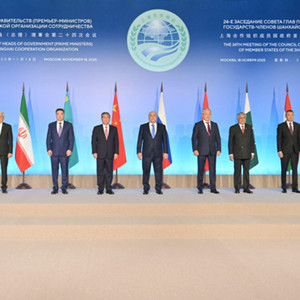
The Chinese premiers called on the Shanghai Cooperation Organization members to make greater contributions in global governance.
The U.S.
House has overwhelmingly supported a bill to release the Epstein files to the public.
In business, China criticizes the revised U.S. patent rules.
In sports, action on the track at China's 15th National Games.
In culture and entertainment, the Art Without Walls movement in Shanghai.
Now checking the day's top stories.
China is urging the international community to thwart any attempts to revive militarism and to safeguard the post-war international order.
The call comes as the world marks 80 years since the victory in the Chinese People's War of Resistance against Japanese aggression and the anti-fascist war.
A spokesperson from China's foreign ministry said Japanese militarism has frequently used the so-called existential threats to justify its aggression.
The Chinese official stressed that collective self-defense rights under the UN Charter were to safeguard international security and prevent the revival of fascist forces.
Japan was restricted from exercising those rights after World War II.
Here's a look at the wars Japan waged using what it called existential threats as an excuse.
It attacked the Qing government navy in 1894 in what's known as the Sino-Japanese War, claiming that military assistance on the Korean Peninsula to quell the Donghak Peasant Rebellion threatened Japan's security.
Japan won that war in the following year and seized Taiwan through the Maguan Treaty.
In 1931, the Japanese army blew up a section of a railway in Shenyang and blamed it on Chinese troops in order to justify a full-scale invasion.
The September 18th incident marked the beginning of the Chinese people's war of resistance against Japanese aggression.
On July 7th 1937, Japanese troops stationed near Lugua Bridge, also known as the Marco Polo Bridge, on the outskirts of Beijing, demanded entry to nearby Wenping County to search for a soldier that allegedly went missing.
The Chinese military refused before the Japanese bombed the county seat and the bridge, triggering China's full-scale resistance against Japanese invasion.
Japan once again claimed its empire's existence was in danger when it attacked Pearl Harbor in 1941.
Ray Addison explains China's outrage at recent Japanese comments and moves.
Real concern is that the the remarks made by the prime minister of japan are similar in tone to those used prior to previous attacks by japan on china, including back in the events which ultimately led to world war ii.
Japan's new prime minister has been described as an energetic nationalist.
We know that she's visited a japanese war shrine in tokyo more than once.
It not only honors japan's war dead from World War II, but it includes convicted World War II criminals.
So that's quite a serious situation.
She's also called for discussions to restore a controversial World War II military title, which had been removed after the events of World War II.
So it's concerning to China that Japan is adopting this stance, particularly after Article 9 of its own Constitution, which was written in about 1947, forever renounced war as a sovereign right for Japan and also renouncing the threat or use of force as a means of settling international disputes.
Well, China says it's been watching the rise of the right wing in Japan for a long time and it will never allow the Japanese militarism to return.
That was Ray Addison reporting.
China says Japan's not qualified for a permanent seat on the United Nations Security Council, addressing the UN General Assembly's annual debate on Security Council reform.
Chinese Ambassador to the UN, Fu Tsong, condemned Japanese Prime Minister Sanae Takeuchi's remarks about the Taiwan region, saying they violate Japan's commitments to peaceful development.
Sanae Takeuchi's remarks on Taiwan are extremely erroneous and dangerous.
The remarks represent blatant interference in China's internal affairs, are a severe violation of the one China principle and the spirit of the four political documents between China and Japan.
They are an affront to international justice, the post-war international order and the basic norms of international relations.
They represent a blatant departure from Japan's commitment to peaceful development.
Such a country is totally unqualified to seek a permanent seat on the Security Council.
United Nations has reaffirmed its commitment to Resolution 2758, which states that the People's Republic of China is the sole legitimate representative of China and its government the only legitimate representative.
Also speaking at the General Assembly meeting, a North Korean envoy said Japan has no right or legitimate reason to seek a permanent seat on the UN Security Council.
The North Korean official said Tokyo has been denying its crimes against humanity and distorting history.
He accused Japanese politicians of insulting victims in Asia and denying the victory of the world anti-fascist war with their visits to the Yasukuni Shrine, which honors Japanese war dead, including convicted World War II criminals.
The North Korean envoy urged Japan to fulfill its moral responsibility and international legal obligations.
We asked Professor Chu Chung at the Belt and Road Research Center of Minzu University of China about the post-war international order and Japan's role in it.
When we look at Japan's recent remarks on the Taiwan region through a historical lens, do you think Tokyo is deviating from the commitments it made under post-World War II documents such as the Cairo Declaration and the Potsdam Proclamation?
And how should we understand Japan's obligations under these agreements today?
I think there's a bit of misunderstanding about the attitude of Japan, not only on Taiwan, but also on the whole legal framework after the Second World War.
Japan actually, as a nation never actually tightly closely followed the arrangement of the post-war arrangement, even about their commitment to the whole world, to the United States, to all the alliances, the victory countries.
According to the Cairo Declaration and Boston Proclamation, Actually, Japan will have to return all the occupied land to all the alliance or victorious country, including Taiwan of China.
And I think this is the legal obligation as a legal comparative that the Japan need to do.
And they have to accept that, no matter you're willing to do it or not, as a failed, lost country, you have to do that.
It's sometimes it's like your commitment, but also it's like your obligation or your punishment.
But currently some far-right politicians in japan are frequently saying the wrong thing is like when taiwan have something, then japan need to get involved.
I think this kind of assertion not only violated one china principle, but also this is a open betrayal of all the legal documents after the Second World War.
It shows that one issue or a Taiwan problem is just one excuse.
It's just one startup for Japan to deviate from all the arrangement and the commitment after the Second World War.
That was Professor Chiu Chung at the Belt and Road Research Center, Minzu University of China.
Japan's travel sector has taken a hit after the diplomatic fallout with China.
Kyoto News reports that hotels in Tokyo have experienced increased cancellations after China issued a travel alert.
Mainichi Shimbun newspaper says Osaka has also seen a large number of reservations cancelled.
A hotel in Japan's Aichi Prefecture has reported mass cancellations from Chinese tour groups.
Nearly 30 group bookings and 1,000 guests have changed their minds so far this month.
Local businesses have expressed concern I'm very worried about losing Chinese customers.
They account for 20% to 30% of our total customers.
There used to be Chinese customers all day long, but there is only one order from Chinese customers left today.
The decrease in the number of customers is a problem.
Figures from Japan's transport authority show that more than 8 million Chinese travelers visited Japan in the first 10 months of the year, making up the largest share of foreign tourists.
And Chinese customers also accounted for nearly a third of all tourist spending in Japan in the first nine months.
Insiders estimate that the tensions in bilateral relations could cost Japan's tourism industry 2 trillion yen, or roughly 128 million US dollars, within a one-year period.
An atomic bomb survivors group in Nagasaki says it'll issue a formal protest of Takeichi's insinuated revisions of Japan's 54-year-old three non-nuclear principles.
Officials from the city struck by nuclear weapons are warning that any shift on the principles will deepen Japan's reliance on nuclear deterrence and undermine global disarmament efforts.
Sanae Takeichi's remarks have triggered outcry and protests in Taiwan.
Scholars say the words are intentional and aimed at reviving Japanese militarism.
I tend to believe Sanae Takeichi did this deliberately.
Why?
Because, before she made these remarks, her cabinet meeting had already extensively discussed revising or abandoning the three non-nuclear principles.
It's clear that Takeichi is using the false issue of something happening to Taiwan to stir up disputes between China and Japan.
That's why I say she did it on purpose.
Taiwan is the pawn and tool she's using.
To many people in Taiwan, it just looks like Sanae Takeichi is creating trouble.
She's asking for trouble on Taiwan's behalf.
She made these remarks for Japan's right-wingers and Japanese militarism, and in the end, Taiwan might have to bear the consequences.
I believe more and more people in Taiwan will publicly express their dissatisfaction with Sanae Takeuchi's dangerous remarks.
Such remarks are not new.
Japan has a history of avoiding self-criticism regarding its militaristic past.
Now, Takeuchi hopes to use the Taiwan question as a means to revive Japanese militarism.
The specter of Japanese militarism has been lingering, lurking for a chance to emerge.
Now is the time when they reveal their true, aggressive nature.
Analysts and insiders in Taiwan say the island shouldn't fall for Takeuchi's comments, which are political rhetoric inciting cross-strait relations.
They also accuse Japan of harming the interests of the people in Taiwan, as the island marks 80 years since its restoration as Chinese territory.
Zhou Jiaxin spoke with analysts about the post-war international order and the legal basis of the One China Principle.
Taiwan's restoration to China is a legal fact inscribed in the history of the Allied victory in World War II, remaining integral to the post-war international order.
Politicians seeking to split Taiwan from China reject or distort historical facts.
Fact 1.
Japan's surrender in World War II triggered a series of legally binding documents that returned Taiwan to China.
The Japanese instrument surrender in 1945 referred to the legal foundation for territory arrangements and the post-war order as cited from the Cairo Declaration.
The US-UK-China endorsed document says all the territories Japan has stolen from the Chinese, such as Manchuria, Taiwan and Penghu Islands, shall be restored to the Republic of China.
Fact two in October 1949, The People's Republic of China became the sole legal government representing all of China.
Its sovereignty and territory, including Taiwan, have remained unchanged ever since.
China actually underwent a change of government without any alteration to its status as a subject of international law.
The fact has been confirmed, actually under the international law, through UN General Assembly Resolution 2758 and other subsequent universal.
Denying world legacy or undermining post-war order poses a grave threat to peace in Asia, from separatist provocation and external interference in Taiwan to the so-called 2016 arbitral award on the South China Sea.
In fact, China's historical basis for the claims could date back to its Han Dynasty.
2000 years ago, Following the Cairo Declaration and the end of World War II, the Chinese government restored sovereignty over the islands from Japan.
A naval fleet was dispatched to the Xishan and Nanshan Islands in 1946, conducting ceremonies.
The four warships central to such mission called Taiping Zhongye, Yongxing and Zhongjian, were later immortalized by having their names assigned to the four largest and most strategically vital islands in the South China Sea.
Similarly, those commanders involved in the operation were honored through the geographical nomination, such as Hong Xiu Da and Dunqian Sha Zhou.
Naming reclaimed territories demonstrated a very clear political message to all over the world.
So such claims, ever since that time, is constant, unchanged, and undeniable.
As the world marks 80 years since the victory over fascism, China's message is clear.
Not an inch of sovereignty will be ceded.
The post-war order will not be overturned.
That was Joe Jiaxin reporting.
Coming up, China calls on SEO members to help reform global governance.
Tesla is accelerating its shift away from components made in China, the American automakers pushing suppliers to eliminate China-made auto parts for cars built in the US within the next year or two.
But why now?
Is this strategy due to political pressure from Washington, or is it preparation for a more aggressive trade environment?
And the bigger question, is this even possible?
We'll also look at how this could reshape Tesla's business in China, where the company has long enjoyed policy support and unmatched efficiency.
How this push for de-cynicization may affect U.S. automakers' global ledge.
Get all these on this week's Chat Lounge, wherever you get your podcasts, and on CGTN Radio.
Sixteen minutes past the hour.
Chinese Premier Li Cheng has stressed the significance of the Shanghai Cooperation Organization in building and reforming the global governance system.
In his speech at the SEO meeting of the Council of Heads of Government, Premier Li also called for the organization to leverage its unique strengths.
He appealed for the SCO to make greater contributions to global governance.
The Chinese premier said the organization should focus on key areas of development and security.
He said China stands ready to work closely with member states to establish the SCO Development Bank and propose the establishment of a China SCO cooperation center for metabolic diseases.
He also called on the SCO to stimulate strong vitality for innovation and transformation.
Also in Moscow, Premier Li met with Russian President Vladimir Putin.
Dasha Chernyshova has more from Moscow.
We have seen the discussions being focused on how to beef up economic and trade potential of cooperation between the two countries, as well as within the framework of the Shanghai Cooperation Organization.
Now we've heard Chinese Premier Li Jian saying that China is ready for more cooperation in trade with Russia and Moscow reaffirming that it is ready for that as well.
The Russian president has said in the meeting with Chinese Premier that Moscow will soon be facilitating the travel regime for the Chinese residents, making sure they will go to Russia visa-free.
That is expected to promote even more entrepreneurial spirits between the two nations and enhance contacts.
We also understand that the sides are going to cooperate deeper in the areas of investment agriculture, as well as energy.
And the Russian president has been saying that both Russia and China are playing a very important role in making sure that trade barriers are lifted within the framework the seo, and that is actually something that is helping establish the seo as a much stronger heavyweight in eurasia.
We also hearing the russian officials insist that the gdp share of the seo countries globally is going to reach 35 by the end of 2025 and that chair is expected to grow even further.
All that is expected to be beneficial for the well-being of people who live on the territories of those states.
That was dasha chernoshova in moscow.
The Shanghai Cooperation Organization member states have rejected all unilateral and coercive measures that violate international law or impede international cooperation.
They issued a joint communique pledging to firmly uphold an open, just and non-discriminatory multilateral trading system.
They'll also push forward with improvements to the global financial governance system and enhance the role of developing countries in international financial institutions.
Following his attendance at the SCO event in Russia.
Premier Li Cheng will be paying an official visit to Zambia.
China-Zambia relations continue to grow, with their partnership focused on trade, major infrastructure projects, job creation and a shared vision for growth.
Daniel Aratmoy reports.
The diplomatic ties between China and Zambia started back in 1964, right after Zambia won its independence.
Back then, China helped Zambia establish build the Tazara Railway, a huge project that gave the southern African country a vital link to the sea.
Zambia's founding leader, Kenneth Kaunda, famously branded China an old weather friend, a reliable ally that provided crucial support during the anti-colonial struggle.
The investment is enormous.
Like just a few months ago, the fertilizer plant 300 million was being commissioned, thereby making Zambia a net exporter of fertilizers for the first time.
High-level visits have upgraded the relationship to a comprehensive strategic and cooperative partnership.
This means a much deeper collaboration, spanning everything from debt resolution to new green technology.
A crucial part of this push is trade.
China recently opened its enormous market of 14 billion consumers by removing all tariffs on Zambian exports.
This, coming up in 2024, has translated to the growth in terms of the bilateral trade between the two countries, which has increased to almost like US4 billion just from the time the zero-tariff schedule was implemented.
The partnership which is evolving has been dominated by large-scale infrastructure and industrial projects, many falling under China's Belt and Road Initiative.
The Kafu Gorge lower hydropower project, built by Chinese contractors, has significantly boosted Zambia's electricity generation capacity.
Another key project is the new Simon Mwansa Kapwepwe International Airport, engineered and constructed by the Aviation Industry Corporation of China.
But this partnership is also shifting gears.
It's moving past its roots to focus on something more vital, value addition.
Experts say the new goal is simple helping Zambians turn their raw materials into finished products before they leave the country.
This means more jobs, more local factories, and more economic stability.
And the focus is also increasingly green.
China is working with Zambia to boost its clean energy supply with new solar technology, reducing the country's reliance on hydropower.
That was Daniel Ratmoy on China-Zambia cooperation.
Chinese customs authorities say preparations are basically complete in the final month ahead of the new special customs operations in Hainan.
The General Administration of Customs says a regulatory system involving key policies and operational guidelines is in place.
China expects the Hainan Free Trade Port to serve as a global gateway for its opening up in the new era.
While visiting Hainan Province earlier in the month, Chinese President Xi Jinping urged the southern island to deepen coordinated development with the Greater Bay Area.
He also called for enhanced connections with the Beijing Tianjin Hebei region and the Yangtze River Economic Belt.
With more, I earlier spoke with reporter Wan Hongjia.
The president called for the free trade port to pursue coordinated development and deepen cooperation with other clusters in China.
How do Hainan and regions such as the Greater Bay Area and the Yangtze River Delta complement each other?
Well Shane.
When President Xi visited earlier this month, he emphasized that Hainan should play a leading role in advancing high-standard opening-ups through strengthening coordinated development and deeply integrating into the Belt and Road cooperation.
So Hainan is being positioned to forge a new development paradigm that works with and for these major city clusters.
Building on its natural strengths and free trade port policies.
Hainan's role is often summarized as three zones and one center.
That is, a pilot free trade zone, a reform and innovation demonstration zone, a national ecological civilization pilot zone and an international tourism and consumption center.
These national missions naturally link Hainan with other regions.
For the Greater Bay Area, the complementarity lies in openness and innovation.
We all know that GBA the Greater Bay Area, is China's hub for high-tech industries, advanced manufacturing and global finance.
Hainan, with its zero-tariff rules and simplified customs procedures, offers a platform where the Greater Bay Area companies can cut costs, test new business models and reach Southeast Asia more efficiently.
But with the Yangtze River Delta, the synergy is in talent and research.
Hainan provides a policy environment that complements the innovation strengths of Shanghai, Jiangsu and Zhejiang.
We have seen that in Yazhou Bay Science and Technology City, several universities and institutions from the Yangtze River Delta have already set up laboratories.
Hainan is becoming a rising engine for the whole country, a place where the tide of openness lifts all boats.
What efforts are regions across China making to ride Hainan's wave?
And what have they achieved together?
Yeah, what we've seen now is that provinces across China are not just watching Hainan's development.
They're actively plugging themselves into the momentum.
And this is happening across sea, air and land.
Take the Guangdong, Hong Kong, Macau, Greater Bay Area as an example here.
At sea, the city Zhuhai has rolled out the drone trade shipping model with Hainan's Yangpu Port.
Domestic and international cargo can now travel on the same vessel and transfer overseas without repeated customs checks.
That's cutting logistics time and costs for exporters.
Oh, in the air, prostrate drone delivery has brought the time from five hours down to 19 minutes.
On land, provinces are setting up joint industrial parks to use Hainan's 30 value-added processing policy.
That is to say, the products that gain 30 added value in Hainan can return to the mainland tariff-free.
As of July this year, 50 companies have joined the pilot across 10 sectors, from food and pharmaceuticals to petrochemicals and jewelry.
So this is forging a new regional industrial chain made in Guangdong, value-added in Hainan and sold worldwide.
That was Wen Hongjia in Hainan Province.
Coming up, U.S. lawmakers have voted to release the Epstein files.
At 26 past the hour, the U.S.
House of Representatives has overwhelmingly approved a bill requiring the Justice Department to publicly release its files on convicted sex offender Jeffrey Epstein.
The measure passed 427-1, with a lone no vote coming from Louisiana Republican Clay Higgins.
Lawmakers from both parties voiced strong support as they left the Capitol.
California Democrat Ro Khanna, an early backer of the Epstein Files Transparency Act, said Americans are sick and tired of powerful men escaping accountability.
I mean, it was sick to create a rape island where young girls were taken and trafficked.
And it's a horrific moment in our history.
It is going to be something we have to grapple with as a nation.
I do think when these files come out, from what I've heard from survivors, it's going to shock people that we allowed this to happen, that these rich and powerful people were so divorced from ordinary American values.
He added that survivors believe the disclosures will be shocking.
Tennessee Republican, Tim Burchett, urged Congress to stay focused, saying lawmakers too often move on to another shiny object.
Moments after the House vote.
Senate Majority Leader John Thune said his chamber will act swiftly on the bill.
At the United Nations Climate Talks in Brazil, negotiators are being pushed to work late as pressure mounts to reach a breakthrough on the future of fossil fuels.
The COP30 summit, held on the edge of the Amazon, is urging countries to agree on phasing out or transitioning away from oil, coal and natural gas.
Although the meetings are scheduled to run through Friday, the Brazilian presidency is pressing delegates to deliver an interconnected deal sooner, including on four major issues that weren't originally on the agenda.
Meanwhile, a broad coalition of developing and developed nations is calling for a clear global roadmap to move the world beyond fossil fuels.
Jiwo Abdullahi is the Minister of the Environment and Climate Change of Sierra Leone.
For countries like Sierra Leone, which are some of the most vulnerable countries around the world.
You know, 1.5 is a survival issue.
It's not just a climate issue.
It's an issue of our very existence.
And the argument is sometimes made that moving from fossil fuels is just a climate issue, but it's also an economic issue.
Colombia's environment minister also emphasized that the urgency of the climate crisis leaves no room for delay.
United Nations World Urbanization Prospects Report says Dhaka Bangladesh, is on track to overtake Jakarta as the world's largest city by 2050.
Björk Sandkjaer is the Assistant Secretary General for Policy Coordination at the UN Department of Economic and Social Affairs.
Sustainable development requires integrated planning that treats cities, towns and rural areas as interconnected and interdependent.
So we need to recognize the unique role of all settlement types and our policies need to be tailored accordingly.
Population experts say 45 of the world now lives in cities, a share expected to rise globally by 2050.
Two-thirds of global population growth will occur in urban areas, with rural populations beginning to decline.
At 29 past the hour, Beijing down to zero Wednesday evening.
It'll be sunny in 12 on Thursday.
Nanchang 6 overnight, then sunny in 16.
Also in Asia, Islamabad's at 10 overnight, then sunny in 22 for Thursday.
BNTN will see a light rainfall in 15 overnight, then overcast in 23.
Phnom Penh will see moderate rainfall with a low of 20 overnight.
Tomorrow's overcast in 26.
It's time for a short break.
So far this hour.
China calls for international vigilance against militarism following Japan's controversial remarks on the Taiwan region and nuclear weapons.
The Chinese premier has called on the Shanghai Cooperation Organization members to make greater contributions in global governance.
And the U.S.
House has overwhelmingly supported a bill to release the Epstein files to the public.
Shane Bigamuthi, stay with us here on the Beijing Hour.
Shh, listen up.
And you hear the heartbeat of our world.
It's vibrant and pulsating with the essence of life itself.
From the stem of trees to the gurgle of rivers.
From the silent strength of mountains to the icy whispers of glaciers.
Even the solid ground beneath our feet.
And right there, Ever wondered what's actually going on in Africa through the perspective of an African?
How are things really going between China and Africa?
What's the narrative of this relationship?
Well, get a perspective with China Africa Talk.
Hear from African diplomats, entrepreneurs, academics, Chinese natives and more.
Get on our wavelength every week to find out what's real with China Africa Talk.
Find us on your favorite podcast.
We'll see you there.
Examining the events that impact and shape China and the rest of the world.
This is the Beijing Hour, one hour of news and information brought to you every weekday.
Now here's your host.
Shane Bigum with you on this Wednesday.
Still to come.
In business, China criticizes the revised U.S. patent rules.
In sports, action on the track at China's 15th National Games.
In culture and entertainment, the Art Without Walls movement in Shanghai.
To contact us, you can email radio at cgtn.com or follow our ex-account at cgtnradio.
But now with the check of the day's headlines, here's Tian Liu.
Thank you, Shane.
China says Japan is not qualified to seek a permanent seat on the UN Security Council.
Foreign Ministry spokesperson Mao Ning, criticized Tokyo for failing to fully atone for its World War II aggression, citing controversial visits to the Yasukuni Shrine and a distorted view of history.
Beijing also condemned Japanese Prime Minister Sina Tokaichi's recent remarks on China's Taiwan region, demanding a retraction and warning of severe countermeasures if Japan continues on this path.
Meanwhile, China has suspended imports of Japanese seafood.
Mao Ning said Japan failed to provide the promised safety and regulatory documents.
Coupled with Takeuchi's controversial statement.
The spokesperson said Japanese seafood would not find a market in China anyway.
More than 90 of respondents to a multilingual CGTN poll believe Japan should reflect on its historical crimes and fully respect China's sovereignty and territorial integrity.
More than 88 of them say Japan's prime minister is finding excuses for military expansion by linking the so-called emergency in the Taiwan Strait with self-defense.
An official from the Taiwan Affairs Office of China's State Council says the poll suggests that history is not forgotten and cannot be rewritten.
She urged Japan to immediately stop interfering in China's internal affairs and its provocative actions.
The spokesperson also called on Taiwan compatriots to crush interference and safeguard the interests and security of the Chinese nation.
Israeli Prime Minister, Benjamin Netanyahu, says Israel is determined to disarm Hamas in Gaza and complete the war on all fronts following the latest violence in the occupied West Bank.
The comments came after a Palestinian attacker stabbed an Israeli to death and wounded three others, before being shot by troops.
The attack follows recent settler violence, including a rampage through the Palestinian village of Al-Jabbar, which drew rare condemnation from Netanyahu and other Israeli leaders.
Officials, including U.S.
Secretary of State Marco Rubio, warned the unrest could threaten the fragile truths in Gaza.
Netanyahu's latest comments come a day after the U.N.
Security Council gave its backing to U.S.
President Donald Trump's blueprint to secure and govern Gaza.
Macau is aiming to further diversify its economy and deepen integration to national development in the coming year.
That's according to a policy address from Chief Executive Sam Ho-Fai, who also pledged to push ahead with administrative reform and improve people's livelihoods.
The special administrative region will improve the business environment, enhance cooperation with regions on the mainland and contribute to the development of the Guangdong-Hong Kong-Macao Greater Bay Area.
The chief executive also vowed to build a collaborative, accountable and efficient service-oriented government.
The United Nations says global efforts to cut methane emissions are falling far short, despite the gas's powerful role in driving climate change.
Methane traps around 30 times more heat than carbon dioxide, but stays in the atmosphere for only about 12 years, meaning fast cuts could quickly slow warming.
Martina Otto, who heads the UN Commission on Methane Pollution, says current national climate plans would lower methane emissions by just 8 from 2020 levels by 2030.
Without action, emissions are on track to rise 13%.
Obviously decarbonisation will give us methane benefits as well, obviously.
If we are fast on a just energy transition, this will obviously bring down methane emissions by about a third, but not fast enough for the near-term benefits to kick in.
And that's why we need at the same time to pull that other lever as well.
The U.N.'
's global methane pledge calls for a 30% cut.
Otto says momentum is growing, but far more effort is needed.
Scientists say methane and carbon dioxide emissions have risen about 4% in six years.
Thank you very much.
That's Tianlu with headlines.
Coming up in business, China criticizes the revised U.S. patent rules.
Thank you, Shane.
Stock markets on the Chinese mainland closed mixed on Wednesday.
The Shanghai composite was up nearly 0.2%, while the Shenzhen component remained almost flat.
Fisheries and precious metals were among the top gainers.
The Hong Kong stock market also ended lower as the Hang Seng Index decreased nearly 0.4%.
In Japan, the Nikkei also declined over 0.3%.
The Chinese Commerce Ministry says the United States' recent revision of its patent rules constitutes a discriminatory restriction on the legitimate rights of Chinese companies.
The United States Patent and Trademark Office revised transparency rules related to patent invalidation petitions, with a particular focus on applications submitted by entities with foreign backgrounds.
The ministry says the move, made in the name of national security, has violated the United States' international obligations on intellectual property protection.
The ministry added that China will follow all developments closely and will safeguard the legitimate rights and interests of Chinese companies.
The Turkish branch of the Industrial and Commercial Bank of China has launched Turkey's first renminbi clearing bank, making a new milestone in China-Turkey financial cooperation.
The launch follows the decision of China's central bank to authorize ICBC Turkey as Turkey's RMB clearing bank.
The ICBC says the RMB clearing bank aims to build a high-speed corridor for RMB use between China and Turkey.
Chinese Ambassador Jiang Xuebin says the bank will further facilitate the use of RMB in local settlement financing and trading.
In recent years, China-Turkey cooperation has maintained steady momentum.
Bilateral trade has grown rapidly, reaching nearly US43 billion in 2024, while China's stock of direct investment in Turkey stands at US32 billion.
China has already become one of Turkey's largest trading partners, with full-year trade expected to reach a new record.
China now has more than 18.6 million electric vehicle charging piles, up 54% from a year ago.
About 4.5 million are public chargers, while over 14 million are private.
Last month, China unveiled a three-year plan to expand its EV charging network.
The plan aims to build a nationwide network of 28 million charging facilities, with public charging capacity exceeding 300 million kilowatts by the end of 2027.
The US equity market is seeing intense pressure and a tech-led sell-off this week due to concerns over an AI bubble and anticipation of Nvidia's earnings report due later on Wednesday.
The pressures have also weighed on Bitcoin, which fell below a key level for the first time in seven months.
Mitch McCann has more from New York.
Alphabet's Sundar Pichai has done a wide-ranging interview with the BBC where he talked about the exponential growth of artificial intelligence.
And the context here is that much of the recent losses that we've seen on Wall Street have been driven in part by fears that AI companies may be overvalued and the bubble could be about to burst.
Now, for example, the NASDAQ, the tech-heavy index, is down more than 3% in the past week.
In this interview, Pichai told the BBC that the growth of AI had been an extraordinary moment, but he also said there with some irrationality in the current AI boom.
He was asked whether Google would be immune from an AI bubble burst and he said that they could get through it, but added I think no company is going to be immune, including us.
All MAG7 stocks, that's the magnificent seven, were down.
So no escape for those tech stocks.
And as we've mentioned, we are waiting for those Nvidia earnings, which are coming out on Wednesday.
Well, on the 1st of January this year, Bitcoin was valued at US$93,462.
11 months later, it has fallen, or it did fall below that number a little earlier today.
The drop in recent days is being put down to a couple of things.
One is that investors now have less appetite for riskier investments in this market, and Bitcoin is often regarded as one of those.
Another is the Fed's decision on cutting interest rates in December.
There is some pessimism seeping in among investors.
I think the Fed might not choose to cut rates in December, possibly because the shutdown didn't give them enough clear economic data to inform their decision.
When they cut rates, investors look for higher return opportunities in bank savings, such as things like Bitcoin.
So any future rise in the price may depend on a decision to cut rates.
That will come in a couple of weeks.
So Bitcoin rising slightly this morning, but over the last 11 months, if we look at that trend, it has gone down significantly and that will be concerning to investors that still have money in Bitcoin.
And that was Mitch McCann reporting.
Electric two-wheeler exports from Wuxi have surged in recent years as local manufacturers expanding to overseas markets with innovations from the eastern Chinese city.
In the first three quarters, exports of electric motorcycles and bicycles increased over 30 more than twice the city's overall export growth rate.
The Wuxi Electric Vehicle Industrial Park had seen a steady influx of international buyers, drawn by the affordability, quality and advanced technology of Chinese electric vehicles.
It's good for the environment as well, so it's an all-in-all best solution.
Very nice, very high quality.
I think they'll be very popular.
Backed by core technologies, Wuxi manufacturers are steadily rolling out high-tech products to meet global demand.
To help companies expand their reach.
The city in Jiangsu province has organized more than 20 domestic and international exhibitions this year, connecting electric vehicle makers with overseas buyers.
The local business bureau is actively assisting companies venturing overseas by addressing various issues, including cross-border e-commerce advancements and founding applications.
The local government also offers financial support to companies that establish marketing networks and direct sales outlets overseas.
So far, Wuxi's electric vehicle companies have opened more than 2000 sales stores in over 40 countries, with annual exports exceeding 1 million units.
For generations, people have been handpicking acai berries deep in the Amazon rainforest.
Now, a new robot makes the job faster and easier.
This innovation is reshaping how one of the region's most recognized fruits is harvested.
Lucretia Franco reports.
Strapping on a palm leaf harness, then climbing.
Harvesting acai berries is difficult work that poses serious risks of falling.
But this remote controlled model called Azaibot is coming to the rescue.
Unlike other worker replacing technologies, this machine promises to efficiently take on the dangerous speaking tasks.
At the same time, it creates well-paying, low-risk operator jobs.
Marketed as a superfood, açaí has found its way into frozen treats, powdered supplements and even specialty restaurants like this one, where stirring crunchies and purple smiles are all part of the experience.
Demand for açaí skyrocketed both inside and outside Brazil in recent years.
Production increased from 150000 metric tons 10 years ago to nearly 2 million in 2024, and expectations are that growth will continue in the coming years.
It's harvest season and Belém, the capital of the Amazon state of Pará, is buzzing.
The window for processing the food from the time it is picked is a short 24 hours, and dock workers rush to send boatloads of açaí to the several plants that have sprung up since the boom began.
Farah produces 95% of Brazilian açaí and is the world's leading exporter.
But despite the ever-increasing orders, researchers say only about 10 of the rainforest açaí is currently being harvested.
And that, says Felipe Santos, is where açaí bots can help.
The advantage of the açaí bot is the time-saving, productivity and safety it offers.
It can harvest about one ton of açaí in a single day.
Açaí Casa's business model is putting the bot into the hands of local pickers and creating many more well-paying jobs in the process.
We're not harming the environment.
To the contrary, we're transforming what used to be waste into income.
There's no deforestation in our system, and the fruit that's now lost will finally be collected, processed and sold elsewhere.
The acai market is projected to surpass 3 billion by 2029, according to the latest research and markets report.
That will be possible in part because of sometimes small but powerful innovations.
And that was Lucrezia Franco reporting.
And finally, one of the largest and most influential trade fairs for medical devices is underway in Dusseldorf, Germany.
Medica 2025 focuses on medical technology and devices, digital health and diagnostics.
More than 1300 Chinese companies are attending the event, the largest number from a non-European country.
According to China Association for Medical Devices Industry, Chinese companies are gaining global recognition and their products are becoming more technologically sophisticated and expanding variety over the years.
The exhibition runs through Thursday.
Thank you very much.
That's Tianyu with Business.
You're listening to The Beijing Hour.
Coming up in sports, action on the track at China's 15th National Games.
Sideline Story brings you all things sports-related the hottest topics, latest events, juiciest stories, all with a very personal take.
Subscribe to sideline story podcast for heated sports discussions covering events that are happening in china and around the world.
47 past now with sports.
Here's young one.
Thank you, shane.
We start with the 15th national games, where a rainy day in guangzhou didn't slow down the action on the track.
In the men's 400 meters national record holder Liu Kai of Shandong powered through the weather to take his first national games gold.
Sichuan's Liu Yinglan then delivered a surprise in the women's race, edging out Guangdong's favorite Mo Jiadie with a personal best.
Long distance events were just as competitive, as Liaoning's Yu Xueqin claimed the men's 5000 meters, while Henan's Liang Tiantian topped a women's field packed with personal best performances.
In field events Jiang Xi's Wei Lingxia won a tight women's pole vault battle and Jiang Su swept men's hammer throw.
Ji Ling's Shu Hong dominated men's long jump with a strong opening leap.
In weightlifting, Li Jiangqin from Guizhou claimed gold in the men's 81kg division.
In the snatch, only three of the eleven competitors completed all three attempts.
In the clean and jerk, Xiang Feiyang from Hubei lifted 193 and then 196kg on his first two attempts.
Lei missed his second attempt but came back to complete his third lift, finishing with a total of 366kg to edge out Xiang.
Xiang took silver and Sichuan's Luo Chongyang claimed bronze.
Defending 81kg champion Li Daoyin has moved up to compete in the 89kg category.
The Chongqing lifter succeeded with his opening snatch at 170kg but missed his next two attempts at 175kg.
Tu Yi from Hubei also opened at 170kg.
He lifted 206 on his second clean and jerk attempt and followed with 213 to secure gold with a personal best of 388kg.
19-year-old Hu Yifan of Beijing set a new national youth snatch record and took the silver.
Liu Qingyi from Henan successfully defended her breaking title, narrowly defeating Guo Pu from Shandong 2-1.
Breaking was first introduced as an official event at the 2021 National Games in Shanxi, where then 16-year-old Liu emerged as a rising star by winning the inaugural women's title.
Liu reflected on her performance.
I incorporated some wushu elements and my signature moves into the dance as I wanted to improve the quality of my moves and bring out the passion of battling.
I could not find my form after the Paris Olympics and fell into a relatively low-spirited state, so I was eager to win at the national games.
But it's hard to control my injuries and mentality, so I just tried my best to keep things in check and show my best form in the battle.
Liu has since topped the podium at the Hangzhou Asian Games and won bronze at the Paris Olympics.
In football, Scotland is heading back to the World Cup the first time since 1998, after a 4-2 win over Denmark in Glasgow.
Deep into injury time, Kieran Turney called in a stunning strike before Kenny McLean sealed it from near halfway, sending Hampton Park into chaos.
The fans could barely believe what they had witnessed.
That's just been so much to my country, you know, years in the making.
We're all here tonight.
I think it's just amazing.
It's amazing what our country's done, you know, to get this far.
It's just unreal.
Thank you.
I was watching at the house, but I just ran down.
This is my local pub.
Unbelievable.
But that was amazing.
That unbelievable fourth goal.
I was calling for the whistle.
Saw it.
I was like, no, don't blow the whistle.
Don't blow the whistle.
And it went 4-2.
What more can you say?
Like, we're going where they are.
USA, here we come.
The win completes a remarkable night for Steve Clarke's squad, who twice lost their lead before delivering a finish for the ages.
Spain, Belgium, Switzerland and Austria have also secured places at the 2026 World Cup.
Also in football, Iraq took one step closer to reaching the World Cup for the first time in 40 years after a dramatic 2-1 win of the United Arab Emirates.
Forward, Amir Al-Amari struck a penalty in the 17th minute of second-half stoppage time to give Iraq the lead, as they edged the Emirati nation 3-2 on aggregate in the fifth-round AFC qualifier.
Iraq will now advance to the final playoffs in March, alongside New Caledonia Bolivia, the Democratic Republic of the Congo and two CONCACAF nations with the final two tickets to the World Cup up for grabs via that competition.
And finally in the NBA, Luka Doncic pulled in 37 points and 10 assists as the Lakers beat Utah Jazz 140-126 in Los Angeles.
The night also marked LeBron James' season debut after missing 14 games with the Sciatica.
With his return, he became the first player ever to appear in 23 straight NBA seasons.
James added 11 points in 30 minutes.
Austin Reeves chipped in 26, while DeAndre Ayton posted 20 points and 14 boards to help the Lakers pick up their third straight win.
All right, thank you very much.
That's Yang Guang with sports.
Just ahead in culture and entertainment, the Art Without Walls movement in Shanghai.
From north to south, east to west, people in China are chasing their dreams and leaving their mark.
Want to know how they beat the odds and made a difference?
Footprints brings you the true life stories of their journeys.
53 past the hour, turning to culture and entertainment.
ArtSky has grown into one of the most distinctive public cultural programs in Shanghai.
This year features nearly 100 events and more than 2000 artists, bringing world-class performances into parks, plazas and other open public spaces.
Zhang Yue has more.
When the French musical Romeo and Juliet rings out across Shanghai's major commercial districts.
I feel my heart warm when you hear this kind of music.
When a central Italian orchestra brings the gentle voice of the ocarina to the shores of Dishui Lake in Lingang.
We think it is something really unique in the world and we are astonished looking at what is around us.
When the yin-ge dance of Lingnan culture strikes its batons and draws its sword in the streets, embodying an indomitable spirit of chivalry and heroism.
This year's China Shanghai International Arts Festival is generating a citywide artistic energy that radiates across the country.
Under the ArtSky public benefit program, 47 productions and 118 events will take place in public spaces throughout Shanghai, with nearly 2000 artists from more than 30 countries and regions taking the stage.
Behind the crowds drawn by these performances lies another force the festival's growing role as a catalyst for economic vitality and consumer spending.
But as art leaves the halls and enters the streets, does it lose some of its artistic edge?
Or is this simply the next step toward making high art accessible to all?
It's not the perfect way to listen to the opera because the opera is done for theatres.
But it's a perfect way to go to people that don't know this art.
As urban spaces are transformed into open cultural grounds where residents and visitors can encounter art at any moment.
The idea of art without walls is creating far more than food, traffic and commercial buzz.
It is shaping a gentle yet confident cultural identity for the entire city.
And it is not only the performances that matter.
The German symphony musicians visiting local universities.
A Spanish dance expert speaking directly with residents.
An Italian ocarina artist exchanging techniques with young Chinese folk musicians.
These small but meaningful moments during the festival bring the arts tourism, commerce and everyday life together.
I mean, we're very glad to play here with the big orchestra in the big halls and presenting our concerts.
Same we do this education.
We don't only want to give the message by the big concerts, but we also want to meet the people, meet the students.
See, you know what's music making like in the other countries and then try to sort of support where we can and and bring our message about music on the street, around the corner, in shopping malls, on the city alarms.
The walls around art are quietly dissolving.
These fleeting, ever-present moments of art are quietly weaving a new cultural fabric into the city.
That was Zheng Yue reporting.
This year's China Film Week is opened in Myanmar, bringing nearly 500 representatives from the Southeast Asian countries' film literature, education and media sectors.
The event showcasing eight Chinese films, including Wukong and the historical war drama The 800.
Visitors shared their reactions after the screenings.
I grew up listening to the stories about the Monkey King since I was a child, so I'm very happy to have the opportunity to attend the China Film Week and I'm really interested in the Chinese culture and Chinese films.
I think the film week will further deepen the friendship and mutual understanding between Chinese and Myanmar people.
The event also marks the 75th anniversary of diplomatic relations between the two countries.
We're at 57 past the hour.
Beijing's down to zero Wednesday evening.
It'll be sunny in 12 on Thursday.
Nanchang, six overnight, then sunny in 16.
Elsewhere in Asia, Islamabad's down to 10 and then sunny in 22 on Thursday.
Vientiane will see a light rainfall with a low of 15 overnight, then overcast in 23.
Phnom Penh will see moderate rainfall in 20 this evening, then overcast in 26.
In Africa, Nairobi is getting a light rain and 26 degrees on Thursday.
Kampala will see a light rainfall Wednesday night and through tomorrow, with a low of 18 and a high of 27.
Juba will be overcast and 24 overnight, then cloudy and 34 degrees Celsius.
That's it for this edition of the Beijing Hour.
Making news today.
China calls for international vigilance against militarism following Japan's controversial remarks on the Taiwan region and nuclear weapons.
The Chinese premiers called on the Shanghai Cooperation Organization members to make greater contributions in global governance.
On behalf of the staff, this is Shane Biggum in the Chinese capital.
Hopefully you'll join us for the next edition of the Beijing Hour and open a window to the world together.
Find the Beijing Hour.
At precisely 6 p.m.
Beijing time, we meet you on podcast and on air every weekday.
The Beijing Hour, your window on China and the rest of the world.
He can't live without the Yellow River in his eyes.
The Yellow River is so noble and elegant.
Both my grandpa and dad made the living from the river.
Would you like to move away from the Yellow River?
I don't think I will.
I love it so much.
The Yellow River, the second longest river in China, is regarded as a shaping force in the history, economy and culture of northern China.
Today, about 100 million people live within its water basins, making up nearly 9 of the country's population.
How is climate change felt at its headwaters?
And what are the locals doing to cope with it?
What are the descendants of the boatmen doing?
What has kept some people from leaving their home village by the river?
And what has drawn others back?
Could the fading fishing community revive in a time of digital transformation?
From 2021 to 2024.
Our reporters visited the upper, middle and lower reaches of the Yellow River, talked to the herders farmers boatmen, fishermen and eco-activists who share a close bond with the river, and present their stories in pictures, podcasts and videos, all in our 12-part series, The Yellow River Mosaic, available only on CGTN Radio.