Take away Chinese, where you can take some Chinese away and experience progress day by day.
Take away Chinese. We will promise you a difference.
Welcome to Take away Chinese.
I'm Yeon -hong Lin. Joining me today is Steve Hetterly.
Hello Steve! Hello!
Hello -hello! Happy holidays to you!
Happy holidays! It's the holiday season, isn't it?
We have the end of the year Christmas for people living outside of China in the Western world And the New Year's Day and coming soon would be the Chinese New Year My favorite favorite holiday not entirely because it's a really long holiday But more importantly I get to spend the holidays with my family and it's about family reunion Great food a lot of red.
I don't know why but maybe it's because I'm good.
I look good in red And just a lot of good reasons to be happy about.
Yeah lots of celebrations happening in different cultures, in different parts of the world.
And we're getting closer now to the end of the year.
Are you ready to say hello to 2025?
Not even a little bit.
It's weird, right? It's weird.
At the end of the year when we start getting ready for the new year to come, then that's our practice period to start saying the new year.
I believe the previous year has already concluded.
It feels like it's just started.
We say that all the time.
No, I know. We say it every single year, right?
And for some reason, we are still surprised that we feel like this, even though we feel like this every 12 months.
But yeah, it's a new word, 20, 25, 2025.
So we have to start getting used to saying that.
But my feeling is that we should bid farewell with 2024 properly, like, you know, at the beginning of the year you always think about our new year's resolution, what I wanna do for the coming year, but maybe it's because I'm getting older or maybe wiser.
I started to realize the way to have a better new year is to conclude the old year so that you know what to do next.
what can you improve?
What can be done better?
And maybe you can enjoy the next year better?
Yeah, you take some time to reflect on your previous 12 months and focus on the things that went well, and maybe a little bit on the things that didn't go so well.
Not so that you can feel sad but so that you can use those as learning experiences.
Exactly. I mean, self -improvement is always the Year on year totally.
So Steve tell me if you get to pick one word for your 2024 What would that word be?
What is your word of the year for me personally for your personally?
Wow That is the word that is my that is my word I was trying to teach you a Chinese word, you know, but it's not Find your word of 2024 and give you the Chinese version of it, but you gave me Wow Wow in English is also wow.
In Chinese it's also wow.
Yeah. I love those little universal words, like, huh, that's universal.
Right. That's every language in the world and wow is Chinese.
Is another one. Say, my Chinese is improving all the time and I don't even know when it's improving.
The only thing is, it's weird because I don't think I should be teaching wow, but let me teach wow in Chinese.
Please do. In Chinese.
An expert on this Chinese word, by the way.
Okay, the thing is in English, you say, wow.
So there is a wu sound at the end of the wow in Chinese.
It's just wah. Yes.
Yes, ah. You're so surprised.
That's the same in Korean, by the way.
Oh, really? Wah, means wow.
It feels like you have a lot that you want to think about, that you want to emphasize on that you merely cannot spare another minute closing your mouth.
It stayed open. See, now there's other useful words we can use with simply that mouth structure.
When you answer the phone, in Chinese you can say Wai.
Wai. Right, so it may be if someone, the person that's calling you, is an unexpected caller, like your grandma or something, you can say Wai, Wah, immediately after.
Yes. Yes. There you go.
Hey, it's you! Something like that.
Okay, so why is wow your word of the year?
I moved to China this year.
Ah, good. Good reason.
It's amazing. You talk about reflection.
If I go back 25 years when I left my country, which I still love, by the way.
I didn't leave because I didn't like Canada.
I just wanted to see the world more.
I was shocked at that time that I moved to Asia because it was unexpected and then it was somewhat unexpected that I would come live in Beijing in China and chat with you on this show and other shows and it's Wonderful and it's exciting and it makes me say and feel like wow Like that.
Well, that is a very nice word and great great reflection of the past year as for me I think my word of the year would be new.
Xun. Yes. Now, I'm teaching you Chinese.
You are. I was about to say new not only because that's my last name or the pronunciation of my last name, but more importantly, I think I am taking on new tasks.
I have been trying to do things that I haven't done before.
Well, that you, you started a new position, a new career position.
Something like that.
It's like I'm taking on more and new responsibilities.
And it's also something quite challenging, I'm still adapting, but, yeah, it's something new.
It's neutral. There are something good about it.
There are something really challenging and make me wanna, you know, bite the bullet and just get it over with.
But in all, I think it's a good year.
Yeah. Yeah. That's, that's really good.
You know, of course, new things in your life, new challenges can sometimes make you think, why am I doing this?
Is it worth doing? but if you consider the opposite you know for a lot of people they keep the same job for many years, they do the same tasks for many years, it becomes mundane, it becomes things that they do without even needing to think really.
So if you consider that, that's the alternative, that's the other choice then being challenged by new things even though it might be difficult sometimes, I think it's more exciting.
Yes. Definitely. It's the alternative that makes you say WOW.
Wow. You're like, Oh my God, this is super hard, but WOW.
This is fun too. Definitely.
But enough about us.
Actually, a lot of things have happened around the world and at least in China and people are looking at new trends, new things happening in the world, and even new words have been created.
Yes. New Chinese These words have been created, new English words have been created.
Definitely we're going to focus on the Chinese words for today's episode.
We're going to give you an idea about certain, you know, new words and phrases that can capture the spirit of the times.
These words tell us what people are thinking, feeling and talking about, whether it's a viral slang, a witty abbreviation, or term that reflects shifting cultural trends.
These words hold a mirror to society.
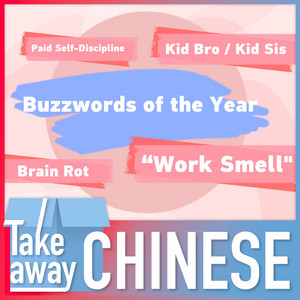
So today, We'll take a look at some of the most popular Chinese buzzwords of the year.
For our dear listeners, if you're interested in Chinese culture and you want to get a grip on the Chinese language, then this is the show for you.
Stick with us for 30 minutes and you soon see the rewards.
And for more fun Chinese learning, follow our Facebook page, Learn Chinese to watch many fun videos and live streams.
But now, let's provide you with some free Chinese, some keywords of of 2024 for Takeaway.
Actually, the words we have today are relatively light -hearted.
I think many of the words are internet slang, the kind of words that you can use in everyday life, that can be used like a native.
So these are the newly coined Chinese terms that young people are using.
Young people are using.
Yeah, that happens in every language, doesn't it?
Yeah. These new buzz words come out and then it's fun at the end of the year to kind of improve our I mean these are probably some of these are probably new words for you too yes, that's what I mean yeah yeah even as native Chinese speakers you might have an opportunity to improve your or expand your vocabulary yes and the thing about the Chinese language is that we know the smallest unit of the language would be the character and you have one or two or three or four or many characters to form a word and then words together become phrase question what's the maximum number of characters in a word.
That is a really good question and a question, you know how some English words are like really, really long?
It's not the easy or the perfect example or comparison, but some English words are short.
Some are super long.
Some Chinese words have one character or two characters.
Some have more. What's the max you can have?
The reason I said it's a good question, a question that I do not have an answer to is because actually the line between a phrase and a word is kind of blur in the Chinese language.
The reason I was bringing about the character being the smallest unit is because even though we say word is technically the smallest unit because word carries a certain meaning and you have the meaning and you put different meanings together to form a complete sentence with a relatively more complete meaning of what you're trying to say.
Yet for Chinese language, the different here is that for example in English, you have different syllables, you put the syllables together so that you know how to pronounce the word for the Chinese language.
Yes, we have different characters and each character would have a sound.
Yet the character itself carries a certain meaning already.
So with the meaning of the character, you can kind of guess the meaning of the word.
That's the thing. In every language, there would be new words coming up and most of the new words in different languages I don't know many languages by saying no I mean know how to use for example in English when a new word comes up sometimes if there is the lack of the scenario the word is being used I would not understand what the word sure in Chinese you can kind of guess what the word means I understand so it's not like you've never heard the sounds of these because they're characters put together, right.
Yes, the characters are there.
And also putting both characters together would give you a sense of the meaning of the word already.
For example, one of the words of 2004 is 만웰.
만웰. So 만, 만 is a character.
It carries the meaning of 생마 go to work.
It can also be a class.
So 이 만 would be class one or 만 class two.
만지 that is a class.
bān za the head of the class so it can be class.
And wéi is a funny one because in the Chinese language qi wéi is smell, and wéi za is taste, so they're kind of together.
Wéi is the entire feeling of something, it's a little bit like that but definitely it relates to smell and taste.
So if we put bān wéi together and I tell you bān here refers to work, Work taste?
Uh -huh. The taste of work, the smell of work.
Do you like the taste and smell of work?
The taste and smell of work.
It means you've been working too hard and too long.
How interesting. And you staying with work.
Oh. The work smell.
Yeah, the work smell.
In a bad way. OK. Yeah.
If you stay at the office for 14 hours one day, you've got the stench.
We have that word in English.
Yes. The stench of work.
yes smell like the office huh this is a play on words right yes this is not really some sort of smell from your no okay and it talks about the entire feeling that the vibe that you sent out to people oh it's a negative word because people believe if you work too hard and for too long and if you're not the kind of person who's basically a work colleague and enjoy work so much you're radiant with work then you would look tired.
You would look like you've been working for so long that you have little wrinkles that your face is not radiated in a good way and you don't have enough time to take care of your appearance then you're dressing the wrong clothes and you don't have makeup and all that all together can be summed up with Ben Wei.
Yes. And they can use it in different ways like nǐ yī lian, bān vǎr.
Yes, I'm using vǎr because I am from the north side of the country and I rǎ huá yīn a lot of my words.
I put r sound at the end of the word.
You can put r sound at the end of vǎr here, so bān vǎr.
So technically speaking your face cannot be full of the smell of work yet.
You can say ah nǐ yī lian, bàn vǎr.
It's like saying, looking at your face, give me a hint that you've been working too hard.
Okay, so it's interesting, because in the term, you're saying work smell.
But really what it's about is the visual.
It's a feeling. So it's a vibe.
It's a vibe. It's a vibe.
You've got that work vibe.
Yeah and that leads to some other words like 칠 만와.
So 칠 is 칠 들 remove.
Get rid of. So, they would say, let's go shopping.
Let's go have some fun.
That would remove Chuban with, get rid of the work smell.
And it doesn't, these two words in English don't really go that nicely together.
Do they work and smell?
But I understand the point.
Yes. And when you play with words here in China with the Chinese language, actually, like I said, characters is a very important part, for example, we know, weiz.
Weizdao, it's a smell or a taste.
so it can be heavy, so banh war can be chong, heavy.
See because we have a certain fixed understanding of the characters, when we use the existing characters to come up with new words, you kind of already know how to use it.
Yeah, got it. That's the funny thing about banh war.
So now do people use this banh, way banh war about themselves Selves or do you use this expression about other people anything?
Okay. Yeah, you can use it for your coworker yourself You and your colleagues your friends who are coming to the party But does not look like they can party with you all night anybody can you use this literally by the way if For example, I get distracted really really really easily So, sometimes in the middle of one thing that I'm doing, I'll completely stop it and do something else and forget to return to the thing that I'm doing.
This has happened on a couple of occasions where I'll put on deodorant in the morning and I'll do one arm and then I'll stop doing that and I get distracted and do something else.
and then in the middle of the day i realize oh i've got that panhui because i have only put deodorant on one arm instead of two.
Can you use it literally?
I don't think so. Understood.
That would be a little weird.
Understood. Yes. But when I talk about playing with words I think another good example about playing with words would be xiao hai gu letter Oh this is a long one one more time please.
Those are actually two words.
Xiao ha means little kid.
Xiao har. Yes. And Gu is older brother.
Gu. Gu Gu. Older brother, older sister.
So Xiao hai we know it's little kid.
Xiao hai. Yes, kid.
And you put them together you've got to Xiao hai Gu.
So little kid older brother little kid older brother Okay little kid older sister little kid older sister so just to give you a little background for those of you who do not have the you know basic understanding about the Chinese language actually Good one you put them a bit older than you or For a outer generation in the Chinese language it carries the meaning of respectful Okay, we're being respectful if we're calling someone good, yeah I don't think that culture still exists in all of the places but in some workplace if you enter a company And you have some peers they're not so much older than you
They have only come to the office one or two years earlier than you you have a lot to learn from them You can address them as good or it.
Yeah, it's kind of like being respectful So good yet respectful yet so hard little kid.
Can you take a guess what that word might mean?
So you're being respectful by saying 가 or 기약.
Yeah. The nature of this person is only a kid.
So this is a work senior who is younger than you?
No, this is actually talking about the kind of little kids on social media who are so good at what they're doing in the video that you feel like they are super better than what you can do for this specific thing that you are being respectful because they are being 궀 어지에 on this round, yet they're only kids, so you cannot really call them 궀 어지에, so you're calling them 살해 어지에.
It's like a little kid who's an expert at something.
Yes, at something. So you're watching them and you're thinking, Oh my gosh, they are so much better than I am.
Yes. So you want to be show them some respect, but you're also Acknowledging that there's still a little kid.
Yes. Have you ever watched any videos like that?
Gosh? I'm trying to think the first example that comes to mind for me is video games Oh, yeah, some of those players are just wow I used to play online a little bit and you know I'm an adult and Trash talking is an online thing and you know I would get trash talked by I can tell that the kid is very very young but I got to give respect because they're doing so much better at this so good yeah so that's the perfect example of Xiao hai gu guy or Xiao hai jie.
I've also seen some of those videos I've seen a little girl I'm trying to solve actually not trying to just very greatly managed to solve a math problem and the way she was teaching how to solve the math problem is just like my primary school teacher.
I mean, the facial expression, the tone, and even the gesture she was using, and the very encouraging.
So the next step is...
Yes! We want to choose A for this question.
The kind of everything.
She was so good. Have you ever seen the videos online of the children performing Wushu?
Oh yeah. I would not want to meet them in a dark alley.
In a fight with them?
No, wait, no, how? These kids are unbelievable.
I've done some martial arts in the past, nothing impressive.
So when I see these kids who look like they're, I don't know, 7, 8, 9 years old, they're flexibility.
They're like rubber bands.
They're like a spaghetti noodle after it's been cooked.
They can go in any direction and you can just tell That they are incredibly talented at what they do.
That is another example of shaohai -gu or shaohai -cha Yes, shaohai -gu or shaohai jie Yeah I love the Chinese language so much sometimes when you put two words to characters that are completely contradictory to each other, yeah, they make perfect sense Yes, when you understand the context, it does make sense for sure.
And actually on social media platforms, we get to see a lot of those very talented kids and sometimes we say, Ah, technology is a double edged sword.
The internet is squeezing our free time.
We do not talk to each other anymore, blah, blah, blah.
But when you see these, you realize it's these kinds of platforms that allow them to show the world their talent.
And they deserve all the attention 100 % agree with you There are some remarkably talented young people doing some incredible things on the internet Yes and when they get encouraged they continue to put more effort and time in it and they get perspective of exactly how great they are and they know they should be continued doing what they're doing It's another great point, I think And that's when the internet's doing its positive work Yes, and when it comes to playing with words another example, I've got here, it's also a very funny one It's called Tó gan.
So Tó means to steal, so xiao to is thief And tó dong xi is still something dong xi is something, so still something from someone Tó qi is a very official way of saying theft and Gan is Gan zu feeling Okay.
개주 feeling. Or you can say, 거러, 히나고, I am feeling sad.
Hmm. Something like that.
So 개 the feeling. So 폄간, the feeling of stealing.
What does it mean? Take a guess.
The feeling of stealing.
It rhymes. Hmm. Yes, that's right.
The feeling of stealing.
So, you're not actually stealing something.
But you feel like you're stealing something.
If I ask you to steal something, what would you do?
I mean, when you're stealing I'm pretty sure you do not really have a lot of experience in stealing.
Yeah, I would say no if you asked me to steal something.
But if you have to steal something, you must be very timid.
you must feel like you're doing something wrong.
Ah, it's the anxiety?
Ah, togan. Togan. So it's a deal -thy, cautious, and kind of secretive way of doing something.
OK. So ah, that little anxious, nervous excitement.
There's an excitement, huh?
Well, excitement doesn't always have a positive meaning.
I guess right like that nervous bundle of energy of fear yes when you're doing something naughty or it's just merely because you're not someone who is perfectly comfortable with doing things in front of a lot of people so if we have a company party and you ask me to stand up and sing in front of the group then I can say, that's what you can say.
Very heavy. Remember you can be more good as well.
So means very heavy.
And the thing is that you're kind of awkward.
You are not comfortable with it.
And especially in today's day and age because I think for my generation when I was a kid, people would want their kid, actually people want everybody to be outgoing.
If you're outgoing, if you like to make friends, it must mean that you get to do things easily.
It means you can probably do a better job in making friends and asking your friends to help you with stuff.
So it is encouraged to be outgoing.
Yet in today's society, I think being someone who is relatively introvert is also accepted.
People stop saying it's not okay to be an introverted person.
Sure. You have to be outgoing all the time.
You have to go out there and just break the comfort zone and just go outside of your comfort zone.
People stop saying that all the time.
People believe it's OK to be a little bit introverted.
Yeah. And that is why we have this word, if we kindly make fun of someone who is doing something in front of people and showing a little bit of awkwardness, we will say, oh, that's a good person.
It feels like he or she is not very comfortable with it and we're not actually mocking that person we're just saying, oh, I can totally see myself in that occasion as well.
I feel their pain. Yes.
So we can use this about ourselves or about other people.
Yes. As well. And it's not mocking them.
It's just not negative.
It's just an acknowledgement of their difficult situation.
Yes, yes. Here's another example, maybe.
Tell me if I'm wrong.
If you're at a serious company meeting and the CEO is not happy about something, and the CEO is asking the group, somebody give me an answer.
Somebody answer this.
Steve, and I have a 30 people in the meeting.
Then you look at me and go, oh, tōgan hao jung.
See that is an example that you cannot use togan because token is it still carries that very subtle sense of stealing something.
It's like you're stealing something so that you're doing something that you're not supposed to do.
But it's not entirely awkward.
But like if I'm singing in front of the group, I'm not stealing anything there.
I'm not doing anything I'm not supposed to do.
Yeah, it's more like when you're stealing something, Even though you don't want to, you don't like it.
It's not something you're supposed to do, you're still doing it.
So if I put you on a spot by asking you to sing in front of people, you're still kind of doing it.
Yet if I put you on a spot, by asking you a question that you do not have the answer, it's awkward, it's merely just embarrassment.
At that moment, I would use a word that is not entirely the word of the year, but it's still kind of a 20 -word online, we say 小中 義個 小中 義個 小中 義個 is your toe toe is scratched, 他 is the ground like you're digging into the ground yeah so digging into the ground and we would even say 小中 義個 because I am just so embarrassed and I'm so in the moment that I'm using my toe to dig out an entire hole with four bedrooms and one living room So Dougan Haojung is not for serious...
It's not for all the embarrassing moments.
Gotcha, the very light, playful ones.
Relatively and also the ones that it feels like you should not be doing it but you're still doing it.
You have to be still doing the things that are sending out the Dougan.
Got it. Instead of at the moment and not know what to do.
Understood. Yes. So that's Dougan.
And some other words include Fù Fei Tzu Liu.
Fù Fei means you're paying for it, and Tzu Liu is self -discipline, so Fù Fei Tzu Liu.
This is relatively easy to understand.
It means that it's a paid discipline.
It means you, for example, go to a self -study room that requires you to pay and by paying for it, you have to go because you've already paid for it.
So it's a paid self -discipline.
Jim membership. Kinda like that.
Now you got it. Fù Fei Tzu Liu.
FÜ, Fei, Zhi, Liu. And a really good one now fù.
So now is your brain.
And fù is rot. So literally brain rot.
Literally brain rot.
Yes. Now fù. Now fù.
It's actually brain rot is named Oxford Word of the Year for 2024.
And it is defined as the supposed deterioration of a person's mental or intellectual state, especially viewed as the result of overconsumption of online material.
So yeah, the viral ones, the trivial or unchallenging things would make you brain -rot sometimes also in Chinese.
If you have Banh Wei, then you may have Next, Nao Fu.
It happens too. Actually on some of the short videos I scrolled down, sometimes I can see the comments, saying, yes, I am the next Idiet who have finished watching the entire video.
And now I have bring me on to know something like that.
So a lot of different words of the year we covered.
Actually, I don't think these are all of the words of the year.
They're more like the lighthearted online ones that we can use on in our daily life, which is quite practical, actually.
The list of new words at the end of the year is very long.
We would be here for hours and hours and hours if we went through all of them, but you did a good job picking out some of the fun ones.
And hopefully, those of you would find it interesting.
And maybe you can use one or two in your daily life.
And that brings us to the end of today's Takeaway Chinese.
I'm Yuhan Lin with Steve Hatherly here in the studio.
For more episodes of the show, you can visit our website at video .cgtn .com and go to the column podcast.
You can listen to the show and read the script there.
Find us wherever you listen to your favorite podcasts.
Just search for Takeaway Chinese.
Don't forget to leave your questions, comments, and ratings.
Thank you very much.
See you next time!