Get the unmissable news stories of the day.
This is the Beijing Hour, Examining the events that impact and shape China and the rest of the world.
This is the Beijing Hour, one hour of news and information brought to you every weekday.
Now here's your host.
Shane Begum with you on this Wednesday, September 24th, 2025.
You're listening to the Beijing Hour, coming to you live from the Chinese capital.
On today's program, the Chinese president, Xin Erunqi, ahead of a gathering to celebrate the 70th founding anniversary of Xinjiang Uyghur Autonomous Region.
The Chinese premier has reaffirmed that the country is not seeking special treatment when negotiating reforms of the World Trade Organization.
Super typhoon Magasa is now hitting China's southern coast after causing deadly destruction in the Taiwan region.
In business, the China International Industry Fair has drawn thousands of companies in Shanghai.
In sports, Real Madrid maintains its flawless start.
In culture and entertainment.
China Media Group is hosting an artistic reflection at UN headquarters in New York.
Now the day's top stories.
China is celebrating the 70th founding anniversary of Xinjiang Uyghur Autonomous Region in the Far West.
Leading a central delegation, Chinese President Xi Jinping is currently in Urumqi, where he'll attend a grand gathering to mark this important occasion on Thursday.
The president's visited a themed exhibition which provides a panoramic view of the development achievements stemming from unity, diligence and perseverance among people of all ethnic groups in Xinjiang, under the leadership of the CPC and with the support of other parts of the country.
President Xi also met representatives from all walks of life.
He extended greetings and encouraged them to work together to build a beautiful Xinjiang in the process of Chinese-style modernization.
Pan Dong has details.
On Tuesday afternoon, President Xi and the delegation arrived at the Tianshan International Airport.
They received a warm welcome from people of various ethnic groups in Xinjiang.
President Xi stepped out of the cabin and waved to the welcoming crowd before descending the air stairs.
Local children presented him with flowers.
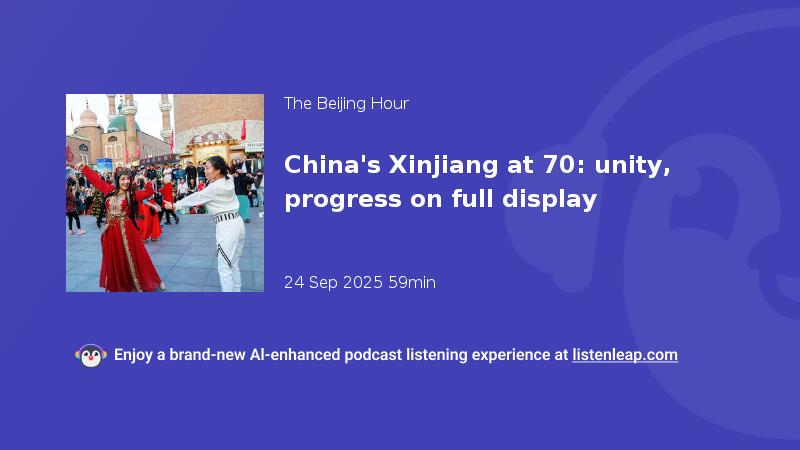
Representatives of various ethnic groups, dressed in traditional clothes, sang and danced to express their warm welcome and heartfelt blessings for him.
The city of Urumqi was filled with festive atmosphere.
Crowds also lined the streets to welcome the convoy with Xi waving back through the car window.
This year marks the 70th anniversary of the Xinjiang Uyghur Autonomous Region.
Home to more than 26 million people.
Xinjiang has undergone a remarkable transformation over the past seven decades.
Its GDP has surged from just 1.2 billion yuan in 1925.
The region has led China in cotton production for 32 consecutive years, lifted more than 3 million residents out of poverty and raised average life expectancy from just 30 years before 1949 to 77 years today.
Trade, tourism and connectivity continue to thrive.
Foreign trade exceeded 435 billion yuan last year.
China-Europe freight trains now operate along 23 routes through the region, and Xinjiang welcomed 302 million tourist visits in 2024.
The autonomous region has prioritized people-centered development.
More than 70 of Xinjiang's public budget goes directly to safeguarding and improving livelihoods, ensuring equal benefits for all ethnic groups.
On Tuesday afternoon, Chinese President Xi Jinping also met with representatives from all ethnic groups and all walks of life in northwest China's Xinjiang Uyghur Autonomous Region.
He extended sincere greetings to the people of Xinjiang and urged concerted efforts to build a beautiful Xinjiang in the process of Chinese modernization.
Xi Jinping met with leading officials from the Xinjiang Uyghur Autonomous Region, officials from relevant departments prefectures, cities and counties, as well as veteran comrades.
She also met with members of the leadership of the Xinjiang Production and Construction Corps, senior officials aiding Xinjiang's development, political and legal officers, patriotic religious figures and representatives of grassroots religious work cadres.
Starting in 1997, China has organized 12 batches totaling over 20000 officials and professionals to assist Xinjiang.
These groups have worked hard with people in Xinjiang, sustaining stability through unity, nourishing culture, boosting prosperity and facilitating the region's long-term development.
In the afternoon, Xi met with senior officers at the rank of colonel and above from the troops stationed in Urumqi, along with some grassroots role models and civilian personnel.
On behalf of the CPC Central Committee and the Central Military Commission.
He extended sincere greetings to all officers and soldiers stationed in Xinjiang before posing for a group photo.
That was Pan Deng on the Chinese president's tour in Xinjiang.
After years of steady growth, Urumqi has blossomed into a vibrant hub of thriving businesses, booming tourism and rich cultural life.
As locals in the regional capital put it, they're the ones who are directly reaping the benefits of this economic progress.
I've lived here my entire life and witnessed truly profound changes.
It's a comprehensive transformation from the city's infrastructure and urban development to a tangible rise in our personal quality of life.
Xinjiang's ongoing development has led to a visible improvement in our daily lives.
You can see the joy as people come together through song and dance to celebrate this anniversary.
There's a real sense of happiness and excitement here.
Our businesses are thriving, more tourists are visiting, and our incomes have grown significantly.
The progress in our autonomous region is constant.
Year after year, you can see that Xinjiang's development has truly achieved remarkable prosperity.
All across Xinjiang, a festive mood is taking hold.
City streets are adorned with vibrant flower displays and celebratory banners, setting a joyful and harmonious scene.
Guayan's now joining us live at one of the celebration sites, inside of a modern factory in Rumqi, where workers and other locals have gathered together.
Artistic troops and school groups have brought lively performances to a small vehicle production workshop, sharing the holiday spirit with frontline industrial workers.
Good evening, Guayan.
Thanks for joining us.
And could you describe the atmosphere where you are for us?
Good evening, Shane.
Yes, I joined some workers and people from local community inside the production hall of a car factory here in the suburb of Rumqi, and the atmosphere is both festive and heartwarming.
The factory floor has been transformed with colorful banners and flowers, while music and dance performances bring bursts of energy to the space.
Workers in their uniforms are smiling, some even joining the performers to dance at the factory floor.
And the community residents have also come in to celebrate alongside them.
You can also feel a sense of pride and unity as everyone marks this special anniversary together.
Back to you, Shane.
What activities are underway and what does the celebration mean to the people there?
Well, the highlight here is, I think, the cultural performances.
Local art troupes, school groups and even some amateur performers have prepared songs and dances that showcase the diverse traditions in Xinjiang.
And one thing that impressed me most is I joined some of the workers and some lovely dance ladies through the beauty of traditional ethnic dances.
And they are dressed in stunning costumes representing various ethnic minorities in Xinjiang the Han Uighur Kazakh, Tajik and the Mongolian cultures and which shows I think it's a typical example of the diversity, of the cultural richness or the cultural diversity in Xinjiang.
And for the workers, it is also a meaningful moment.
The celebration is happening right at their workplace, acknowledging their role in the region's modern development.
And one thing that impressed me most is that I encountered a worker here.
He grew up in a small village.
He shared a very touching story with me.
He grew up in a small village in a remote place in Kanshi district in Xinjiang.
And he grew up in an impoverished village but with a special program which is called the Peer Assistance Program.
It's from Guangdong province.
A lot of talented, a lot of talents, young talents and various investments And high-end manufacturers would pour their investment into his hometown.
And this gave him a lot of opportunities to grow, for well education, as well as opportunities to find a decent job.
And now he became, he moved to Urumqi and he got a very decent job.
He had some, he find some new work opportunities and career growth opportunities in this place.
I think his growth shows us how the change, the growth of local economy helped foster these young people to grow.
And for these community residents, it's a chance to share joy and connect with people who are driving Urumqi's growth.
And many told me it feels like a celebration not only for the 70 years of Xinjiang Uyghur Autonomous Region, but also for the bright future they're building together.
Back to you, Shane.
Thank you very much.
That's Guoyan reporting from Urumqi. a once known mainly for its stunning landscapes and vibrant cultural heritage.
Xinjiang's now taken on a new role as China's gateway to global trade.
Located in Ili, Kazakh Autonomous Prefecture, Horgos is a major Eurasian economic hub, connecting China with Central Asia, West Asia, Europe and beyond.
Here.
The China-Kazakhstan-Horgos International Border Cooperation Center, which straddles the two countries, has become a popular tourist destination.
Chinese and Kazakh citizens and international travelers can visit the center visa-free.
Chen Lanyo takes us there to find out more.
With just one single piece of paper, I get to be in two countries at the same time.
That's the magic of Horgos, a unique strip of land connecting China and Kazakhstan.
And right at his heart, a duty-free, visa-free zone where people and goods flow as freely as a bird in flight.
This is the Khorgos International Cooperation Center, China's first cross-border economic zone established with another country.
It allows citizens of China and Kazakhstan, plus international travelers, to enter visa-free by using their passport or ID to get a one-time entry permit.
Here you will find a sprawling marketplace with more than 5000 shops selling products from over 40 countries.
Okay, so we've got iced tea from Armenia and crackers from Kazakhstan.
If only I had brought a bigger suitcase with me.
But it's not just tourists who find great deals.
Business owners also flock here for the exceptional opportunities.
During my visit, I met Dinah Yerbor, a Kazakh shop owner and a frequent visitor to the center.
I run a small business and come here to stock up on inventory for my store, which specializes in bedding and clothing.
I originally found out about this place through my mother-in-law.
She bought 50 microwaves here for her own store and was really impressed with the quality and prices.
I have also compared prices with those in Almaty and found the deals here are much better.
Plus, it's super convenient to come here.
No visa required.
The cooperation center has also attracted ambitious young people from across China and Central Asia, many of whom are becoming live streamers to better sell products to a global audience.
D. Mohamed Erlam is one of them.
He told me that a package from Korgos to Almaty, the largest city in Kazakhstan, can arrive within 24 hours.
He also enjoys being able to engage with customers online, as well as meeting them in person.
This great atmosphere not only Kazakh country, also Uzbekistan Kyrgyzstan, also Turkmenistan, so more countries interests people is really good in conversation.
D Mohamed has already gained 6000 followers in just five months here and is confident he can grow even further.
His determination reflects the rapid development taking place across Korgos.
In the first half of this year, cross-border e-commerce trade in Korgos reached nearly 29 billion yuan, or about 41 billion US dollars, a staggering 889 increase year on year.
To further accelerate trade and people-to-people exchanges.
The Cooperation Center has been continuously introducing new measures to optimize the end-train experience.
As of the end of July, passenger traffic at the Cooperation Center has exceeded 595 million, a 65 increase from the previous year.
From a simple border city to a dynamic bridge for commerce and culture, Orgos has developed itself as a vital hub for China's connectivity to Central Asia, West Asia, Europe and beyond.
Continuing the spirit of the ancient Silk Road for a new generation.
That was Chen Lanyo in Xinjiang.
And for more on Xinjiang's development.
Pandong and Li Dongneng spoke with Wang Zeyi, a lecturer at the Institute of China's Borderland Studies at Zhejiang Normal University, who was born and raised in the region.
Tell us more about the unique advantages the region has.
So Xinjiang is my hometown.
It is China's northwestern and it covers roughly one-sixth of the total area of China.
So it is also the core area of the Eurasia continent.
If you go to Xinjiang, you may notice that there are many places called Yaxin.
Literally, it means the heart of Asia, and this is Xinjiang's advantage for its opening up.
It can range multiple routes from the China-European railway expresses and host 90 border ports that open to its other side way.
And now nowadays it's not only the highways, the railways and cross-border pipelines and communication cap together from land, say airspace.
It's kind of like the dimensional continentally network, and also Xinjiang's rich historical and cultural heritage and its vibrant ethnic tradition provide a solid foundation for its opening up.
Well, it is the core area of the Silk Road Economic Belt.
It also launched the first pilot free trade zone in China's northwestern border region in 2023.
And we just saw the vitality of trade in Hong Kong.
How will these advances promote Xinjiang's institutional innovation and also industrial upgrading?
The pilot free trade zone is established in 2023 and in 2024 it attracts 9000 newly registered enterprises and its total import and export volume accounted for more than 30 of the entire region's foreign trade.
It aims to create a world-class business environment for customers and financial services.
Also, the core area of the Silk Road Belt will sink down as well.
It focuses more on the building industrial infrastructures like roads, railways, and highways.
So it combines Xinjiang's strengths as a geography pathway with the advantage of institutional innovation.
And also its goals to transform Xinjiang from a logistic corridor into an industrial hub and a commercial center that drives regional development.
That was Wang Ziya from Zhejiang Normal University.
Coming up, China says it's not seeking special treatment during WTO negotiations.
Decades on, Xinjiang has completely transformed.
It's the last place you'd expect to find an ocean harvest, and yet, it's happening.
Technology is redefining cultivation.
I never imagined such breathtaking lavender fields transform the very structure of the soil beneath our feet.
It's difficult to get a full appreciation of the sheer scale of this facility almost solar panels as far as the eye can see.
Xinjiang isn't just a region where cultures meet, it's where they mix, evolve and come alive.
Modernization has also given this land a canvas for the future.
And I'm really looking forward to finding out why.
19 minutes past the hour.
Chinese Premier Li Cheng has reaffirmed that China, as a responsible, major developing country, will not seek any new special treatment in World Trade Organization negotiations.
At a high-level meeting on the Global Development Initiative on the sidelines of the 80th session of the UN General Assembly, Li announced that China will launch 2000 additional livelihood projects in developing countries over the next five years.
To date, over 130 countries and international organizations have taken part in the implementation of the GDI, making it a widely supported global public good.
Today we are gathered here for the high-level meeting on the GDI to build greater consensus and foster greater synergy for development.
Li also outlined plans for China to implement 200 marine development cooperation projects aimed at supporting small island developing states and enhancing their sustainable development capacity.
We need to promote green and low-carbon development with greater sustainability.
Climate change, environmental degradation and overconsumption of resources are a major challenge facing the world.
Development is an urgent need of a green transition.
UN Secretary General, António Guterres, highlighted that the Chinese initiative supports the UN's goals to mitigate climate change and achieve a green energy transformation, and the Global Development Initiative can be an important mechanism to help accelerate progress on the 2030 agenda around the world.
And I took good note of the points expressed by the distinguished Prime Minister of China in relation to the objectives and in relation to the mechanisms putting in place to make the initiative even more effective at the global level.
Chinese electric vehicles now account for more than half of the global market share, a clear reflection of the country's commitment to climate goals.
The UN hopes that the Global Development Initiative will help foster greater international cooperation and revitalize multilateralism worldwide.
A senior member of the Lesotho government says China's global governance initiative offers hope to nations often sidelined in major international affairs.
Deputy Speaker Tsepung Sita-Masena of the Lesotho parliament says the initiative promotes a global order in which all nations, regardless of size, can participate in global decision-making and have their voices heard.
In an interview with Xu Yaowen, the official praised China's long-standing relationship with Lesotho, particularly in sectors like health, education and infrastructure.
She called for more collaboration between the two nations to support economic growth and reduce unemployment in Lesotho.
Recently, China proposed this global governance initiative.
It's a new initiative which is built on sovereign equality issues, respect for international rule of law multilateralism, people-centered approaches and taking concrete actions.
What's your assessment of the GGI and how do people in Africa receive this initiative?
I think the Global Governance Initiative.
It's really a well appreciated initiative because it talks to the consideration of everybody as equal human beings.
And it talks to governance at an international level, but that considers everybody at a multilateral level.
For me, that is a big one.
Coming from a very small nation, my country, and knowing that power is normally perceived as economic and it's also sometimes, in fact, also perceived as population.
We don't have both.
So that says normally we find ourselves feeling that we are at the back end of decision making.
So the Global Governance Initiative definitely talks to us.
It says despite your size, your economy, We see you as people that can be considered for what you feel is important.
We see you at the table and we see you as equal partners.
So that resonates very well with us.
Granted, Lesotho has been part of the, I can say the international order that considers multiple nations part of the United Nations, for example, which we can safely say.
The Global Governance Initiative is not necessarily coming up as a fairly new concept but it comes with different dimensions of that multilateralism.
That was a senior member of the Lesotho government sharing her thoughts on China's Global Governance Initiative.
At the opening of the UN General Assembly debates on Tuesday, Secretary General António Guterres and Assembly President Annalena Baerbock urged member states to strengthen the global body in a time of uncertainty.
The principles of the United Nations that you have established are in the siege.
We must choose to strengthen the United Nations for the 21st century.
The forces shaking our world are also testing the foundations of the United Nations system.
We are being hit by rising geopolitical tensions and divisions, chronic uncertainty and mounting financial strain.
We are literally now at a crossroads, a make it or break it moment, politically, financially.
Therefore, we have to deliver a United Nations that is agile, cost-effective, and fit for purpose.
Member states have to give the Secretary General and this process their full support.
More than 30 heads of state and government address the UN headquarters, many echoing the Secretary General's appeals.
Coming up.
Communities in southern China have issued high-level warnings as Typhoon Ragasa strikes the region.
From north to south, east to west, people in China are chasing their dreams and leaving their mark.
Want to know how they beat the odds and made a difference?
Footprints brings you the true life stories of their journeys.
At 26 past the hour.
Super Typhoon Ragasa now the strongest storm of the year, is hitting China's southern coast.
The region, including Guangdong, Guangxi and Fujian, is on high alert and has taken emergency precautions to ensure public safety.
Nearby Hong Kong has also issued high-level warnings and grounded hundreds of flights.
We spoke with Xu Hua to find out how the region's coping.
I'm here in Maoming city in South China's Guangdong province, which is directly in the super typhoon Rexha's path.
The response here is massive.
More than 78,000 people have been relocated from coastal areas and from inland danger zones.
The city's 2,200 shelters are fully operational, capable of hosting 88,000 people.
And behind me is one of the city's key emergency shelters.
It's actually a primary school that's going inside.
So how many people have been relocated here?
We have a total of 120 beds set up at this shelter.
Currently, 84 people have been accommodated.
Everyone has been provided with a folding bed and a quilt.
In terms of supplies, we are ensuring the provision of milk bread, instant noodles and drinking water.
So what kind of support and service have you provided?
Power, water and communication services are all functioning properly.
We also have a boiled water station set up here for everyone's use.
To address any sudden illnesses like fevers or colds, we have set up a medical station with medical staff on duty 24-7 and stocked with common medicines.
The town has arranged for over 20 town officials and volunteers to be stationed here to maintain order and assist with any issues that may arise.
Behind the scenes, a significant rescue force is on standby.
The city has mobilized nearly 7,000 rescuers.
Over 6,000 fishing vessels and more than 100 commercial and passenger ships are safely back in port.
Everyone who works on fish farms or marine postures have been brought ashore.
And all three of Maoming's coastal scenic spots have been closed.
That was Xu Hua in Guangdong province.
In Taiwan, torrential rains triggered a devastating flash flood in Hualien County, bursting a barrier lake and washing away a bridge.
State Council, Taiwan Affairs Office spokesperson Chen Binhua, expressed condolences for those killed in the storm and extended sympathies to the bereaved families and the injured.
Due to the impacts of Typhoon Ragusa, the barrier lake in Hualien County in Taiwan overflowed, causing casualties and property damage.
We'd express our condolences to the families of the Taiwan compatriots who unfortunately lost their lives.
We also convey our condolences to the injured and hope that affected people can return to their normal lives and production as soon as possible.
The 18th typhoon of the year has killed over a dozen people in Taiwan.
We're at 29 past the hour, and Beijing's down to 15 degrees Wednesday evening.
Sunny and 28 for Thursday.
Nanjing's getting downpours and 21 this evening, then thundershowers and 25.
Guangzhou's getting heavy rainstorms and 24 overnight.
Heavy rain and a high of 29 for Thursday.
Hong Kong's getting downpours and 24 this evening, then heavy rainfall and 29 degrees.
Elsewhere in Asia, Islamabad's 23 overnight, then a light rainfall and 34 on Thursday.
The Antian will see moderate rain and 24 this evening, followed by heavy rain and a high of 31 degrees.
It's time for a short break.
So far this hour, the Chinese president in Urumqi, ahead of a gathering to celebrate the 70th founding anniversary of Xinjiang Uyghur Autonomous Region.
The Chinese premiers reaffirmed that the country is not seeking special treatment when negotiating reforms of the World Trade Organization.
And Super Typhoon Ragasa is now hitting China's southern coast after causing deadly destruction in the Taiwan region.
Shane Bigham with you.
Stay with us here on The Beijing Hour.
Listen up.
Can you hear the heartbeat of our world?
It's vibrant and pulsating with the essence of life itself.
From the stem of trees to the gurgle of rivers.
From the silent strength of mountains to the icy whispers of glaciers.
Even the solid ground beneath our feet, Right there in the midst of all, beats the heart of humanity.
What if those other heartbeats were to stop?
Would ours keep on ticking?
Every week to find out what's real with China Africa Talk.
Find us on your favorite podcast.
We'll see you there.
Examining the events that impact and shape China and the rest of the world.
This is the Beijing Hour, one hour of news and information brought to you every weekday.
Now here's your host.
Shane Bigum with you on this Wednesday.
Still to come in business.
The China International Industry Fair has drawn thousands of companies to Shanghai.
In sports, Real Madrid maintains its flawless start.
In culture and entertainment.
China Media Group is hosting an artistic reflection at UN headquarters in New York.
To contact us, you can email radio at cgtn.com or follow our X account at CGTN Radio.
But now checking the day's headlines, here's Tianyu.
Thank you, Shane.
Chinese President Xi Jinping has visited a themed exhibition marking the 70th founding anniversary of Xinjiang Uyghur Autonomous Region.
The exhibition in Urumqi provides a panoramic view of the development achievements stemming from unity, diligence and perseverance among people of all ethnic groups in Xinjiang, under the leadership of the CPC and with the support from other parts of the country.
Xi Jinping will attend a celebration on Thursday morning.
Typhoon Ragasa has made landfall in Guangdong province, packing winds over 140 km per hour.
The city of Yangjiang is under the highest level response and has closed schools, businesses and construction.
It has opened more than 1,000 temporary shelters that provide food, water and beds.
China has proposed an initiative that will enable artificial intelligence to propel global development.
In line with the vision of building a community with a shared future for humanity, the AI Plus International Cooperation Initiative urges efforts to deeply integrate AI into economic and social development to benefit all countries, including the Global South.
It calls on all countries to carry out AI Plus campaigns in public well-being, technological advancement, industrial application, cultural prosperity and talent cultivation.
Unveiling the initiative at a meeting at the United Nations in New York, Chinese Premier Li Qiang welcomed participation from all sides.
He said China will establish a funding program dedicated to digital capacity building and provide solid support of space observation data for global development.
Poland will reopen all border crossings with Belarus at midnight local time on Thursday.
Prime Minister Donald Trump's announcement ended a nearly two-week closure.
Warsaw sealed the border on September 12 as Russia and Belarus launched joint military exercises.
Poland's interior minister had vowed to keep the crossings shut until the safety of Polish citizens was guaranteed.
Officials now say the drills have ended, but are warning that the borders could be closed again if security threats return.
A crowd of cheering fans gathered in Hollywood on Tuesday as broadcaster ABC announced the return of Jimmy Kimmel's popular late-night show.
This came less than a week after US authorities suspended the program over the host's remarks about the killing of conservative activist Charlie Kirk.
Kimmel is seen as a sharp critic of the Trump administration.
The move set off a national debate on free speech and government pressure.
President Trump praised the suspension as great news for America, but critics accused him of trying to silence dissent.
Hundreds of Hollywood and Broadway stars, including Tom Hanks and Meryl Streep, have voiced support for Kimmel calling on Americans to defend constitutional rights.
U.S.
President, Donald Trump's approval rating has dipped as concerns grow over the economy and raising prices.
A Reuters-Ipsos poll shows 41 of Americans approve of Trump's performance down a point from earlier this month.
Approval rate of his handling of the economy fell to 35 and just 28 back his efforts on cost of living.
The survey found more than half of respondents believe the economy is on the wrong track.
The downturn comes despite Trump's campaign pledge to revive growth and curb inflation.
Recent data shows payroll growth slowing sharply in August, with only 22000 jobs added, while unemployment rate rose to 43, the highest in nearly four years.
And finally, heavy fighting has broken out in Sudan.
The rapid support forces say they have seized positions near the main army base in Al-Fasher and parts of a displacement camp, pledging to take full control soon.
The Sudanese armed forces insist they have repelled attacks and still control the city.
Meanwhile, the humanitarian situation is worsening with services collapsing and aid blocked.
The UN has warned of a looming catastrophe and urged an immediate ceasefire to allow relief access.
The conflict, raging since April 2023, has already claimed tens of thousands of lives and displaced millions.
Thank you very much.
That's Tianyu with headlines.
Coming up in business.
The China International Industry Fair has drawn thousands of companies to Shanghai.
You're listening to the Beijing Hour 60 minutes of comprehensive news, your window on China and the world.
Thank you, Shane.
Stock markets on the Chinese mainland closed higher on Wednesday.
The Shanghai composite gained over 0.8%.
The Shenzhen component added 1.8%.
Stocks related to semiconductors and back contact batteries led the gainers, while those related to tourism and hotels saw notable declines.
In Hong Kong, the Hang Seng surged over 1.3%.
Tokyo stocks also ended higher on this trading day, supported by gains in some heavyweight technology shares on prospects for solid demand for artificial intelligence.
The Nikkei was up a third of 1%.
One of the world's largest industrial fairs is underway in Shanghai.
The China International Industry Fair has drawn nearly 3000 companies from 28 countries and regions to the Chinese financial hub.
Chen Yilin reports.
For the latest industrial trends in China, Shanghai is the place to be.
This year's China International Industry Fair is just packed with cutting-edge innovations.
It's an amazing place to see what's coming next, from advanced robots to the state-of-the-art management systems.
One standout example is the Slice-Out factory developed by 4Radar Group.
It's a powerful tale of transformation from a traditional mold-making company to a smart manufacturing leader.
Our transformation began in 2016.
Our group has four bases in Malaysia Hong Kong, Zhongshan and Shenzhen.
Before it was very difficult to manage.
We have benefited greatly from digital transformation, developing a digital management system that allows for real-time data connectivity, which has significantly maximized our efficiency.
A key contributor to the company's digital transformation is the Hong Kong Productivity Council.
As one of Hong Kong's largest RD institutions, the council is making its first appearance at the Industrial Fair.
Beyond bringing advanced technologies, it aims to meet vast demand, helping China's manufacturers go global.
So we are very honored to be able to participate at this time for our first time, because we want to showcase our capability and experience in helping enterprises to go through the technology transformation.
Again, we have been helping Hong Kong companies to go global for the last 58 years.
So that's why when we heard that, oh, you know, we did it, finally there's such a big need here.
That's why we changed our focus.
We set up Cradle specifically to support mainland enterprises to go through Hong Kong, make use of Hong Kong Productivity Council services to go global together.
A prime example is a collaboration with Beijing's Yunji Technology, a company that has deployed AI robotic solutions to over 30000 scenarios, not just in China, but in the Middle East, North America and beyond.
Yunji's partnership with the Hong Kong Productivity Council is crucial to our global expansion.
It has helped us quickly adapt to international technical standards and provided valuable advice on localized operations and intellectual property protection across over 40 countries and regions.
Through these partnerships, we hope to bring China's innovative smart service robots to a wider international market.
It's this blend of learning from the best at home while collaborating for new opportunities on the world stage that truly transforming China's manufacturing sector.
That was Chen Yilin reporting from Shanghai.
The China Gulf Cooperation Council Tourism Trade Fair has taken place in Dubai, attracting over 160 participants from government, business and academic sectors.
More than 50 Chinese and over 80 GCC tourism companies attended the two-day event.
China's ambassador to the UAE said the countries are important tourist markets for each other.
He invited more Arab visitors to explore China's cities and natural beauty.
The event follows a new China visa-free policy for citizens of four Gulf Cooperation Council nations.
China now offers visa-free entry to all council countries, a move expected to boost domestic tourism.
The Organization for Economic Cooperation and Development has raised its global economic growth forecast, but with a warning.
It is urging caution over the risk of a U.S. tariff shock.
The organization now projects global growth at 32 for this year, up from the 29 in June, but still a slowdown from the 33 growth recorded in 2024.
In China, growth was revised upward to 49 from June's forecast, driven by effective government spending.
Meanwhile, the US economy is expected to slow to 18 growth this year, down from 28 last year and further ease to 15 in 2026.
The OECD warns that US tariffs will increasingly affect consumer spending, labor markets and inflation.
U.S.
Federal Reserve Chair, Jerome Powell, has signaled that the central bank will take a cautious approach to future interest rate cuts.
If we ease too aggressively we could leave the inflation job unfinished and need to reverse course later to fully restore 2 inflation.
If we maintain restrictive policy too long, the labor market could soften unnecessarily.
When our goals are in tension like this, our framework has long called for us to balance both sides of our dual mandate.
Powell's comments showed little sign of urgency for rate cuts on the horizon.
His comments came after the Fed cut its key rate last week for the first time this year, amid deepening divisions on its rate-setting committee.
U.S. stocks took a turn and closed the Tuesday session lower after the comments.
Brazil's fruit exporters are feeling the pinch from new U.S. tariffs.
In the San Francisco River Valley, the source of nearly all of Brazil's exported grapes and most of its mangoes, producers are already counting their losses and looking for new markets.
Paulo Cabral reports.
The grapes in Brazil's San Francisco River Valley are ripe and ready for harvest.
This region in the Brazilian Northeast produces nearly all of the grapes exported by the country.
But with a 50% tariff imposed by the U.S., some producers say it could negatively impact profits.
The U.S. is a very loyal customer for us.
We grow specific grape varieties just for that market.
That's why this situation is so complicated.
The grapes are being packed to be shipped to the United States.
Actually it's a very specific variety cotton candy, very sweet and extremely popular in the American market.
Not so much in other parts of the world.
Best Farmer estimates, profits in trade with the US could drop by about 20, as prices may have to be adjusted to offset the higher tariffs.
Right now we're debating whether to keep growing these varieties for the US or switch to others that are more valued in different markets.
The future of this situation with the tariffs is very uncertain.
Mangoes are another key crop in the San Francisco River Valley.
Around 90% of Brazil's mango exports come from the region, and the U.S. is one of the main buyers.
Exporters say shipments are expected to continue despite the shrinking margins due to the US tariff.
We'll have to see if U.S. prices stay attractive enough for us to keep shipping.
If not, unfortunately, we'll need to look for other markets.
The region is at Brazil's arid northeastern heartland, where constant sun favors fruit production, with scarce rain replaced by irrigation using the waters of Brazil's second longest river, the San Francisco.
Such conditions allow for high productivity year-round.
In recent years, Brazil's federal agriculture research agency Embrapa, has worked to expand the global reach of Brazilian fruit expertise.
That proves valuable now.
We've been researching methods to keep fruit fresh even after long journeys.
So it arrives in Asia, for example, with the same quality.
The Chinese market is highly demanding.
After the US announced tariffs on Brazil in July, farmers feared exports might collapse altogether.
That hasn't happened.
But lower earnings are pushing producers to diversify crops so markets can withstand shocks in the future.
That was Paulo Cabral reporting.
McDonald's China says it will invest over 400 million yuan in talent training.
This three-year plan will modernize its Hamburger University in Shanghai.
The goal is to create a smarter, more open training center for the digital age.
The announcement marks the 15th anniversary of the school, which now trains more than 10000 people each year.
Thank you very much.
That's Wang Ziheng with Business.
And coming up in sports, Real Madrid maintains its flawless start.
Thank you, Shane.
We begin with football from the Spanish La Liga.
Real Madrid maintained their flawless start to the season with a 4-1 away victory at Levante.
The result keeps Los Blancos comfortably atop the standings on 18 points after six matches, five ahead of reigning champions Barcelona.
Vinicius Junior scored in the 28th minute and then provided an assist for Franco Mostantuano 11 minutes later.
Levante briefly threatened a comeback in the second half with a header from Eta Ayon.
However, a brace from Kylian Mbappe ensured a real start to the season with six victories in a row.
In the early kick-offs, Athletic Bilbao drew 1-0 at home to Girona.
The draw keeps Bilbao in fifth place while Girona remain on the bottom.
Barcelona faces being without Spain international midfielder Gavi until February or March after he underwent an exploratory operation on his right knee on Tuesday.
A statement from Barcelona's website said recovery time could take four to five months.
Gavi suffered an injury in training before the last international break.
The injury is to the same knee where Gavi suffered a torn cruciate ligament while playing for Spain in November 2023, which kept him out of action for a year.
The news comes after it was confirmed that Firmin Lopez would be out of action for three weeks with a ground injury, while Lamin Amal missed last week's action with a pelvic problem.
To England.
Hugo Akitike tapped home a late winner for Liverpool against Southampton in the League Cup.
The French striker then removed his shirt in celebration, earning a second yellow card.
He was sent off the pitch five minutes from time, leaving Liverpool defending a 2-1 lead with 10 men.
Liverpool manager Arne Slott blasted Akitike for the sending off.
In the first one was already needless and to a certain extent stupid, because you have to control your emotions, and I know how hard it is if you play Premier League or every league in the world.
If you are number nine, then the other, the defender, can almost do everything he wants and then when you shirt pull a little bit or you push him a little bit, then you get a free kick against you.
But it's always the best to control your emotions and if you cannot control your emotions, do it a way that it doesn't lead to a yellow card.
Liverpool, with a perfect record so far this season, has a tricky away trip to unbeaten Crystal Palace next in the Premier League.
Aki Tiki will miss that game.
Slotfield did a completely changed starting line-up on Tuesday from the side that played Everton on Saturday, with Alexander Isak starting and scoring his first goal for the club.
In tennis, Paris Olympic champion Chen Qingwen says her recovery from elbow surgery is on the right track as she prepares for the China Swing starting with the China Open in Beijing.
The 22-year-old admitted the recovery process has tested her patience.
Last year, I had just won the Olympic gold medal and was on a high.
And this time, I'm returning from an injury after my first ever surgery.
So for me, the China season will be the starting point of my return.
I haven't made a thorough recovery yet and just found out that the last 5% is the hardest part.
I had a speedy recovery at the beginning but it slowed down a lot towards the end.
CD7's Zheng receives a first round buy and starts from the second round at the CS China Open.
Looking ahead, Jones said her best-case scenario would be to play the entire China season, but uncertainty remains.
Although World No.
1 Arena.
Sabalenka withdrew at the last minute.
The women's singles main draw of this year's China Open remains star-studded.
The tournament features World No.
2 Igor Sviantak, defending champion Coco Gauff, American duo Amanda Anisimova and Jessica Pegula, Italy's Jasmine Paolini and Britain's Emma Raducanu.
On the men's side, all three Chinese players enter the main draw with a wild card.
Zhang Zhizhen and Shang Juncheng will face qualifiers in the first round, while Bu Inchukta will take on the third-seeded Australian, Alex Domingo.
Top seed Yannick Sinner has a potentially tricky opener against veteran Marin Sinic.
Second seed Alexander Zverev will face Lorenzo Sonego.
Staying in tennis from the ATP Chengdu Open, Chilean qualifier Alejandro Tabilo saved two championship points to upset top seed Lorenzo Musetti in the third set tiebreak and capture the third ATP 250 title of his career.
The 28-year-old said saving two championship points was insane.
Yeah, I mean, I'm still kind of...
Processing everything.
It just happened so fast in the tiebreak.
Just remember being 4-1 down and then all of a sudden just having match points.
So that was insane being able to save two match points.
It was just a crazy match.
Had to be there so mentally.
I had the team and my girlfriend there also helping stay in the match.
I was a little tired getting to the third.
With vain, Tabielou moved up 40 places to 72nd in the world rankings.
In the final of the ATP Hangzhou Open, third seeded Alexander Bublik of Kazakhstan had a much tougher time than expected against the French qualifier Valentin Royer and needed two tiebreaks to claim his fourth title of the year.
And finally, China has confirmed its roster for the 2025 ITTF Mixed Team World Cup in Chengdu, after two players qualified for the event through team competition.
The women's side features Sun Yingsha and Wang Manyu, the top two paddlers in the world rankings, along with double specialist Kuai Man.
Wang Yidi also secured place in the event's reigning champion squad after she beat Shi Xunyao 4-1 in the team trial.
On the men's side, top players Wang Chuqin, Lin Shidong and Liang Jingkun were selected.
Xu Yingbin outplayed teammate Chen Yuanyu and will participate in the tournament for the first time.
The mixed team event has been included in the 2028 Los Angeles Olympic Games.
The World Cup will take place from November 30th to December 7th.
Thank you very much.
That's Yang Guang with sports.
Coming up in culture and entertainment.
China Media Group is hosting an artistic reflection at UN headquarters in New York.
The best military commander is not he who fights a hundred battles and wins every one of them.
The best military strategy does not lead to the desiccation of the enemy's capital city.
Decoding the art of war will help you understand why there's no art in war and how Sun Tzu stayed undefeatable using the science of war, with fun stories and insightful breakdown of famous battles.
Find Decoding the Art of War wherever you listen.
53 past the hour now.
Turning to culture and entertainment.
A China media group is hosting a visual art exhibition titled Beauty in Harmony, Destiny in Unity at the UN headquarters in New York.
Coinciding with the 80th anniversary of the UN General Assembly, this exhibition invites viewers to reflect on the founding vision of the UN and encourages discussions about building a global community with a shared future.
Tony Shor is an American artist at the event.
He's previously traveled to China as part of a cultural exchange program.
Events like the one that brought me here are just that cultural exchange.
It does create moments for dialogue and an opportunity to just sort of have conversations, even on just sort of a basic cultural level, to start to exchange ideas and also start to think about solving some of the issues and problems that we're facing.
The exhibition features a diverse array of artworks, including paintings and multimedia installations, which trace the evolution and implementation of the UN's core ideals over the past eight decades.
The showcase pieces underscore significant advancements in key areas that are vital to the 2030 agenda for sustainable development.
Topics covered include poverty alleviation, food security, green energy innovations, global health initiatives and international peacekeeping efforts.
A Song of Nie'er, a choral drama presented by the China Conservatory of Music, will take the stage at the National Center for the Performing Arts in Beijing in mid-October.
Under the batons of conductors Li Xingcao and Jin Ye, students and teachers of the conservatory will perform together in this production.
The drama tells the story of Nie Er, the famous composer who wrote the March of the Volunteers, the national anthem of the People's Republic of China.
The chorus of the China National Symphony Orchestra will also join the performance.
The songs in the production are all adapted from the composer's music.
Born in Kunming in 1912.
Nyaar's real name is Nya Shoshin, often referred to as the People's Musician.
Nyaar created a series of musical works, including music for movies, theatrical productions and one opera.
His music reflected working-class life and struggles.
Since its premiere in 2024, the production has been staged 15 times in Beijing Lanzhou, Gansu Province and Kunming.
Wang Xungua, a professor in the opera department of the Chinese Conservatory of Music, will play the role of Nie for the upcoming round of performances.
The 24th Shanghai International Arts Festival will run from October 17th to November 27th.
A world-renowned orchestra from Vienna, Dresden, and St.
Petersburg will deliver master interpretations of classical pieces.
This year's event will feature performances, exhibitions and activities spanning eight main sections, with the main performance section consisting of 55 stage productions.
Over the years, the festival works with over 800 art troupes from more than 80 countries and regions.
Claudia Cardinale, a glamorous symbol of post-war Italian cinema, has died at the age of 87.
Raised in Tunisia to a family of Sicilian origin, Cardinale's introduction to the movie world came in 1957, after she won a beauty contest in Tunis and was rewarded with a trip to the Venice Film Festival.
Her voice had to be dubbed for her first Italian screen roles, because she'd grown up in a family where a Sicilian dialect was spoken and had been educated at a French-speaking school.
After a series of smaller roles, she shot to international fame in 1963 when she featured in Federico Fellini's Eight and a Half, while also starring alongside Burt Lancaster in The Leopard in the same year.
Her growing profile opened the door to Hollywood productions, and she appeared in the comedy The Pink Panther, directed by Blake Edwards, and Sergio Leone's Once Upon a Time in the West in 1968.
We're at 57 past the hour.
Beijing's getting 15 degrees overnight, sunny and 28 for Thursday.
Nanjing will see downpours in 21 overnight, then thundershowers in 25.
Guangzhou is getting heavy rainstorms this evening.
It's down to 24 degrees, followed by more heavy rain and 29 degrees Celsius.
Hong Kong will see downpours in 24 this evening, more heavy rain tomorrow.
The high is 29.
And elsewhere in Asia, Islamabad's 23 degrees overnight.
Thursday gets a light rainfall and 34 degrees Celsius.
And that's it for this edition of the Beijing Hour.
Making news today, the Chinese president's in Rumshi ahead of a gathering to celebrate the 70th founding anniversary of Xinjiang Uyghur Autonomous Region, and Super Typhoon Ragasa is now hitting China's southern coast after causing deadly destruction in the Taiwan region.
On behalf of the staff.
This is Shane Biggum in the Chinese capital, hoping you'll join us for the next edition of The Beijing Hour and open a window to the world together.
Find The Beijing Hour at precisely 6 p.m.
Beijing time.
We meet you on podcast and on air every weekday.
The Beijing Hour, your window on China and the rest of the world.
He can't live without the Yellow River in his eyes.
The Yellow River is so noble and elegant.
Both my grandpa and dad made a living from the river.
Would you like to move away from the Yellow River?
I don't think I will.
I love it so much.
The Yellow River, the second longest river in China, is regarded as a shaping force in the history, economy and culture of northern China.
Today, about 100 million people live within its water basin, making up nearly 9 of the country's population.
How is climate change felt at its headwaters?
And what are the locals doing to cope with it?
What are the descendants of the boatmen doing?
What has kept some people from leaving their home village by the river?
And what has drawn others back?
Could the fading fishing community revive in a time of digital transformation?
From 2021 to 2024.
Our reporters visited the upper, middle and lower reaches of the Yellow River.
Talk to the herders farmers boatmen, fishermen and eco-activists who share a close bond with the river.
And present their stories in pictures, podcasts and videos.
All in our 12-part series, The Yellow River Mosaic.
Available only on CGTN Radio.