This is the indicator from Planet Money, I'm Adrien Ma.
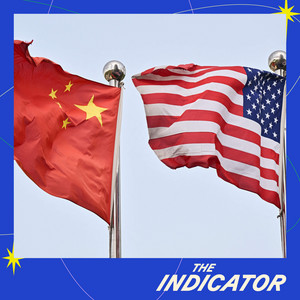
As we're probably all aware by now, the world's two largest economies are locked in a high -stakes economic standoff.
Let's recap. It started in early February… The president will be implementing tomorrow a 10 % tariff on China.
— than China hit back with retaliatory tariffs.
— China says it will counter U .S. President Donald Trump's tariffs with its own import fees.
— A couple months later.
— ...we're going to be charging a discounted reciprocal tariff of 34%.
— To which China responded.
— ...it will impose additional tariffs on U .S. goods from April 10, at a rate of 34%.
Uh -oh. — And around and around, it's gone.
The United States will impose additional tariffs on China of 50 percent.
Beijing announced it will impose 84 percent tariffs.
As it stands, the U .S. has a 145 percent tariff on Chinese goods.
And China has a 125 percent tariff on U .S. goods.
And just yesterday, China threatened to retaliate against other countries if they cut a trade deal with the U .S. that hurts China.
Now, we've heard a lot about how this trade war has been affecting U .S. businesses and US consumers.
But how is this trade war being felt in China?
And what is the end game for Chinese President Xi Jinping?
Today on the show, NPR correspondents Emily Feng and John Ruitch bring us some answers.
They bring us a view of this trade war from China.
NPR correspondent Emily Feng, hello.
Hey Adrian. NPR correspondent John Ruitch. Yo Adrian, how's it going?
It is good. And thank you for joining us at what is sort of an unusual time.
I'm speaking at about nine o 'clock in the evening in Washington, D .C., which is where you are Emily.
But John is in China right now.
He is literally on the other side of the world.
That's right. And this is perfect.
I mean, you're both here because you are NPR's resident China experts.
So let's get into it starting off with a little bit of compare and contrast. So, since Trump began rolling out tariffs, there's been quite a bit of freaking out in the U .S. I think I think it's fair to say right the stock market has been going haywire Consumers have been panic buying stuff and to top it all off some economists are even concerned about a possible recession So I'm curious about what is the reaction you're seeing over there Yeah, yesterday I came down to Guangzhou this town in the south to attend the Canton Fair which is this It's gigantic.
It's the longest running trade fair in the country.
It's been going since the late fifties.
And I would say the people we talk to on the manufacturing side are sort of everyone is holding their breath at this point.
An example is this guy we met named Gavin Yang.
He works for a company called Nu -X.
They supply air conditioners to the US and Latin America.
And he just said up and down the supply chain everybody's nervous and everything is ground to a halt.
They are not shipping to the United States production, therefore has been paused.
If nobody just knows what tomorrow's going to bring, I think that's a big part of it.
It's impossible to make business decisions if you have no idea what's coming.
So this is sort of like the mirror image of what we've been hearing from all these business owners in the U .S. that they're dealing with all this uncertainty.
Absolutely, so the disruption is massive.
And Emily, what about you?
What have you been seeing from your reporting?
So I'm sitting here in Washington, D .C.
where the tariffs originated.
And I've been watching, you know, regardless of what Chinese exporters feel, how Chinese leaders want the rest of the world to think they're feeling, which is a combination of things.
It's a mixture of defiance.
You know, you have leaders like Xi Jinping, the head of the Communist Party, saying, you know, the road's not going to be smooth, but we're going to continue onwards.
On TikTok, I've been noticing this week, there have been more and more Chinese factories that have been putting out videos in English, telling American consumers basically saying, you might never have thought about where your supply chains are but they're here in China and we're the ones making your stuff.
OK, so when it comes to justifying the trade war with China, one story Trump has repeated a lot is that the U .S. has been getting ripped off by China for years.
When it comes to the Chinese side of this trade relationship, what's the story they tell themselves?
So it is undeniable that there have been unfair trade practices that China has perpetuated, and they have dumped goods and they have stolen IP and, you know, all that stuff, but I think a lot of Chinese, if you ask them about the export market, they'll say, we did this stuff So, you didn't have to.
And they are skeptical and incredulous when you ask them, well, do you think Americans would want to assemble iPhones or glue rubber soles onto shoes?
I think that China feels like it has done manufacturing much more efficiently than any other country, more efficiently than Southeast Asia certainly can do right now, and at costs much lower than the US and that it's dirty hard work that they don't believe Americans would do, even if they could do it at the same cost that China does.
There's also the bigger question about China's understanding of what Trump wants, right?
And by the way, 20 % of these tariffs are supposedly related to fentanyl, which has nothing to do with trade, right?
Beijing has this long standing paranoia or maybe it's not paranoia about the Trump administration about the US government in general, just trying to hold China down.
They can't deal with the fact that China is going to, at some point, potentially be the biggest economy in the world.
It's got a strong military, it's a pure competitor.
But China's economy has struggled a bit in the past few years, right?
I mean, they've had slower growth and a real estate crisis to deal with.
So do you think this kind of affects its negotiating position with the US?
Like the economy here has been pretty strong according to the indicators at least you know before the tariffs really started rocking things I would be careful making the argument that because China's economy was kind of limping along before these tariffs that they're then in a weaker negotiating position because a lot of the policies that created this plateauing economy were intentional and they're strategic and Xi Jinping has been warning for years that there are quote rough seas ahead and that he's of intentionally willing to take a slower economy.
Even before the tariffs he was trying to structurally change China's economy away from things like relying on building houses all the time, or exporting cheap goods to the US, or creating an economy that was reliant on consumerism.
I think what China's leaders have been telegraphing is they were kind of prepared for long -term economic pain even before another trade war with the US, and so a trade war is kind of just accelerating all of these structural economic changes they're trying to force through.
Speaking of long -term economic pain, I mean, this is what both countries could be facing if a protracted trade war goes on.
And yet, neither side seems to be rushing to the bargaining table right now.
How is President Xi Jinping looking at this?
Basically, I think if I were China, I would say, I don't really have to do anything, I kind of can let the U .S. put out — be this chaos agent and just present myself as a more stable, more calm world leader in comparison to the U .S. Anybody placing any bets on who's going to make the first call?
It wouldn't surprise me if in the halls of power in Beijing, there was a lot of confidence that the Chinese system and the Chinese people can endure more pain, economic pain, than Americans can, than Donald Trump can, because he ran on this platform of bringing inflation down on day one.
And if you cut off all products from China, one guaranteed outcome is that prices of stuff is going to go up.
Yeah, I think the first move is probably going to come from the US.
And it's mostly because Because the two countries have completely different political languages.
China is all about the details about sending little symbolic gestures that then they they trust the other side to know how to interpret.
Whereas the White House right now is about making these big dramatic moves to pressure the other side to corner them into a weaker negotiating stance.
So simply because I think the White House has been much more melodramatic.
I would expect Trump to make the first move.
NPR's John Ruyich and Emily Fang, thank you so much for taking time this night slash morning to break down China with us.
Thanks for having us, Adrian.
Fun to cross time zones with you, John.
Likewise, likewise.
This episode was produced by Julia Richie and Cooper Katz -McKim with engineering by Robert Rodriguez.
It was fact checked by Ciara Juarez.
Kicking Cannon edits the show and the indicators of production of NPR.