Get the unmissable news stories of the day.
This is the Beijing Hour.
Examining the events that impact and shape China and the rest of the world.
This is the Beijing Hour.
One hour of news and information brought to you every weekday.
Now here's your host.
Shane Bigum with you on this Friday, February 20th, 2026.
You're listening to a special holiday edition of the Beijing Hour.
Coming to you live from the Chinese capital.
On today's program.
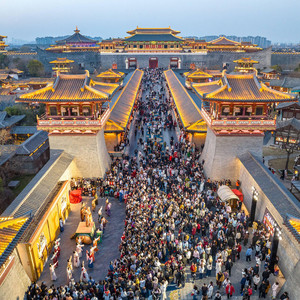
The Spring Festival shopping season has been strong, with spending on shopping, dining and travel across China.
The U.S.
President is reportedly considering a limited strike against military and government targets to pressure Iran into a new nuclear deal.
Former President Yun Suk-yeol has apologized to the South Korean public after his conviction and life sentence on insurrection charges.
In the second half, we'll continue our three-part series on China's transition to a cleaner future.
In the second episode, we go to Guangdong province to hitch a ride on electric mobility.
Now checking the day's top stories.
China's consumer sectors received an early boost during the Spring Festival holiday, with strong spending on shopping, dining and travel across the country.
Average daily sales at major retailers and restaurants rose 86 through the first four days of the break, while traffic and revenue at key shopping districts also increased.
The spending surge combined tradition with new trends.
Online platforms reported brisk demand for smart devices, with wearable gadget sales up nearly 20 and smart glasses more than doubling.
Services consumption also picked up, as domestic tourism spending rose and car rental bookings jumped 26.
In Hainan province, duty-free sales climbed almost 16%.
Officials say nationwide trade-in subsidies and holiday promotions helped drive this festive boom.
New visa-free policies and direct flights have made Hainan a top destination for the New Year holiday, drawing international tourists with its warm weather and tropical scenery.
Lin Hua has more.
Data from the online travel agency Qunar shows that the number of foreign passport holders flying to Sanya has more than tripled.
Spending Chinese New Year in Hainan has become a new trend among travelers worldwide.
We have heard a lot about Sanya.
That's why we are here to visit today.
In addition to coastal resorts and duty free shopping, immersive experiences of traditional Chinese New Year customs have become a must do for foreign tourists.
Special cultural activities provided by local hotels have enabled foreigners to experience the charm of the Chinese New Year.
During the spring festival, our hotel saw a 70 increase in foreign guest occupancy compared to last year, with many guests coming specifically for the traditional New Year activities.
And to celebrate the Chinese New Year is a very good experience, a very nice lively, happy time to celebrate the Chinese New Year here in China.
I love it.
The visa-free policy for citizens of 86 countries and newly added international flight routes have made it more convenient for tourists to visit Hainan.
Local immigration authorities have also made thorough preparations to welcome international arrivals.
We have introduced an integrated service model that combines multiparty coordination, intelligent inspection and guided traffic division.
This approach has comprehensively improved port clearance efficiency and ensured smooth customs processing for cruise passengers.
We aim to let both Chinese and international travelers feel the warmth of the Spring Festival in Sanya.
According to forecasts from the Haikou General Station of Exit and Entry Frontier Inspection, the three major airports in Hainan are expected to handle approximately 80000 inbound and outbound passengers.
During this year's Spring Festival holiday, a 24% increase compared to the same period last year.
That was Lin Wa reporting.
Spring Festival celebrations are underway in San Francisco.
As Mark Neal reports, local Chinatown businesses are hoping the Year of the Horse will bring plenty of fortune, customers and visitors.
In San Francisco, Chinatown's Portsmouth Square, residents and community leaders officially launched festivities for the Chinese New Year.
As Chinatown goes, so goes San Francisco.
And so I want to wish everybody a happy year of the horse.
Despite the heavy downpour, hundreds of people packed the park.
This is wonderful.
Come on.
The rings are always in Chinese tradition.
Rings bring good luck.
And at this event, we have a special guest, the golden dragon.
This is the same one that will be in San Francisco Chinatown's closing Chinese New Year parade.
And at today's ceremony, they've got to make sure that it wakes up.
Civic leaders and dignitaries dot the eyes of the lions before the dragon comes to life.
While Lung's White Crane and Lion Dance Association has been manning the Dragon for decades, there's always room for new recruits, like Eric Valdivia.
I've been helping to guide the procession and then also carry the head for a time, which was a real privilege.
For the gentlemen that have been doing it for 40 years a lot of spirit across those decades, and I think that spirit is still here in the city.
So this is one of the ways that we can manifest that that will welcome tourism and then it's nice for everyone in the Bay Area.
While the start of spring festival has provided an economic boost, declining tourism and the rising cost of imported goods have taken their toll on local businesses over the past year.
We saw less and less tourists from China.
And as you know, they are the biggest spender.
They're the one that put tourists.
So we miss those tourists coming from China.
By holding these celebrations, it's a way for us to continue to promote people to people and for American, the mainstream American, to understand our culture.
They will share the same wish that the people of China and the United States to know each other and their relationship through clothing, through daily interaction, and it makes the public foundation for China-US relations much stronger.
At the ceremony, blessings for good fortune are made by Choi's sons, gods of wealth.
They and their volunteers hand out red packets and fruit to both the young and old.
The celebration closes with an even bigger bang.
50000 firecrackers help usher in the new year, aiming to both ignite and harness the thunderous energy of the horse for the prosperity of the community.
That was Mark Neal from San Francisco.
On the windswept pampas of southern Brazil, the horse is more than an animal.
It's a living identity.
And as China's embracing the year of the horse, Lei Shengping traveled to Brazil's Rio Grande do Sul to explore how a shared devotion to the horse is bridging worlds 10000 miles apart.
A 40-minute drive from Porto Alegre, capital of Rio Grande do Sul, fresh grass sends the air.
This is Gaishu country, the heartland of South American cowboys.
Pedro Castillos is the fourth generation to run his family's ranch.
He cares for nearly 100 criollo horses, a native breed famed for resilience.
But this is more than a walking ranch, it's a sanctuary.
Pedro's children grow up in the saddle, and for 13 residents who no longer keep horses, the ranch offers a return to their roots.
The horse is our pillar.
Our entire gaucho tradition is carried on its back.
We organize rides and traditional barbecues for people who no longer live on the land but still see themselves as gauchos, to give them a chance to touch the Kelly Fagunges who has traveled hundreds of kilometers from neighboring Santa Catalina.
For her family, horse breeding is a way of life.
We've ridden since childhood.
It's a lifetime passion.
The horse is essential.
It's part of our work and our festivals, our competitions and parades.
Everything revolves around the horse.
Gaushu tradition is now protected by law in Rio Grande do Sul.
Its cultural pillars include horsemanship, drinking mate, and sharing a saddle.
In the 1940s, as foreign popular culture spread, some dismissed Gaushu dress and riding as backward.
That thought led to the creation of the centers of Gaushu traditions.
Henrique Arruda Rodriguez leads the first, founded in 1948.
Today the horse is present in our festivals and competitions.
We are bound to them.
The horse Caramello, rescued during the 2024 floods, became a national symbol of the gaucho spirit never giving up.
2026 marks the Chinese Year of the Horse, a symbol of strength and endurance.
From the Pampas to the Far East.
Culture far apart share the same rhythm of the hoofbeats, a bond of resilience and respect for nature.
That was Lei Shengping reporting from Brazil with contributions from Chen Guo.
China's cosmetics market hit a new high of 144 billion in 2025, with local brands now leading the charge.
Global giants are doubling down, but the game has changed.
Beauty in China is no longer just about looks.
It's high-stakes, innovation-driven, an ecosystem.
Bi Ren has more from Shanghai.
Look into any department store in China today, and you'll see it instantly.
The prime space on the ground floor belongs to beauty.
When we say China's domestic market is massive, we're not just talking about skyscrapers or shopping festivals.
We're talking about this little bottle here.
Cosmetic sales in China hit US1436 billion in 2025, capturing the sheer size and energy of this market.
That market includes makeup, skincare, perfume, cologne, hair care, the list goes on.
But in this lucrative market, local brands are no longer on the sidelines, while global names do hold their shine.
In the past 10 years, the market share of a Chinese company has grown significantly.
So you can see that the market share has risen from 43% to 57% last year.
Chinese brands took half of the domestic market for the first time in 2022, with their share continue to grow, since reaching 53 in 2023, 55 in 2024 and 57 last year.
But what makes Chinese domestic products so popular?
This growth is primarily driven by continuously advancement in innovation in brand equity and product use experience.
Yaxin Group, One of China's biggest local cosmetic groups, has invested about 100 million US dollars in RD since 2020.
Many local brands are betting on biotech and naturally sourced ingredients.
Being cheap is no longer their tech.
Domestic players are leading in RD with breakthroughs in core ingredients and bioactive materials that power real product performance.
Meanwhile, local trends are rewriting the playbook for international beauty brands in China.
Chinese consumers are very efficacy-driven and want to understand the science behind it.
So our research covers the whole process, from studying their skincare habits to validating ingredients on China-specific cell models and testing the final product on real consumers.
To stay competitive, French company Clarins built its only overseas research center in Shanghai, developing foundations for local skin tones, skincare for different climates and textures tailored to Chinese consumers.
Here in the lab, researchers carry out in vitro cell experiments using Chinese skin samples.
The data collected here is later sent to France for further evaluation.
Global beauty giants like L'Oreal and Estee Lauder have also established high-level research centers in Shanghai, a sign that China is no longer just a sales market but an innovation hub.
So the real competition is no longer local versus global.
It's about who understands the Chinese consumers best and who can turn that insight into innovation.
That was B. Ran reporting.
Coming up, the U.S. president is considering another military strike against Iran.
You've been listening to programs from CGTN Radio.
We invite you to visit us online for more audio, pictures and in-depth reports.
At radiocgtncom, you can access a wide range of programs and find your favorite news, talk features, entertainment shows and podcasts.
Hear the difference with CTTN Radio.
U.S.
President Donald Trump is reportedly weighing an initial limited military strike on Iran, aiming at pressuring Tehran to agree to a nuclear deal.
The Wall Street Journal, citing sources familiar with the deliberations, reports that, if authorized, such an operation could come within days, targeting a few specific military or government sites.
This comes after President Trump warned Iran that bad things will happen if it does not agree to a nuclear deal within the next 10 to 15 days.
If there is a U.S. military to make a deal or we're going to get a deal one way or the other.
I'm not going to talk to you about that, but we're either going to get a deal or it's going to be unfortunate for them.
I would think that would be enough time, 10, 15 days, pretty much maximum.
The warning comes amid a significant military buildup, with US, Iranian and Russian naval assets gathered near the Arabian Sea.
In Washington, U.S.
President Trump is chairing the first meeting of his Board of Peace.
While expressing optimism for a diplomatic breakthrough with Tehran, President Trump is also keeping the threat of military action on the table.
Owen Fairclough has more.
As Donald trump talk peace between Hamas and Israel on Thursday warships were gathering near Iran.
The US Navy has the world's biggest aircraft carrier and it's reportedly heading to the Arabian Sea to join another carrier leading a strike group prime for attack.
Further north, Iran and Russia were conducting joint exercises in the Gulf of Oman region.
Joint exercises with washington are part of our regular planning and are carried out annually within the framework of defense diplomacy activities.
Chairing the first meeting of his board of peace in washington, dc trump's tone on new but indirect talks with iran was optimistic, but with a threat they cannot continue to threaten the stability of the entire region and they must make a deal.
Or if that doesn't happen, i maybe can understand.
If it doesn't happen, it doesn't happen, but bad things will happen.
That threat was spelled out by the White House a day earlier, recalling Trump's strike on Iran's nuclear program sites last year to support Israel in its conflict with Tehran.
The president had a very successful campaign Operation as commander in chief with Operation Midnight Hammer, as you know.
As you just said, totally obliterated Iran's nuclear facilities.
Both the US and Israel claim Tehran is developing nuclear weapons, but Iran's president again refuted this.
We are in no way seeking nuclear weapons.
Whatever form of verification they want to carry out, we are ready.
And Israel's prime minister, who met Trump at the White House last week to discuss the Iran talks, added his own warning.
One thing is certain if the Ayatollahs make the mistake and attack us, they will experience a response they cannot even imagine.
The growing international concern over fresh military conflict with Iran was underscored on Thursday by Poland's prime minister.
Please leave immediately.
Everyone's still in Iran.
And under no circumstances should you travel to that country.
The possibility of a heated conflict is very, very real.
Iran has asked for a two-week pause on negotiations with the US following the latest talks on Wednesday.
Tehran wants any deal to focus solely on its nuclear program, while Washington wants an end to ballistic missile development and support for regional groups such as Hezbollah.
That was Owen Fairclough reporting.
Iran's warned UN Secretary General António Guterres that any military aggression against Tehran will be met with a decisive response.
In a letter from Iran's permanent mission, the Islamic Republic said it'll consider all bases, facilities and assets of hostile forces in the region as legitimate targets.
The letter also pointed to recent rhetoric from U.S.
President Donald Trump, saying it signals a real risk of military aggression.
In Tehran, residents have expressed defiance, saying they're unafraid of military action and vowing they'll never back down or surrender, despite recent threats from the US president.
Iran must use all its energy and capability to prevent the US, the superpower, from taking military action, if at all possible.
Then we will see how things play out.
Honestly, nothing about how this will end is certain.
We are not afraid of these threats.
We have been hearing them for years.
And even if an attack does come, we will not back down or surrender.
We have strong military capabilities.
And Iran's response will be firm.
One, the U.S. will regret.
Iran's reaffirmed its right to develop its nuclear program in accordance with the rules of the UN nuclear watchdog.
The tension between the US and Iran is just one part of a larger diplomatic scene unfolding in Washington.
Dozens of world leaders are in the U.S.
Capitol for the inaugural meeting of Donald Trump's Board of Peace, an initiative created to oversee the Gaza ceasefire and its reconstruction.
President Trump first announced the plan last year during ceasefire negotiations between Israel and Hamas, but several key US allies have opted not to participate.
Walter Morris reports.
It's the first family photo of its kind.
On Thursday, U.S.
President Donald Trump hosting the first ever meeting of his Board of Peace.
Representatives from more than 40 countries and official observers from a dozen more coming to Washington DC for the inaugural event at the US.
Institute of Peace while protesters gathered outside.
What we're doing is very simple, peace.
It's called the Board of Peace and it's all about an easy word to say, but a hard word to produce peace.
Trump signed documents formally establishing the Board of Peace in Davos, Switzerland, last month.
He proposed the board last year as part of his plan to end the conflict in Gaza, but he quickly expanded the mission to include all global conflicts.
According to the charter, member states will serve a three-year term unless they pay one billion in cash within the first year to the board for permanent membership.
And despite dozens of countries participating, key US allies like the UK, France and Canada turning down the invitation.
On Tuesday, a representative for the Vatican said Pope Leo XIV will not participate because he believes the United Nations should take the lead on world peace initiatives.
In terms of power And in terms of prestige, there's never been anything close, because these are the greatest world leaders.
Almost everybody's accepted, and the ones that haven't will be.
Some are playing a little cute.
It doesn't work.
You can't play cute with me.
The White House says maintaining the ceasefire and stabilizing Gaza is the primary focus of the meeting.
However, there are no Palestinian representatives on the board.
Trump says members are pledging billions of dollars for reconstruction and humanitarian efforts in Gaza.
But the big question that is on the minds of a lot of these leaders right now isn't really the technocratic, bureaucratic details of reconstruction.
It's whether Donald Trump will serve as a restraining force on what Israel may or may not do next.
That was Walter Morris reporting.
As the Board of Peace convenes in the U.S., a UNICEF official warns that life in Gaza remains dire.
Severe shortages of food, clean water and shelter are leaving families struggling to observe the holy month of Ramadan, with aid delivery still limited.
This is my first time after the ceasefire and I'm seeing a little change for families.
While we can see that more commodities are in the market and a little bit of more aid is going in our ability to deliver the last mile to the people themselves, But still that's not what is needed.
It's just part of it.
It's just a portion of it.
Children and families are still struggling with daily tasks and daily needs.
We're talking about water.
We're talking about food, shelter.
All that is still not adequate for the children and families in the Gulf Strait.
UN officials say humanitarian supplies entering from Egypt remain critically low, citing high rejection rates by Israeli authorities.
Food aid donated by Mexico has begun reaching vulnerable families in Cuba, as the island grapples with deepening shortages and power cuts.
Authorities in Havana distributed parcels of rice beans, cooking oil and canned goods through state-run ration stores, prioritizing households with children and the elderly.
The shipments were part of emergency assistance pledged by President Claudia Scheinbaum.
The aid comes as tighter US sanctions and fuel shortages push Cuba deeper into economic and energy crisis, with widespread blackouts and rationing reported across the country.
Coming up, South Korea's former presidents apologized after receiving a life sentence in prison.
Discover the realities and responses to our changing climate with Climate Watch.
Uncover critical issues such as the Maasai Mara's disrupted wildebeest migration and the drop in the Panama Canal's water levels.
Delve into solutions for a sustainable future.
Tune in to Climate Watch on your favorite podcast platform.
Become more eco-conscious and take action to protect our planet.
Former South Korean President, Yoon Seok-yool apologized to the public after a court sentenced him to life in prison on insurrection charges linked to his brief declaration of martial law in 2024.
In a statement on Friday, Yoon expressed regret for what he called public frustration and hardship caused by his shortcomings, but insisted his decision was made to protect the nation and rejected the court's ruling as unjust.
The court said the key issue was Yoon's deployment of troops to the National Assembly, which it found amounted to an attempt to obstruct Parliament's functioning.
Yoon declared emergency martial law on December 3, 2024, but lawmakers overturned it within hours.
He was impeached and removed from office in April of last year, becoming the country's first sitting president to be arrested and indicted.
Police have released the former Prince Andrew from custody following his arrest on suspicion of misconduct in public office.
Police questioned the younger brother of King Charles III and searched his home.
The 66-year-olds alleged to have passed confidential government documents to late financier and sex offender Jeffrey Epstein.
It marks the first reported arrest of a senior member of the British royal family in centuries.
CNN's Max Foster reports from London.
Royal sources telling me the king wasn't even warned that Andrew Mountbatten-Windsor would be arrested on his estate early morning, and then a series of questions coming from the police which lasted hours as Andrew was taken to a police station, eventually released in the evening.
In that time, the police would have been searching his homes in Norfolk and his previous home in Windsor and gathering evidence.
So Andrew has been released under investigation and can be called back in for further questioning based on what they discover.
He has not yet been charged.
And these investigations are only in relation to his role in public office as a trade envoy representing the United Kingdom on trade missions.
This is not in relation to any sexual allegations.
Although, if there's any evidence found in what the police discover, on Andrew's computers, for example, they will have to take any of that criminality seriously, if indeed they do find some criminality.
The King, very quickly issuing a statement, distancing himself from his brother by describing him just as Andrew Mountbatten-Windsor and throwing full support behind the police investigation.
This could be a crisis not just for Andrew, but for the monarchy.
If there is some sort of discovery in this process that the palace knew something about all of this which they haven't admitted at this point.
There's no evidence of that, but it does make the palace in a vulnerable position when you also consider that the king is continuing with his diary of engagements, still being flung questions about Prince Andrew, as he was as a working royal when all of these allegations happened.
It's very difficult for the monarchy to continue doing their work with all these distractions.
So it's a huge pressure, but it's not going to go anytime soon.
These police investigations can last months, if not years, can cast a shadow over the British monarchy.
But many survivors of Jeffrey Epstein.
In relation to the sexual allegations here, which is separate from the police investigation appraising what's happened here in the United Kingdom,
They'd like to see similar types of accountability in the United States with all the other people accused of being engulfed in Jeffrey Epstein's web.
That was Max Foster from London.
Public health and environmental groups in the United States are warning that vulnerable communities will face greater health risks after the Trump administration rolled back a key federal climate finding.
The Environmental Protection Agency revoked the 2009 endangerment finding, which classified greenhouse gases as a threat to public health, a cornerstone for US climate and air pollution regulations.
Climate manager Hilda Berganza from Hispanic Access Foundation says the move could worsen pollution-related illness in low-income and minority neighborhoods, especially in industrial corridors such as Louisiana's so-called Cancer Alley.
The endangerment finding affirmed what frontline communities have known for a long time, which is that climate pollution endangers public health and welfare.
The repeal undermines, as we know, decades of scientific evidence linking it to the heat-trapping gases which are rising the rates of preterm birth, low birth weight asthma, health-related illnesses, developmental delays and other serious health incomes.
Matthew Tejeda from the Natural Resources Defense Council warns that communities of color and poor Americans already face the heaviest exposure to industrial pollution and climate impacts.
Which communities feel those impacts most severely and earliest?
All of that points back to overburdened communities, which are typically communities of color, indigenous communities and low-income communities.
A coalition of health and environmental groups has filed suit challenging the repeal, warning that it could lead to higher emissions, more disease and increased climate-related risk nationwide.
At 29 past the hour.
Checking the forecast before we go.
Beijing's down to plus one Friday evening.
It'll be sunny and 19 degrees on Saturday.
Shanghai's down to nine, then sunny and 23.
Chongqing's nine overnight, cloudy and 23.
Nanchang's down to seven, then sunshine and 23.
Lhasa will be getting cloudy conditions tonight and tomorrow.
A low of minus three and a high of 10.
Elsewhere in Asia, Islamabad's cloudy overnight and down to 10, then sunny and 23 on Saturday.
Vientiane's 19 this evening, then cloudy and 33.
Phnom Penh's cloudy tonight and tomorrow a low of 23 and a high of 35 degrees Celsius.
And that's it for this edition of the Beijing Hour making, or rather up next, the second installment of our three-part series on China's path toward its dual carbon goals.
Making news today.
The Spring Festival shopping season's been strong, with spending on goods, dining and travel across China.
On behalf of the staff, Shane Biggum, in the Chinese capital, hoping you'll join us for the next edition of the Beijing Hour and open a window to the world together.
Listen up.
Can you hear the heartbeat of our world?
It's vibrant and pulsating with the essence of life itself.
From the stem of trees to the gurgle of rivers.
From the silent strength of mountains to the icy whispers of glaciers. even the solid ground beneath our feet right there in the midst of all beast a heart of humanity what if those other heartbeats were to stop would ours keep on ticking ever wondered what's actually going on in africa through the perspective of an african how are things really going between china and africa what's the narrative of this relationship well get a perspective with china africa talk hear from african diplomats entrepreneurs academics chinese natives and more get on our wavelength every week to find out what's real with china africa talk find us on your favorite podcast we'll see you there In large parts of China, people are rethinking how they move, commute, and live, embracing a smarter, greener future on wheels.
Guoyan helps us discover how new energy vehicles are driving toward a more sustainable tomorrow.
Electric or gasoline, who would you choose?
In China, for more and more drivers, the question isn't hypothetical.
They answer it daily on the bustling streets of cities like Guangzhou, the capital of Guangdong province.
I want to buy an electric car because gas prices are really high.
For daily commuting, new energy vehicles save on fuel and are good for the environment.
In Guangzhou, nearly every taxi you flag down is electric.
The buses, too.
They hum along powered by lithium batteries.
Located at the center of the dynamic growth engine in southern China, the city is moving fast.
But now, it's moving on a new kind of energy.
As China works to meet its ambitious climate targets, transportation has become a focus.
And reducing carbon emissions is now a national priority.
Carbon dioxide emissions, many from burning fossil fuels, are the major driver of global climate change.
They trap heat in the atmosphere, warming the planet and intensify weather disasters.
According to the International Energy Agency, the transport sector is responsible for 23 of global carbon dioxide emissions in 2022.
While in China, official figures put that share at just over 10%.
With goals to peak emissions by 2030 and achieve carbon neutrality by 2060.
China is betting big on new energy vehicles, or enemies.
Bai Mei is a senior researcher from the Chinese Academy of Social Sciences who specializes in industrial economy.
New energy vehicle, or NEV, refers to any car that doesn't rely on gasoline.
That includes pure electric cars, hybrids, and hydrogen-powered vehicles.
But an EV usually means just a battery-powered car.
EVs, pure electric vehicles, are racing ahead for the moment.
One key reason electric vehicles have pulled ahead is the breakthrough in battery technology.
Thanks to improvements in lithium-ion batteries, The safety and charging speed of EVs have improved significantly, while costs have dropped.
Chinese carmakers have launched the EV models for every budget and lifestyle.
Battery costs are also dropping, making these vehicles more affordable than ever.
We visited some of China's top manufacturers in Guangdong, as winning every Ford and Elise in the country is made in the province, the EV subsidiary of Guangzhou Automobile Group, or GAC.
The management's attitude toward an EV has been evolving.
We started with hesitation has become a firm commitment to development.
The shift to develop EVs really began around 2015.
We started planning the transition at the time because the Chinese government was encouraging the development of new energy vehicles.
We believed it was going to be a major trend.
But back then, the concept of NEVs was still unclear.
Gu Huinan is the general manager of ION.
As technology matured and government support intensified, the company gradually increased its investment in research and development.
Gu said, the consumer market also responded more positively, boosting the company's confidence even further.
Back in 2015, China had around 583,000 NEVs on the road.
According to China's Ministry of Public Security, That number has skyrocketed to 31 million by the end of 2024.
Electrification is an irreversible trend, at least in the short term.
Electricity is the path to achieving autonomous driving.
Our entire industrial ecosystem runs on electricity, computers, production, communication.
If everything runs on electricity, building intelligent connected systems and autonomous driving with EVs becomes easier.
From a different perspective.
The transition to electric vehicles is about more than reducing carbon emissions or embracing the latest technology.
Is also deeply connected to how a country manages its energy resources.
Gu Huinan, general manager of AYEN, pointed out that electrification serves national energy security.
China imports about 70% of its oil.
If we increase the share of new energy in the energy mix, we can reduce oil imports.
That's why developing NEVs is crucial for China's energy security.
According to China Association of Automobile Manufacturers, China became the first to surpass 10 million NEVs produced in a year.
By the end of 2024, NEVs made up 8.9% of all registered vehicles.
Pure electric vehicles exceeded 22 million, accounting for over 70% of all NEVs.
Still, climate expert Wu Changhua says there's a long way to go.
While the share of new car sales that are, new energy vehicles is already very high in China, the overall picture on the road tells a different story.
Most of the cars still running in Chinese cities were sold years ago and many of them are gasoline-powered.
Today, China has over 30 million NEVs on the road.
But when you look at the total number of vehicles in the country, NEVs account for less than 10%.
That's a small share and far from enough.
If China wants to meet its dual carbon goals of peak emissions by 2030 and carbon neutrality by 2060.
Researchers see even greater potential for EVs, not just in reducing emissions, but also in supporting the electric grid.
Each electric car is like a mini storage unit, a giant power bank.
With vehicle-to-grid or V2G technology, EVs could one day feed power back into the grid.
For example, EVs could store electricity during off-peak hours and supply it back when demand peaks.
The technology is already feasible.
It just needs to be more cost-effective.
As the industry accelerates toward a greener future.
Some of China's most innovative companies are leading the way not just in electrification, but also in building the future of mobility.
To get a better understanding of EV trends, we visited Xpeng Motors, a leading EV startup, headquartered in Guangzhou.
Known for its focus on intelligent driving and next-generation technologies, Xpeng is pushing the boundaries of electric vehicle capabilities.
Electrification is just the beginning.
The next big leap is intelligence, vehicles that are cleaner and smarter.
Zheng Yeqing is the vice president of Expo.
In the past 10 years, NEVs have gone from hybrids to fully electric.
Today, EVs make up more than half of monthly car sales in China.
In the next 10 years, we believe the next transformation will be toward intelligent vehicles.
Electric drivetrains make it possible to power advanced electronics and AI.
That means fully autonomous driving could become a reality sooner than people think.
Unlike traditional gasoline-powered cars, EVs are built on electric architecture, which allows for seamless integration of sensors, software and AI computing systems.
This makes them the ideal platform for developing autonomous technologies.
At Xpeng, the connection between electrification and intelligence drives the company's strategy.
But the company's vision doesn't end with smarter cars.
It's looking beyond roads toward a future where transportation includes the sky, the sea and everything in between.
Well, first of all, I think EV is a very important part of the.
Brian Gu, vice chairman of Expo Motors, believes electrification is the first step in a broader mobility revolution.
We think in the future.
First of all, the world will become more electric, because I think it's one of the most efficient energy formats to use across transportation solutions.
Secondly is that human transportation is not limited to two-dimensional road travel.
You probably can see that we spend a lot of time on flying cars.
We also look at different segments of mobility to address the last mile, address low altitude, to address even submerged scenarios.
So I think these technologies can be used in a lot of future mobility solutions.
In Guangzhou, we see this shift happening in real time.
Electric taxis gliding through busy streets, charging stations built into neighborhoods and automakers racing toward a smarter and cleaner future.
Across China policy is accelerating change, industries are innovating and millions of people are rethinking how they move.
From steady progress to new challenges.
China's NEV industry remains central to the nation's green transition.
Yang Yang continues the journey in Guangdong to see how carmakers there are trying to reduce costs, supply chain emissions and data gaps.
Every step in the life of an electric vehicle, from production to use, faces the test of going carbon neutral.
It's really tough to achieve absolute zero carbon emission.
So many technologies in the labs seemed great at the time, but in the end they never made it to the market.
I'm always worried about his battery life.
I started my visit in Jiaxian.
Stepping into the factory where new energy cars were taking shape in rows.
I was impressed by that environmentally friendly workplace.
The air was fresh and there was no smell of gasoline.
There was only the hum of robotic arms moving in quiet order.
A sign indicated that this was a green factory.
But Huang Guihua, a senior manager from the engineering department of GAC Iron, told me that decarbonizing was harder than it looked.
It's really tough to achieve absolute zero carbon emission.
He said one major reason is the huge amount of energy it takes to make these cars.
Car factories use a lot of energy.
Although they're not the biggest energy users, they're huge and it all adds up.
Some of the energy they use still comes from fossil fuels like gas or coal.
For that, solar power is one answer.
But it's not perfect.
Solar is unstable.
When clouds block the sun, the power drops.
When the sun's too strong, the power spikes.
Solar power also means higher cost.
If we switch entirely to solar, it will be way too expensive.
So, while we are cutting down on gas, we still need to buy carbon credits to make up for the emissions we cannot avoid.
Economically speaking, that's still a heavy cost.
And it's not enough to just decarbonize the factory.
Cutting emissions involves the whole supply chain.
Pan Jingchi, head of the engineering department of GAC Iron, explained.
Manufacturing is responsible for only a small part of the emissions.
Most emissions come from the materials we use up front and how we run the vehicles once they're on the road.
When Penn mentions the materials, he referred to the upstream part of the industry, which includes the production of core components like batteries motors, electric control systems and their RD.
The upstream of the automobile industry covers the development and production of the auto parts.
The midstream focuses on the vehicle manufacturing process and the downstream involves sales and after-sales services.
To truly reduce carbon, every part of the industry has to decarbonize.
Some of China's biggest carmakers are already working on it.
JCIEN is on this journey, and so is Xbone.
Zheng Yeqing is its vice president.
When it comes to the assembly plant, it only eats up less than 10 of the total energy used across the entire production process.
Real carbon reduction is not only about what happens on the assembly line.
More importantly, it's about working with our suppliers to cut emissions across the whole production chain.
But it's no small task cutting emissions across the entire process.
One big challenge is measuring the carbon footprint in this process.
Wu Changhua explains.
The production of electric vehicles involves a massive supply chain.
The challenge is that a lot of the carbon data just isn't there because we haven't tracked it yet.
Getting detailed data costs time and money.
Bai Mei, an energy economics expert from the Chinese Academy of Social Sciences, elaborates further on it.
Another problem is the precise calculation of carbon emissions.
The total amount of carbon emissions might be easy to figure out, but a company often makes different products and figuring out how much energy each product uses can be hard.
If there's no legal requirement, the companies won't add the cost of doing that.
Coal is an issue too.
Unlike standardized products, different batches of coal may have different properties, such as impurities, and thus produce different amounts of electricity, so tracking carbon emissions from each batch of coal is difficult.
To really get the calculations right, power plants should have a carbon emission meter that measures carbon dioxide, just like our water meter that measures water flow.
But that's not the case now.
For now, emissions are calculated based on averages.
They figure out the average carbon emission factor and estimate how much carbon dioxide is produced.
Clearly, it's not the actual emissions attributed to the electricity being used.
This difficulty isn't exclusive to China.
As is pointed out by NPJ Climate Action, an open access journal in Climate Action, And direct carbon outputs generated along a company's supply chain typically account for the largest portion of its overall carbon footprint.
Yet currently these emissions are often estimated using industry averages and rough approximations, which contributes to the disadvantage of carbon data calculation.
To exacerbate the problem.
Bai Mei says providing carbon data can be difficult due to business secrets protection concerns.
A vehicle has too many parts.
Each part connects with many different suppliers.
The main difficulty right now is that carbon emissions can be used to calculate output, which can be a business secret.
So when it comes to calculating cumulative emissions, it's tough.
A survey of 210 German companies reveals in a research report from PricewaterhouseCoopers, a multinational firm that provides accounting, auditing and consulting services, found out that the biggest reason companies hesitate to share data through traditional business platforms is a fear of exposing core information and business secrets.
Beyond carbon emissions along the supply chains, when a new energy vehicle leaves the factory and hits the road, new challenges arise.
Even though electric vehicles don't produce tailpipe emissions, the energy to drive them has to come from somewhere.
The power consumed by the battery and motor still leads to indirect carbon emissions.
That's according to Gu Huainan, general manager of GACIEN.
Everyone knows electricity isn't a primary energy source.
We don't just dig it up.
We dig up minerals, oil.
But electricity is converted.
It comes from coal, oil, solar energy, everything that can be converted.
So reducing energy consumption of an electric vehicle on the road is just as important.
An Exmon employee told me that autonomous driving could be part of the solution.
Autonomous driving reduces the need for frequent braking and acceleration, which are common habits of human drivers.
When we see a red light, we slam on the brakes.
That wastes energy.
But with autonomous driving, the vehicle can brake smoothly and efficiently.
But Expo's Vice President Zhong Yejing pointed out, the hard part isn't just building self-driving, it's making those investments paid off in features drivers can use today.
We are making long-term investments in autonomous driving, with RD efforts that have already lasted a decade.
At the same time, we are placing more emphasis on features that consumers can actually see, touch and experience in the short to mid-term.
These are features they will be able to enjoy inside the car within the next year or two, giving them a real sense of advanced technology.
Striking a balance between these two priorities is challenging.
General Manager of DSAI, and Gu Huinan added that in an industry where everything evolves fast, a new technology must prove its value in the market before you call it a success.
Take autonomous driving, for example.
We've put in a lot of resources, but the return hasn't matched the investment.
Technology is evolving so fast that before you start to make money, it's time for an upgrade again.
Climate expert Wu Changhua points out that some technologies never even get off the ground.
So many technologies in the lab seemed great at the time, but in the end they never made it to the market.
According to China Automotive Low Carbon Action Plan, compared to traditional gasoline cars, electric vehicles reduce carbon emissions by 434.
The International Energy Agency estimates that to meet the UN's 2030 Sustainable Development Goals, global EV sales need hit around 45 million units by 2030.
And, according to EVTank, in 2023, global sales of China's new energy vehicles surpassed 60 of the world's total.
As the world's largest in-EV market, China is a key player in the global effort to reduce carbon emissions and promote sustainable development.
But even though Chinese consumers are increasingly embracing in-EVs, there are still concerns.
I'm always worried about his battery life.
They've packed it with features and focused on computing power, but does it matter to us?
Only time will tell.
Unlike a gas-powered car, an electric one accelerates and decelerates more rapidly.
I'm not very used to that.
Beyond consumer concerns, China's EV makers also face considerable challenges in the export markets.
As the country's new energy vehicles make their way overseas.
Some observers believe that China's NEV industry is running into overcapacity.
Wu Changhua disagrees.
I don't think we're overproducing.
Overcapacity means more goods have been produced than are needed, right?
But from the perspective of tackling climate change, what we're doing now isn't enough.
Look at the number of NEVs in China.
It's a small percentage compared to all types of vehicles.
How can there be overcapacity?
And it's not just about selling cars abroad.
Wu Henan from JCIM pointed out the software localization is also a complex process.
Take smart connectivity, for instance.
When you go abroad.
Your map might not work, your music might not play, you might have to use someone else's navigation.
Even things like databases, you need to build them locally.
For example, if I want to monitor the battery's temperature remotely, it's very difficult to send that data back to China.
These are huge challenges.
At the same time, taking part in global discussions on carbon emissions and establishing international standards is another formidable task for China's energy sector.
In Europe, some observers still raise questions about China's carbon emission data.
If we want to be part of shaping global standards, we need to make sure our data is clear and verifiable, and that means ongoing dialogue and building mutual understanding.
Achieving carbon neutrality concerns various parties.
It isn't just any one country's responsibility.
It's a global mission.
While China's making strides in cutting emissions, it will take the collective effort of everyone to achieve net zero.
Reducing emissions and protecting the environment is something the whole society needs to work on.
We need to work together in every field to achieve this goal.
We must stay firm, stick to the right path and be patient.
Find The Beijing Hour at precisely 6pm Beijing time.
We meet you on podcast and on air every weekday.
The Beijing Hour, your window on China and the rest of the world.
He can't live without the Yellow River in his eyes.
The Yellow River is so noble and elegant.
Both my grandpa and dad made a living from the river.
Would you like to move away from the Yellow River?
I don't think I will.
I love it so much.
The Yellow River, the second longest river in China, is regarded as a shaping force in the history, economy and culture of northern China.
Today, about 100 million people live within its water basin, making up nearly 9 of the country's population.
How is climate change felt at its headwaters?
And what are the locals doing to cope with it?
What are the descendants of the boatmen doing?
What has kept some people from leaving their home village by the river?
And what has drawn others back?
Could the fading fishing community revive in a time of digital transformation?
From 2021 to 2024.
Our reporters visited the upper, middle and lower reaches of the Yellow River, talked to the herders farmers boatmen, fishermen and eco-activists who share a close bond with the river, and present their stories in pictures, podcasts and videos, or in our 12-part series, The Yellow River Mosaic, available only on CGTN Radio.