Discussion keeps the world turning.
This is Roundtable.
You're listening to Roundtable.
I'm Steve Hatherly.
Together today with Yushan and Xinyu.
Coming up. the ultimate local meal in China isn't in a restaurant.
It's in a government canteen.
In a surprising new trend, municipal buildings are opening their doors serving the public.
Incredibly affordable, authentic food.
Is this the new face of public service?
Don't forget our podcast listeners.
That's you.
You can find us at Roundtable China on Apple Podcasts.
And don't forget as well that we love to hear from you.
An email is great, but a voice note is great, great.
Send those our way with your thoughts on any of the issues that we discuss here on the show.
Here's how you do it.
Roundtable podcast at qqcom.
Once again roundtable podcast at qqcom.
And now Picture this
You're traveling through China, hungry for some authentic local cuisine.
You skip the tourist traps, you ignore the fancy hotels and you head straight for the local municipal government building.
Huh?
Sounds like a mistake, but it's actually the hottest new dining trend.
From the spicy avenues of Chongqing to the scenic towns of Jiangsu, government canteens are tearing down their walls and inviting the public in for lunch.
We're talking about some delicious red braised pork that's one of my favorites and some mapo tofu that's one of my favorites too, and these meals don't cost you much at all.
But it's not just about the cost.
It's a fascinating experiment in urban resource management local governments.
They're trying to prove that serving the people isn't just a slogan.
It can be taken literally as well, but it's a sustainable model for public resources, or perhaps just a flash in the frying pan, if you will.
So this is kind of cool, I think opening up the doors, opening up the restaurant doors to the public for these government buildings.
In fact we're mentioning it now, but it didn't really just pop up like very recently.
In fact it can date back to earlier this year, around the may day holiday season.
That's when a lot of the local um canteen or government, government affiliated or institutional canteens across multiple cities here in china have opened their dining facilities to the general public.
So these facilities were often restricted to only serving internal staff and employees of the government agencies or enterprises previously, but not anymore.
Now the bear Barriers are broken down, both physically for the people and like psychologically, for everybody too.
And they're allowing ordinary citizens everybody, including you and I tourists, even surrounding residents and office workers to dine in these canteens.
Yes.
So you've mentioned the May Day holiday.
Actually, during the holiday in May, the government canteens in Rongchang District, which is located in Chongqing, and also Hongcun Town in East China's Anhui Province, and also Quzhou and Yangzhou, which are located in Zhejiang and Jiangsu provinces.
They have also welcomed tourists from nationwide to dine in their canteens.
It's kind of interesting that it's open to tourists, too.
Yes.
Something that wouldn't have even been on the radar, I'm sure, for many tourists before.
But why, you know, this does go back to May, but even still, it's still... pretty new.
Why have they made that decision to open the doors to the public?
You know, for some of these local authorities, to ease tourism pressure is one thing that's not only their original work, that's their responsibility, but also something that they can help share by opening up their canteens, such as where you mentioned Xinyu, the Rongchang District in southwest China's Chongqing municipality.
You know, during peak travel seasons like May Day holidays and other major holidays that follows.
Rongchang, for example, the local authorities there were dealing with a huge influx of visitors, but the district can only prepare about 20000 meals a day.
Which is a lot.
Which is a lot, but considering the, the amounts, the packs of tourists going to visit there, because Rongchang is known for a lot of things food, for one main reason why people are attracted to visit.
So they really had to plan carefully to make sure everyone was fed properly and felt um taken care of, and in fact it turned into a bit of a foodie hot spot.
In may for them, the the very first meal, if i'm remembering remembering it correctly, the the very first meal they serve attracted more than 3 000 people to show up.
Right, that's impressive.
It eases the pressure on the staff too um, because preparing 20000 meals a day is not an easy thing to do and it requires large teams of people.
But when you've got people backed up out the door and down the street and down the sidewalk, then it makes the pressure all the more.
So when you provide more space, more food, more seats, more trays for people, it just eases the pressure on everyone.
Yeah, actually, I checked the data on May the 1st.
This canteen in Rongchang District.
It consumed 1500 pounds of pork and also 280 pots of steamed rice to cater to these tourists.
And also they offer this over 20 local specialty dishes.
What stood out to me is its iconic lu e, which can be translated as braised goose.
And also they have this zhu you pao ba.
It's a traditional snack originating from this district.
In English, it's called pork lard steamed rice cake.
Rice cake, yes.
So pork lard is pot pork fat, but it's a yellowish like a cup shaped steamed rice made of the fermented rice.
Yes so yeah, it might not be something for everybody, but it also offers you a chance for visitors to taste the local dishes.
And you took the words right out of my mouth.
That's one of the things that tourists always say when they go on vacation.
They want to eat what the locals eat.
They want to go where the locals go.
And community canteens are exactly where the locals go.
So if the lineups are too long, that would obviously discourage people from doing that, because tourists have busy schedules.
So again, when you create more seats, then that's great.
But it gives people a sense of...
When you're traveling like that and you get that opportunity, you might not like everything on the menu.
Who cares?
Doesn't matter, right?
You're trying things for the first time and it just brings you that much closer to...
Chinese culture when you're here on vacation.
But again, we've been talking about the tourists, but it's not just about the tourists.
Yeah, and for the general public as well.
I think it really addresses the public needs, especially for those who are working or living nearby like state-owned enterprise or public institutions.
These canteens offer really convenient dining options for them that can benefit surrounding communities.
It definitely is cheaper and it's healthy in terms of diet because some canteens they offer like low fat or low salt diet options as well and it also caters to a better use of public resources like some of these canteens they can be really empty during non work hours or during weekends so by opening the canteen to the public, it can increase the seat occupancy and also decrease the food waste.
Right.
That's one thing that I noticed too.
We call it a community canteen sometimes, but that usually referred to a specific canteen that serves food.
But now it's the governmental facility canteen that's being opened up, meaning that, if we look at this core idea of this move, it's a transformation of resources from specific groups to a broader public service, because it utilizes institutions that often have just idle resources during non-work hours, such as empty tables after breakfast and unused cookware after dinner, or unoccupied spaces during weekends.
So in this way, this move becomes a practical implementation of the redistribution of public resources.
That's one of the highlights of this whole incident.
100%.
You mentioned...
One example, I think you talked about Rongchang in Chongqing municipality.
There they had 20 local specialty dishes.
If you've never eaten at one of these places before, if you're not familiar with what we're talking about.
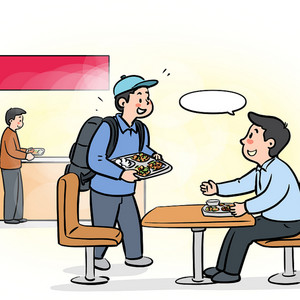
Imagine like a really really good school cafeteria.
Yeah.
That's kind of like what it looks like in terms of the layout.
It's that buffet style.
But the food is really, really good.
And I remember when I first moved to China, I was super excited to eat at these places too, because a lot of the dishes same thing, as I said before I had never seen before.
What is?
This was one of my most common questions asked when I first arrived.
And I really enjoyed the options that were available.
So yeah, multiple dishes available, and they're all really quite affordable too.
Right.
Back to the Rongchang example.
The prices were super affordable there, with dishes ranged from just three to 18 yuan per dish.
That's less than three US dollars.
So not only did tourists get an authentic culinary experience, they also didn't really have to worry too much about breaking the bank for it.
Well, on the, on the lower end, that three yuan, that's what.
That's less than 50 cents.
Yes, so the lower end would be around 50 cents and the upper end would be about three dollars or less.
Yeah, yeah and um, back in that, there's something that pops up in my mind just now, when you mentioned that steve, have you ever tried dining in a university canteen here in Beijing before?
Because there are many of them, are open to the public too, and that's often mentioned along with the governmental facility canteen opened up as well, because here in Beijing, many of such institutional canteens or governmental canteens the meteorological bureau canteen here in Beijing, as one example are just attracting more and more people.
That got itself on the news again just very recently, in November.
So this internal canteen, the Meteorological Bureau canteen, they kind of put different categories so that the folks flow of people getting into their canteen are better distributed.
So their first floor of the canteen is still reserved for internal staff.
So you kind of need a special dining card proving that you work there to get in.
And then for the basement level, the B1 level, that one is open to the public and it's super easy to use.
You can just go there, scan a code and pay for the various dishes you can get.
So that's something really smart that they're designing as well, as far as I've noticed.
You're separated from the employees who work there, though so it doesn't affect those staff working for this company or this institution.
And also, what stood out to me is another like high-tech canteen opened in beijing actually just opened on november.
The first is called the jingshan mountain ai canteen, which is located in robot chefs.
Actually, the dishes are made by these automated cooking machines.
So yes, it's more precise and it offers like more consistent taste.
For these i think i checked last time i checked it's 300 adaptable dishes.
Um, the machines can provide.
And um, how do you get?
How do you get in there to pay?
Or Yes, that's the more high-tech version, because you don't need any physical cards for these canteens.
You just need to recognize your face and put in your personal information.
And next time you go there, you can just pay through your facial recognition.
Pay with your face.
Virtual cards, yes.
And there's also smart serving coupons.
They can weigh food and also they can calculate prices and estimate the calories you consume by these dishes.
Okay, wow, really?
Yes, very smart canteen just opened.
From the government building side of things, they're making use of space, perhaps...
Cutting down on costs.
I was looking up, you know, in Canada and the United States if they do this.
And apparently in America they do this at some Senate buildings.
They have cafes and restaurants there that are open to the public.
And one of the advantages there is, that is the cost effectiveness, because you're bringing.
You're bringing more people, people in.
You kind of think about it like a movie theater, right?
If a movie theater was only open for a morning screening and an evening screening, it wouldn't necessarily make that much sense.
So when you have a lot of visitors or tourists in the area, why not allow them to take advantage of it?
Right.
But here, what would be some of the reasons, some of the motivation for people to want to go there and eat.
Well, first of all, it's Definitely the affordability and also cost-effectiveness.
Because, as we mentioned earlier, a lot of these people who go and dine in these canteens are just local residents who live nearby.
And instead of going out and buying grocery, if less than 15 cents, how much did we mention?
Less than 18 yuan.
With that amount of money, you can get dishes and good quality, nice dishes.
Then why not?
So the affordability is there and it can... of course, benefits the local people.
And then for the canteens.
In turn, they can also be benefited from the cost advantage of collective purchasing, because they are purchasing in a lot of food.
And, like you mentioned earlier Xingyu, there are probably times when they are not really using those resources inside the canteens.
So this will be a good way for them to avoid waste and stay more sustainable too.
Yeah.
And I also think that many people, ordinary people, they wonder what people inside these government buildings they eat during the day.
Yeah, I know what you mean.
We talked about barriers before.
This would be the elimination of one of those barriers.
Yeah, because in China, if you want to work for these government institutions, you have to take this very competitive and hard exam to be the civil servants.
Pressure's already up.
Yeah, really huge pressure.
And for these canteens, I think...
Many ordinary people.
They just go to experience what canteens they're having are like and maybe post some photos and videos as well on their social media.
I would think, too, that it helps to eliminate a barrier.
I don't know if barrier is the right word, but create a stronger sense of community when the entire community area is accessible for people.
I don't mean the entire area inside the building, but just the neighborhood itself.
When you don't have, oh, that's off limits.
We can't go there.
When you eliminate that, it gives you a stronger sense of perhaps I don't know social trust or a shared community or something like that.
Yeah, and here's some data from Beijing Youth Daily which indicate that once these canteen opens up, the dinner seating rate jumped to around 70, from much, much lower than before, which is a huge improvement for them as part of a community welcoming people in.
Like you said, it bridges the physical and the psychological gap between authorities and communities.
So when you unite staff and unit staff and community residents that queue at the same window, it kind of cultivated this trust that yeah, these people serve us and we're among them and they're part of us too.
Yes, that's exactly what I was trying to say.
Just you said it better.
So what are people saying about it then?
Are people loving it?
What are they saying?
I think so far we have received very positive feedbacks from netizens and people who have experienced dining at the canteens.
They think that the food options a tourist surname, the Zhang.
He praised the cost-effectiveness and generous portion after spending 36 yuan for five dishes at the canteen.
So pretty much everybody is happy for it.
And people's perspectives are shifted, too.
They feel like the city's warmth is showing to them and it's been closer to them as of their coming back home as well.
So, yeah, in general, people like it.
Who knows?
Might be the new hot date place.
Maybe.
For the seniors in the community.
Yeah.
Why not?
Why not?
Exactly.
Everybody's always looking for a new spot.
All right.
That'll do it for Roundtable 4 today.
Thank you very much for sharing your time with us.
I'm Steve for Yushan and Xinyu.
We thank you all and we hope you'll come back and join us next time.